Sorbisterit
Italy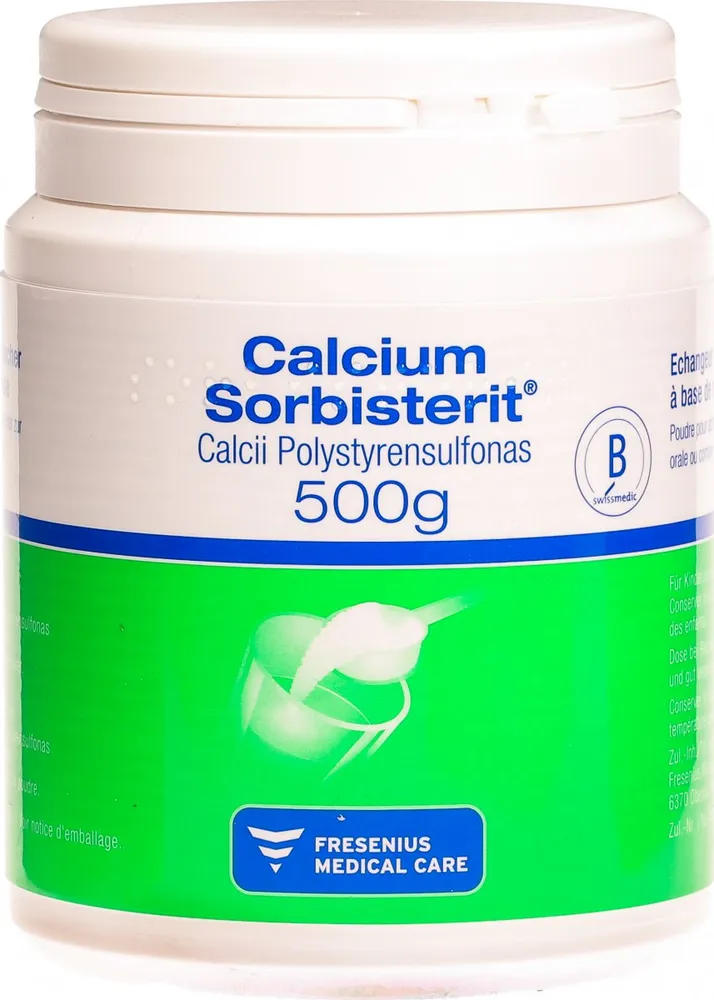
Table of Contents
- Package leaflet: Information for the user
- Sorbisterit, powder for oral/rectal suspension
- 1. What Sorbisterit is and what it is used for
- 2. What you need to know before using Sorbisterit
- 3. How to use Sorbisterit
- 4. Possible side effects
- 5. How to store Sorbisterit
- 6. Package contents and other information
Package leaflet: Information for the user
Sorbisterit, powder for oral/rectal suspension
Calcium polystyrene sulfonate
Please read all of this leaflet carefully before you start using this medicine, as it contains important information for you.
- Keep this leaflet. You may need to read it again.
- If you have any questions, ask your doctor or pharmacist.
- This medicine has been prescribed for you only. Do not give it to other people, even if their symptoms are the same as yours, as it could be harmful.
- If you experience any side effects, including those not listed in this leaflet, contact your doctor or pharmacist. See section 4.
Contents of this leaflet:
- What Sorbisterit is and what it is used for
- What you need to know before using Sorbisterit
- How to use Sorbisterit
- Possible side effects
- How to store Sorbisterit
- Contents of the pack and other information
1. What Sorbisterit is and what it is used for
Sorbisterit is used in the treatment of hyperkalaemia (increased potassium levels in the
blood) in patients with renal disorders or undergoing dialysis (removal of waste products from the blood).
Sorbisterit is a cation-exchange resin (an insoluble structure that releases certain ions in exchange for
other ions) which exchanges potassium for calcium in the intestine. As a result, it reduces the absorption of
potassium into the blood.
2. What you need to know before using Sorbisterit
Do not use Sorbisterit
- if your blood potassium level is too low, especially if severe symptoms such as muscle cramps, muscle weakness, or fatigue have occurred
- if your blood calcium level is too high
- if you are allergic to calcium polystyrene sulfonate or to any of the other ingredients of this medicine (listed in section 6)
- if you have constipation or intestinal obstruction
- if you are taking sorbitol (a laxative) at the same time
- in newborns by oral route
- in newborns with constipation
Warnings and precautions
Talk to your doctor or pharmacist before using Sorbisterit.
- if it is administered orally. You must take it while sitting upright to prevent aspiration of the liquid.
- if you suffer from constipation, consult your doctor before using this medicine.
The electrolyte levels in your blood must be monitored daily.
Inform your doctor if any of the above warnings apply to you now or have applied to you in the past.
Children
Particular caution is required when using this medicine in children and newborns, as an excessively high dose or incorrect dilution may cause the resin to have too strong an effect. Extreme caution is necessary in patients with low body weight, especially newborns, due to the risk of gastrointestinal bleeding and the possibility of colon necrosis (death of colon tissue).
Other medicines and Sorbisterit
Tell your doctor if you are taking, have recently taken, or might take any other medicines.
Concomitant administration with other medicines taken orally should be avoided. Sorbisterit should be taken at least three hours before or three hours after other oral medicines. For patients with gastroparesis, a six-hour interval should be considered.
You should consult your doctor especially if you are taking:
- sorbitol: must not be used as a laxative, as it may cause damage to the colon (necrosis)
- medicines containing potassium
- medicines for heartburn or laxatives, such as magnesium hydroxide, aluminium hydroxide, or calcium carbonate
- medicines that increase heart function, such as digoxin (cardiac glycosides), as their effect may be enhanced
- Lithium: an antidepressant, as its absorption may be reduced by Sorbisterit
- L-thyroxine: Sorbisterit reduces the absorption and thus the effectiveness of this thyroid medication
- medicines that interact with calcium, or oral ciprofloxacin: an antibiotic, whose effect is reduced by Sorbisterit; or oral tetracyclines: an antibiotic, whose effect is reduced by Sorbisterit
- medicines that remove fluid from tissues, such as hydrochlorothiazide (thiazide diuretics) or furosemide and torasemide (loop diuretics)
- certain medicines affecting nerve cells or nerve fibers (anticholinergics), as this may increase the risk of Sorbisterit's side effects on the stomach
Sorbisterit with food and drinks
Sorbisterit must not be taken with fruit juices (e.g. pineapple, grapefruit, orange, tomato, or grape juice) that are rich in potassium, as this may counteract the effect of Sorbisterit.
Pregnancy and breastfeeding
If you are pregnant, think you may be pregnant, are planning to become pregnant, or are breastfeeding, consult your doctor or pharmacist before using this medicine.
The use of Sorbisterit is contraindicated during pregnancy or breastfeeding unless your doctor considers it essential.
Driving and using machines
No effects on the ability to drive or operate machinery are known.
Sorbisterit contains sucrose
If your doctor has diagnosed you with an intolerance to certain sugars, contact them before taking this medicine.
3. How to use Sorbisterit
Use this medicine exactly as instructed by your doctor or pharmacist. If you are unsure, consult your doctor or pharmacist.
The required duration of treatment depends on daily blood potassium measurements.
The recommended dose is:
Oral use
- Adults and elderly: 1 measuring spoon (20 g of powder) 1 - 3 times daily, dissolved in approximately 150 ml of liquid.
- Children: 0.5 - 1 g of powder per kilogram of body weight per day, dissolved in approximately 150 ml of liquid. This preparation should be taken in at least three separate doses over a 24-hour period. Suitable liquids include water, tea, or non-alcoholic beverages. Sorbisterit should be taken during main meals with the body in an upright position. Concomitant administration with other orally administered medicines should be avoided (see section 2).
Rectal use
- Adults and elderly: After using an enema, dissolve 2 measuring spoons of Sorbisterit (40 g) in 150 ml of 5% glucose solution and administer rectally 1 - 3 times daily. Retention time: 6 hours.
- Children: Rectal administration is used when Sorbisterit cannot be swallowed. Dissolve 0.5 - 1 g of powder per kilogram of body weight per day in 150 ml of 5% glucose solution and administer in at least three separate doses over 24 hours. Six hours after administration into the anus, the colon should be irrigated to remove the resin.
If you think the effect of Sorbisterit is too strong or too weak, contact your doctor or pharmacist.
If you use more Sorbisterit than you should
If you have used too much Sorbisterit, contact your doctor or pharmacist immediately. In general,
an overdose of Sorbisterit may cause a reduction in blood potassium levels
(hypokalaemia), with symptoms such as cramps, leg pain while sitting, extreme weakness, and occasionally paralysis. Abnormal heart rate may occur. Other adverse effects of overdose may manifest as an increase in blood calcium levels (hypercalcaemia), with symptoms such as fatigue, muscle weakness, frequent urination, constipation, abnormal heart rate, kidney failure, or coma. In addition, an overdose may cause constipation, intestinal obstruction, and fluid accumulation.
If you forget to use Sorbisterit
Consult your doctor or pharmacist for advice.
Do not take a double dose to make up for a forgotten dose.
If you stop using Sorbisterit
The consequence may be an increase in blood potassium levels.
If you have any doubts about how to use this medicine, consult your doctor or pharmacist.
4. Possible side effects
Like all medicines, this medicine can cause side effects, although not everybody gets them.
The classification of side effects is based on the following frequencies:
very common: may affect more than 1 in 10 people
common: may affect up to 1 in 10 people
uncommon: may affect up to 1 in 100 people
rare: may affect up to 1 in 1,000 people
very rare: may affect up to 1 in 10,000 people, including isolated cases
not known: frequency cannot be estimated from the available data
Common:
- too much calcium in the blood
- too little potassium in the blood, which in severe cases may manifest as muscle cramps or muscle weakness and fatigue
- too little magnesium in the blood
- nausea
- vomiting
Uncommon:
- constipation
- diarrhoea
- stomach ulcers
- damage to the colon, which may lead to intestinal perforation
- loss of appetite
- intestinal obstruction
Rare:
- complete intestinal obstruction due to, in the most severe cases:
- accumulation of the resin in the intestine
- "thickening" of stools after rectal use in children
- formation of occlusions after oral use in newborns
- episodes of rectal bleeding after rectal use have been reported in underweight premature infants and newborns
Very rare:
- acute inflammation of the airways, manifested by cough and elevation of the diaphragm and/or a particular form of pneumonia caused by inhalation of this medicine.
When taken orally, you may experience difficulty swallowing a large amount of dissolved powder.
Reporting of side effects
If you get any side effects, including ones not listed in this leaflet, talk to your doctor or pharmacist.
You can also report side effects directly via the national reporting system at https://www.aifa.gov.it/content/segnalazioni-reazioni-avverse
By reporting side effects, you can help provide more information on the safety of this medicine.
5. How to store Sorbisterit
Keep this medicine out of the sight and reach of children.
Keep the container tightly closed to protect the medicine from moisture.
Do not use this medicine after the expiry date stated on the container after "Exp". The expiry date refers to the last day of that month.
Validity after first opening of the container: 3 months
Do not dispose of any medicine via wastewater or household waste. Ask your pharmacist how to dispose of medicines you no longer use. This will help protect the environment.
6. Package contents and other information
What Sorbisterit contains:
- The active substance is calcium polystyrene sulfonate. 1 g of Sorbisterit contains from 759 to 949 mg of calcium polystyrene sulfonate. 20 g of Sorbisterit contain from 15.18 to 18.98 g of calcium polystyrene sulfonate.
- The other components are sucrose and citric acid.
Description of the appearance of Sorbisterit and pack contents
Sorbisterit is a fine powder of cream or light brown colour, available in 500 g containers with a dosing device.
Marketing Authorisation Holder and Manufacturer
Marketing Authorisation Holder
Fresenius Medical Care Nephrologica Deutschland GmbH
Else-Kröner-Straße 1, 61352 Bad Homburg v.d.H., Germany
Manufacturer
Fresenius Medical Care Deutschland GmbH
Else-Kröner-Straße 1
61352 Bad Homburg v.d.H., Germany
Distributed by:
Vifor Fresenius Medical Care Renal Pharma Italia S.r.l.
Tel: +39-0373 977 321