Solaraze
Italy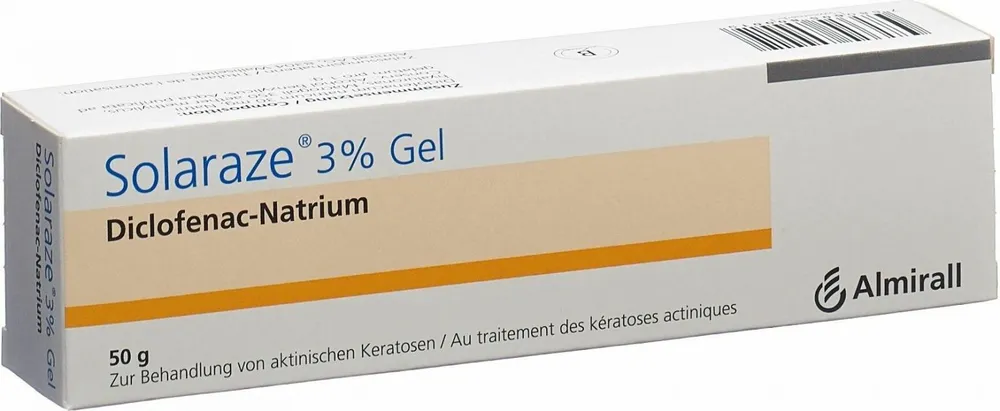
Table of Contents
Package leaflet: Information for the user
Solaraze 3% gel
Diclofenac sodium 3% w/w
Read this entire leaflet carefully before using this medicine because it contains important information for you.
- Keep this leaflet. You may need to read it again.
- If you have any questions, ask your doctor or pharmacist.
- This medicine has been prescribed for you only. Do not give it to other people, even if they have the same symptoms as you, because it may be harmful.
- If you experience any side effects, including those not listed in this leaflet, tell your doctor or pharmacist. See section 4.
Contents of this leaflet:
- What Solaraze is and what it is used for
- What you need to know before using Solaraze
- How to use Solaraze
- Possible side effects
- How to store Solaraze
- Contents of the pack and other information
1. What Solaraze is and what it is used for
Solaraze is a non-steroidal anti-inflammatory topical gel.
When applied to the skin, Solaraze gel is used to treat a skin condition known as actinic or solar keratosis,
caused by excessive exposure to sunlight.
2. What you need to know before using Solaraze
Do not use Solaraze
- If you are allergic to diclofenac or to any of the other ingredients of this medicine (listed in section 6).
- If you have previously experienced allergic reactions such as skin rash (urticaria), breathing difficulties (wheezing), or runny nose (allergic rhinitis) after taking aspirin or other non-steroidal anti-inflammatory drugs (NSAIDs).
- If you are in the last trimester of pregnancy.
Warnings and precautions
- The possibility of systemic side effects with the use of Solaraze cannot be ruled out if the product is used over large areas of skin and for prolonged periods.
- Consult your doctor if:
- You suffer or have previously suffered from stomach ulcers or gastrointestinal bleeding,
- You have heart, liver, or kidney problems,
- You have any bleeding disorders or bruise very easily.
- Avoid exposure to sunlight and sunbeds (tanning lamps) during treatment with Solaraze. If skin reactions occur, discontinue use.
- Do not apply Solaraze on wounds, infected skin, or areas with dermatitis.
- Avoid contact of Solaraze with the eyes, inside the nose or mouth, and do not swallow it. If Solaraze is accidentally ingested, contact your doctor immediately.
- If you develop a widespread skin rash, stop using Solaraze and consult your doctor.
- After applying medicines containing diclofenac to the skin, you may use a permeable (non-occlusive) dressing. Do not use an occlusive dressing that does not allow air passage.
Pregnancy and breastfeeding
Inform your doctor if you are pregnant or think you might be pregnant. Solaraze should be used with
caution during the first six months of pregnancy, but must not be used during the last trimester of
pregnancy.
Consult your doctor if you are breastfeeding. Solaraze may be used with caution during
breastfeeding, but must not be applied to the breast area.
If you are pregnant, trying to become pregnant, or breastfeeding, and your doctor considers this
treatment appropriate, you must not apply Solaraze over an area of skin larger than one-third of the body surface and must not use it for longer than three weeks.
Ask your doctor or pharmacist for advice before taking any medicine.
3. How to use Solaraze
- Solaraze is not suitable for children.
- Use the gel as directed by your doctor.
- Before first use, pierce the aluminium membrane covering the tube opening with the cap's tip.
- Gently apply a small amount of gel to the skin in the area to be treated. The amount needed depends on the size of the treatment area. Generally, 0.5 grams of gel (about the size of a pea) is sufficient to cover an area of 5x5 cm, but no more than 8 grams should be applied per day.
- Solaraze may be applied twice daily, unless otherwise directed by your doctor. When applying the gel, you may feel a mild cooling sensation.
- The usual duration of treatment is 60–90 days. Maximum effectiveness is achieved with a treatment duration towards the upper end of this range. Complete healing may occur up to one month after stopping treatment.
- After applying the gel, wash your hands unless the hands are one of the areas being treated.
If you use more Solaraze than you should
Remove excess gel by washing with water.
If you forget to use Solaraze
Continue applying the gel as prescribed, but do not apply a double dose to make up for the missed application.
4. Possible side effects
Like all medicines, this medicine can cause side effects, although not everyone experiences them.
If you experience any of the following side effects, stop using Solaraze and inform your doctor as soon as possible:
skin rash (urticaria), breathing difficulties (wheezing), facial swelling, runny nose (allergic rhinitis). These symptoms indicate a possible allergy to Solaraze.
If any of the following common side effects become severe or last for more than a few days, stop using Solaraze and consult your doctor: itching, skin rash, redness or inflammation of the skin, contact dermatitis, pain and blistering.
Other common side effects: (occur in 1–10 out of 100 patients)
irritation or tingling at the application site, conjunctivitis, allergy, pain sensation when touching the skin, tingling, muscle stiffness, dermatitis, eczema, dry skin, swelling, skin rash (including peeling and blistering), skin breakdown and skin ulcers.
Uncommon side effects: (occur in 1–10 out of 1,000 patients)
eye pain, eye watering/dry eyes, abdominal pain, diarrhoea, feeling unwell, hair loss, facial swelling, excessive bleeding or oily skin, measles-like rash.
Rare side effects: (occur in 1–10 out of 10,000 patients)
dermatitis with large blisters
Very rare side effects: (occur in less than 1 out of 10,000 patients)
stomach bleeding, kidney problems, breathing difficulties (asthma), infected skin rash, skin sensitivity to sunlight.
A temporary change in hair colour in the treated area has been reported, which usually resolves when treatment is stopped.
Reporting of side effects
If you experience any side effect, including those not listed in this leaflet, talk to your doctor or pharmacist. You can also report side effects directly via the national reporting system at:
www.agenziafarmaco.gov.it/content/come-segnalare-una-sospetta-reazione-avversa
By reporting side effects, you can help provide more information on the safety of this medicine.
5. How to store Solaraze
Keep this medicine out of the sight and reach of children.
Do not use this medicine after the expiry date (stated under “EXP”) printed on the tube and packaging. The expiry date refers to the last day of that month.
Do not store above 25 °C.
Usable duration after first opening: 6 months.
Do not dispose of any medicine via wastewater or household waste. Ask your pharmacist how to dispose of medicines you no longer use. This will help protect the environment.
6. Package contents and other information
What Solaraze contains
- The active substance is sodium diclofenac. Each gram of gel contains the equivalent of 30 mg of sodium diclofenac.
- The other components are sodium hyaluronate, benzyl alcohol, macrogol monomethyl ether 350 and purified water.
Description of the appearance of Solaraze and contents of the pack
Solaraze gel is a clear, transparent, colourless or pale yellow gel, packed in tubes containing 25, 50, 60, 90 or 100 grams of product.
Marketing Authorisation Holder and Manufacturer
The Marketing Authorisation Holder is Almirall SA, Ronda General Mitre 151 - 08022 Barcelona, Spain
The representative in Italy is Almirall Spa, via Messina 38, Torre C – 20154 Milan
The manufacturer is Almirall Hermal GmbH, Scholtzstrasse 3, D-21465 Reinbek, Germany.