Sofargen
Italy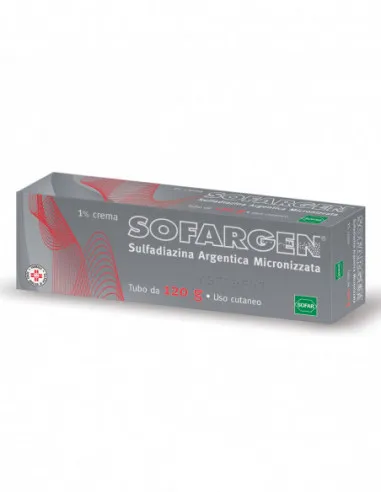
Table of Contents
Package leaflet: Information for the user
Sofargen 1% cream
Micronized silver sulfadiazine
Please read all of this leaflet carefully before you start using this medicine because it contains important information for you.
Use this medicine exactly as described in this leaflet or as your doctor or pharmacist has instructed you.
- Keep this leaflet. You may need to read it again.
- If you need more information or advice, consult your pharmacist.
- If you experience any side effects, including those not listed in this leaflet, contact your doctor or pharmacist. See section 4.
- Contact your doctor if you do not notice improvement or if you notice worsening of symptoms after a short period of treatment.
Contents of this leaflet:
- What Sofargen is and what it is used for
- What you need to know before using Sofargen
- How to use Sofargen
- Possible side effects
- How to store Sofargen
- Contents of the pack and other information
1. What Sofargen is and what it is used for
Sofargen contains the active substance silver sulfadiazine and belongs to a group of medicines called sulfonamides. Silver sulfadiazine is a sulfonamide antibiotic that blocks bacterial replication mechanisms through the action of the sulfadiazine moiety, and exerts a broad-spectrum bactericidal effect due to the presence of silver ions.
Sofargen is a topical antibiotic indicated:
- for the prevention and treatment of bacterial infections occurring in burns affecting deeper or less deep layers of the skin (second- and third-degree burns);
- for the treatment of bacterial infections occurring in lesions typically developing near the ankle due to circulatory blood disorders (venous ulcers) and in hard-to-heal wounds that may occur following prolonged immobility (pressure sores);
- for the treatment of skin diseases associated with bacterial infection or at risk of further infections.
2. What you need to know before using Sofargen
Do not use Sofargen if:
- you are allergic to the active substance or to any of the other ingredients of this medicine (listed in section 6);
- you are in the last months of pregnancy.
- you intend to use Sofargen on a premature infant or during the first months of life (see section “Children and adolescents”).
Warnings and precautions Talk to your doctor or pharmacist before using Sofargen if:
- you have liver problems (hepatic insufficiency);
- you have kidney problems (renal insufficiency);
- you have a deficiency of an enzyme called glucose-6-phosphate dehydrogenase.
Stop treatment with Sofargen and consult your doctor if you experience:
- hypersensitivity reactions (allergic reactions) occurring after prolonged use of the cream;
- secondary infections (superinfections) caused by microorganisms resistant to treatment with Sofargen.
If you need to apply Sofargen to large areas of skin (e.g. in case of extensive burns), your doctor will prescribe tests to monitor sulfadiazine blood levels, kidney and liver function, and the presence of sulfonamide crystals in the urine. Your doctor will instruct you to discontinue treatment with Sofargen if renal or hepatic insufficiency occurs.
Children and adolescents
Sofargen must not be used in premature infants or in newborns during the first months of life, as sulfonamides increase the risk of developing yellow discoloration of the skin associated with elevated blood bilirubin levels (neonatal jaundice).
Other medicines and Sofargen
Inform your doctor or pharmacist if you are taking, have recently taken, or might take any other medicines.
Pay particular attention when using Sofargen together with topical proteolytic enzymes, as their anti-inflammatory action may be inactivated by silver ions present in the cream.
Pregnancy and breastfeeding
If you are pregnant, think you might be pregnant, are planning a pregnancy, or are breastfeeding, consult your doctor or pharmacist before using this medicine.
Sofargen should only be used during pregnancy or breastfeeding if clearly needed and under strict medical supervision. Do not use Sofargen during the last months of pregnancy, as it may increase the risk of neonatal jaundice.
Driving and using machines
Sofargen does not affect your ability to drive or operate machinery.
Sofargen contains:
- cetyl alcohol, which may cause local skin reactions (e.g. contact dermatitis);
- propylene glycol, which may cause skin irritation;
- methyl p-hydroxybenzoate, which may cause allergic reactions (including delayed reactions).
3. How to use Sofargen
Use this medicine exactly as described in this leaflet or as instructed by your doctor or pharmacist. If you have any doubts, consult your doctor or pharmacist.
Consult your doctor if symptoms persist after a short period of treatment or worsen at any time.
Burn treatment
Clean the area of skin to be treated before applying Sofargen. Apply an even layer of cream 2 or 3 mm thick to the burned surface, one or two times daily. You may apply the cream directly to the lesion, possibly with the help of a clean glove, or spread it onto a sterile gauze dressing.
Thoroughly clean the wound with water or physiological solution at each dressing change, using irrigation or gentle washing. Be sure to promptly reapply the cream if it has been accidentally removed.
Treatment with the cream should continue uninterrupted as long as there is a risk of infection and until the lesion is completely healed.
Treatment of varicose ulcers, pressure sores, wounds, and skin conditions at risk of infection
Clean the affected area of skin, if necessary, and apply an even layer of cream 2 or 3 mm thick, one or two times daily. You may apply the cream directly to the lesions, possibly with the help of a clean glove, or spread it onto a sterile gauze dressing. Be sure to keep the lesion completely covered with cream at all times.
If you need to use a compression bandage (e.g., a legging-type bandage), unroll portions of 20–30 cm of an appropriately long bandage and spread a generous layer of cream onto it. Rewind the cream-impregnated section, unroll the next 20–30 cm, and repeat the process until the entire length of the bandage is fully impregnated with cream. Use this medicated bandage for the dressing.
If you use more Sofargen than you should
In case of accidental ingestion or overdose, contact your doctor immediately or go to the nearest hospital.
No cases of overdose due to excessive use of Sofargen are known.
If you forget to use Sofargen
If you forget to apply the cream, do so as soon as you remember. Then continue applying it according to the usual schedule.
If you stop using Sofargen
Do not stop treatment as long as there is a risk of infection and until the lesion is completely healed.
If you have any doubts about how to use this medicine, consult your doctor or pharmacist.
4. Possible side effects
Like all medicines, Sofargen can cause side effects, although not everybody gets them.
Uncommon side effects (may affect up to 1 in 100 people)
temporary reduction in the number of white blood cells in the blood (transient leucopenia);
local reactions such as pain and burning, and hypersensitivity reactions (allergic reactions) at the site of
administration.
After applying Sofargen to large areas of skin, you may experience side effects that are usually observed with oral or injectable (systemic route) sulfonamide-containing medicines.
Reporting of side effects
If you experience any side effect, including those not listed in this leaflet, talk to your doctor or pharmacist. You can also report side effects directly via the national reporting system at: https://www.aifa.gov.it/content/segnalazioni-reazioni-avverse .
By reporting side effects, you can help provide more information on the safety of this medicine.
5. How to store Sofargen
Keep this medicine out of the sight and reach of children.
Do not use this medicine after the expiry date stated on the packaging after "Exp". The expiry date refers to the last day of that month.
The stated expiry date applies to the medicine kept in its original intact packaging and stored correctly.
The cream must be used within 6 months of first opening the tube.
Store below 30°C.
Do not dispose of any medicine via wastewater or household waste. Ask your pharmacist how to dispose of medicines you no longer use. This will help protect the environment.
6. Package contents and other information
What Sofargen contains
The active substance is micronized silver sulfadiazine.
100 g of cream contain 1 g of micronized silver sulfadiazine.
The other components are: stearyl alcohol, isopropyl myristate, propylene glycol,
polyethylene glycol monostearate, polyoxyethylene sorbitan monolaurate, methyl p-hydroxybenzoate, distilled water.
Description of the appearance of Sofargen and contents of the pack
Sofargen is a white pearly cream, supplied in aluminum tubes of 30 g, 50 g, 120 g, 180 g or in a jar of 600 g. The 180 g and 600 g pack sizes are intended exclusively for use in hospital settings.
It is possible that not all pack sizes are marketed.
Marketing Authorization Holder and Manufacturer
Marketing Authorization Holder
Alfasigma S.p.A. - Via Ragazzi del '99, n. 5 - 40133 Bologna (BO)
Manufacturers
SOFAR S.p.A.
via Firenze 40
20060 Trezzano Rosa (MI)
VAMFARMA S.r.l.
Via Kennedy 5
26833 Comazzo (LO)