Sodium phosphate New.Fa.Dem.
Italy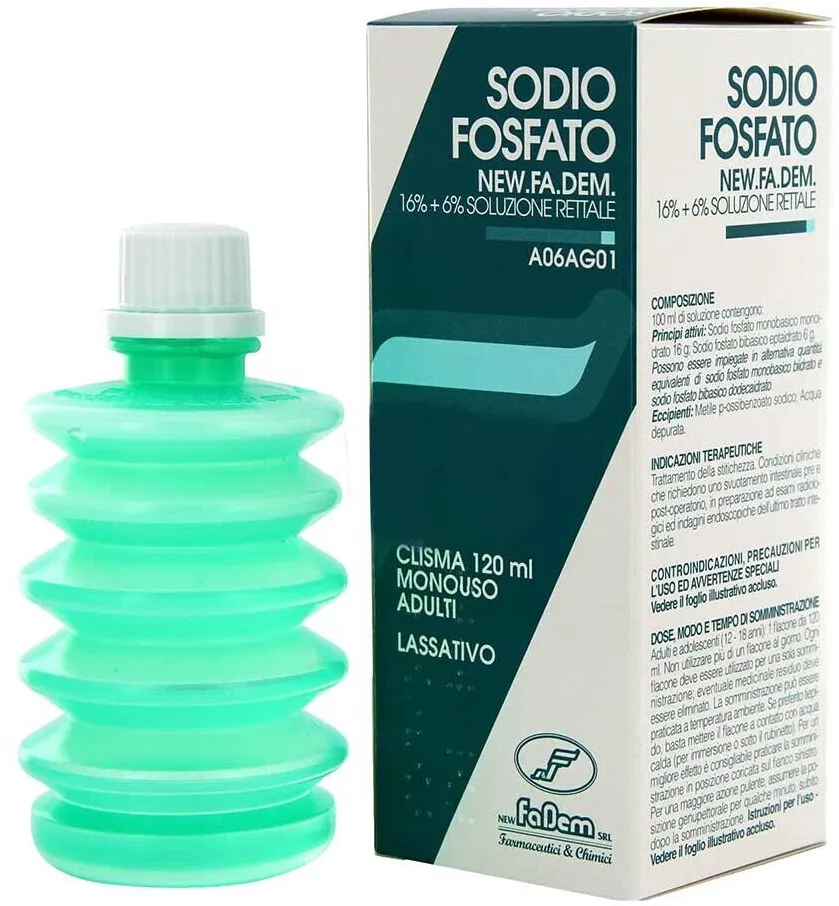
Table of Contents
PACKAGE LEAFLET
SODIUM PHOSPHATE NEW.FA.DEM. 16% / 6% RECTAL SOLUTION
PHARMACOTHERAPEUTIC CATEGORY
Laxatives.
THERAPEUTIC INDICATIONS
- Treatment of constipation.
- Clinical conditions requiring pre- and post-operative bowel evacuation, in preparation for radiological examinations and endoscopic investigations of the distal intestinal tract.
CONTRAINDICATIONS
- Hypersensitivity to the active substance or to any of the excipients.
- Acute or unknown origin abdominal pain,
- Nausea or vomiting,
- Intestinal obstruction or stenosis or anorectal stenosis,
- Intestinal subocclusion,
- Mechanical ileus,
- Paralytic ileus,
- Inflammatory intestinal disorders and other conditions that may increase drug absorption.
- Anal perforation,
- Congenital or acquired megacolon,
- Hirschsprung's disease,
- Rectal bleeding of unknown origin,
- Acute hemorrhoidal crisis with pain and bleeding,
- Severe dehydration,
- Children under twelve years of age.
Phosphates are contraindicated in patients with cardiac disorders, severe renal insufficiency, or in the presence of hyperphosphatemia.
Concomitant administration of other sodium phosphate preparations, including oral phosphate solutions or sodium phosphate tablets, must not be given (see section “INTERACTIONS”).
PRECAUTIONS FOR USE
The 120 ml bottle must not be used in children under 12 years of age.
Abuse of laxatives (frequent or prolonged use, or excessive doses) may cause persistent diarrhoea, resulting in loss of water, minerals (especially potassium), and other essential nutrients.
In more severe cases, dehydration or hypokalaemia may occur, which can lead to cardiac or neuromuscular dysfunction, particularly if the patient is also receiving cardiac glycosides, diuretics, or corticosteroids.
Patients should be encouraged to drink fluids to help prevent dehydration, especially those with conditions predisposing to dehydration, or those taking medications that may reduce glomerular filtration rate, such as diuretics, angiotensin-converting enzyme inhibitors (ACE inhibitors), angiotensin receptor blockers (ARBs), or non-steroidal anti-inflammatory drugs (NSAIDs).
Since Sodio Fosfato New.Fa.Dem. contains sodium phosphates, there is a risk of elevated serum levels of sodium and phosphate, and decreased levels of calcium and potassium, leading to hypernatraemia, hyperphosphataemia, hypocalcaemia, and hypokalaemia. These imbalances may present clinically with tetany and renal failure.
Abuse of laxatives may lead to dependence (and thus a possible need for progressively increasing doses), chronic constipation, and loss of normal intestinal function (intestinal atony).
Repeated use of laxatives may lead to habituation or various types of damage.
Prolonged use of a laxative for the treatment of constipation is not recommended.
Pharmacological treatment of constipation should be considered an adjunct to hygienic-dietary measures (e.g. increasing dietary fibre and fluid intake, physical activity, and re-education of intestinal motility).
Treatment of chronic or recurrent constipation always requires medical supervision for diagnosis, prescription of medications, and monitoring during therapy.
Consult a physician if the need for a laxative arises from a sudden change in previous bowel habits (frequency and characteristics of evacuations) lasting more than two weeks, or if use of the laxative fails to produce effect.
In episodes of constipation, it is first recommended to correct dietary habits by increasing daily intake of fibre and water.
When using laxatives, it is advisable to drink at least 6–8 glasses of water or other fluids daily to promote stool softening.
Elderly individuals or those in poor health, and patients with uncontrolled hypertension, ascites, heart disease, or changes in rectal mucosa (ulcers, fissures), should consult a physician before using this medicine.
Patients should be advised to stop administration if resistance is encountered, as forced administration of the enema may cause injury.
INTERACTIONS
Inform your doctor or pharmacist if you have recently taken any other medicines, including those without a prescription.
Systemic absorption of sodium phosphate rectal solution is limited; however, in certain conditions it may be increased and predispose to possible interactions with other drugs.
Concomitant use of drugs affecting electrolyte balance (such as diuretics, corticosteroids, calcium antagonists, lithium) may facilitate the onset of hyperphosphataemia, hypercalcaemia, and hypernatraemia.
Patients taking drugs that can prolong the QT interval may be at increased risk of developing this adverse reaction when treated concomitantly with sodium phosphate.
Since hypernatraemia is associated with low lithium levels, concomitant use of Sodio Fosfato New.Fa.Dem. and lithium may reduce serum lithium levels, leading to decreased efficacy.
Concomitant use of calcium supplements or calcium-containing antacids may increase the risk of ectopic calcification.
It is known that laxatives may reduce intestinal transit time, and consequently also the absorption of other orally administered drugs taken simultaneously.
Therefore, it is recommended to wait at least 2 hours after taking an oral medication before administering a laxative.
Concomitant administration of other sodium phosphate preparations, including oral solutions or sodium phosphate tablets, must not be given.
SPECIAL WARNINGS
Pregnancy and breastfeeding
Consult your doctor or pharmacist before taking any medicine.
Adequate and well-controlled studies on the use of this medicine during pregnancy or breastfeeding have not been conducted.
Although there are no apparent contraindications for the use of this medicine during pregnancy or breastfeeding, it is recommended to use the medicine only when necessary and under medical supervision.
Effects on the ability to drive vehicles and use machinery
This medicine does not impair the ability to drive vehicles or operate machinery. However, adverse effects may occur during treatment; therefore, it is advisable to be aware of your individual response to the medicine before driving or operating machinery.
Important information about certain excipients: This medicine contains methyl p-hydroxybenzoate, which may cause allergic reactions (including delayed reactions), and sodium benzoate, which is mildly irritating to the skin, eyes, and mucous membranes.
Health education notes
First of all, it should be noted that in most cases, a balanced diet rich in water and fibre (bran, vegetables, and fruit) can permanently resolve constipation.
Many people believe they suffer from constipation if they do not defecate every day.
This is a mistaken belief, as such a pattern is entirely normal for many individuals.
Constipation should instead be considered present when bowel movements are reduced compared to one’s usual pattern and are associated with the passage of hard stools.
If episodes of constipation recur repeatedly, a physician should be consulted.
DOSAGE, METHOD AND DURATION OF ADMINISTRATION
Adults and adolescents (12–18 years): 1 bottle of 120 ml. Do not use more than one bottle per day.
Each bottle is intended for single use only; any unused medicine should be discarded.
Administration may be performed at room temperature. If preferred warm, place the bottle in contact with warm water (by immersion or under running tap water). For optimal effect, administration is recommended while lying on the left side. For enhanced cleansing effect, assume the knee-chest position for a few minutes immediately after administration.
Instructions for use
- Remove the rectal cannula provided in the package from its protective pouch.
- Remove the screw cap and screw the rectal cannula onto the bottle.
- Hold the bottle and gently insert the cannula into the rectum, then squeeze the bottle completely. A small amount of solution may remain in the bottle. In children, the cannula should not be inserted beyond half its length.
- After administration, remove the cannula and dispose of the empty bottle in its original box according to local regulations for medicine disposal.
- Remain lying down until a strong urge to defecate occurs, usually within 5 minutes. In any case, it is not necessary to retain the enema for more than 10–15 minutes.
OVERDOSE
The most frequently observed effect following ingestion or rectal administration is gastrointestinal irritation (abdominal pain, nausea, vomiting, diarrhoea). Persistent diarrhoea leads to loss of water, minerals (especially potassium), and other essential nutrients. Fluid and electrolyte losses must be replaced. Electrolyte imbalances are characterized by symptoms such as thirst, vomiting, weakness, oedema, bone pain (osteomalacia), and hypoalbuminaemia. In more severe cases, dehydration or hypokalaemia may occur, which can lead to cardiac or neuromuscular dysfunction, particularly if the patient is also receiving cardiac glycosides, diuretics, or corticosteroids. Fluid and electrolyte losses must be replaced. Conservative measures are generally sufficient; plenty of fluids, especially fruit juices, should be administered. See also the section “Precautions for use” regarding laxative abuse.
If a significant amount of phosphate is absorbed, hyperphosphataemia, hypocalcaemia, and hypomagnesaemia may occur. Alterations in fluid and electrolyte balance have been observed following oral, rectal, and intravenous exposure. Severe hyperphosphataemia and hypocalcaemia may cause tetany, seizures, bradycardia, QT interval prolongation, arrhythmias, coma, and cardiac arrest. Severe dehydration, hypernatraemia, hypotension, metabolic acidosis, and tachycardia may also occur. Elderly patients, children, and patients with renal insufficiency are at higher risk of toxic effects.
In case of accidental ingestion/overdose of an excessive amount of sodium phosphate New.Fa.Dem.,
contact a doctor immediately or go to the nearest hospital.
If you have any doubts about the use of sodium phosphate New.Fa.Dem., consult your doctor or pharmacist.
UNDESIRABLE EFFECTS
Like all medicines, sodium phosphate may cause adverse effects, although not everyone experiences them.
The following adverse effects of sodium phosphate are reported. There are insufficient data to determine the frequency of individual listed effects.
Immune system disorders
Hypersensitivity reactions (e.g. urticaria)
Skin and subcutaneous tissue disorders
Blisters, pruritus, burning sensation
Gastrointestinal disorders
Isolated cramp-like pains or abdominal colic and diarrhoea, with loss of fluids and electrolytes, more frequent in cases of severe constipation, as well as rectal irritation.
Nausea, vomiting.
Metabolism and nutrition disorders
Hyperphosphataemia, hypokalaemia, hypernatraemia, hypocalcaemia, and tissue calcification may rarely occur.
Following the instructions in this leaflet reduces the risk of adverse effects.
Reporting of adverse effects
If you experience any adverse effect, including those not listed in this leaflet, contact your doctor or pharmacist. Adverse effects can also be reported directly via the national reporting system at
www.agenziafarmaco.gov.it/it/responsabili ". Reporting adverse effects contributes to providing more information on the safety of this medicine.
EXPIRY DATE AND STORAGE
Expiry date: see the date printed on the packaging.
The expiry date refers to the medicine in unopened, properly stored packaging.
WARNING: Do not use the medicine after the expiry date stated on the packaging.
Storage conditions
Keep the container tightly closed and store at a temperature not exceeding 30 °C.
Medicines must not be disposed of via wastewater or household waste. Ask your pharmacist how to dispose of medicines no longer required. This will help protect the environment. Keep the medicine out of the sight and reach of children.
COMPOSITION
100 ml of solution contains:
Active substances: monobasic monohydrate sodium phosphate 16 g;
dibasic heptahydrate sodium phosphate 6 g
Equivalent quantities of monobasic dihydrate sodium phosphate and dibasic dodecahydrate sodium phosphate may alternatively be used.
Excipients: sodium methyl p-hydroxybenzoate, purified water
PHARMACEUTICAL FORM AND CONTENT
Rectal solution
- 16% / 6% rectal solution – 1 single-dose bottle of 120 ml, for adults
- 16% / 6% rectal solution – 25 single-dose bottles of 120 ml, for adults
MARKETING AUTHORISATION HOLDER AND MANUFACTURER
New.Fa.Dem. srl Farmaceutici e Chimici
Head office and manufacturing site: Viale Ferrovie dello Stato, zona A.S.I., Giugliano in Campania (NA), Italy
REVISION OF THE PACKAGE LEAFLET BY THE ITALIAN MEDICINES AGENCY (AIFA):
AIFA Determination V&A No. 1352 of 01/12/2011