Sodium iodide 131I Polatom
Italy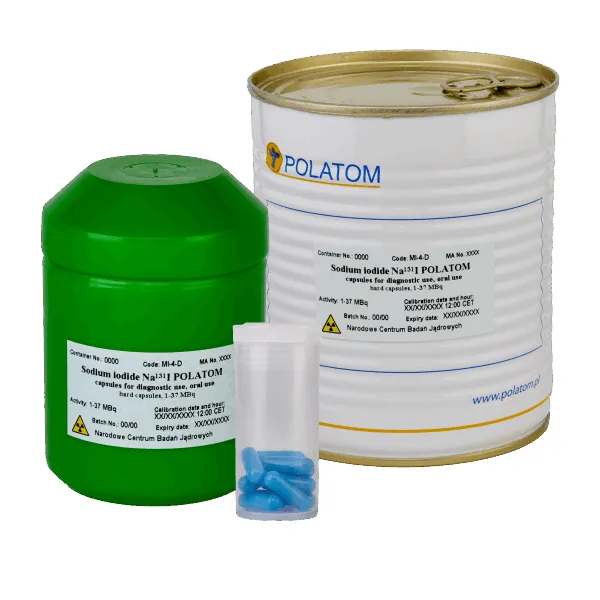
Table of Contents
- PACKAGE LEAFLET: Information for the patient
- Sodio ioduro ( I) POLATOM
- 1. What Sodio ioduro ( I) POLATOM is and what it is used for
- 2. What you should know before being administered Sodio ioduro (I) POLATOM
- 3. How Sodium iodide (I) POLATOM is administered
- 4. Possible side effects
- 5. How Sodio ioduro (I-13 I 1) POLATOM is stored
- 6. Package contents and other information
PACKAGE LEAFLET: Information for the patient
Sodio ioduro ( I) POLATOM
37-7400 MBq, hard capsules
Sodium iodide ( I)
Please read this leaflet carefully before you are administered this medicine, because it contains important information for you.
- Keep this leaflet. You may need to read it again.
- If you have any questions, ask the nuclear medicine specialist supervising the procedure.
- If you experience any side effects, including those not listed in this leaflet, contact the nuclear medicine physician. See section 4.
Contents of this leaflet:
- What Sodio ioduro ( I) POLATOM is and what it is used for
- What you need to know before you are administered Sodio ioduro ( I) POLATOM
- How Sodio ioduro ( I) POLATOM is administered
- Possible side effects
- How Sodio ioduro ( I) POLATOM is stored
- Contents of the pack and other information
1. What Sodio ioduro ( I) POLATOM is and what it is used for
Sodio ioduro ( I) POLATOM is a medicine used in adults, children and adolescents for the
treatment of:
- tumours of the thyroid gland
- overactivity of the thyroid gland
- large and compressive thyroid gland, when no alternative therapy is available
This medicine contains sodium iodide ( I), a radioactive substance that accumulates in certain organs,
such as the thyroid gland.
This medicine is radioactive, but doctors consider that the beneficial effect of the medicine on your
condition outweighs the potential harm from radiation.
2. What you should know before being administered Sodio ioduro (I) POLATOM
Sodio ioduro (I) POLATOM must not be administered
if you
- are allergic to sodium iodide or to any of the other ingredients of this medicine (listed in section 6).
- are pregnant or think you might be pregnant
- are breastfeeding
if you have:
- swallowing difficulties
- oesophageal obstruction
- stomach disorders
- reduced abdominal or intestinal motility.
If any of these situations apply to you, inform the nuclear medicine physician.
Warnings and precautions
Inform the nuclear medicine physician:
- if you suffer from impaired renal function.
- if you have problems urinating
- if you have digestive or stomach problems.
- if protruding eyes are part of the symptoms of your disease (Graves' disease-induced ophthalmopathy)
Low blood sodium levels have been observed in elderly patients who have undergone thyroid removal. This event is more likely to occur in women and in patients taking medicines that increase the amount of water and sodium excreted in the urine (diuretics, such as hydrochlorothiazide). If you belong to any of these groups, your doctor may perform periodic blood tests to monitor the levels of electrolytes (e.g. sodium) in your blood.
If any of these conditions apply to you, consult your nuclear medicine physician. Sodio ioduro (I) POLATOM may not be suitable for you.
Your doctor will inform you if any special precautions need to be taken after using this medicine.
If you have any questions, speak with your nuclear medicine physician.
Before administration of Sodio ioduro (I) POLATOM you should:
- follow a low-iodine diet.
- drink plenty of water before starting treatment so that you urinate as frequently as possible during the first few hours after taking Sodio ioduro (I) POLATOM.
- fast on the day of treatment.
Children and adolescents
Inform the nuclear medicine physician if you are under 18 years of age or if you are unable to swallow a capsule.
Other medicines and Sodio ioduro (I) POLATOM
Inform the nuclear medicine physician if you are currently taking, have recently taken, or might take any other medicines, including those without a prescription.
Inform your nuclear medicine physician if you are taking or have been administered any of the following medicines or substances, as they may affect the effectiveness of this treatment.
Your doctor may recommend that you stop taking the following medicines before treatment:
- medicines that reduce thyroid gland function, such as: carbimazole, methimazole, propylthiouracil, perchlorate, for one week;
- salicylates: medicines used to reduce pain, fever or inflammation such as aspirin, for one week;
- corticosteroids: medicines to reduce inflammation or prevent organ transplant rejection, for one week;
- sodium nitroprusside: medicine used to reduce high blood pressure, even during surgery, for one week;
- sodium sulfobromophthalein: medicine used to assess liver function, for one week;
- other medicines for one week or to reduce blood coagulation or to treat parasitic infections or antihistamines: used to treat allergies or penicillins and sulfonamides: antibiotics or tolbutamide: medicine used to reduce blood sugar levels;
- thiopentone: anaesthetic medicine used during surgery to reduce intracranial pressure and also for the treatment of severe epileptic seizures, for 1 week;
- phenylbutazone: medicine to reduce pain and inflammation, for 1-2 weeks;
- medicines containing iodine to help clear airways of sputum, for 2 weeks;
- medicines containing iodide applied only to a limited area of the body, for 1-9 months;
- iodine-containing contrast agents, up to 1 year;
- vitamins containing iodine salts, for 2 weeks;
- medicines containing thyroid hormones such as levothyroxine (for 6 weeks) or triiodothyronine (for 2 weeks);
- benzodiazepines: medicines for mood and supportive treatment in patients for sleep and muscle relaxation, for 4 weeks;
- lithium: medicine used to treat bipolar disorders, for 4 weeks;
- amiodarone: medicine used to treat heart rhythm disorders, for 3-6 months.
Sodio ioduro (I) POLATOM with food
Your doctor may recommend that you follow a low-iodine diet and avoid foods such as shellfish and crustaceans.
Pregnancy and breastfeeding
This medicine must not be used during pregnancy. Therefore, you must inform the nuclear medicine physician before administration of Sodio ioduro (I) POLATOM
if there is any possibility that you are pregnant, if you have missed a period, if you think you may be pregnant, or if you are planning to have a child.
If you are pregnant
You must not take Sodio ioduro (I) POLATOM. Any possibility of pregnancy must be ruled out before using this medicine.
Contraception in males and females
Women must not become pregnant for at least 6 months after treatment with Sodio ioduro (I) POLATOM. Women are advised to use contraception for a period of 6 months. As a precaution, men should not father children for a period of 6 months after treatment with Sodio ioduro (I) POLATOM to allow irradiated sperm to be replaced by non-irradiated sperm.
Fertility
Reproductive capacity in men and women may be temporarily reduced after treatment with Sodio ioduro (I) POLATOM. In men, high doses of sodium iodide (I) may temporarily affect sperm production. If you wish to father a child, speak with your doctor about sperm storage at a sperm bank.
If you are breastfeeding
Inform the nuclear medicine physician that you are breastfeeding, as you must completely stop breastfeeding before treatment. Breastfeeding must not be resumed after treatment with Sodio ioduro (I) POLATOM.
Driving and using machines
It is considered unlikely that Sodio ioduro (I-131) POLATOM affects the ability to drive vehicles or use machinery.
Sodio ioduro (I) POLATOM contains sodium and quinoline yellow (E 104)
Sodio ioduro (I) POLATOM contains up to 97 mg of sodium (the main component of table/cooking salt) per capsule. This corresponds to 4.85% of the maximum daily sodium intake recommended in the adult diet. This should be taken into account if you are on a sodium-controlled diet. Sodio ioduro (I) POLATOM contains the colouring agent quinoline yellow (E 104). It may cause allergic reactions. It could have a negative effect on the activity and attention of children.
3. How Sodium iodide (I) POLATOM is administered
There are strict regulations governing the use, handling, and disposal of radioactive medicinal products. Sodium iodide (I) POLATOM must only be used in designated, controlled areas.
This medicine will be administered to you only by healthcare professionals trained and qualified to use it safely. These individuals will take particular care in ensuring the safe use of this product and will keep you informed about their actions.
The nuclear medicine physician supervising the procedure will determine the correct dose of Sodium iodide (I) POLATOM for you. This will be the smallest amount necessary to achieve the desired effect.
Sodium iodide (I) POLATOM is administered as a single capsule by specialists who are responsible for taking all necessary precautions.
The recommended doses for adults are normally:
- 200–800 MBq to treat an overactive or large, compressive thyroid gland;
- 1,850–3,700 MBq for partial or total removal of the thyroid gland and for treatment of cancer cell spread, known as metastases;
- 3,700–11,100 MBq for follow-up treatment of metastases.
MBq (megabecquerel) is the unit of measurement used to express the radioactivity of the medicine.
Use in children and adolescents under 18 years of age
Lower doses are used for children and adolescents.
Method of administration of Sodium iodide ( I) POLATOM and procedure
Sodium iodide (I) POLATOM will be administered to you as a single capsule.
Your stomach must be empty when you take this capsule.
Swallow the capsule with plenty of water to ensure it passes completely into the stomach as quickly as possible.
Children should take the capsule with crushed food.
Drink as much water as possible after taking the capsule and during the day following treatment: this will help eliminate the active substance from your bladder.
Duration of the procedure
Your nuclear medicine physician will inform you about the duration of the procedure.
After administration of Sodium iodide ( I) POLATOM
Your nuclear medicine physician will inform you about any special precautions you need to take after receiving this medicine.
In particular, you must:
- avoid close contact with pregnant women or young children for several days. Your doctor will inform you of the necessary duration;
- drink plenty of fluids and urinate frequently to help eliminate the medicine from your body;
- flush the toilet thoroughly and wash your hands carefully, as body fluids will be radioactive for several days;
- drink beverages or eat sweets containing citric acid, such as orange, lemon, or lime juice, which stimulate saliva production and help prevent saliva accumulation in the salivary glands;
- take laxatives to stimulate the bowel if you have fewer than one bowel movement per day.
Blood, faeces, urine, or any vomit may be radioactive for several days and should not come into contact with other people. Consult your nuclear medicine physician if you have any questions.
If you have been given more Sodium iodide ( I) POLATOM than you should have received
Overdose is unlikely, as you will receive only a single, carefully controlled dose of Sodium iodide (I) POLATOM, administered under the supervision of the nuclear medicine physician.
However, in the event of an overdose, appropriate treatment will be given.
If you have any further questions about the use of Sodium iodide (I) POLATOM, please consult your nuclear medicine physician supervising the procedure.
4. Possible side effects
Like all medicines, this medicine can cause side effects, although not everybody gets them.
Frequent adverse reactions are: hypothyroidism (underactive thyroid gland), temporary
hyperthyroidism (overactive thyroid gland), salivary and lacrimal gland disorders, and local radiation
effects. In cancer treatment, side effects affecting the stomach and intestines, as well as reduced
blood cell production in the bone marrow, may also occur frequently.
If you experience a severe allergic reaction causing difficulty breathing or dizziness, or if you have a
severe crisis of excessive thyroid activity, contact your doctor immediately.
All side effects associated with the Sodio ioduro (131I) POLATOM capsule are listed below,
grouped according to the conditions of use of Sodio ioduro (131I) POLATOM, as these depend on
the dosage used for different treatments.
Treatment of overactive or enlarged and compressive thyroid gland
Very common: may affect more than 1 in 10 people
- underactive thyroid
Common (may affect up to 1 in 10 people)
- a type of eye inflammation called endocrine ophthalmopathy (after treatment of Graves' disease)
- temporary overactivity of the thyroid gland
- inflammation of the salivary gland
Very rare (may affect up to 1 in 10,000 people)
- vocal cord paralysis
Frequency not known (frequency cannot be estimated from the available data)
- severe allergic reaction causing difficulty breathing or dizziness
- severe hyperactive crisis of the thyroid gland
- inflammation of the thyroid gland
- reduced lacrimal gland function characterized by dry eyes
- reduced or loss of parathyroid hormone production with tingling in hands, fingers, and around the mouth, up to more severe forms of muscle cramps
- deficiency of thyroid hormone in offspring
- abnormal liver function
Treatment of tumours
Very common (may affect more than 1 in 10 people):
- severe reduction in blood cells which may cause weakness, bruising, or increased risk of infections
- lack of red blood cells
- bone marrow failure with reduction in red blood cells, white blood cells, or both
- disturbance or loss of smell or taste
- nausea (feeling of discomfort)
- decreased appetite
- insufficient ovarian function
- flu-like illness
- headache, neck pain
- extreme tiredness or drowsiness
- inflammation causing red eyes, tearing, and itching
- inflammation of the salivary glands with symptoms such as dry mouth, dry nose, and dry eyes; tooth decay, tooth loss
Common (may affect up to 1 in 10 people)
- abnormal and cancerous increase in white blood cells
- lack of white blood cells or platelets
- runny nose
- breathing difficulties
- vomiting
- areas of tissue swelling
Rare (may affect up to 1 in 1,000 people):
- severe or temporary overactivity of the thyroid gland
Frequency not known (frequency cannot be estimated from the available data):
- severe allergic reaction causing difficulty breathing or dizziness
- cancer of the bladder, large intestine, or stomach
- permanent or severe reduction in blood cell production in the bone marrow
- inflammation of the thyroid gland
- reduced or loss of parathyroid hormone production
- increased production of parathyroid hormone
- underactive thyroid
- inflammation and/or narrowing of the trachea and/or throat
- proliferation of connective tissue in the lungs
- breathing difficulties or shortness of breath
- lung inflammation
- vocal cord paralysis, hoarseness, reduced ability to produce vocal sounds using vocal organs
- mouth and throat pain
- accumulation of fluid in the brain
- inflammation of the inner lining of the stomach
- difficulty swallowing
- inflammation of the bladder
- menstrual cycle disorders
- decreased male fertility, low number or absence of spermatozoa
- deficiency of thyroid hormone in offspring
- abnormal liver function
- low sodium concentration in the blood
If you experience any side effects, consult your nuclear medicine physician. This includes any
possible side effect not listed in this leaflet.
Reporting of side effects
If you experience any side effect, including those not listed in this leaflet, please contact your
Nuclear Medicine physician. You may also report side effects directly via
By reporting side effects, you can help provide more information on the safety of this medicine.
5. How Sodio ioduro (I-13 I 1) POLATOM is stored
Do not store this medicinal product. This medicinal product is stored under the responsibility of the specialist in appropriate facilities. Radiopharmaceuticals must be stored in accordance with current national regulations concerning radioactive materials.
The following information is intended exclusively for the specialist.
The Sodio ioduro (I) POLATOM capsule must not be used after the expiry date indicated following "Scad".
6. Package contents and other information
What Sodio ioduro ( I) POLATOM contains
The active substance is iodide ( I) as sodium iodide.
Each hard capsule contains from 37 to 7400 MBq of sodium iodide ( I).
The other ingredients are:
- Sodium carbonate
- Sodium hydrogen carbonate
- Sodium hydroxide
- Disodium phosphate dihydrate
- Sodium thiosulfate
Composition of the gelatin capsule:
Quinoline yellow (E 104)
Erythrosine (E 127)
Titanium dioxide (E 171)
Gelatin
Description of the appearance of Sodio ioduro ( I) POLATOM and contents of the pack
The polypropylene vial is placed in a lead-shielded container, closed with a lead cap containing a polypropylene insert with iodine absorber. The pack contains a single capsule. Each pack is accompanied by a separate polypropylene applicator for capsule administration.
Marketing Authorization Holder and Manufacturer
National Centre For Nuclear Research
ul. Andrzeja Sołtana 7
05-400 Otwock
Poland
Phone: 22 7180700
Fax: 22 7180350
Email: [email protected]
This medicinal product is authorized in the European Economic Area countries under the following names:
Austria: Iodopol 37‐7400 MBq Hartkapseln
Bulgaria: Iodopol
Czech Republic: Iodopol
Denmark: Sodium iodide (I-131) POLATOM
Estonia: Iodopol
Finland: Sodium iodide (I-131) POLATOM
Germany: Iodopol
Greece: Iodopol
Italy: Sodio ioduro ( I) POLATOM
Lithuania: Sodium iodide ( I) POLATOM 37‐7400 MBq kietosios kapsulės
Norway: Iodopol
Poland: Iodopol
Portugal: Iodopol
Slovakia: Iodopol
Slovenia: Natrii iodidum ( I) POLATOM, 37‐7400 MBq trde kapsule
Sweden: Sodium iodide (I-131) POLATOM
The following information is intended exclusively for physicians and healthcare professionals:
Instructions for opening the radioactive product container using the applicator:
- Check the radioactivity and calibration date stated on the outer packaging.
- Remove the upper lid of the shipping container (metal box).
- Remove the upper polystyrene insert.
- Remove the capsule protection container.
- Tear open the aluminium foil wrapper of the applicator and remove the applicator.
- Open the capsule protection container. To do this, hold the lower part of the container and pull the upper part upwards. The vial containing the capsule must remain inside the protective container.
- Attach the applicator to the vial. To do this, screw the applicator into the vial containing the capsule.
- During capsule administration, it is recommended to keep the vial containing the capsule inside the protective container. The patient, holding the protective container in hand, places the applicator in the mouth and then tilts it to allow the capsule to pass from the vial through the applicator. When required, it is possible to administer a capsule without using the shielded container. The patient grasps the applicator, removes the capsule vial from the protective container, places the applicator in the mouth, and then tilts it to allow the capsule to pass from the vial through the applicator.
- After capsule administration, the applicator and vial must be disposed of. The shielded container must be returned to the manufacturer.
- To disconnect the applicator from the vial, insert the vial with the attached applicator back into the protective container and, while holding the container with one hand, unscrew the applicator to detach it.
- To measure the capsule activity, take the applicator attached to the capsule vial and place it into the dose calibrator’s holder device, then load the dose calibrator. After measurement is complete, remove the applicator attached to the capsule vial and return it to the protective container. When it is necessary to transfer the capsule to another room, the applicator must be disconnected from the vial according to the instructions above. After disconnecting the applicator, cover the shielding container with its lid.
Unused product or waste materials must be disposed of in accordance with local legal requirements.