Sodium calcium edetate S.A.L.F.
Italy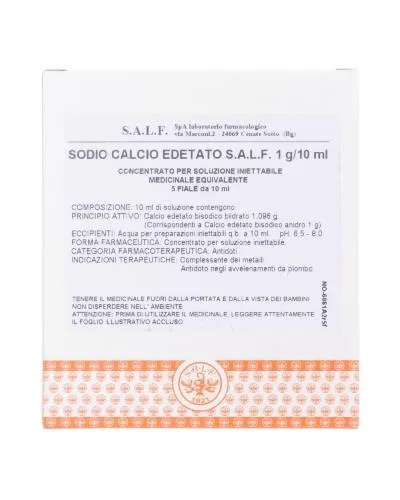
Table of Contents
- Package leaflet: Information for the user
- SODIUM CALCIUM EDETATE S.A.L.F. 1 g/10 ml concentrate for solution for injection
- 1. What SODIO CALCIO EDETATO S.A.L.F. is and what it is used for
- 2. What you should know before using SODIO CALCIO EDETATO S.A.L.F.
- 3. How to use SODIO CALCIO EDETATO S.A.L.F.
- 4. Possible side effects
- 5. How to store SODIO CALCIO EDETATO S.A.L.F.
- 6. Package contents and other information
- The following information is intended exclusively for physicians or healthcare professionals
Package leaflet: Information for the user
SODIUM CALCIUM EDETATE S.A.L.F. 1 g/10 ml concentrate for solution for injection
Sodium calcium edetate
Equivalent medicine
Please read this leaflet carefully before using this medicine because it contains important information for you.
- Keep this leaflet. You may need to read it again.
- If you have any questions, ask your doctor, pharmacist or nurse.
- This medicine has been prescribed for you only. Do not give it to others, even if their symptoms are the same as yours, because it could be harmful.
- If you experience any adverse reactions, including those not listed in this leaflet, contact your doctor, pharmacist or nurse. See section 4.
Contents of this leaflet:
- What SODIUM CALCIUM EDETATE S.A.L.F. is and what it is used for
- What you need to know before using SODIUM CALCIUM EDETATE S.A.L.F.
- How to use SODIUM CALCIUM EDETATE S.A.L.F.
- Possible side effects
- How to store SODIUM CALCIUM EDETATE S.A.L.F.
- Contents of the pack and other information
1. What SODIO CALCIO EDETATO S.A.L.F. is and what it is used for
SODIO CALCIO EDETATO S.A.L.F. contains the active substance calcium disodium edetate, which belongs to a group of medicines called antidotes used to treat poisoning.
SODIO CALCIO EDETATO S.A.L.F. works by binding metals and facilitating their elimination through urine.
This medicine is used to treat lead poisoning.
2. What you should know before using SODIO CALCIO EDETATO S.A.L.F.
Do not use SODIO CALCIO EDETATO S.A.L.F.
- if you are allergic to calcium disodium edetate or to any of the other ingredients of this medicine (listed in section 6);
- if you have severe kidney problems;
- if you have problems producing urine (anuria);
- if you have liver problems (hepatitis);
- if you are pregnant or breastfeeding, unless after careful evaluation by your doctor (see section “Pregnancy and breastfeeding”).
- if the patient is a neonate (age less than or equal to 28 days), SODIO CALCIO EDETATO S.A.L.F. must not be administered simultaneously with ceftriaxone (an antibiotic), even when using separate infusion lines. There is a risk of fatal
formation of particles in the neonate's bloodstream (see section Other
medicines and SODIO CALCIO EDETATO S.A.L.F.).
Warnings and precautions
Talk to your doctor, pharmacist, or nurse before using SODIO CALCIO EDETATO S.A.L.F.
This medicine may cause adverse effects that could even lead to death.
The medicine may initially worsen symptoms of lead poisoning, as it releases lead from body stores: in such a case, dimercaprol should be administered (see section How to use SODIO CALCIO EDETATO S.A.L.F.).
If you have brain problems due to lead poisoning (lead encephalopathy) and have fluid accumulation inside the brain (cerebral edema), this medicine should be administered by intramuscular injection or, when not possible, by very slow intravenous injection, because an increase in intracranial pressure may occur, which could be fatal.
Ensure adequate urine production during treatment with this medicine. Periodically check for the presence of protein (proteinuria) and blood (hematuria) in the urine and monitor kidney function during treatment with SODIO CALCIO EDETATO S.A.L.F., as kidney damage (iatrogenic) may occur due to the medicine.
Do not swallow this medicine, as it may enhance lead absorption in the intestine.
Other medicines and SODIO CALCIO EDETATO S.A.L.F.
Inform your doctor, pharmacist, or nurse if you are taking, have recently taken, or might take any other medicines.
SODIO CALCIO EDETATO S.A.L.F. may bind to various metals, including zinc, increasing their elimination. Treatment should alternate periods of administration with periods of interruption to prevent zinc deficiency.
Concomitant administration of ceftriaxone is contraindicated, as it may cause formation of particles in the blood (see section “Do not use SODIO CALCIO EDETATO S.A.L.F.”).
In neonates (≤ 28 days of age), even when separate infusion lines are used, there is a risk of fatal precipitation of ceftriaxone-calcium salt in the bloodstream. In patients older than 28 days (including adults), ceftriaxone must not be administered concomitantly with intravenous solutions containing calcium, including Sodio calcio edetato S.A.L.F. 1 g/10 ml concentrate for injectable solution, through the same infusion line (e.g., via a Y-connector). If the same line is used for sequential administrations, the line must be flushed with a compatible fluid between infusions.
Pregnancy and breastfeeding
If you are pregnant, suspect you may be pregnant, are planning a pregnancy, or are breastfeeding, consult your doctor, pharmacist, or nurse before using this medicine.
Pregnancy
This medicine should be administered during pregnancy only if necessary and always under direct medical supervision.
Breastfeeding
This medicine should be administered with caution during breastfeeding.
Driving and using machines
This medicine does not affect the ability to drive or operate machinery.
3. How to use SODIO CALCIO EDETATO S.A.L.F.
This medicinal product will be prepared by a doctor, pharmacist, or nurse and must not be mixed or administered simultaneously with injections containing ceftriaxone. If in doubt, consult your doctor, pharmacist, or nurse.
Deep intramuscular administration
The recommended dose is 1 g per m² of body surface area per day, divided into equal single doses administered every 8–12 hours. Treatment should continue for 5 consecutive days. Administration should then be suspended for 2–4 days and, if necessary, repeated for a further 5 days at the same dosage as stated above.
To the volume of solution to be administered, injectable solutions of a local anesthetic (procaine or lidocaine) should be added, as intramuscular administration may be painful. The final anesthetic solution must have a concentration of 0.5%.
Intravenous administration
The recommended dose is 1 g per m² of body surface area per day. Each gram of SODIO CALCIO EDETATO S.A.L.F. must be diluted in 250–500 ml of 0.9% sodium chloride injection solution (physiological saline) or 5% glucose injection solution.
Infusion should be maintained for 8–12 hours and repeated for 5 consecutive days. After a 2–4 day break, administration may be repeated if necessary, using the same dosage as stated above.
For dilution of this medicinal product, only 0.9% sodium chloride solution (physiological saline) or 5% glucose solution should be used.
Use in patients with kidney problems
Your doctor will adjust the dose according to your kidney function, based on blood creatinine levels (serum creatinine).
Do not use this medicinal product if you are unable to urinate (anuria).
Severe intoxication in symptomatic patients
It is recommended to administer a medicine called dimercaprol 4 hours before SODIO CALCIO EDETATO S.A.L.F., at a dosage of 4 mg/kg. It is also recommended to administer additional doses of 3–4 mg/kg of dimercaprol during SODIO CALCIO EDETATO S.A.L.F. injection, using a different body area from the previous one.
In cases of severe intoxication, the maximum dose achievable is 1.5 g per m² of body surface area per day.
If you use more SODIO CALCIO EDETATO S.A.L.F. than you should
In case of accidental ingestion/overdose of SODIO CALCIO EDETATO S.A.L.F., contact your doctor immediately or go to the nearest hospital.
An overdose of SODIO CALCIO EDETATO S.A.L.F. may initially worsen symptoms of lead poisoning. (see section How to use SODIO CALCIO EDETATO)
If you have any doubts about using this medicinal product, consult your doctor, pharmacist, or nurse.
4. Possible side effects
Like all medicines, this medicine can cause side effects, although not everybody gets them.
The following side effects may occur:
Not known (frequency cannot be estimated from the available data)
- blood-related changes (anaemia, prolonged prothrombin time);
- skin inflammation (dermatitis), skin lesions (macules, papules), skin rashes;
- reduced calcium levels in the blood (hypocalcaemia), zinc deficiency (in case of excessively rapid infusion);
- muscle pain (myalgia), headache, sensory dullness (ottundement) and joint tingling (paraesthesia);
- tearing (lacrimation);
- low blood pressure (hypotension), electrocardiogram changes (T-wave inversion);
- nasal congestion, sneezing;
- nausea, vomiting, diarrhoea, thirst, decreased appetite (anorexia), abdominal pain;
- kidney toxicity (nephrotoxicity), reduced urine production (oliguria), severe kidney failure, increased creatinine levels, presence of protein in the urine (proteinuria), presence of sugar in the urine (glucosuria), persistent urge to urinate (vesical tenesmus);
- muscle weakness, joint pain, cramps;
- tearing (lacrimation);
- fever, inflammation of the vein at the infusion site (phlebitis);
- kidney problems caused by calcium-ceftriaxone salt deposits. Pain during urination or reduced urine output may occur.
Reporting of side effects
If you experience any side effect, including those not listed in this leaflet, talk to your doctor, pharmacist or nurse. You can also report side effects directly via the national reporting system at www.aifa.gov.it/content/segnalazioni-reazioni-avverse. By reporting side effects, you can help provide more information on the safety of this medicine.
5. How to store SODIO CALCIO EDETATO S.A.L.F.
Keep this medicine out of the sight and reach of children.
Do not use this medicine after the expiry date stated on the pack after "Exp". The expiry date refers to the last day of that month.
Store in the original packaging to protect the medicine from light.
This medicine must be used immediately after opening the container; after use, the container (and any remaining medicine) must be discarded, even if partially used.
Do not freeze this medicine. Store SODIO CALCIO EDETATO S.A.L.F. separately from other medicines containing edetate sodium to reduce the risk of confusion.
Do not dispose of any medicine via wastewater or household waste. Ask your pharmacist how to dispose of medicines you no longer use. This will help protect the environment.
6. Package contents and other information
What SODIO CALCIO EDETATO S.A.L.F. contains
- The active substance is calcium sodium edetate dihydrate. Each 10 ml vial contains 1.096 g of calcium sodium edetate dihydrate (equivalent to 1 g of anhydrous calcium sodium edetate).
- The other component is water for injections.
Description of the appearance of SODIO CALCIO EDETATO and contents
SODIO CALCIO EDETATO S.A.L.F. is presented as a clear, colourless concentrate for injectable solution, free from visible particles. Pack containing 5 vials of 10 ml each.
Marketing Authorisation Holder and Manufacturer
S.A.L.F. S.p.A. LABORATORIO FARMACOLOGICO
Via Marconi, 2
24069, Cenate Sotto (BG)
Italy
The following information is intended exclusively for physicians or healthcare professionals
CLINICAL INFORMATION
Dosage and administration
Intramuscular administration
Adults and children
The total daily dose is 1 g per m² of body surface area, divided into equal single doses administered every 8–12 hours. Treatment should be continued for 5 consecutive days. Then discontinue administration for 2–4 days, and if necessary, repeat the treatment for an additional 5 days according to the dosage regimen described above.
WARNING: Intramuscular administration may be painful. It is therefore advisable to add to the volume of solution to be administered an injectable solution of procaine or lidocaine to achieve a final anesthetic concentration of 0.5%.
Intravenous administration
Adults and children
The total daily dose is 1 g per m² of body surface area. Each gram of calcium disodium edetate should be diluted in 250–500 mL of 0.9% sodium chloride injection (physiological saline) or 5% glucose injection. The infusion should be administered over 8–12 hours and repeated for 5 consecutive days. After an interval of 2–4 days, administration may be repeated if necessary, according to the dosage regimen described above.
Patients with renal impairment
Dosage should be adjusted according to serum creatinine levels:
- Serum creatinine concentration between 2 and 3 mg/dL: administer 500 mg per m² of body surface area every 24 hours for 5 days.
- Serum creatinine concentration between 3 and 4 mg/dL: administer 500 mg per m² of body surface area three times, each dose spaced 48 hours apart.
- Serum creatinine concentration greater than 4 mg/dL: administer 500 mg per m² of body surface area once weekly. Do not administer the drug in cases of anuria. The infusion should be administered over 8–12 hours and repeated for 5 consecutive days. After an interval of 2–4 days, administration may be repeated if necessary, according to the dosage regimen described above.
Severe intoxication in symptomatic patients
In cases of severe intoxication, the maximum dose achievable is 75 mg/kg/day in adults and 1500 mg per m² of body surface area/day in children.
Calcium disodium edetate may initially worsen symptoms of lead intoxication; therefore, it is advisable, especially in symptomatic patients or those receiving high doses of the drug, to administer dimercaprol at a dose of 4 mg per kg of body weight 4 hours before calcium disodium edetate, followed by additional doses of 3–4 mg per kg of body weight concomitantly with calcium disodium edetate, but administered at a different site.
Overdose
Overdose may result in mobilization of a large amount of lead, thereby triggering or exacerbating symptoms of intoxication. Administration of dimercaprol is recommended in symptomatic patients.
Incompatibilities
Do not administer calcium disodium edetate together with other medicinal products.
The drug is incompatible with Amphotericin B, hydralazine, sodium lactate, glucose solutions with concentrations exceeding 5%, Ringer's solution, Ringer's lactate, and Ringer's acetate.
Do not mix with saline solutions containing di- or trivalent metal ions, to avoid chelation of these ions and consequent loss of drug efficacy.
Calcium salts may form complexes with many drugs, potentially leading to precipitate formation.
Physical incompatibility has been reported with ceftriaxone.
Only use 0.9% sodium chloride (physiological saline) or 5% glucose as diluent solutions.
For further information, please consult the Summary of Product Characteristics.