Sintredius
Italy
Table of Contents
Patient Information Leaflet
Sintredius 1.0 mg/ml oral solution
Prednisolone sodium phosphate
Please read all of this leaflet carefully before taking this medicine
because it contains important information for you.
- Keep this leaflet. You may need to read it again.
- If you have any questions, ask your doctor or pharmacist.
- This medicine has been prescribed for you only. Do not give it to other people, even if they have the same symptoms as yours, because it could be harmful.
- If you experience any adverse reaction, including those not listed in this leaflet, contact your doctor or pharmacist.
- Sintredius is a steroid medicine, prescribed for various conditions, including serious diseases.
- You must take it regularly to get the maximum benefit.
- Do not stop taking this medicine without consulting your doctor. You may need to gradually reduce the dose.
- In some people, Sintredius may cause adverse reactions (see section 4 below). Some adverse reactions, such as mood changes (feeling depressed or "euphoric") or stomach problems, may occur immediately. If you experience any discomfort, continue taking the oral solution but contact your doctor immediately.
- Some adverse reactions may occur only after weeks or months. These include weakness in arms and legs or facial swelling (for further information, see section 4).
- Stay away from people with chickenpox or shingles, if you have never had these diseases. These illnesses could affect you severely. If you come into contact with someone who has chickenpox or shingles, contact your doctor immediately.
Now continue reading this leaflet. It contains further information on the safe and effective use of this medicine that may be particularly important for you.
Sintredius – information on benefits
Sintredius belongs to a group of medicines called steroids. The full name is corticosteroids. Corticosteroids occur naturally in the body and help maintain health and well-being. Providing additional corticosteroids (such as prednisolone) is an effective way to treat various diseases involving inflammation in the body. Sintredius reduces inflammation, which otherwise could worsen your condition. To get the maximum benefit, you must take this medicine regularly.
Contents of this leaflet
- What Sintredius is and what it is used for
- What you need to know before taking Sintredius
- How to take Sintredius
- Possible side effects
- How to store Sintredius
- Contents of the pack and other information
1. Sintredius: what it is and what it is used for
The full name of the medicine is "Sintredius 1.0 mg/ml Oral Solution", but in this leaflet it will be referred to as "Sintredius". This medicine contains the active substance prednisolone, which belongs to a group of medicines called corticosteroids or "steroids". Steroids work by reducing inflammation and suppressing the body's immune response.
Sintredius is used to treat a variety of inflammatory conditions, including severe asthma, rheumatoid arthritis, allergic reactions, serious skin disorders, and certain blood disorders.
2. What you need to know before taking Sintredius
Do not take Sintredius:
- if you are allergic to prednisolone or to any of the other ingredients of this medicine (listed in section 6). Allergic reactions include mild symptoms such as itching and/or skin rash. More severe symptoms include swelling of the face, lips, tongue and/or throat, with difficulty swallowing or breathing;
- if you have recently received a vaccination or are due to receive one;
- if you have a viral infection such as measles, chickenpox or shingles, or any other infection. Inform your doctor immediately if you have been in contact with people affected by measles, chickenpox or shingles in the last three months;
- if you have tropical worm infections;
- if you have systemic fungal infections.
Warnings and precautions
Talk to your doctor or pharmacist before taking Sintredius, especially if you currently or previously have had, or if someone in your family has had:
- severe depression or manic-depressive illness (bipolar disorder). This includes having experienced depression before or during treatment with steroid medicines such as Sintredius;
- TB (tuberculosis);
- diabetes;
- epilepsy;
- depression or other mental illnesses;
- an eye condition caused by increased internal eye pressure (glaucoma);
- loss of bone density (osteoporosis);
- muscle disorders during previous treatment with steroids;
- gastric ulcers;
- kidney failure, high blood pressure, heart failure or recent heart attack;
- scleroderma (also known as systemic sclerosis, an autoimmune disease), since daily doses equal to or greater than 15 mg may increase the risk of a serious complication called scleroderma renal crisis. Signs of scleroderma renal crisis include increased blood pressure and reduced urine output. Your doctor may advise regular monitoring of blood pressure and urine;
- any type of liver problems;
- reduced thyroid activity (hypothyroidism).
For athletes: using this medicine without a therapeutic need constitutes doping and may result in a positive anti-doping test.
If any of the above conditions apply to you, or if you are unsure, consult your doctor or pharmacist before using this medicine.
Mental health problems during treatment with prednisolone
Mental health problems may occur during treatment with steroids such as prednisolone (see also section 4, "Possible side effects").
- These conditions can be serious.
- They usually appear within a few days or weeks after starting treatment.
- They are more likely to occur with high doses.
- Most of these problems resolve when the dose is reduced or the medicine is discontinued. However, if these problems occur, they may require treatment.
Consult your doctor if you (or the person taking this medicine) show signs of mental health problems. This is particularly important in cases of depression or suicidal thoughts. In some cases, mental health problems have also occurred when doses were reduced or when the medicine was stopped abruptly.
Consult your doctor if you experience blurred vision, difficulty reading, or any other changes in vision during or after treatment.
Regular medical check-ups (including eye examinations every three months) are recommended during long-term treatment.
Other medicines and Sintredius
Inform your doctor or pharmacist if you are taking, have recently taken, or might take any other medicines.
This is particularly important if you are taking:
- Medicines for epilepsy, such as carbamazepine and phenobarbitone, phenytoin or primidone;
- Antibiotics such as rifampicin, erythromycin;
- Mifepristone (used to induce termination of pregnancy);
- Ritonavir (used in the treatment of HIV infection);
- Oral contraceptives;
- Somatropin (used to treat growth disorders);
- Medicines for diabetes, such as insulin, glibenclamide or metformin;
- Medicines used to treat high blood pressure, such as diuretics (medicines that increase urine production), e.g. bendroflumethiazide and furosemide;
- Warfarin or other medicines used to thin the blood;
- Aspirin or similar medicines;
- Theophylline (used to treat asthma);
- Medicines used to treat fungal infections, such as amphotericin, ketoconazole;
- Acetazolamide (used to treat glaucoma);
- Carbenoxolone (used to treat gastric ulcer);
- Methotrexate (used for rheumatoid arthritis, psoriasis and some types of cancer);
- Any medicine belonging to a group of medicines called sympathomimetics;
- Medicines used to treat myasthenia gravis;
- Medicines used as contrast agents during X-rays;
- Cyclosporine (used to prevent the body rejecting bone marrow or organ transplants).
Inform your doctor if you are taking or have recently taken any other medicines, including those obtained without a prescription.
Some medicines can increase the effects of Sintredius oral solution, and your doctor may wish to monitor you closely if you are taking these medicines (including some HIV medicines: ritonavir, cobicistat).
Pregnancy, breastfeeding and fertility
If you are pregnant, think you may be pregnant or are planning to become pregnant, or if you are breastfeeding, consult your doctor or pharmacist before taking this medicine.
Pregnancy
Treatment during pregnancy should only be started after careful assessment of the benefit/risk ratio. Since impaired fetal growth and harm to the unborn child cannot be ruled out with prolonged glucocorticoid treatment during pregnancy, inform your doctor if you intend to become pregnant, are pregnant or think you may be pregnant.
Breastfeeding
Glucocorticoids such as Sintredius pass into breast milk. So far, no harm to the newborn has been reported. However, when high doses of prednisolone are administered, you should avoid breastfeeding for 4 hours after a dose. Ask your doctor for advice.
Fertility
Reversible disturbances of spermatogenesis have been observed after high doses of prednisolone (30 mg/day for at least 4 weeks), lasting for several months after stopping the medicine.
Driving and using machines
This medicine is unlikely to affect your ability to drive vehicles or operate machinery.
Sintredius contains sucrose and glycerol
This medicine contains 1.5 g of sucrose per dose. This should be taken into account in patients with diabetes mellitus. If your doctor has told you that you have an intolerance to certain sugars, contact them before taking this medicine.
This medicine contains glycerol.
3. How to take Sintredius
Take this medicine exactly as prescribed by your doctor. If you have any doubts, consult your
doctor or pharmacist.
- It is preferable to take the oral solution undiluted.
- The solution must be taken by mouth.
- The solution should preferably be taken as a single daily dose in the morning. However, if necessary, divided daily doses may be used.
- In children, the medicine should preferably be taken as a single dose on alternate days.
- Shake well before use.
- If you are on long-term treatment, make sure you do not run out of oral solution.
- Since opening several units on the same day may lead to dosing errors, this 5 ml presentation is suitable for treatments requiring daily doses not exceeding 30 mg. The dosage depends on the condition being treated and, in adults, may vary considerably between 10 mg and 30 mg per day in divided doses. Your doctor will prescribe the lowest effective dose needed to treat your condition.
- When more than two units are to be taken at once, after opening and administering the contents, each opened unit should be placed on a tray or suitable surface. This will help you avoid dosing errors that could occur if you lose count of the opened units.
- The package contains a dosing spoon with markings at 1.25 ml, 2.5 ml, and 3.75 ml corresponding to partial doses.
- All opened units must be discarded after the required dose has been withdrawn.
Instructions for use
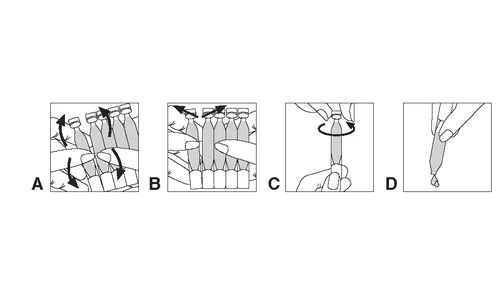
- Bend the single-dose container in both directions (see figure A).
- Separate the single-dose container from the strip (see figure B).
- Turn the cap counterclockwise as shown in figure C.
- Gently press the container to dispense the prescribed amount of medication (see figure D). For the 5 ml dose, drink the entire contents of the single-dose container. If a partial dose is required, use the dosing spoon provided in the package to measure 1.25 ml, 2.5 ml, or 3.75 ml (see figure E).
- After administering a partial dose, the opened container must be discarded.
E
Use in children
For the treatment of acute asthma attacks, the paediatrician may prescribe:
- For children under 2 years of age: 10 mg per day for up to three days.
- For children from 2 to 5 years of age: 20 mg per day. For treatment, a maximum duration of three days is usually sufficient, but the doctor will decide the treatment duration based on the number of days considered necessary.
- For children over 5 years of age: 30 mg per day or more (up to 40 mg per day). Since opening multiple containers on the same day may lead to dosing errors, consult the paediatrician if a daily dose exceeding 30 mg has been prescribed, as another pharmaceutical form of prednisolone (e.g. high-dose tablets) might be more appropriate.
If you feel the effect of this medicine is too strong or too weak, consult your doctor
or pharmacist.
If you take more Sintredius than you should
If you have taken more Sintredius than prescribed, contact immediately your doctor or the nearest hospital emergency department. Take this leaflet and/or the packaging with you to show the doctor what you have taken.
If you forget to take Sintredius
If you forget to take Sintredius, take the missed dose as soon as you remember, unless it is almost time for your next dose. Do not take a double dose to make up for the forgotten dose.
If you stop taking Sintredius
Consult your doctor if you wish to stop taking the oral solution: your doctor may consider it necessary to gradually reduce the dose.
Do not stop taking the oral solution unless instructed by your doctor, even if you feel better, because your condition could worsen. If you stop taking the oral solution suddenly, you may develop withdrawal symptoms such as fever, nausea, muscle and joint pain, runny nose, painful, red and sticky eyes (conjunctivitis), itching, and weight loss.
If you have any questions about the use of this medicine, consult your doctor or pharmacist.
4. Possible side effects
Like all medicines, this medicine can cause side effects, although not everybody will experience them.
Steroids, including prednisolone, may cause serious mental health problems, such as those listed below. These are common in both adults and children. If you notice any of these problems, contact your doctor immediately:
- Feelings of depression, including suicidal thoughts.
- Feelings of euphoria (mania) or mood swings.
- Feelings of anxiety, sleep disturbances, difficulty thinking or confusion, and memory loss.
- Hearing, seeing, or feeling things that are not real (hallucinations). Having strange or frightening thoughts, changes in behaviour, or feelings of isolation.
The following side effects may be signs of an allergic reaction. If you experience any of the
following symptoms, stop taking Sintredius and contact your doctor immediately:
- Itching or skin rash;
- Swelling of the face, lips, or throat;
- Difficulty breathing or shortness of breath.
If steroids are administered at high doses for a prolonged period, the following side effects may occur:
- General feeling of being unwell;
- Nausea;
- Hiccups;
- Digestive problems or stomach discomfort;
- Gastric ulcer (which may perforate and bleed) or oesophageal ulcer;
- Oral thrush;
- Inflammation of the pancreas (pancreatitis) causing abdominal pain;
- Muscle weakness;
- Muscle pain;
- Loss of bone density increasing the risk of fractures (osteopor0sis);
- Tendon damage;
- Joint stiffness causing limited movement, pain, and muscle spasms;
- Fluid retention leading to swelling;
- Feeling of dehydration;
- High blood pressure (hypertension);
- Slowed wound healing, thinning of the skin, easy bruising, acne, stretch mark-like lesions;
- Appearance of small red, purpuric, or bluish spots on the skin surface (caused by blood vessels beneath the skin);
- Reduced adrenal gland function;
- Slowed growth in infants, children, and adolescents;
- Irregularities or interruption of the menstrual cycle;
- Puffy, rounded face (Cushingoid facies or "moon face");
- Excessive hair growth;
- Increased appetite and weight gain;
- Carbohydrate intolerance;
- Mood changes, dependence, depression, sleep disturbances, worsening of schizophrenia;
- Severe headaches with blurred vision or temporary visual problems in children (usually after discontinuation of treatment);
- Worsening of epilepsy;
- Increased internal eye pressure (glaucoma), cataract, thinning and inflammation of the cornea (a part of the eye), worsening of viral or fungal eye infections, blurred vision and visual impairment, choroid and retinal disorders (chorioretinopathy);
- Heart attack (sudden, severe chest pain);
- Changes in the body's chemical parameters;
- Increased number of white blood cells in the blood;
- Blood clot formation;
- Porphyria;
- Stevens-Johnson syndrome;
- Prolonged use of high-dose steroids may lead to weakening of the immune system, which in turn may increase the risk of worsening of the underlying condition (malignant disease).
Scleroderma renal crisis in patients already affected by scleroderma (an autoimmune disease). Signs of scleroderma renal crisis include increased blood pressure and reduced urine output.
Kaposi's sarcoma (a type of tumour) has also been reported in patients receiving corticosteroid therapy. However, this condition may resolve once treatment is discontinued.
This medicine may increase susceptibility to infections, which very rarely can be fatal. Infections such as chickenpox and measles may present in a more severe form, or tuberculosis (TB) may reactivate.
Reporting of side effects
If you experience any side effect, including those not listed in this leaflet, talk to your doctor or pharmacist. You can also report side effects directly via the national reporting system at: www.agenziafarmaco.gov.it/content/come-segnalare-una-sospetta-reazione-avversa.
By reporting side effects, you can help provide more information on the safety of this medicine.
5. How to store Sintredius
Keep this medicine out of the sight and reach of children.
Store the oral solution in a safe place at a temperature below 30 °C. Keep the medicine in its original
packaging.
Do not use this medicine after the expiry date stated on the carton after "Exp". The expiry date refers to the
last day of that month.
Once opened: when administering partial doses, the opened container must be discarded immediately after the
required dose has been withdrawn.
Do not dispose of any medicine via wastewater or household waste. Ask your pharmacist how to dispose of
medicines no longer in use. This will help protect the environment.
6. Package contents and other information
What Sintredius contains
- The active substance is prednisolone (as sodium phosphate). One (1) ml of oral solution contains 1 mg of prednisolone (as sodium phosphate).
- The other components are: sucrose, glycerol, edetate sodium (EDTA), anhydrous disodium phosphate, monosodium dihydrogen phosphate monohydrate, vanilla/cream flavour, honey flavour, masking flavour, water for injections.
Description of the appearance of Sintredius and contents of the pack
Sintredius is a homogeneous, clear, light brown solution.
It is available in monodose containers made of polyethylene. One container holds 5 ml of oral solution. The containers are grouped in strips of five. Each strip is packaged in a pouch made of PET/Al/PE. Each box contains two pouches (for a total of ten single doses), one dosing spoon (with markings at 1.25 ml, 2.5 ml, and 3.75 ml corresponding to partial doses), and a patient leaflet.
Pack size: 10 monodose containers.
Marketing Authorization Holder
Dompé farmaceutici S.p.A.
Via San Martino 12
20122 Milano - Italy
Manufacturer
GENETIC SpA - Contrada Canfora - Nucleo Industriale 84084 Fisciano - Salerno (Italy)