Sevendoc
ItalyInstructions for Use
PACKAGE LEAFLET
Package leaflet: Information for the user
SEVENDOC 1 mg/ml + 5 mg/ml
eye drops, solution
dexamethasone / levofloxacin
Please read this entire leaflet carefully before using this medicine, because it contains important information for you.
- Keep this leaflet. You may need to read it again.
- If you have any questions, ask your doctor or pharmacist.
- This medicine has been prescribed for you only. Do not give it to other people, even if their symptoms are the same as yours, because it could be harmful.
- If you experience any side effect, including those not listed in this leaflet, talk to your doctor or pharmacist. See section 4.
Contents of this leaflet
- What SEVENDOC is and what it is used for
- What you need to know before using SEVENDOC
- How to use SEVENDOC
- Possible side effects
- How to store SEVENDOC
- Contents of the pack and other information
1. What SEVENDOC is and what it is used for
What type of medicine it is and how it works
SEVENDOC is an ophthalmic solution containing levofloxacin and dexamethasone.
Levofloxacin is an antibiotic belonging to the class of fluoroquinolones (also referred to, for short, as quinolones). This antibiotic works by killing certain types of bacteria that can cause infections.
Dexamethasone is a corticosteroid that has an anti-inflammatory action (suppressing symptoms such as pain, heat, swelling, and redness).
What this medicine is used for
SEVENDOC is used to prevent and treat inflammation and to prevent possible eye infections following cataract surgery.
2. What you need to know before using SEVENDOC
Do not use SEVENDOC:
- if you are allergic to levofloxacin (or other quinolones) or to dexamethasone (or other corticosteroids) or to any of the other ingredients of this medicine (listed in section 6).
- if you have an eye infection that you are not treating with medication, including viral infections (e.g. herpes simplex, keratitis, or varicella), fungal infections, or tuberculosis of the eye. Your eye may be infected if it has sticky discharge or is red and has not been examined by a doctor.
Warnings and precautions
Talk to your doctor before using SEVENDOC:
- If you are using other antibiotics, including oral antibiotics. Like other anti-infective agents, prolonged use may lead to antibiotic resistance and overgrowth of pathogenic microorganisms.
- If you have high intraocular pressure or have previously experienced it after using a steroid eye medication. Using SEVENDOC may cause this problem to recur. If you have high intraocular pressure, inform your doctor.
- If you have glaucoma.
- If you have visual disturbances or blurred vision.
- If you are using NSAIDs (Non-Steroidal Anti-Inflammatory Drugs), read the section “Other medicines and SEVENDOC”.
- If you have conditions causing thinning of the eye tissues, as prolonged steroid treatment may lead to further thinning and possible perforation.
- If you have diabetes.
Important information if you wear contact lenses
After cataract surgery, you must not wear contact lenses throughout the duration of treatment with SEVENDOC.
Children and adolescents
SEVENDOC is not recommended in children and adolescents under 18 years of age due to lack of safety and efficacy data in this age group.
Other medicines and SEVENDOC
Inform your doctor or pharmacist:
- if you are taking, have recently taken, or might take any other medicines, including those not requiring a prescription.
- if, before using SEVENDOC, you were already using any other type of eye drops or eye ointment (see section 3 - How to use SEVENDOC).
- if you are using NSAIDs for the eyes (used to treat pain and inflammation), such as ketorolac, diclofenac, bromfenac, and nepafenac. The concomitant use of NSAIDs and steroid eye medications may increase the risk of poor eye healing.
- if you are taking ritonavir or cobicistat (used in the treatment of HIV), as they may increase the level of dexamethasone in the blood.
- if you are taking probenecid (for gout), cimetidine (for gastric ulcer), or cyclosporine (to prevent transplant rejection), as they may alter the absorption and metabolism of levofloxacin.
Pregnancy and breastfeeding
If you are pregnant, think you might be pregnant, planning to become pregnant, or are breastfeeding, ask your doctor or pharmacist for advice before using this medicine.
SEVENDOC must not be used during pregnancy or breastfeeding.
Driving and using machines
After using this medicine, you may experience temporary blurred vision. If this occurs, you must not drive or operate machinery until this symptom has resolved.
SEVENDOC contains phosphate buffer
This medicine contains 4.01 mg of phosphates per ml, equivalent to 0.12 mg per drop. If you have severe damage to the outermost transparent layer of the eye (the cornea), phosphates may very rarely cause calcium deposits leading to cloudy spots on the cornea during treatment.
Inform your doctor, who may recommend a phosphate-free treatment.
SEVENDOC contains benzalkonium chloride
This medicine contains 0.05 mg of benzalkonium chloride per ml, equivalent to 0.0015 mg per drop.
Benzalkonium chloride may also cause eye irritation, especially if you have dry eyes or corneal disorders (the outermost transparent layer of the eye). If you experience an abnormal sensation in the eye, such as burning or pain after using this medicine, speak to your doctor.
3. How to use SEVENDOC
Use this medicine exactly as instructed by your doctor or pharmacist. If you have
any doubts, consult your doctor or pharmacist.
The recommended dose is 1 drop in the affected eye every 6 hours. The maximum dose is 4 drops per day.
The treatment course with SEVENDOC is usually 7 days, followed, if deemed necessary by your doctor, by another 7 days of treatment with a steroid eye drop.
Your doctor will determine the duration of treatment.
If you are using other eye drops or ophthalmic ointments, you must wait at least 15 minutes between each application. Ophthalmic ointments should be applied last.
Instructions for use:
If possible, ask another person to administer the drops for you. Ask this person to read the instructions together with you before administration.
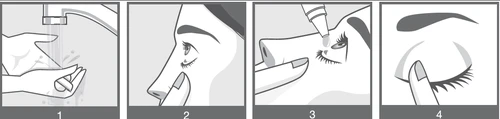
- Wash your hands thoroughly (Figure 1).
- Open the bottle. Remove the security ring, which detaches from the cap upon first opening of the bottle.
The dropper tip must not touch the eye, the area around the eye, or your fingers. - Unscrew the bottle cap. Hold the bottle upside down, gripping it between your thumb and the other fingers.
- Pull down the lower eyelid with one finger to create a "pocket" between the eyelid and the eye. The drop should be instilled into this pocket (Figure 2).
- Tilt your head backward and bring the dropper tip close to the eye. Gently press the center of the bottle until one drop falls into the eye (Figure 3). Note that it may take a few seconds between pressing the bottle and the drop coming out. Do not squeeze too hard.
- After applying SEVENDOC, press with one finger on the inner corner of the eye near the nose. This will prevent the medicine from spreading into the rest of the body (Figure 4).
If a drop misses the eye, try again. Immediately after use, screw the cap back on tightly.
If you use more SEVENDOC than you should
If you have applied an excessive amount of medicine, rinse the eye with lukewarm water.
If you forget to use SEVENDOC
If you forget to use this medicine, do not worry—apply it as soon as possible. Do not apply a double dose to make up for the missed dose.
If you stop using SEVENDOC
If you stop treatment with this medicine earlier than planned, inform your doctor. If you have any doubts about how to use this medicine, consult your doctor or pharmacist.
4. Possible side effects
Like all medicines, this medicine can cause side effects, although not everybody gets them. These are mostly non-serious side effects affecting only the eye.
- Very rarely, this medicine may cause severe allergic reactions (anaphylactic reactions), accompanied by swelling and a feeling of tightness in the throat and breathing difficulties.
- Stop using SEVENDOC and contact your doctor immediately if you experience any of these symptoms.
- Oral or intravenous administration of fluoroquinolones may cause swelling and rupture of tendons, particularly in elderly patients and in those being treated concomitantly with corticosteroids. Stop using SEVENDOC if you experience tendon pain or swelling (tendinitis).
One or more of the following effects affecting one or both eyes may also occur:
Very common (may affect more than 1 in 10 people):
- increased intraocular pressure.
Common (may affect up to 1 in 10 people):
- eye discomfort, stinging pain or irritation, burning, itching,
- blurred or reduced vision,
- presence of mucus in the eye.
Uncommon (may affect up to 1 in 100 people):
- delayed healing of corneal wounds,
- eye infections,
- abnormal sensation in the eye,
- increased tear production,
- dry and tired eyes,
- eye pain,
- increased brightness of vision,
- swelling or redness (bloodshot eyes) of the outer layer of the eye (conjunctiva),
- swelling or redness of the eyelid,
- light sensitivity,
- sticky eyelids.
Very rare (may affect up to 1 in 10,000 people):
- pupil dilation,
- drooping of the eyelid,
- calcium deposits on the surface of the eye (corneal calcification),
- tearing and sensation of sand in the eye (crystalline keratopathy),
- changes in the thickness of the superficial layer of the eye,
- ulcer on the surface of the eye,
- small holes on the surface of the eye (corneal perforation),
- swelling of the surface of the eye (corneal edema),
- inflammation of the eye causing pain and redness (uveitis).
Effects affecting other parts of the body may also occur:
Uncommon (may affect up to 1 in 100 people):
- headache,
- altered taste,
- itching,
- stuffy or runny nose.
Rare (may affect up to 1 in 1,000 people):
- allergic reactions such as skin rash.
Very rare (may affect up to 1 in 10,000 people):
- facial swelling.
Not known:
- reduced adrenal gland function, which may present as low blood sugar levels, dehydration, weight loss, and confusion.
- Hormonal problems: increased body hair growth (especially in women), muscle weakness and atrophy, purple stretch marks on the skin, increased blood pressure, irregular or absent menstrual cycle, changes in protein and calcium levels in the body, delayed growth in children and adolescents, and swelling and weight gain of the body and face (called “Cushing's syndrome”).
Reporting of side effects
If you experience any side effect, including those not listed in this leaflet, talk to your doctor or pharmacist. You can also report side effects directly via the national reporting system at: www.aifa.gov.it/content/segnalazioni-reazioni-avverse.
Reporting side effects may help provide more information on the safety of this medicine.
5. How to store SEVENDOC
Keep this medicine out of sight and reach of children.
Do not use this medicine after the expiry date stated on the bottle label and on the
carton after "Exp.". The expiry date refers to the last day of that month.
Do not use this medicine if, before opening a new bottle, you notice that the plastic seal
around the cap and neck of the bottle is damaged or missing.
Keep the bottle tightly closed. To avoid infection, discard the bottle and use a new one
28 days after first opening.
This medicine does not require any special storage conditions.
Do not dispose of any medicine via wastewater or household waste. Ask your pharmacist how to
dispose of medicines no longer in use. This will help protect the environment.
6. Package contents and other information
What SEVENDOC contains
- The active substances are levofloxacin, as hemihydrate, and dexamethasone, as sodium phosphate. Each millilitre of solution contains 5 mg of levofloxacin and 1 mg of dexamethasone.
- The other components are: monohydrate disodium dihydrogen phosphate, dodecahydrate disodium phosphate, sodium citrate, benzalkonium chloride, sodium hydroxide and hydrochloric acid (for pH adjustment), water for injections.
Description of the appearance of SEVENDOC and contents of the package
SEVENDOC is a clear, pale yellow-green solution, practically free from particles, although the dispensed drop appears transparent and colourless. It is supplied in a pack containing a 5 ml plastic bottle with a white dropper. The plastic bottle is closed with a screw cap.
Marketing Authorisation Holder and Manufacturer:
Marketing Authorisation Holder
DOC Generici S.r.l.
Via Turati 40
20121 Milan
Italy
Manufacturer
Tubilux Pharma S.p.A.
Via Costarica, 20/22,
00040 Pomezia (Rome)
Italy
This medicinal product is authorised in the Member States of the European Economic Area under the following names:
| Germany, Italy. | SEVENDOC 1 mg/ml + 5 mg/ml |
Similar Medications
-
Combitimor
Form: solution, eye
Active substance Dosage TOBRAMYCIN — Dexamethasone Sodium Phosphate — Manufacturer: FIDIA FARMACEUTICI S.P.A.
-
Ducressa
Form: solution, eye
Active substance Dosage DESAMETHASONE — LEVOFLOXACIN — Manufacturer: SANTEN OY
-
Galminor
Form: solution, eye
Active substance Dosage Dexamethasone Sodium Phosphate — NETILMICIN SULFATE — Manufacturer: GENETIC S.P.A.
-
Ipokima
Form: solution, eye
Active substance Dosage NETILMICIN SULFATE — DESAMETHASONE — Manufacturer: DOC GENERICI SRL
-
Leviosa
Form: solution, eye
Active substance Dosage DEXAMETHASONE — LEVOFLOXACIN — Manufacturer: NTC S.R.L.
-
Netildex
Form: solution, eye
Active substance Dosage DESAMETHASONE — NETILMICIN — Manufacturer: SIFI S.P.A.
-
Slaner
Form: solution, eye
Active substance Dosage DESAMETHASONE — NETILMICIN — Manufacturer: GENETIC S.P.A.
-
Trigon
Form: solution, eye
Active substance Dosage DESAMETHASONE — TOBRAMYCIN — Manufacturer: I.B.N. SAVIO S.R.L
-
Vardamir
Form: solution, eye
Active substance Dosage DESAMETHASONE — TOBRAMYCIN — Manufacturer: OMIKRON ITALIA S.R.L.
-
Visucombidex
Form: solution, eye
Active substance Dosage TOBRAMYCIN — Dexamethasone Sodium Phosphate — Manufacturer: VISUFARMA S.P.A.
This page has been machine-translated and may contain inaccuracies. The original data is available in the manufacturing country's language.
Last data check: May 11, 2026 · Data source: Agenzia Italiana del Farmaco (AIFA)