Sevelamer Sandoz
Italy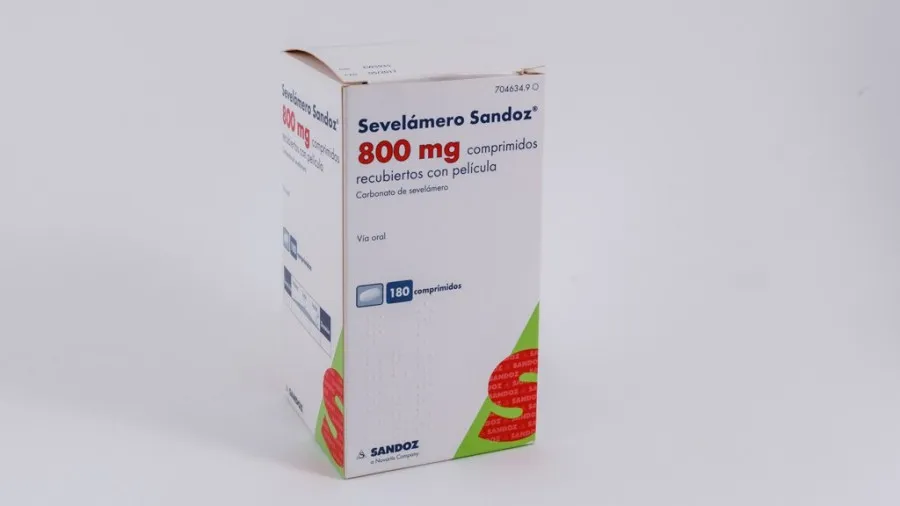
Table of Contents
- Package leaflet: Information for the user
- Sevelamer Sandoz 800 mg film-coated tablets
- 1. What Sevelamer Sandoz is and what it is used for
- 2. What you need to know before taking Sevelamer Sandoz
- 3. How to take Sevelamer Sandoz
- 4. Possible side effects
- 5. How to store Sevelamer Sandoz
- 6. Package contents and other information
Package leaflet: Information for the user
Sevelamer Sandoz 800 mg film-coated tablets
Sevelamer carbonate
Please read this leaflet carefully before taking this medicine because it contains important information for you.
- Keep this leaflet. You may need to read it again.
- If you have any questions, ask your doctor or pharmacist.
- This medicine has been prescribed for you only. Do not give it to other people, even if they have the same symptoms as you, because it may be harmful.
- If you experience any side effects, including those not listed in this leaflet, tell your doctor. See section 4.
Contents of this leaflet
- What Sevelamer Sandoz is and what it is used for
- What you need to know before taking Sevelamer Sandoz
- How to take Sevelamer Sandoz
- Possible side effects
- How to store Sevelamer Sandoz
- Contents of the pack and other information
1. What Sevelamer Sandoz is and what it is used for
Sevelamer Sandoz contains sevelamer carbonate as the active substance. This binds phosphate
from food within the digestive tract, thereby reducing serum phosphate levels in the blood.
Sevelamer Sandoz is used to control hyperphosphataemia (high levels of phosphates in the blood) in:
- adult patients on dialysis (a blood purification technique). It can be used in patients undergoing haemodialysis (using a blood filtration machine) or peritoneal dialysis (fluid is pumped into the abdomen and an internal membrane filters the blood);
- patients with chronic kidney disease (long-term) who are not on dialysis and who have serum phosphate levels (in the blood) equal to or greater than 1.78 mmol/l. Sevelamer Sandoz should be used together with other treatments such as calcium supplements and vitamin D to prevent the development of bone disease.
Elevated serum phosphate levels can cause hard deposits in the body, known as calcifications. These deposits can stiffen blood vessels and make it more difficult for blood to be pumped throughout the body. Increased serum phosphate levels may also lead to itching, red eyes, bone pain and fractures.
2. What you need to know before taking Sevelamer Sandoz
Do not take Sevelamer Sandoz if:
- you have low levels of phosphate in the blood (your doctor will check this).
- you have intestinal obstruction.
- you are allergic to sevelamer carbonate or to any of the other ingredients of this medicine (listed in section 6).
Warnings and precautions
Talk to your doctor before taking Sevelamer Sandoz if any of the following apply to you:
- problems with swallowing.
- problems with motility (movement) in the stomach and intestines.
- frequent vomiting.
1/5
- active inflammation of the intestine.
- you have undergone major surgical procedures on the stomach or intestines.
- you have a severe inflammatory bowel disease.
Additional treatments:
Due to your kidney problems or dialysis treatment, you might:
- develop low or high levels of calcium in the blood. Since sevelamer carbonate does not contain calcium, your doctor may prescribe additional calcium tablets.
- have low levels of vitamin D in the blood. Therefore, your doctor may monitor your vitamin D levels and prescribe additional vitamin D as needed. If you are not taking multivitamin supplements, you might also develop low levels of vitamin A, E, K, and folic acid in the blood, and therefore your doctor may monitor these levels and prescribe vitamin supplements as needed.
Special note for patients undergoing peritoneal dialysis:
You may develop peritonitis (infection of the abdominal fluid) related to peritoneal dialysis.
This risk can be reduced by using strict aseptic techniques when changing bags. You must inform your doctor immediately if you experience new signs or symptoms of
abdominal pain, abdominal distension, abdominal tenderness, abdominal rigidity, constipation, fever, chills, nausea, or vomiting. You should expect more careful monitoring if problems related to low levels of vitamin A, D, E, K, and folic acid occur.
Children
The safety and efficacy in children (under 6 years of age) have not been established. Therefore, the use of Sevelamer Sandoz is not recommended in children under 6 years of age.
Other medicines and Sevelamer Sandoz
Tell your doctor if you are taking, have recently taken, or might take any other medicines.
Sevelamer Sandoz must not be taken at the same time as ciprofloxacin (an antibiotic).
If you are taking medicines for heart rhythm disorders or for epilepsy, you should consult your doctor when taking Sevelamer Sandoz.
Sevelamer Sandoz may reduce the effects of medicines such as cyclosporine, mycophenolate mofetil, and tacrolimus (medicines used to suppress the immune system). Your doctor will advise you on what to do if you are taking these medicines.
In rare cases, in some individuals taking levothyroxine (used to treat low thyroid hormone levels) and Sevelamer Sandoz, a deficiency of thyroid hormones has been observed. Therefore, your doctor may monitor your thyroid-stimulating hormone levels more closely.
If you are taking medicines to treat heartburn, gastroesophageal reflux disease (GERD), or gastric ulcer, such as omeprazole, pantoprazole, or lansoprazole, consult your doctor when taking Sevelamer Sandoz.
Your doctor will regularly check for possible interactions between Sevelamer Sandoz and other medicines.
In some cases, when Sevelamer Sandoz must be taken at the same time as another medicine, your doctor may advise you to take that medicine 1 hour before or 3 hours after taking Sevelamer Sandoz, or may consider monitoring blood levels of that medicine.
2/5
Pregnancy and breastfeeding
If you are pregnant, think you may be pregnant, planning to become pregnant, or breastfeeding, ask your doctor for advice before taking this medicine. It is not known whether Sevelamer Sandoz has effects on the fetus.
Inform your doctor if you intend to breastfeed. It is not known whether Sevelamer Sandoz passes into breast milk and could affect the baby.
Driving and using machines
It is unlikely that Sevelamer Sandoz will affect your ability to drive or use machines.
Sevelamer Sandoz contains lactose
Sevelamer Sandoz contains lactose (a milk sugar). If your doctor has diagnosed you with an intolerance to certain sugars, contact him before taking this medicine.
If you have any further questions about the use of this medicine, consult your doctor or pharmacist.
3. How to take Sevelamer Sandoz
Always take this medicine exactly as instructed by your doctor. Contact your doctor if you
are unsure. Your doctor will base the dose on your serum phosphorus level.
The recommended starting dose of Sevelamer Sandoz tablets for adults and elderly patients (over 65
years) is one or two 800 mg tablets to be taken with each meal, three times a day.
The tablets must be swallowed whole. Do not crush, chew, or break the tablets.
Initially, your doctor will monitor your blood phosphorus levels every 2–4 weeks and may adjust
the dose of Sevelamer Sandoz, if necessary, to achieve an appropriate phosphate level.
Patients taking Sevelamer Sandoz must follow the prescribed diet.
If you take more Sevelamer Sandoz than you should
In the event of a possible overdose, contact your doctor immediately.
If you forget to take Sevelamer Sandoz
If you have forgotten a dose, skip it and take the next dose at the usual time with a meal. Do not
take a double dose to make up for a forgotten dose.
4. Possible side effects
Like all medicines, this medicine can cause side effects, although not everyone will experience them.
Since constipation may be an early symptom of intestinal obstruction, inform your doctor or pharmacist if it occurs.
The following side effects have been reported in patients taking Sevelamer Sandoz:
Very common (may affect more than 1 in 10 people):
vomiting • constipation • upper abdominal pain • nausea
Common (may affect up to 1 in 10 people):
diarrhoea • abdominal pain • indigestion • flatulence
3/5
Very rare (may affect up to 1 in 10,000 people):
hypersensitivity
Not known (frequency cannot be estimated from the available data):
cases of itching, skin rash, slow intestinal motility, intestinal obstruction (signs include: severe bloating; abdominal pain, swelling or cramps; severe constipation), intestinal wall rupture (signs include: severe stomach pain, chills, fever, nausea, vomiting, or abdominal pain), gastrointestinal bleeding, inflammation of the large intestine, and crystal deposition in the intestine have been reported.
Reporting of side effects
If you experience any side effect, including those not listed in this leaflet, talk to your doctor, pharmacist, or nurse. You can also report side effects directly via the national reporting system at: https://www.aifa.gov.it/content/segnalazioni-reazioni-avverse. By reporting side effects, you can help provide more information on the safety of this medicine.
5. How to store Sevelamer Sandoz
Keep this medicine out of the sight and reach of children.
[for HDPE bottles without box]
Do not use this medicine after the expiry date stated on the bottle and the carton after
“Exp”. The expiry date refers to the last day of that month.
[for HDPE bottles with box]
Do not use this medicine after the expiry date stated on the bottle and the carton after
“Exp”. The expiry date refers to the last day of that month.
This medicine requires no special storage conditions.
Do not dispose of medicines via wastewater or household waste. Ask your pharmacist how to
dispose of medicines you no longer use. This will help protect the environment.
6. Package contents and other information
What Sevelamer Sandoz contains
- The active substance is sevelamer carbonate. Each film-coated tablet contains 800 mg of sevelamer carbonate.
- The other ingredients are monohydrate lactose, colloidal anhydrous silica, zinc stearate. The tablet coating contains hypromellose (E464) and monoglyceride diacetate.
Description of the appearance of Sevelamer Sandoz and package contents
Sevelamer Sandoz is presented as film-coated tablets, white to off-white in colour, oval-shaped, with the imprint 'SVL' on one side.
HDPE bottles with polypropylene caps. Each bottle contains 30, 60, 180, 200 or 210 tablets.
Packages containing 1, 2 or 3 bottles are available.
<[Only for bottles containing desiccant]:> The HDPE bottles contain a desiccant. Do not remove the desiccant from the bottle.
It is possible that not all pack sizes are marketed.
Marketing Authorization Holder
4/5
Sandoz S.p.A.
L.go U. Boccioni 1
21040 Origgio (VA)
Italy
Manufacturers
Synthon Hispania SL
Castello, 1
Poligono Las Salinas
08830 Sant Boi de Llobregat
Spain
Salutas Pharma GmbH
Otto-von-Guericke-Allee 1
39179 Barleben
Germany
This medicinal product is authorised in the European Economic Area countries under the following names:
Denmark Sevelamercarbonat “Sandoz”
Germany Sevelamercarbonat Hexal 800 mg Filmtabletten
Greece SEVELAMER/SANDOZ, 800 mg, επικαλυμμένα με λεπτό υμένιο δισκία
Italy Sevelamer Sandoz
5/5