Selexipag EG
Italy
Table of Contents
- Package leaflet: Information for the user
- Selexipag EG 200 microgram tablets, 400 microgram tablets, 600 microgram tablets, 800 microgram tablets, 1,000 microgram tablets, 1,200 microgram tablets, 1,400 microgram tablets, 1,600 microgram tablets (film-coated tablets)
- 1. What Selexipag EG is and what it is used for
- 2. What you need to know before taking Selexipag EG
- 3. How to take Selexipag EG
- 4. Possible side effects
- 5. How to store Selexipag EG
- 6. Package contents and other information
Package leaflet: Information for the user
Selexipag EG 200 microgram tablets, 400 microgram tablets, 600 microgram tablets, 800 microgram tablets, 1,000 microgram tablets, 1,200 microgram tablets, 1,400 microgram tablets, 1,600 microgram tablets (film-coated tablets)
Generic medicine
- Read this leaflet carefully before taking this medicine because it contains important information for you.
- Keep this leaflet. You may need to read it again.
- If you have any questions, ask your doctor or nurse.
- This medicine has been prescribed for you only. Do not give it to other people, even if they have the same symptoms as you, because it may be harmful.
- If you experience any side effects, including those not listed in this leaflet, contact your doctor or nurse. See section 4.
Contents of this leaflet
- What Selexipag EG is and what it is used for
- What you need to know before taking Selexipag EG
- How to take Selexipag EG
- Possible side effects
- How to store Selexipag EG
- Contents of the pack and other information
1. What Selexipag EG is and what it is used for
similar to the natural substance prostacyclin, causing them to relax and widen.
Selexipag EG is used for the long-term treatment of pulmonary arterial hypertension (PAH)
in adult patients who are inadequately controlled with other PAH medications known as
endothelin receptor antagonists and type 5 phosphodiesterase inhibitors. Selexipag EG may be
used alone if the patient cannot take these medications.
PAH is characterized by high blood pressure in the blood vessels that carry blood from the heart to the
lungs (the pulmonary arteries). In people with PAH, these arteries become narrowed, making it harder for the
heart to pump blood through them. This leads to symptoms such as fatigue, dizziness, shortness of breath, or other
symptoms.
By acting similarly to the natural substance prostacyclin, this medicine widens the pulmonary arteries and
reduces their stiffness, making it easier for the heart to pump blood through the pulmonary arteries.
Selexipag EG reduces blood pressure in the pulmonary arteries, relieves PAH symptoms, and
slows the progression of the disease.
2. What you need to know before taking Selexipag EG
Do not take Selexipag EG:
- if you are allergic to selexipag or any of the other ingredients of this medicine (listed in section 6);
- if you have heart problems such as:
- inadequate blood flow to the heart (severe coronary artery disease or unstable angina); symptoms may include chest pain;
- a heart attack within the last 6 months;
- heart failure (cardiac decompensation) that is not under close medical supervision;
- severely irregular heart rate;
- a heart valve defect (congenital or acquired) causing inadequate heart function (not due to pulmonary hypertension);
- if you have had a stroke within the last 3 months, or any other event that reduced oxygen supply to the brain (e.g., transient ischemic attack);
- if you are taking gemfibrozil (a medicine used to lower blood fat [lipid] levels).
Warnings and precautions
Talk to your doctor or nurse before taking Selexipag EG if:
- you are taking medicines for high blood pressure;
- you have low blood pressure associated with symptoms such as dizziness;
- you have recently experienced significant blood loss or fluid loss, such as with severe diarrhoea or vomiting;
- you have thyroid gland problems;
- you have severe kidney problems or are undergoing dialysis;
- you have or have had severe liver function problems.
If you notice any of these signs or a change in your condition, tell your doctor immediately.
Children and adolescents
Do not give this medicine to children under 18 years of age.
Elderly patients
Experience with Selexipag EG in patients over 75 years of age is limited. Selexipag EG should be used with caution in this patient group.
Other medicines and Selexipag EG
Tell your doctor if you are taking, have recently taken, or might take any other medicines.
Tell your PAH specialist or nurse if you are taking any of the following medicines:
- Gemfibrozil (a medicine used to lower blood fat [lipid] levels);
- Clopidogrel (a medicine used to inhibit blood clot formation in coronary artery disease);
- Deferasirox (a medicine used to remove iron from the bloodstream);
- Teriflunomide (a medicine used to treat relapsing-remitting multiple sclerosis);
- Carbamazepine (a medicine used to treat certain types of epilepsy, neuralgia, or to help control severe mood disorders when other medicines are ineffective);
- Phenytoin (a medicine used for epilepsy);
- Valproic acid (a medicine used for epilepsy);
- Probenecid (a medicine used for gout);
- Fluconazole, rifampicin or rifapentine (antibiotics used to treat infections).
Pregnancy and breastfeeding
The use of Selexipag EG is not recommended during pregnancy and breastfeeding. If you are a woman of childbearing age, you must use an effective method of contraception during treatment with Selexipag EG. If you are pregnant, suspect you may be pregnant, planning to become pregnant, or are breastfeeding, consult your doctor before taking this medicine.
Driving and using machines
Selexipag EG may cause side effects such as headache and low blood pressure (see section 4), which could affect your ability to drive. In addition, symptoms of your disease may also reduce your ability to drive safely.
3. How to take Selexipag EG
Selexipag EG may only be prescribed by a physician experienced in the treatment of pulmonary arterial
hypertension. Take this medicine exactly as instructed by your doctor. If you have any doubts, consult your
doctor.
Inform your doctor if you experience any adverse effects, as they may recommend adjusting your dose of
Selexipag EG.
Inform your doctor if you have liver problems or are taking other medicines, as they may recommend that
you take a lower dose of Selexipag EG twice daily or only once daily.
If you have vision problems or any form of blindness, always have someone assist you when taking Selexipag
EG during the titration period (the process of gradually increasing the dose).
Finding the right dose for you
If your doctor prescribes the 200 microgram tablets
At the beginning of treatment, most patients will take one tablet of 200 micrograms in the morning and
another 200 microgram tablet in the evening, approximately 12 hours apart. Starting treatment in the
evening is recommended. Your doctor will instruct you on how to gradually increase the dose. This
procedure is called titration and allows your body to adapt to the new medicine.
The goal of titration is to reach the most appropriate dose—the highest dose you can tolerate—up to a
maximum of 1,600 micrograms in the morning and 1,600 micrograms in the evening.
The first pack you receive will contain light yellow tablets of 200 micrograms. Your doctor will instruct you to
increase the dose step by step, usually every week, although the interval between dose increases may be
longer.
At each increase, you will add one 200 microgram tablet to your morning dose and another 200 microgram
tablet to your evening dose. It is recommended to take the first increased dose in the evening. The
diagram below shows the number of tablets to take each morning and each evening for the first 4
stages.
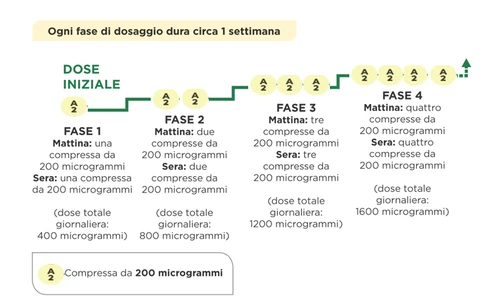
If your doctor instructs you to further increase the dose, you will add one 200 microgram tablet to the
morning dose and one 200 microgram tablet to the evening dose at each new stage. It is recommended to
take the first increased dose in the evening.
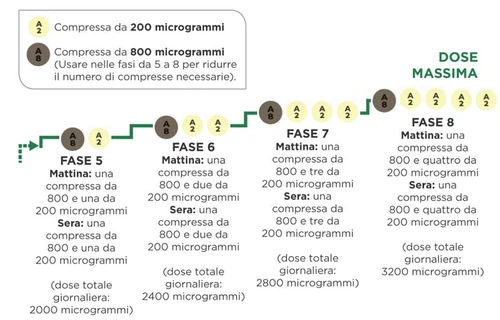
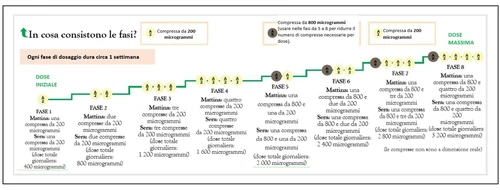
If your doctor instructs you to further increase the dose and move to stage 5, this can be achieved by taking
one brown 800 microgram tablet and one light yellow 200 microgram tablet in the morning, and one 800
microgram tablet and one 200 microgram tablet in the evening.
The maximum dose of Selexipag EG is 1,600 micrograms in the morning and 1,600 micrograms in the
evening. However, not all patients will reach this dose, as different patients may require different doses.
The diagram below shows the number of tablets to take each morning and each evening at each stage from
stage 5 onwards.
If your doctor prescribes the 100 microgram tablets
This medicine is not available in the 100 microgram strength; therefore, if this dose is required, other
medicines available on the market must be used.
Using the titration guide during gradual dose escalation
You will receive a titration pack containing a titration guide and the patient leaflet. The titration guide
provides information on the titration process and allows you to record the number of tablets you take each
day.
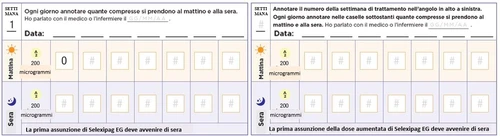
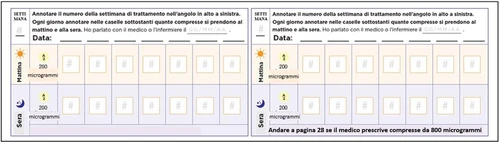
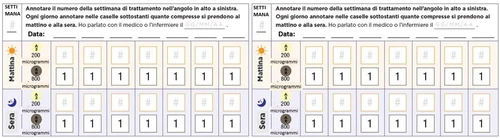
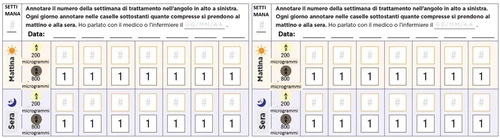
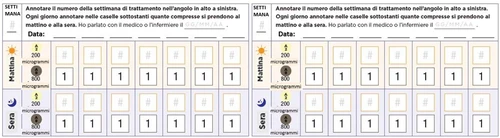
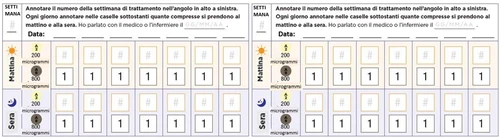
Remember to record the number of tablets you take each day in the titration diary. Titration stages usually
last about 1 week. If your doctor advises extending each titration stage beyond 1 week, additional pages of
the diary are available to help you keep track. Remember to speak regularly with your PAH specialist or
nurse during titration.
Reducing to a lower dose due to adverse effects
During titration, you may experience adverse effects such as headache, diarrhoea, feeling unwell (nausea),
being unwell (vomiting), jaw pain, muscle pain, leg pain, joint pain, or facial flushing (see section 4). If you
find these adverse effects difficult to tolerate, consult your doctor on how to manage or treat them. Various
treatments are available that may help relieve these side effects. For example, painkillers such as
paracetamol may help treat pain and headache.
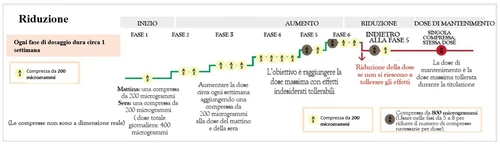
If these adverse effects cannot be managed or do not gradually improve at your current dose, your doctor
may adjust the dose by removing one light yellow tablet from the morning dose and one light yellow tablet
from the evening dose. The diagram below shows the stages for reducing the dose. Do this only if instructed
by your doctor.
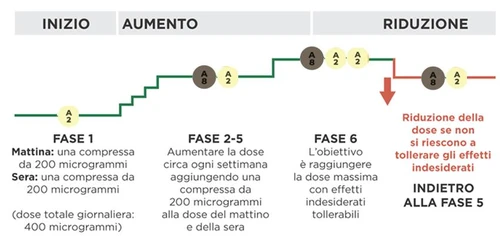
If, after reducing the dose, the adverse effects become manageable, your doctor may decide not to make
further dose adjustments. For more information, see the section below “Maintenance dose”.
Maintenance dose
The highest dose tolerated during titration will become your maintenance dose. The maintenance dose is
the dose you should continue taking regularly.
Your doctor will prescribe the tablet strength appropriate for your maintenance dose. This may allow you
to take just one tablet in the morning and one in the evening, instead of taking multiple tablets at the same
time.
For a complete description of Selexipag EG tablets, including their colours and markings, refer to section 6 of
this leaflet.
Over time, your doctor may decide to adjust your maintenance dose if necessary.
If, at any time after taking the same dose for a long period, you experience adverse effects that you cannot
tolerate or that interfere with your normal daily activities, contact your doctor, as your dose may need to be
reduced. Your doctor may then prescribe a lower dose. Remember to dispose of unused tablets properly (see
section 5).
Take Selexipag EG once in the morning and once in the evening, approximately 12 hours apart.
Take the tablets with food, as you may tolerate the medicine better this way. The tablet coating provides
protection. Swallow the tablets whole with a glass of water. Do not break or crush the tablets.
If you take more Selexipag EG than you should
If you have taken more tablets than instructed, seek advice from your doctor immediately.
If you forget to take Selexipag EG
If you forget to take Selexipag EG, take the dose as soon as you remember, then continue taking the
medicine at your usual times. If it is almost time for your next dose (within 6 hours before your next
scheduled dose), do not take the missed dose; instead, continue taking the medicine at your usual time. Do
not take a double dose to make up for a forgotten tablet.
If you stop taking Selexipag EG
Suddenly stopping treatment with Selexipag EG may lead to worsening of symptoms. Do not stop treatment
with Selexipag EG unless agreed with your doctor. Your doctor may instruct you to gradually reduce the
dose before completely stopping treatment.
If, for any reason, you stop taking Selexipag EG for more than 3 consecutive days (e.g., if you miss the dose
for 3 consecutive mornings and 3 consecutive evenings, or 6 consecutive doses or more), contact your doctor
immediately, as your dose may need to be adjusted to avoid adverse effects. Your doctor may decide to
restart treatment at a lower dose, gradually increasing it until the previous maintenance dose is reached.
If you have any questions about the use of this medicine, speak to your doctor or nurse.
4. Possible side effects
Like all medicines, this medicine can cause side effects, although not everyone gets them. You may notice some side effects not only during the titration period, when the dose is being increased, but also after taking the same dose for long periods of time.
If you experience swelling of the face, lips, mouth, tongue or throat, which could cause difficulty in swallowing or breathing (angioedema), you must contact your doctor immediately.
If you experience any of the following side effects: headache, diarrhoea, feeling unwell (nausea), discomfort (vomiting), jaw pain, muscle pain, leg pain, joint pain or facial flushing, that you cannot tolerate or that cannot be managed, contact your doctor, as the dose you are taking may be too high for you and may need to be reduced.
Very common side effects (may affect more than 1 in 10 people)
- Headache
- Facial flushing
- Nausea and vomiting (feeling unwell and being unwell)
- Diarrhoea
- Jaw pain, muscle pain, joint pain, leg pain
- Nasopharyngitis (blocked nose)
Common side effects (may affect up to 1 in 10 people)
- Anaemia (reduced number of red blood cells in the blood)
- Hyperthyroidism (overactivity of the thyroid gland)
- Reduced appetite
- Weight loss
- Hypotension (low blood pressure)
- Stomach pain, including indigestion
- Pain
- Changes in certain blood test results, including red blood cell count or indicators of thyroid function
- Skin rashes, including urticaria, which may cause a burning or stinging sensation and redness of the skin
- Angioedema and related symptoms described at the beginning of this section
Uncommon side effects (may affect up to 1 in 100 people)
- Increased heart rate
Reporting of side effects
If you experience any side effect, including those not listed in this leaflet, consult your doctor. You may also report side effects directly via the national reporting system at https://www.aifa.gov.it/content/segnalazioni-reazioni-avverse. By reporting side effects, you can help provide more information on the safety of this medicine.
5. How to store Selexipag EG
Keep this medicine out of the sight and reach of children.
Do not use this medicine after the expiry date which is stated on the carton and blister after “Exp”. The
expiry date refers to the last day of that month.
Do not store the 200 and 400 microgram tablets above 30°C. The 600, 800, 1\ 000, 1\ 200, 1\ 400 and 1\ 600 microgram tablets do not require any special storage conditions.
Do not dispose of medicines via wastewater or household waste. Ask your pharmacist how to dispose of medicines you no longer use. This will help protect the environment.
6. Package contents and other information
What Selexipag EG contains
Selexipag EG 200 microgram film-coated tablets: each tablet contains 200 micrograms of
Selexipag EG 400 microgram film-coated tablets: each tablet contains 400 micrograms of
Selexipag EG 600 microgram film-coated tablets: each tablet contains 600 micrograms of
Selexipag EG 800 microgram film-coated tablets: each tablet contains 800 micrograms of
Selexipag EG 1 000 microgram film-coated tablets: each tablet contains 1 000 micrograms of
Selexipag EG 1 200 microgram film-coated tablets: each tablet contains 1 200 micrograms of
Selexipag EG 1 400 microgram film-coated tablets: each tablet contains 1 400 micrograms of
Selexipag EG 1 600 microgram film-coated tablets: each tablet contains 1 600 micrograms of
- The other components are: mannitol, maize starch, hydroxypropylcellulose, methacrylic acid-methyl methacrylate copolymer (1:1), magnesium stearate (tablet core); hypromellose, propylene glycol (E1520), titanium dioxide (E171), iron oxides (E172), carnauba wax (tablet coating). Selexipag EG 200 microgram film-coated tablets contain yellow iron oxide (E172). Selexipag EG 400 microgram film-coated tablets contain black and red iron oxides (E172). Selexipag EG 600 microgram film-coated tablets contain red iron oxide (E172). Selexipag EG 800 microgram film-coated tablets contain black, red and yellow iron oxides (E172). Selexipag EG 1 000 microgram film-coated tablets contain red iron oxide (E172). Selexipag EG 1 200 microgram film-coated tablets contain black and red iron oxides (E172). Selexipag EG 1 400 microgram film-coated tablets contain yellow iron oxide (E172). Selexipag EG 1 600 microgram film-coated tablets contain black, red and yellow iron oxides (E172).
Description of the appearance of Selexipag EG and contents of the pack
Selexipag EG 200 microgram film-coated tablets: film-coated, round tablets, light yellow in colour, with “A2” engraved on one side and smooth on the other. The tablets have a diameter of approximately 7 mm.
Selexipag EG 400 microgram film-coated tablets: film-coated, round tablets, purple in colour, with “A4” engraved on one side and smooth on the other. The tablets have a diameter of approximately 7 mm.
Selexipag EG 600 microgram film-coated tablets: film-coated, round tablets, red in colour, with “A6” engraved on one side and smooth on the other. The tablets have a diameter of approximately 7 mm.
Selexipag EG 800 microgram film-coated tablets: film-coated, round tablets, brown in colour, with “A8” engraved on one side and smooth on the other. The tablets have a diameter of approximately 5.5 mm.
Selexipag EG 1 000 microgram film-coated tablets: film-coated, round tablets, red in colour, with “A10” engraved on one side and smooth on the other. The tablets have a diameter of approximately 5.6 mm.
Selexipag EG 1 200 microgram film-coated tablets: film-coated, round tablets, purple in colour, with “A12” engraved on one side and smooth on the other. The tablets have a diameter of approximately 6.5 mm.
Selexipag EG 1 400 microgram film-coated tablets: film-coated, round tablets, light yellow in colour, with “A14” engraved on one side and smooth on the other. The tablets have a diameter of approximately 6.6 mm.
Selexipag EG 1 600 microgram film-coated tablets: film-coated, round tablets, brown in colour, with “A16” engraved on one side and smooth on the other. The tablets have a diameter of approximately 7 mm.
Selexipag EG 200 microgram film-coated tablets are supplied in blisters of 10 or 60 tablets and in packs of 60 or 140 tablets (titration packs).
Selexipag EG 400 microgram, 600 microgram, 800 microgram, 1 000 microgram, 1 200 microgram, 1 400 microgram, and 1 600 microgram film-coated tablets are supplied in blisters of 60 tablets.
Not all pack sizes may be marketed.
Marketing Authorisation Holder
EG S.p.A., via Pavia 6, 20136 Milano, Italy
Manufacturer
Synthon Hispania S.L., Calle De Castello 1, Sant Boi De Llobregat, Barcelona 08830 - Spain
Synthon B.V., Microweg 22, Nijmegen 6545 CM - The Netherlands
Synthon s.r.o., Brnenska 597/32, Blansko 678 01 - Czech Republic
This medicinal product is authorised in the European Economic Area (EEA) Member States under the following names:
DE Selexipag STADA 200, 400, 600, 800, 1000, 1200, 1400, 1600 microgram film-coated tablets
IT SELEXIPAG EG
NL Selexipag STADA 200, 400, 600, 800, 1.000, 1.200, 1.400, 1.600 microgram film-coated tablets
TITRATION GUIDE – TITRATION PACK
Page 1
Selexipag EG 200 microgram film-coated tablets
Guidance on gradual dose increase (titration)
Starting Treatment with Selexipag EG
Read the package leaflet before starting treatment. Inform your doctor if you experience any adverse reactions, as they may recommend adjusting your dose of Selexipag EG. Inform your doctor if you are taking other medicines, as they may recommend taking Selexipag EG once daily.
Page 2 Page 3
| Index How should you take Selexipag EG?........................4 How should you increase the dose?.................................6 What do the phases consist of?..........................................8 When should you decrease the dose?.............................10 Dose reduction............................................12 | Transition to maintenance dose..................14 If you forget to take Selexipag EG.................16 If you stop treatment with Selexipag EG.....17 Dose titration diary..........................................18 |
Page 4 Page 5
| How should you take Selexipag EG? Selexipag EG is a medicine taken twice daily, in the morning and evening, for the treatment of pulmonary arterial hypertension (PAH). The initial dose of Selexipag EG is 200 micrograms, one tablet in the morning and one in the evening. The first dose should be taken in the evening. You should take each dose with a glass of water, preferably during meals. | There are two phases of treatment with Selexipag EG: Titration During the first few weeks, you will work with your doctor to find the right dose of Selexipag EG for you. Your doctor may increase your initial dose to higher doses of Selexipag EG. Your doctor may also decrease your dose of Selexipag EG. This process is called "titration" and allows your body to gradually adapt to the medicine. Maintenance Once your doctor has determined the right dose for you, this will be the dose you will take regularly. This dose is called the "maintenance dose". |
Page 6 Page 7
| How should the dose be increased? You will start by taking a dose of 200 micrograms in the morning and evening. Only after discussing with your doctor or nurse will you increase the dose to the next level. The first intake of the increased dose should occur in the evening. Each step usually lasts about 1 week. It may take several weeks to find the right dose for you. | Every patient with AIP is different. Not everyone will have the same maintenance dose. Some patients may have a maintenance dose of 200 micrograms in the morning and evening, while others may reach the maximum dose of 1600 micrograms in the morning and evening. Others may reach an intermediate maintenance dose. The goal is to find the dose that is right for you. |
| The goal is to find the dose that is right for you. This dose will be your maintenance dose. |
Page 8 Page 9
Page 10 Page 11
| ↓ When should the dose be reduced? As with all medicines, side effects may occur with Selexipag EG as the dose is increased. Contact your doctor or nurse if you notice any side effects. Various treatments are available that may help relieve them. The most common side effects (which may affect more than 1 in 10 people) you may experience while taking Selexipag EG are: • Headache • Diarrhea • Nausea • Vomiting • Jaw pain • Muscle pain • Leg pain • Joint pain • Facial flushing For more information and a complete list of side effects, please read the package leaflet. | If you are unable to tolerate the side effects, even after treatment recommended by your doctor or nurse, they may advise you to reduce the dose. If your doctor or nurse recommends reducing the dose, you should take one 200 microgram tablet less in the morning and one less in the evening. Reduce the dose only after consulting your expert doctor in PAH or nurse. This dose reduction process will help you find the right dose for you, i.e. the maintenance dose. |
Page 12 Page 13
Page 14 Page 15
| Transition to maintenance dose The maximum tolerated dose during titration will become the maintenance dose. The maintenance dose is the dose you must continue taking regularly. Your doctor or nurse may prescribe a single tablet corresponding to the required maintenance dose. This allows you to take just one tablet in the morning and one in the evening, instead of taking multiple tablets for each dose. | For example, if the maximum tolerated dose during titration was 1200 micrograms in the morning and evening: Over time, your doctor or nurse may decide to adjust the maintenance dose as necessary.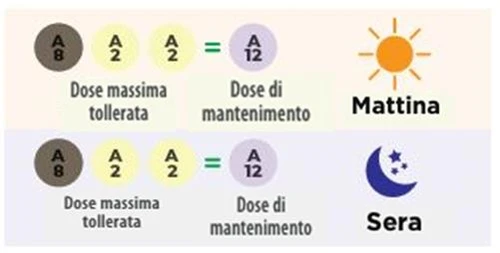 |
Page 16 Page 17
| If you forget to take Selexipag EG Take your dose as soon as you remember, then continue taking the tablets at your usual times. If this happens less than 6 hours before your next scheduled dose, do not take the missed dose and continue your treatment at the regular time. Do not take a double dose to make up for a forgotten dose. | If you stop taking Selexipag EG Do not stop treatment with Selexipag EG unless your doctor or nurse has told you to. If, for any reason, you stop taking Selexipag EG for more than 3 consecutive days (if you miss 6 consecutive doses), contact your PAH specialist doctor or nurse immediately, as your dose may need to be adjusted to avoid side effects. Your doctor or nurse may restart your treatment at a lower dose, gradually increasing it until the previous maintenance dose is reached. |
Page 18 Page 19
| Dosing Titration Diary Read carefully the instructions contained in the package leaflet. The following diary pages will help you keep track of the number of tablets you need to take in the morning and in the evening during the titration phase. Use these pages to record the number of tablets you take in the morning and in the evening. Each phase usually lasts 1 week, unless otherwise instructed by your doctor or nurse. Additional pages are available if your titration phases last longer than 1 week. | Remember to speak regularly with your IAP specialist doctor or nurse. Write here the instructions provided by your doctor or nurse: Doctor's office phone number or email: Pharmacist's phone number: |
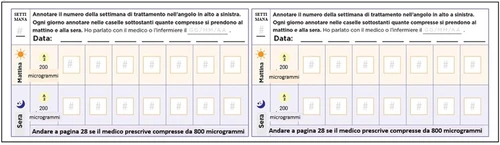
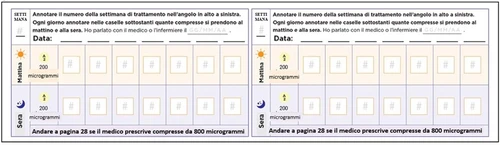
Use pages 20 to 27 to record the first weeks of treatment taking only 200 microgram tablets (phases 1–4). If you have been prescribed both 200 microgram and 800 microgram tablets, use pages 30 to 37 (phases 5–8).  | Notes: |
Page 20 Page 21
Page 22 Page 23
Page 24 Page 25
Page 26 Page 27
Page 28 Page 29
Use the following diary pages if your doctor or nurse prescribes 800 microgram tablets together with 200 microgram tablets. Using the diary, check that you have taken one 800 microgram tablet every morning and evening, and write down the number of 200 microgram tablets prescribed.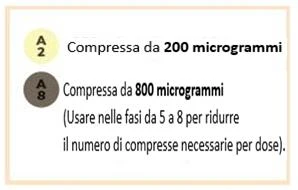 | Remember to speak regularly with your IAP specialist doctor or nurse. Write here the instructions provided by your doctor or nurse: Doctor's office phone number or email: Pharmacist's phone number: Notes: |
Page 30 Page 31
Page 32 Page 33
Page 34 Page 35
Page 36 Page 37
Page 38 Page 39
| Notes |
Page 40