Sandrena
Italy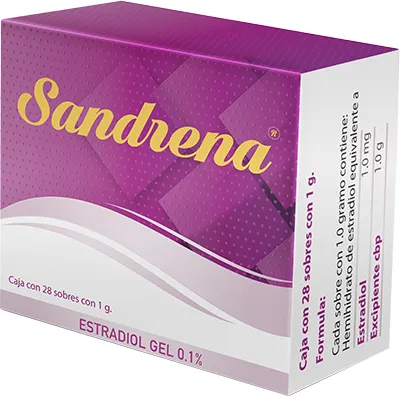
Table of Contents
Patient Information Leaflet: Information for the User
Sandrena 0.5 mg gel, 1 mg gel
estradiol
Please read carefully this leaflet before using this medicine because it contains important information for you.
- Keep this leaflet. You may need to read it again.
- If you have any questions, ask your doctor or pharmacist.
- This medicine has been prescribed for you only. Do not give it to other people, even if their symptoms are the same as yours, because it could be harmful.
- If you experience any side effects, including those not listed in this leaflet, talk to your doctor or pharmacist. See section 4.
Contents of this leaflet:
- What Sandrena is and what it is used for
- What you need to know before using Sandrena
- How to use Sandrena
- Possible side effects
- How to store Sandrena
- Contents of the pack and other information
1. What Sandrena is and what it is used for
Sandrena is a medication used in Hormone Replacement Therapy (HRT). Sandrena
contains the female hormone oestrogen.
Sandrena is used for:
Relief of postmenopausal symptoms
During menopause, the amount of oestrogen produced by a woman's body decreases. This can
cause symptoms such as hot face, neck and chest ("hot flushes"). Sandrena relieves
these postmenopausal symptoms. Sandrena will be prescribed to you only if your symptoms
are seriously interfering with your daily life.
Talk to your doctor if you do not feel better or if you feel worse.
2. What you should know before using Sandrena
Medical history and regular check-ups
HRT carries certain risks that should be considered when deciding whether to start or continue treatment.
Experience in treating women with early menopause (due to premature ovarian failure or surgical removal of the ovaries) is limited. If you have early menopause, the risks associated with HRT may differ. Discuss this with your doctor.
Before starting (or restarting) HRT, your doctor will ask about your personal and family medical history. Your doctor may decide to perform a physical examination. This may include a breast examination and/or an internal pelvic examination, if necessary.
Once you have started HRT, visit your doctor regularly for check-ups (at least once a year). During these visits, discuss with your doctor the risks and benefits of continuing treatment with Sandrena.
Regularly check your breasts for any changes (see section “Breast cancer” below). Have regular breast examinations as recommended by your doctor.
Do not use Sandrena
If you have or develop any of the following conditions. If you have any doubts about the points listed below, consult your doctor before using Sandrena.
Do not use Sandrena
- if you have or have had breast cancer or suspect you may have it
- if you have a tumour sensitive to oestrogen, such as cancer of the uterine lining (endometrium), or suspect you may have it
- if you have unexpected vaginal bleeding
- if you have excessive thickening of the uterine lining (endometrial hyperplasia) that is untreated
- if you have or have ever had a blood clot in a vein (thrombosis), such as in the legs (deep vein thrombosis) or lungs (pulmonary embolism)
- if you suffer from a blood clotting disorder (such as protein C, protein S, or antithrombin deficiency)
- if you have or have recently had a disease caused by blood clots in arteries, such as heart attack, stroke, or angina
- if you have or have had liver disease and liver function tests have not returned to normal
- if you have a rare inherited blood disorder called "porphyria"
- if you are allergic to oestradiol or any of the excipients of this medicine (listed in section 6).
If any of the conditions listed above occur for the first time while using Sandrena, stop taking it immediately and consult your doctor without delay.
Warnings and precautions
Talk to your doctor or pharmacist before using Sandrena. Inform your doctor if you have ever had any of the following conditions before starting treatment, as they may recur or worsen during treatment with Sandrena. If this happens, consult your doctor more frequently for check-ups:
- fibroids in the uterus
- growth of uterine tissue outside the uterus (endometriosis) or a history of excessive growth of the uterine lining (endometrial hyperplasia)
- increased risk of developing blood clots (see "blood clots in veins [thrombosis]")
- increased risk of developing an oestrogen-sensitive tumour (e.g. if your mother, sister, or grandmother had breast cancer)
- high blood pressure
- liver disorder, such as benign liver tumour
- diabetes
- gallstones
- migraine or severe headaches
- an autoimmune disease affecting multiple organs (systemic lupus erythematosus, SLE)
- epilepsy
- asthma
- a disease affecting the eardrum and hearing (otosclerosis)
- very high levels of fat in the blood (triglycerides)
- fluid retention due to heart or kidney problems
- angioedema (hereditary or acquired).
Stop using Sandrena and see a doctor immediately
if during HRT treatment you notice any of the following:
- any of the conditions listed in the section "Do not use Sandrena"
- yellowing of the skin or whites of the eyes (jaundice). These may be signs of liver disease
- a significant increase in blood pressure (symptoms may include headache, fatigue, dizziness)
- a new type of headache resembling migraine
- pregnancy
- signs of a blood clot, such as:
- painful swelling and redness in the legs
- sudden chest pain
- difficulty breathing. For further information, see "Blood clots in a vein (thrombosis)".
Note: Sandrena is not a contraceptive. If less than 12 months have passed since your last menstrual period or if you are under 50 years of age, you may still need to use an additional contraceptive method to prevent pregnancy. Speak to your doctor for advice.
HRT and cancer
Excessive thickening of the uterine lining (endometrial hyperplasia) and cancer of the uterine lining (endometrial carcinoma)
Oestrogen-only HRT increases the risk of excessive thickening of the uterine lining (endometrial hyperplasia) and cancer of the uterine lining (endometrial carcinoma). Taking a progestogen in addition to oestrogen for at least 12 days of each 28-day cycle protects against this additional risk. Therefore, if you still have your uterus, your doctor will prescribe a progestogen separately. If your uterus has been removed (hysterectomy), discuss with your doctor whether you can safely take this medicine without a progestogen.
In women who still have their uterus and who are not using HRT, an average of 5 cases of endometrial carcinoma per 1,000 women are diagnosed between the ages of 50 and 65.
For women aged 50 to 65 who still have their uterus and who use oestrogen-only HRT, between 10 and 60 cases of endometrial carcinoma per 1,000 women (i.e. 5 to 55 additional cases) are diagnosed, depending on the dose and duration of treatment.
Unexpected bleeding
If your doctor has prescribed progestogen tablets in addition to Sandrena, you will usually have monthly bleeding (withdrawal bleed). However, if you experience unexpected bleeding or spotting in addition to your monthly bleeding that:
- continues beyond the first 6 months of treatment
- starts after more than 6 months of taking Sandrena
- continues after stopping Sandrena
consult your doctor as soon as possible.
Breast cancer
Evidence shows that taking combined oestrogen-progestogen HRT or oestrogen-only therapy increases the risk of breast cancer. This additional risk depends on the duration of HRT use. The additional risk becomes evident within 3 years of use.
After stopping HRT, the additional risk decreases over time, but may persist for 10 years or more if HRT has been used for more than 5 years.
Comparison
In women aged 50–54 who do not use HRT, an average of 13–17 cases of breast cancer per 1,000 women will be diagnosed over a 5-year period. In women aged 50 who start oestrogen-only HRT for 5 years, there will be 16–17 cases per 1,000 users (i.e. 0–3 additional cases). In women aged 50 who start combined oestrogen-progestogen HRT for 5 years, there will be 21 cases per 1,000 (i.e. 4–8 additional cases).
In women aged 50–59 who do not use HRT, breast cancer will be diagnosed in an average of 27 women per 1,000 over a 10-year period.
In women aged 50 who start oestrogen-only HRT for 10 years, there will be 34 cases per 1,000 users (i.e. 7 additional cases).
In women aged 50 who start combined oestrogen-progestogen HRT for 10 years, there will be 48 cases per 1,000 users (i.e. 21 additional cases).
Regular breast checks. Make an appointment with your doctor if you notice any changes in your breasts such as:
- small indentations in the skin
- changes in the nipple
- any visible or palpable hardening
In addition, it is recommended to participate in mammography screening programmes when offered. For mammography screening, it is important that you inform the healthcare professional/radiographer performing the X-ray that you are taking HRT, as this medicine can increase breast density, which may interfere with mammogram results. When breast density is increased, mammography may not detect all lumps.
Ovarian cancer
Ovarian cancer is rare – much rarer than breast cancer. The use of oestrogen-only or combined oestrogen-progestogen HRT has been associated with a slight increase in the risk of ovarian cancer.
The risk of ovarian cancer varies with age. For example, in women aged 50–54 who do not use HRT, about 2 in 2,000 will be diagnosed with ovarian cancer over 5 years. For women who have used HRT for 5 years, there will be about 3 in 2,000 (i.e. about 1 additional case).
Effects of HRT on the heart and circulation
Blood clots in a vein (thrombosis)
The risk of blood clots in veins is about 1.3 to 3 times higher in women using HRT compared to those who do not, particularly during the first year of treatment.
Blood clots can be serious, and if one travels to the lungs, it can cause chest pain, shortness of breath, fainting, or even death.
Your risk of developing a blood clot in a vein increases with age and if any of the following apply. Inform your doctor if any of these situations occur:
- you cannot walk for a prolonged period due to major surgery, injury, or illness (see also section 3, if surgery is required)
- you are seriously overweight (BMI > 30 kg/m²)
- you have or have had blood clotting disorders requiring long-term treatment with anticoagulant medication
- a close relative has ever had a blood clot in the leg, lung, or another organ
- you have systemic lupus erythematosus (SLE)
- you have cancer.
For symptoms of blood clot formation, see "Stop using Sandrena and see a doctor immediately".
Comparison
In women aged 50 who do not use HRT, an average of 4 to 7 cases per 1,000 are expected to develop venous blood clots over 5 years.
For women aged 50 who have used combined oestrogen-progestogen HRT for more than 5 years, there will be 9–12 cases per 1,000 (i.e. 5 additional cases).
For women aged 50 who have had a hysterectomy and have been treated with oestrogen-only HRT for over 5 years, there will be 5 to 8 cases per 1,000 (i.e. 1 additional case).
Heart disease (heart attack)
There is no evidence that HRT prevents heart attacks.
Women over 60 who use oestrogen-progestogen HRT have a slightly higher chance of developing heart disease compared to those not using HRT.
For women who have had a hysterectomy and are taking oestrogen-only therapy, there is no increased risk of developing heart disease.
Stroke
The risk of stroke is about 1.5 times higher in women using HRT compared to those who do not. The number of additional stroke cases due to HRT use increases with age.
Comparison
In women aged 50 who do not use HRT, an average of 8 stroke cases per 1,000 are expected over 5 years.
For women aged 50 who have used HRT for more than 5 years, there will be 11 cases per 1,000 (i.e. 3 additional cases).
Other conditions
- HRT does not prevent memory loss. There is some evidence of an increased risk of memory loss in women who start HRT after age 65. Talk to your doctor for advice.
- Women with a tendency to skin pigmentation changes (chloasma) should minimise exposure to sunlight and ultraviolet radiation while using Sandrena.
Other medicines and Sandrena
Inform your doctor or pharmacist if you are taking, have recently taken, or might take any other medicines, including over-the-counter medicines, herbal remedies, or other natural products.
Some medicines may interfere with the effect of Sandrena. This could cause irregular bleeding. These include:
- medicines for epilepsy (such as phenobarbital, phenytoin, and carbamazepine)
- medicines for tuberculosis (such as rifampicin, rifabutin)
- medicines for HIV infection and hepatitis C infection (i.e. protease inhibitors and non-nucleoside reverse transcriptase inhibitors such as nevirapine, efavirenz, ritonavir, and nelfinavir)
- herbal remedies containing St John’s wort (Hypericum perforatum).
Laboratory tests
If you need to have blood tests, inform your doctor or laboratory staff that you are using Sandrena, as this medicine may affect the results of certain tests.
Pregnancy, breastfeeding and fertility
Sandrena is used only in postmenopausal women. If you become pregnant, stop taking Sandrena and contact your doctor.
Driving and using machines
No studies on the effect on the ability to drive or use machines have been conducted.
Sandrena contains propylene glycol and ethanol
This medicine contains 62.5, 125, and 187.5 mg of propylene glycol in 0.5, 1.0, and 1.5 g of dose, respectively.
This medicine contains 292.5, 585, and 877.5 mg of alcohol (ethanol) in 0.5, 1.0, and 1.5 g of dose, respectively. It may cause a burning sensation on damaged skin.
3. How to use Sandrena
Always use this medicine exactly as instructed by your doctor or
pharmacist. If you have any doubts, consult your doctor or pharmacist.
When to start using Sandrena
You can start using Sandrena immediately if:
- you have never used HRT before
- you are coming from a period during which you did not use HRT.
Wait until the end of your menstrual cycle if:
- you are switching from another type of HRT and have had a menstrual bleed.
If your uterus has not been removed, your doctor will likely also prescribe another
medicine containing a progestogen hormone. This is usually a tablet taken for
12 to 14 days each month. After each progestogen cycle, you may experience bleeding similar to menstruation.
How much Sandrena to use
Sandrena comes in sachets containing 0.5 mg of estradiol in 0.5 g of gel, or in sachets
containing 1 mg of estradiol in 1 g of gel.
- Each pack of Sandrena 0.5 mg gel contains only 0.5 g sachets.
- Each pack of Sandrena 1 mg gel contains only 1 g sachets.
Use the amount of Sandrena prescribed by your doctor. Your doctor should prescribe the lowest effective dose needed to treat your symptoms, for the shortest possible duration. Speak with your doctor if you think the prescribed dose is too high or not strong enough.
- The recommended dose is between 0.5 mg and 1.5 mg of estradiol per day.
- Use the following number of 0.5 g or 1 g sachets according to the dose and pack prescribed by your doctor:
For a daily dose of 0.5 mg: use one 0.5 g sachet.
For a daily dose of 1 mg: There are two options. Use one 1 g sachet or use two
0.5 g sachets.
For a daily dose of 1.5 mg: There are two options. Use three 0.5 g sachets
or use one 0.5 g sachet and one 1 g sachet.
If you are also taking progestogen tablets, take them exactly as prescribed by your doctor. You will normally experience bleeding after each progestogen cycle.
How to apply the gel
Sandrena should be gently applied to clean, dry skin. It must not be swallowed.
Where to apply the gel
- Do not apply the gel to the breasts, face, or irritated skin.
- Apply the gel to the lower abdomen or thighs.
- Apply the gel each day to a different area of the body.
Follow these instructions:
- Apply the gel to the skin once daily, on the lower abdomen or thighs.
- Spread the gel over an area 1 to 2 times the size of your hand.
- Allow the gel to dry for a few minutes.
- Wash your hands after applying the gel. Avoid contact of the gel with your eyes. The gel may irritate the eyes.
- Do not wash the area where you applied the gel for at least one hour.
If you are scheduled for surgery
If you are due to undergo surgery, inform your surgeon that you are using Sandrena.
You may need to stop using Sandrena approximately 4 to 6 weeks before surgery to reduce the risk of blood clotting (see section 2, Blood clots in a vein). Ask your doctor when you can start using Sandrena again.
If you use more Sandrena than you should
If you use more gel than prescribed, contact your doctor or pharmacist.
You may feel bloated, anxious, or irritable, or experience breast tenderness. Nausea, vomiting, and breakthrough bleeding may also occur in some women.
Overdose is unlikely with transdermal application. Treatment is symptomatic.
Wash off the gel. Symptoms will resolve when treatment is stopped or the dose is reduced.
If you swallow Sandrena
If you accidentally swallow Sandrena, do not be alarmed. However, contact your doctor.
If you forget to use Sandrena
- Apply the missed dose as soon as you remember, unless more than 12 hours have passed.
- If more than 12 hours have passed, skip the missed dose.
- Missing multiple doses may lead to bleeding between menstrual cycles. This is called breakthrough bleeding.
If you stop using Sandrena
Continue using this medicine exactly as prescribed by your doctor. Continue using Sandrena even if you notice symptom improvement. If you stop treatment too early or too abruptly, your symptoms may return.
If you have any questions about how to use this medicine, consult your doctor or pharmacist.
4. Possible side effects
Like all medicines, this medicine can cause side effects, although not
everyone will experience them.
If you notice any of the following serious side effects, stop using the gel
and contact your doctor immediately:
- your blood pressure increases
- your skin or the white part of your eye turns yellowish (jaundice)
- you suddenly develop a migraine-type headache (see section 2)
- you experience symptoms of blood clot formation (see section 2)
- you develop any of the problems listed in section 2.
The following conditions are reported more frequently in women using HRT compared to those
who do not use HRT:
- breast cancer
- abnormal growth or cancer of the uterine lining (endometrial hyperplasia or cancer)
- ovarian cancer
- blood clots in the veins of the legs or lungs (venous thromboembolism)
- heart disease
- stroke
- possible memory loss if HRT is started after the age of 65. For further information on these side effects, see section 2.
During the first few months of treatment, breakthrough bleeding, spotting, and breast tenderness or swelling may occur. These effects are usually temporary and normally resolve with continued treatment.
Other side effects
Common (may affect up to 1 in 10 people):
- skin itching, rash, pain, increased sweating, swelling of feet and ankles
- breasts become more sensitive or painful
- weight gain or loss
- headache, dizziness
- stomach pain, nausea or vomiting, flatulence
- vaginal bleeding or spotting, menstrual disorders
- depression, nervousness, lethargy, insomnia
- hot flushes
Uncommon (may affect up to 1 in 100 people):
- changes in sexual desire and mood, anxiety, insomnia, apathy, emotional instability, reduced concentration, euphoria, restlessness
- migraine, delirium, tremor
- visual disturbances, dry eyes
- hypertension, superficial phlebitis, purpura
- shortness of breath, rhinitis
- benign tumour of the breast or endometrium
- increased appetite, elevated blood cholesterol levels
- increased heart rate
- constipation, digestive disorders, diarrhoea, rectal disorders
- acne, alopecia, dry skin, nail disorders, skin nodules, excessive hair growth, urticaria (raised, itchy rash appearing on the skin), painful red skin nodules (erythema nodosum)
- joint disorders, muscle cramps
- increased frequency/urgency of urination, loss of bladder control, urinary tract infection, discoloration of urine, haematuria
- tender or swollen breasts, abnormal growth of the uterine lining, uterine disorders
- fatigue, abnormal laboratory tests, weakness, fever, para-influenza-like syndrome, general malaise
- allergic reaction (hypersensitivity)
Rare (may affect up to 1 in 1,000 people):
- venous thromboembolism
- changes in liver function and bile flow
- skin rash
- intolerance to contact lenses
- menstrual pain
- premenstrual-like syndrome
Adverse reactions reported during post-marketing surveillance with unknown frequency ( cannot be estimated based on the available data ):
- uterine fibroids
- exacerbation of angioedema (hereditary or acquired)
- cerebral circulation disorders
- swelling
- liver diseases causing yellowing of the skin
- contact dermatitis, eczema
If you notice any of these side effects, contact your doctor.
Your doctor may decide to discontinue treatment temporarily.
Dementia
HRT does not prevent memory loss. There is some evidence of an increased risk of memory loss in women who start HRT after the age of 65. Talk to your doctor for advice.
The following side effects have been reported with other HRTs:
- gallbladder diseases
- probable dementia in women over 65
- various skin disorders:
- changes in skin pigmentation, especially on the face or neck, known as "pregnancy mask" (chloasma)
- skin rash with redness or sores ( erythema multiforme )
- purpura due to loss of integrity or function of blood vessels (vascular purpura)
Reporting of side effects
If you experience any side effect, including those not listed in this leaflet,
talk to your doctor or pharmacist.
You can also report side effects directly via the national reporting system at https://www.aifa.gov.it/content/segnalazioni-reazioni-avverse .
By reporting side effects, you can help provide more information on
the safety of this medicine.
5. How to store Sandrena
Keep this medicine out of the sight and reach of children.
Do not use this medicine after the expiry date stated on the packaging and on the sachet after the wording “Exp”. The expiry date refers to the last day of that month.
Do not store above 25°C.
Do not dispose of any medicine via wastewater or household waste. Ask your pharmacist how to dispose of medicines no longer required. This will help protect the environment.
6. Package contents and other information
What Sandrena 0.5 mg gel and Sandrena 1 mg gel contain:
- The active substance is estradiol. Each sachet contains 0.5 mg (milligrams) or 1.0 mg (milligrams) of estradiol.
- The excipients are Carbopol 974P, triethanolamine, propylene glycol, ethanol and purified water.
Description of the appearance of Sandrena 0.5 mg gel and Sandrena 1 mg gel and contents of the
packaging
Sandrena is a smooth alcohol-based gel.
Pack sizes:
Sandrena 0.5 mg gel is available in packs of 28 or 91 sachets.
Sandrena 1 mg gel is available in packs of 28 or 91 sachets.
Not all pack sizes are marketed.
Marketing Authorization Holder:
Orion Corporation
Orionintie 1
FI-02200 Espoo
Finland
Manufacturer
Orion Corporation Orion Pharma
Tengströminkatu 8 FI-20360 Turku
Finland
Selling Authorization Holder
Orion Pharma S.r.l., Milan
This medicinal product is authorized in the European Economic Area countries under the
following trade names:
Denmark Ercostrol
France Délidose
Italy, United Kingdom Sandrena
Sweden Divigel