Salbutamol Sandoz
Italy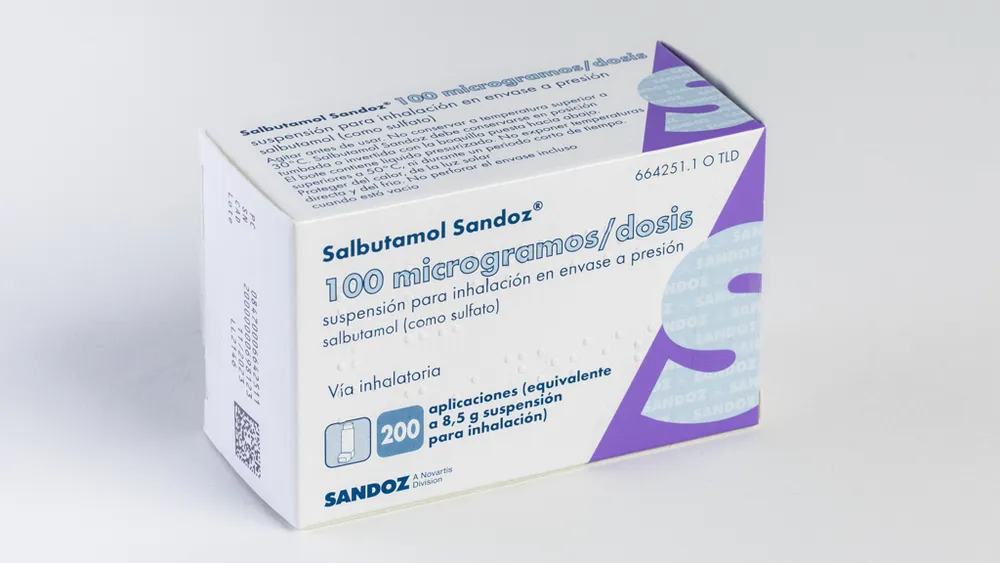
Table of Contents
- Package leaflet: Information for the user
- Salbutamol Sandoz 100 micrograms/dose pressurised inhalation suspension
- 1. What Salbutamol Sandoz is and what it is used for
- 2. What you need to know before using Salbutamol Sandoz
- 3. How to use Salbutamol Sandoz
- 4. POSSIBLE ADVERSE REACTIONS
- 5. How to store Salbutamol Sandoz
- 6. Package contents and other information
Package leaflet: Information for the user
Salbutamol Sandoz 100 micrograms/dose pressurised inhalation suspension
Generic medicine
Please read all of this leaflet carefully before you start using this medicine because it contains important information for you.
- Keep this leaflet. You may need to read it again.
- If you have any questions, ask your doctor or pharmacist.
- This medicine has been prescribed for you only. Do not give it to other people, even if they have the same symptoms as yours, as it may be harmful to them.
- If you experience any side effects, including those not listed in this leaflet, talk to your doctor or pharmacist. See section 4.
Contents of this leaflet:
- What Salbutamol Sandoz is and what it is used for
- What you need to know before using Salbutamol Sandoz
- How to use Salbutamol Sandoz
- Possible side effects
- How to store Salbutamol Sandoz
- Contents of the pack and other information
1. What Salbutamol Sandoz is and what it is used for
Salbutamol Sandoz is used to treat breathing difficulties caused by the following conditions:
- asthma
- chronic obstructive pulmonary disease (COPD), including
- chronic bronchitis
- emphysema.
Salbutamol Sandoz is also used to prevent asthmatic symptoms caused by:
- physical exercise
- allergenic stimuli such as house dust, pollen, cats, dogs, and cigarette smoke.
Salbutamol Sandoz widens the airways, allowing air to flow more freely.
Salbutamol Sandoz should primarily be used to relieve symptoms, rather than as
regular treatment.
Salbutamol Sandoz is indicated in adults, adolescents, and children aged 4 to 11 years.
2. What you need to know before using Salbutamol Sandoz
Do not use Salbutamol Sandoz
- if you are allergic to salbutamol or to any of the other ingredients of this medicine (listed in section 6).
Warnings and precautions
Talk to your doctor before taking Salbutamol Sandoz if you have any of the following conditions:
- severe heart disorders
- a history of heart disease, irregular heartbeat, or angina
- severe untreated high blood pressure
- overactive thyroid gland
- low potassium levels in the blood
- enlargement of an artery (aneurysm)
- diabetes (additional monitoring of blood glucose levels is recommended at the start of treatment with Salbutamol Sandoz)
- tumour of the adrenal medulla (phaeochromocytoma). The medullary portions of the adrenal glands are part of the two adrenal glands located near the top of the kidneys.
Other medicines and Salbutamol Sandoz
Tell your doctor or pharmacist if you are taking, have recently taken, or might take any other medicines.
The following medicines may affect the effects of Salbutamol Sandoz or be affected by it:
- heart and vascular medicines that may constrict the airways and contain active substances whose names end in “-olol”, such as propranolol (beta-blocker). This may cause spasms in the lung airways;
- certain medicines used to treat depression:
- monoamine oxidase inhibitors (e.g. moclobemide);
- tricyclic antidepressants, such as amitriptyline;
- anaesthetics (agents that induce partial or complete loss of sensation), such as halothane;
- medicines used to treat irregular heartbeat, such as digoxin;
- xanthine derivatives (used to aid breathing), such as theophylline;
- steroids (a group of hormones), such as cortisone;
- diuretics, such as furosemide.
Pregnancy and breastfeeding
There is limited information regarding use during pregnancy. However, if your asthma is not treated during pregnancy, there is also a risk to the fetus. Therefore, you should use Salbutamol Sandoz only if your doctor considers it absolutely necessary. Do not change the dosage on your own, but always use the medicine strictly according to your doctor’s instructions.
It is not known whether salbutamol passes into breast milk. Therefore, use Salbutamol Sandoz only if your doctor considers it absolutely necessary.
If you are pregnant, think you might be pregnant, planning to become pregnant, or are breastfeeding, consult your doctor or pharmacist before taking this medicine.
Driving and using machines
No studies have been conducted on the ability to drive or operate machinery. Therefore, do not drive or operate machinery until you know how this medicine affects you.
For athletes: using this medicine without therapeutic need constitutes doping and may lead to a positive result in anti-doping tests.
3. How to use Salbutamol Sandoz
Use this medicine exactly as directed by your doctor. If you have any doubts, consult your doctor or pharmacist.
The recommended dose is:
Adults and adolescents aged 12 years and older
- Relief of attacks: 1–2 inhalations, as needed.
- Prevention of symptoms caused by physical exercise or allergens: 2 inhalations 10–15 minutes beforehand.
- Maximum dosage: 8 inhalations per day.
Children (4–11 years of age)
- Relief of attacks: 1 inhalation, as needed. The dose may be increased to two inhalations if necessary.
- Symptoms caused by physical exercise or allergens: 1 or 2 inhalations, if necessary, 10–15 minutes beforehand.
- Maximum dosage: 8 inhalations per day.
Children under 4 years of age
Dosage recommendations cannot be made, as the effect has not yet been established.
Consult your doctor if treatment is not sufficiently effective or if you need to increase your daily dosage beyond the usual amount. Never increase the dosage or change the duration of use without your doctor’s approval.
Checking the inhaler before use:
Check that the inhaler is working properly if you are using a new inhaler or if it has not been used for 7 days or more. Remove the protective cap, shake the inhaler, and spray twice into the air.
Instructions for use:
Whenever possible, perform the inhalation while sitting or standing.
- Remove the protective cap. Check both the inside and outside of the device to ensure the mouthpiece is clean.
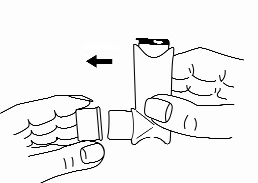
- Before use, shake the inhaler vigorously for a few seconds.
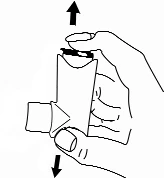
- Hold the inhaler upright, with the base of the canister facing upwards and your thumb resting on the base of the device, below the mouthpiece. Breathe out as much as possible, but do not blow into the mouthpiece.
- Place the mouthpiece in your mouth between your teeth and close your lips around it, taking care not to bite it.
- A moment after starting to inhale through your mouth, press down on the top of the inhaler to release the spray, continuing to inhale deeply and steadily.
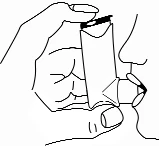
- Hold your breath for 5–10 seconds. Remove the inhaler from your mouth and take your finger off the top of the inhaler.
- If you need to take a second puff, keep the device in an upright position and wait about half a minute before repeating steps 2 to 6.
- After use, always replace the protective cap on the mouthpiece to protect it from dust and fluff. Firmly replace the protective cap over the mouthpiece and press until you hear a click.
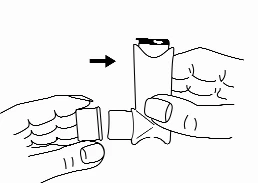
Some people have difficulty releasing the medication spray immediately after starting the inhalation phase. In such cases, or when treating children, a spacer device such as Vortex or AeroChamber Plus may be used. For correct use of the spacer, refer to the instructions provided with the device.
Cleaning
To prevent blockage or if the device becomes blocked, clean the inhaler at least once a week as follows:
- Remove the metal canister from the plastic holder and remove the protective cap from the mouthpiece.
- Rinse the plastic holder and mouthpiece cap with lukewarm water. Do not attempt to remove any residual medication around the mouthpiece with a sharp object such as a pin. You may add a mild detergent to the water, but rinse thoroughly under running water before allowing it to dry. Do not immerse the metal canister in water.
- Allow the plastic holder and mouthpiece cap to dry in a warm place. Avoid excessive heat.
- Reinsert the canister into the inhaler and replace the cap on the mouthpiece.
Contents of the inhaler:
Shake the spray to check the amount of medication remaining in the inhaler. Do not use Salbutamol Sandoz if you do not feel liquid when shaking the inhaler.
Use in cold conditions:
If the inhaler has been stored at temperatures below 0°C, warm it in your hands for 2 minutes, shake it, and spray twice into the air before use.
If you use more Salbutamol Sandoz than you should
In this case, always contact your doctor or go to hospital immediately.
Typical symptoms of overdose include:
- tremor
- headache
- rapid heartbeat
- nausea or vomiting
- inability to stay still
- irritability, excitement
- seizures
- drowsiness
If you have any questions about the use of this medicine, consult your doctor or pharmacist.
4. POSSIBLE ADVERSE REACTIONS
Like all medicines, this medicine can cause adverse reactions, although not everyone experiences them.
Stop treatment with Salbutamol Sandoz and contact your doctor immediately if you develop any of the following symptoms:
- symptoms of an allergic reaction, such as
- swelling of the face, tongue or throat
- difficulty swallowing
- symptoms similar to those caused by contact with stinging nettle
- breathing difficulties
- chest pain, see the section “frequency not known” listed below
- breathing becomes more difficult immediately after inhaling Salbutamol Sandoz, even though Salbutamol Sandoz reduces symptoms. This means that your condition is worsening and urgent alternative treatment is required.
Adverse reactions may occur with the frequencies described below:
Common, may affect up to 1 in 10 people:
- tremor
- increased heart rate
- headache
- muscle cramps
Uncommon, may affect up to 1 in 100 people:
- rapid heartbeat
- irritation of the mouth and throat
Rare, may affect up to 1 in 1,000 people:
- decrease in blood potassium levels
- hot flushes
Very rare, may affect up to 1 in 10,000 people:
- allergic reactions (see “Stop treatment with Salbutamol Sandoz and contact your doctor”)
- decrease in blood pressure
- collapse
- hyperactivity
- hyperexcitability
- hallucinations
- sleep disorders
- irregular heart rhythm
- itchy skin rash
- worsening of breathing immediately after inhalation
Frequency not known (frequency cannot be estimated from the available data):
Although the exact frequency is unknown, some people may occasionally experience chest pain (due to heart problems such as angina). Inform your doctor if you develop these symptoms during treatment with Salbutamol Sandoz, but do not stop taking this medicine unless instructed by your doctor.
Reporting of adverse reactions
If you experience any adverse reaction, including those not listed in this leaflet, talk to your doctor or pharmacist. You can also report adverse reactions directly via the national reporting system at: www.agenziafarmaco.gov.it/it/responsabili. By reporting adverse reactions, you can help provide more information on the safety of this medicine.
5. How to store Salbutamol Sandoz
Keep this medicine out of the sight and reach of children.
Do not use Salbutamol Sandoz after the expiry date stated on the label and on the packaging.
The expiry date refers to the last day of the month.
Do not store above 30°C.
The inhaler must be stored horizontally or upside down, with the mouthpiece facing downwards.
The canister contains pressurised liquid. Do not expose to temperatures above 50°C, even for a short period.
Protect from heat, direct sunlight and frost! Do not pierce or burn the canister, even when it is empty.
Do not dispose of any medicine via wastewater or household waste. Ask your pharmacist how to dispose of medicines you no longer use. This will help protect the environment.
6. Package contents and other information
What Salbutamolo Sandoz contains
- The active substance is salbutamol. One metered dose contains 100 micrograms of salbutamol (as sulphate). The dose delivered through the mouthpiece is 90 micrograms of salbutamol (as sulphate).
- The excipients are norflurane (HFA 134a), anhydrous ethanol and oleic acid.
Description of the appearance of Salbutamolo Sandoz and the contents of the pack
This medicine is a white pressurized suspension for inhalation in aluminium containers with a metering valve and a plastic actuator.
The packs contain:
200 metered doses, equivalent to 8.5 g of pressurized suspension for inhalation
2 x 200 metered doses, equivalent to 2 x 8.5 g of pressurized suspension for inhalation
3 x 200 metered doses, equivalent to 3 x 8.5 g of pressurized suspension for inhalation.
Not all pack sizes may be marketed.
Marketing Authorization Holder
Sandoz Spa – Largo U. Boccioni, 1 – 21040 Origgio (VA)
Manufacturer:
Aeropharm GmbH - François-Mitterrand-Allee 1 - 07407 Rudolstadt – Germany
This medicine is authorized in the Member States of the European Economic Area under the
following names:
Belgium: Salbutamol Sandoz 100µg Aërosol, suspensie
Germany: Salbutamol Sandoz 100 mikrogramm Dosieraerosol Druckgasinhalation, Suspension
Denmark: Salbutamol Sandoz
Estonia: Salbutamol Sandoz 100 mikrogrammi/annuses
Finland: Salbutamol Sandoz
Greece: Salbutamol/Sandoz
Hungary: Salbutamol Sandoz 100 mikrogramm/adag túlnyomásos inhalációs
Italy: Salbutamolo Sandoz 100 mcg sospensione pressurizzata per inalazione
Lithuania: Salbutamol Sandoz 100 mikrogramų/išpurškime suslėgta inhaliacinė suspensija
Latvia: Salbutamol Sandoz 100 microgrami/aerosols inhalacijam, suspensija
Netherlands: Salbutamol Sandoz aërosol 100 µg/dosis, aërosol, suspensie 100 microgram per dosis
Norway: Salbutamol Sandoz
Poland: Sabumalin
Portugal: Salbutamol Sandoz
Slovenia: Salbulin 100 mikrogramov/odmerek inhalacijska suspenzija pod tlakom
Spain: Salbutamol Sandoz 100 mcg/dosis suspensión para inhalación en envase a presión EFG
Sweden: Sabumalin
United Kingdom: AirSalb CFC-free inhaler 100 microgram/dose