Rytelo
Italy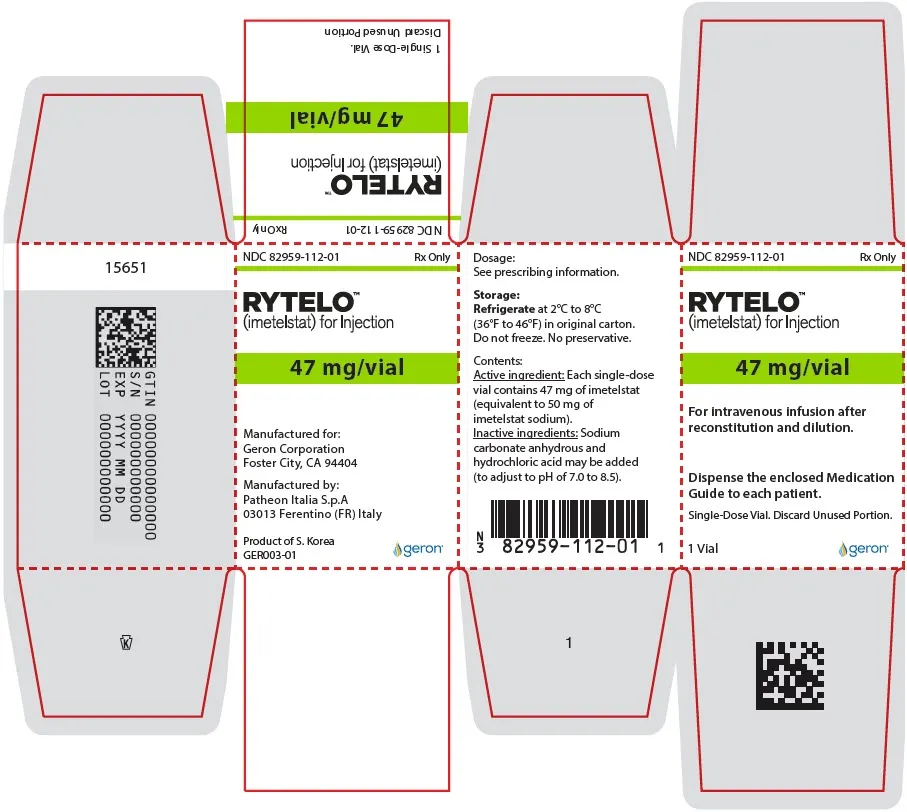
Table of Contents
- Patient Information Leaflet
- Rytelo 47 mg powder for concentrate for solution for infusion, 188 mg powder for concentrate for solution for infusion
- 1. What Rytelo is and what it is used for
- 2. What you need to know before receiving Rytelo
- 3. How you will receive Rytelo
- 4. Possible side effects
- 5. How to store Rytelo
- 6. Package contents and other information
- The following information is intended exclusively for healthcare professionals:
Patient Information Leaflet
Rytelo 47 mg powder for concentrate for solution for infusion, 188 mg powder for concentrate for solution for infusion
imetelstat
This medicinal product is subject to additional monitoring. This will allow rapid identification of new safety information. You can help by reporting any side effects you experience while taking this medicine. See the end of section 4 for information on how to report side effects.
Please read this leaflet carefully before receiving this medicine as it contains important information for you.
- Keep this leaflet. You may need to read it again.
- If you have any questions, ask your doctor or nurse.
- If you experience any side effects, including those not listed in this leaflet, contact your doctor or nurse. See section 4.
Contents of this leaflet
- What Rytelo is and what it is used for
- What you need to know before receiving Rytelo
- How Rytelo will be given to you
- Possible side effects
- How to store Rytelo
- Contents of the pack and other information
1. What Rytelo is and what it is used for
Rytelo is a medicine that contains the active substance imetelstat. Imetelstat is a type of medicine called a “telomerase inhibitor”.
Rytelo is used in adult patients with anaemia (low red blood cell levels) caused by a group of cancers called myelodysplastic syndromes. It is used to treat anaemia in patients who require red blood cell transfusions and who either do not respond well to, or cannot receive, erythropoietin-based therapy (a hormone that stimulates red blood cell production).
In myelodysplastic syndromes, the bone marrow does not produce enough healthy blood cells, and abnormal cells that do not develop properly are present in the blood and/or bone marrow. This can lead to anaemia and cause a feeling of tiredness or lack of energy.
Rytelo works by blocking a protein (an enzyme called “telomerase”) that promotes the growth and multiplication of cancer cells. By doing so, the growth of abnormal cancer cells in the bone marrow is halted, allowing the bone marrow to produce healthy blood cells; this may reduce feelings of fatigue.
2. What you need to know before receiving Rytelo
Do not take Rytelo
- if you are allergic to imetelstat or to any of the other ingredients of this medicine (listed in section 6).
Warnings and precautions
Talk to your doctor or nurse before receiving Rytelo if:
- you are a woman of childbearing potential; see “Pregnancy and breastfeeding” and “Fertility” in section 2;
- you have recently experienced symptoms such as increased tendency to bruise, bleeding more than expected, nosebleeds, blood in urine or stools, or other signs of bleeding;
- you have signs of infection such as fever, chills, feeling unwell, or any other signs of infection.
Bleeding, bruising, or infections may worsen if the number of certain blood cells begins to decrease after administration of Rytelo; see “Serious unwanted effects” in section 4.
To monitor your blood cell counts and check for possible specific side effects, your doctor or nurse will:
- perform blood tests after each dose is administered;
- carry out additional blood tests weekly after the first two doses have been administered; and
- may give you medicines to help prevent infection or perform further blood tests if your blood cell counts remain low.
During or shortly after administration of Rytelo, you may experience unwanted effects called "infusion-related reactions". These reactions can range from mild to severe. To help prevent these reactions, you will be given medications at least 30 minutes before receiving Rytelo, and you will be closely monitored for at least one hour afterwards.
Tell your doctor or nurse immediately if you experience an infusion-related reaction, with symptoms such as: low or very high blood pressure; sudden shortness of breath; lack of energy; feeling unwell; headache; nausea; vomiting; diarrhea; unusually heavy sweating; flushed or itchy skin; swelling; fever; or pain in certain parts of the body (such as chest, abdomen, joints, bones, or back); see also section 4 “Possible side effects”.
Children and adolescents
Rytelo must not be given to children and adolescents under 18 years of age, as it is not known whether this medicine is safe and effective in this age group.
Other medicines and Rytelo
Tell your doctor if you are taking, have recently taken, or might take any other medicines.
Pregnancy and breastfeeding
- Pregnancy Imetelstat is not recommended during pregnancy and in women of childbearing potential who are not using contraceptive measures.
Women of childbearing potential are advised to use effective contraception (birth control) during treatment with Rytelo and for at least 1 week after the last dose. Speak to your doctor or nurse about which contraceptive methods are best for you to prevent pregnancy. Tell your doctor immediately if you become pregnant or suspect you are pregnant during treatment with Rytelo. Before starting treatment, your doctor or nurse will perform a pregnancy test to make sure you are not pregnant.
- Breastfeeding It is not known whether imetelstat is excreted in human breast milk. A risk to the breastfed infant cannot be ruled out. Do not breastfeed during treatment with Rytelo and for 1 week after the last dose.
Fertility
Rytelo may reduce fertility in women. This means that, if you are a woman, you may have difficulty becoming pregnant during or after treatment with this medicine.
Driving and using machines
Rytelo may have a minor influence on the ability to drive, ride a bicycle, or use tools or machines. Do not drive any vehicle, ride a bicycle, or operate tools or machinery if you feel tired or weak, or have symptoms that may affect your ability to perform these activities, until such symptoms have resolved; see section 4 “Possible side effects”.
Rytelo contains sodium
This medicine contains 35 mg of sodium (a main component of table salt) per dose (intended for a patient weighing 80 kg). This is equivalent to approximately 1.8% of the maximum daily recommended dietary intake of sodium for an adult.
3. How you will receive Rytelo
Rytelo will be administered to you by a doctor or nurse experienced in the treatment of blood
disorders.
How Rytelo is administered
- This medicine is given intravenously as an infusion (intravenous drip).
- Rytelo is usually administered over a period of 2 hours.
- This medicine is given every 4 weeks.
How much Rytelo will be administered
The recommended dose is 7.1 mg of Rytelo per kilogram of body weight. Your doctor will decide whether this dose is suitable for you. Depending on how you respond to the medicine, your doctor may:
- interrupt the infusion and restart it at a slower rate
- postpone the infusion and reschedule it for another day
- reduce the dose
- or discontinue treatment with Rytelo.
Your doctor will decide for how long you will receive treatment with Rytelo.
Medicines given before treatment with Rytelo
At least 30 minutes before each dose of Rytelo, your doctor or nurse will administer medicines to help reduce infusion-related side effects (infusion-related reactions); see section 2 “Warnings and precautions” and section 4 “Possible side effects” for more information.
If you miss a dose
If you miss or postpone an appointment to receive a dose of Rytelo, it is very important to reschedule another appointment as soon as possible. The dosing schedule will then continue as prescribed, i.e. every 4 weeks.
If you are given more Rytelo than you should
Since the infusion will be administered by a qualified healthcare professional in a healthcare setting, an overdose is unlikely. If this should occur, you will be closely monitored by the doctor or nurse for any side effects.
4. Possible side effects
Like all medicines, this medicine can cause side effects, although not everyone experiences them.
Serious side effects
Inform your doctor or nurse immediately if you notice any of the following signs, which indicate a
serious side effect. You may need urgent medical treatment.
Very common: (may affect more than 1 in 10 people)
- Low levels of platelets in the blood (thrombocytopenia), which may lead to the following symptoms: increased tendency to bruise or bleed more than expected, bruises or collections of blood (hematomas), prolonged bleeding from a cut, nosebleeds, blood in the intestine, in the urine or in the faeces, black stools.
- Low levels of neutrophils in the blood (neutropenia), which may lead to the following symptoms: fever, cough, sore throat, chills, malaise or any other sign of infection.
Common: (may affect up to 1 in 10 people)
- Infusion-related reactions (some events starting during or after the infusion), which may be mild or severe and may include one or more of the following symptoms: low or very high blood pressure; sudden shortness of breath; lack of energy; feeling unwell; headache; nausea; vomiting; diarrhoea; unusually excessive sweating; red or itchy skin; swelling; fever; or pain in certain parts of the body (such as chest, stomach, joints, bones or back).
- An infection in the bloodstream (sepsis)
Other side effects
Inform your doctor or nurse if you experience any of the following side effects.
Very common: (may affect more than 1 in 10 people)
- decrease in white blood cell levels (leucopenia) indicated by blood tests
- weakness or general feeling of lack of strength or energy (asthenia)
- tiredness (fatigue)
- headache
- urinary tract infection
- increased liver enzyme levels, indicated by blood tests.
Common: (may affect up to 1 in 10 people)
- joint pain
- itchy skin or sensation of itching
- fainting
- irregular or excessively fast heartbeat (atrial fibrillation or atrial flutter).
Reporting of side effects
If you experience any side effect, including those not listed in this leaflet, talk to your doctor or nurse.
You can also report side effects directly via the national reporting system listed in Annex V. Reporting side effects can help provide more information on the safety of this medicine.
5. How to store Rytelo
Rytelo will be stored by healthcare professionals in hospital or outpatient settings. The storage information is as follows:
- Keep this medicine out of sight and reach of children.
- Do not use this medicine after the expiry date stated on the carton and on the label of the vial after Exp./EXP.
- Unopened vial: store in the refrigerator (at a temperature between 2 °C and 8 °C). Do not freeze.
6. Package contents and other information
What Rytelo contains
- The active substance is imetelstat. Each vial contains sodium imetelstat equivalent to 47 mg or 188 mg of imetelstat. After reconstitution, each millilitre of solution contains 31.4 mg/mL of imetelstat.
- The other excipients are sodium carbonate and/or hydrochloric acid (for pH adjustment); see “Rytelo contains sodium” in section 2.
Description of the appearance of Rytelo and contents of the pack
Rytelo is a powder for concentrate, white to off-white or slightly yellowish in colour, for
solution for infusion (powder for concentrate). Rytelo is supplied in single-dose vials containing
47 mg or 188 mg of imetelstat.
Each pack contains 1 vial.
Marketing Authorisation Holder
Geron Netherlands B.V.
Naritaweg 165
1043BW Amsterdam
The Netherlands
Manufacturer
ADOH B.V.
Godfried Bomansstraat 31
6543JA Nijmegen
The Netherlands
Other sources of information
More detailed information on this medicinal product is available on the website of the European
Medicines Agency: https://www.ema.europa.eu. In addition, links to other websites on rare diseases
and related therapeutic treatments are provided.
The following information is intended exclusively for healthcare professionals:
Do not use this medicinal product after the expiry date stated on the vial label and
on the carton after Exp./EXP.
Instructions for preparation, administration and handling
The number of vials used for a single dose depends on the patient's body weight.
Rytelo is a lyophilised powder, white to off-white or slightly yellow, intended exclusively for intravenous infusion and must be reconstituted and diluted before administration.
Premedication and monitoring for infusion-related reactions
Prior to each dose of Rytelo, premedication must be administered to prevent or reduce potential infusion-related reactions. Patients should receive premedication with diphenhydramine (25–50 mg) and hydrocortisone (100–200 mg), or equivalent agents, at least 30 minutes before administration of Rytelo.
Patients must be monitored for the occurrence of adverse reactions for at least one hour after completion of the infusion. See sections 4.2 and 4.4 of the SmPC for symptom management.
Reconstitution
- Calculate the Rytelo dose (total mg) based on the patient’s body weight (in kg): Body weight (X kg) × Dose (7.1 mg/kg, except when dose reduction to 5.6 mg/kg or 4.4 mg/kg is justified).
- Determine the number of Rytelo vials required. More than one vial may be needed to achieve the complete dose. Each Rytelo vial contains 47 mg or 188 mg.
- Remove the Rytelo vials from the refrigerator. Allow vials to reach room temperature (20 °C – 25 °C) for 10–15 minutes (but no longer than 30 minutes) before reconstitution.
- Reconstitute each vial of Rytelo according to the concentration and instructions below:
- Rytelo vials containing 47 mg powder for concentrate for solution for infusion: Inject 1.8 mL of 9 mg/mL (0.9%) sodium chloride injection solution directly into the lyophilised powder to yield a deliverable volume of 1.5 mL. The final concentration of the reconstituted solution will be 31.4 mg/mL per vial.
- Rytelo vials containing 188 mg powder for concentrate for solution for infusion: Inject 6.3 mL of 9 mg/mL (0.9%) sodium chloride injection solution directly into the lyophilised powder to yield a deliverable volume of 6.0 mL. The final concentration of the reconstituted solution will be 31.4 mg/mL per vial.
Each vial contains an overage of medicinal product to compensate for liquid loss during preparation and withdrawal of the reconstituted solution, ensuring a final concentration of 31.4 mg/mL as specified above.
- Gently rotate each vial until the powder is completely reconstituted (do not exceed 15 minutes), avoiding foaming. Do not shake.
- Visually inspect the reconstituted solution for particulate matter or discoloration prior to dilution. The reconstituted solution in each vial should be clear to slightly opalescent and essentially free from visible contaminants, particles and/or particulate matter. Do not use if particulate matter or discoloration is present.
- Use the reconstituted solution immediately to prepare the diluted Rytelo solution in the infusion bag.
Dilution
- Calculate the volume of reconstituted solution required for the patient based on body weight:
Body weight (kg) × Dose (7.1 mg/kg, except when dose reduction to 5.6 mg/kg or 4.4 mg/kg is justified)
Volume (mL) =
31.4 mg/mL (concentration of reconstituted solution)
- Add the required volume of reconstituted solution to an infusion bag containing 500 mL of 9 mg/mL (0.9%) sodium chloride solution. Discard any excess solution remaining in the vial that is not required to achieve the prescribed dose.
- Gently invert the infusion bag at least five times to ensure thorough mixing of the reconstituted solution. Do not shake the infusion bag prior to administration.
Storage of the diluted solution
- Use within 48 hours if stored refrigerated between 2 °C and 8 °C (includes total time from reconstitution to end of infusion).
- Use within 18 hours if stored at room temperature between 20 °C and 25 °C (includes total time from reconstitution to end of infusion).
- Chemical and physical in-use stability has been demonstrated for 48 hours between 2 °C and 8 °C or for 18 hours between 20 °C and 25 °C. From a microbiological standpoint, the medicinal product should be used immediately. If not used immediately, the in-use storage times and conditions prior to use are the responsibility of the user and
should normally not exceed 24 hours between 2 °C and 8 °C, unless reconstitution and dilution were performed under controlled and validated aseptic conditions.
Method of administration
- Administer the diluted solution by intravenous infusion over 2 hours (i.e., at 250 mL/h). Do not administer as intravenous bolus or injection.
- For reduced infusion rates, which may be required in the event of infusion-related reactions, see below or refer to Table 3 in section 4.2 of the SmPC.
Adjustments to infusion rate in the event of infusion-related reactions
| Adverse reaction | Severity grade | Manifestation | Treatment modification |
| Infusion-related reactions (see sections 4.4 and 4.8 of the SmPC) | Grade 2 or 3 | First and second |
|
Grade 1: mild; grade 2: moderate; grade 3: severe
Disposal
- No special instructions for disposal. Unused medicine and waste materials derived from this medicine must be disposed of in accordance with local applicable regulations.