Ryjunea
Italy
Instructions for Use
Patient Information Leaflet: Information for the User
Ryjunea 0.1 mg/mL eye drops, solution
atropine sulfate
Please read all of this leaflet carefully before you or your child starts using this medicine
because it contains important information for you.
- Keep this leaflet. You may need to read it again.
- If you have any questions, ask your doctor or pharmacist.
- This medicine has been prescribed for you only. Do not give it to others, even if their symptoms are the same as yours, as it could be harmful.
- If you experience any side effects, including those not listed in this leaflet, contact your doctor or pharmacist. See section 4.
Contents of this leaflet
- What Ryjunea is and what it is used for
- What you need to know before using Ryjunea
- How to use Ryjunea
- Possible side effects
- How to store Ryjunea
- Contents of the pack and other information
1. What Ryjunea is and what it is used for
Ryjunea eye drops contain the active substance atropine sulfate.
It is used to slow down the progression of myopia in children aged 3 to 14 years whose
myopia ranges between -0.5 and -6 dioptres (a measure of the eye's focusing ability) and whose
rate of progression is equal to or greater than 0.5 dioptres per year at the start of treatment with
Ryjunea.
The benefit of using atropine sulfate eye drops in children is to maintain better vision and reduce the risk of future complications.
2. What you should know before using Ryjunea
Do not use Ryjunea
- if you are allergic to atropine sulfate or to any of the other ingredients of this medicine (listed in section 6).
- if you are allergic to other so-called anticholinergics (substances that block the action of the neurotransmitter acetylcholine), such as antihistamines, certain antidepressants, amantadine, quinidine, disopyramide, and metoclopramide.
- if you have primary angle-closure glaucoma (damage to the optic nerve caused by increased pressure inside the eye).
Warnings and precautions
You or your child may experience photophobia (increased sensitivity of the eyes to bright light) and accommodative dysfunction (blurred vision due to difficulty focusing the eyes) while using Ryjunea. These effects may last up to 14 days. If the eyes are more sensitive to light, we recommend wearing sunglasses to reduce discomfort.
Stopping treatment may lead to renewed worsening of myopia (see section 3 “If you stop treatment with Ryjunea”). After stopping this medicine, you should continue eye examinations for one year. Contact your doctor or your child’s doctor if vision worsens (rebound effect).
Using this medicine may increase the risk of synechiae (abnormal adhesions of the iris), in which the colored part of the eye sticks to surrounding tissue.
Ryjunea may cause blurred vision, which may further impair vision in patients with lens opacification (cataract), lazy eye (amblyopia), or misalignment of the eyes (strabismus).
Talk to your doctor or pharmacist before using Ryjunea if any of the following apply to you or your child:
- You have progressive infantile syndromic myopia, such as optic nerve damage usually caused by high eye pressure (glaucoma), progressive loss of vision (retinitis pigmentosa), congenital day blindness (congenital stationary night blindness), or disorders of the eye's nerve fibers (myelinated nerve fiber syndrome).
- You have heart problems such as tachycardia (fast heartbeat), heart failure (when the heart does not pump blood properly), coronary stenosis (narrowing of blood vessels supplying the heart muscle), or hypertension (high blood pressure). Patients who have recently had a heart attack may develop potentially life-threatening heart rhythm abnormalities while using this medicine.
- You may experience an effect on the ability to regulate body temperature due to inhibition of sweating; therefore, atropine should be used cautiously at high temperatures and in patients with fever, due to the risk of elevated body temperature.
- You have spastic paralysis (a muscle disorder affecting the legs).
- You have Down syndrome.
Children
Ryjunea is not recommended for children under 3 years of age. It is not known whether it is safe or effective in this age group.
Other medicines and Ryjunea
Ryjunea may interact with other medicines. Before you or your child take Ryjunea, inform your doctor or pharmacist if you are taking, have recently taken, or might take any other medicines, including those without a prescription. Specifically inform your doctor:
- if you are taking anticholinergics such as antihistamines, phenothiazines, tricyclic and tetracyclic antidepressants, amantadine, quinidine, disopyramide, or metoclopramide.
- if you are taking medicines containing carbachol, pilocarpine, or physostigmine to lower eye pressure.
- if you are taking sympathomimetic medicines such as dobutamine, dopamine, norepinephrine, epinephrine, or isoproterenol.
- if you are taking medicines used to prevent muscle weakness (antimyasthenics) such as pyridostigmine and neostigmine, potassium citrate, or potassium supplements.
- if you are taking medicines that depress the brain or spinal cord (central nervous system)
If you are unsure whether any of the above apply to you or your child, ask your doctor.
Pregnancy and breastfeeding
If you are pregnant, think you may be pregnant, planning to become pregnant, or breastfeeding, consult your doctor or pharmacist before using this medicine.
During pregnancy, especially during the last three months, Ryjunea should only be used if your doctor considers it absolutely necessary.
Use of this medicine during breastfeeding is not recommended because Ryjunea passes into breast milk.
Driving and using machines
Ryjunea may moderately affect the ability to ride bicycles or scooters, drive vehicles, or operate machinery because this medicine may cause abnormal or blurred vision (see section 4 “Possible side effects”). Do not drive, ride bicycles or scooters, or operate machinery until your vision has cleared. This effect may last up to 14 days after stopping treatment.
Ryjunea contains benzalkonium chloride
This medicine contains 0.1 mg of benzalkonium chloride per mL. Benzalkonium chloride may be absorbed by soft contact lenses and may change the color of contact lenses. You must remove contact lenses before using this medicine and wait 15 minutes before reinserting them.
Benzalkonium chloride may also cause eye irritation, especially if you have dry eye or corneal disorders (the transparent outermost layer of the eye). If you experience unusual sensations, burning, or pain in the eye after using this medicine, speak with your doctor.
3. How to use Ryjunea
Use this medicine exactly as instructed by your doctor. If you have any doubts, consult your doctor or pharmacist.
The recommended dose is one drop of Ryjunea 0.1 mg/mL in each eye daily. It is recommended to use it just before going to bed, as this may help reduce the impact of side effects such as blurred vision or abnormal sensitivity of the eyes to light (see section 4 “Possible side effects”). Your doctor will advise you on how long to use the drops.
If you are using other eye drops, wait at least 15 minutes after using them before applying Ryjunea. If you wear contact lenses, you must remove them before use (see section 2 “Ryjunea contains benzalkonium chloride”). If you are using an eye ointment, it should be applied after Ryjunea. This helps the absorption of Ryjunea into the eye and the onset of its effect.
Instructions for use
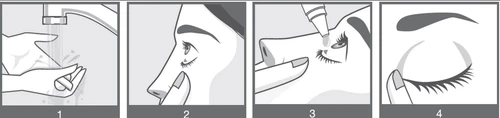
- Wash your hands before starting (Figure 1).
- Open the bottle. When the bottle is opened for the first time, remove the plastic ring that detaches from the cap. Be especially careful that the tip of the bottle does not touch the eye, the skin around the eye, or your fingers.
- Do not use if the tamper-evident ring is broken or if there are visible signs of deterioration.
- Unscrew the cap and place it on a clean surface on its side. Continue holding the bottle, making sure the tip does not come into contact with anything.
- Hold the bottle, pointing downwards, between your thumb and fingers.
- Pull down the lower eyelid with a clean finger to form a “pocket” between the eyelid and the eye (Figure 2). The drop should be placed here.
- Tilt your head backwards.
- Bring the dropper tip close to the eye. Do this in front of a mirror if it helps.
- Do not touch the eyes, eyelids, surrounding areas, or any other surfaces with the dropper tip. This could contaminate the eye drops.
- Gently squeeze the bottle to release one drop of Ryjunea into the eye (Figure 3).
- Apply only one drop to the eye. If the drop does not enter the eye, try again.
- Press a finger against the corner of the eye near the nose. Hold it pressed for 1 minute with the eye closed (Figure 4). There is a small duct here that drains tears from the eye into the nose. Pressing at this point closes the opening of this drainage duct. This helps prevent Ryjunea from entering the rest of the body.
- You must use the drops in both eyes; repeat the steps for the other eye while the bottle is open.
- Replace the cap to close the bottle.
If you use more Ryjunea than you should
Rinse your eyes with warm water. Do not use additional drops until the next scheduled dose.
If you forget to use Ryjunea
If you forget to use this medicine, skip the missed dose and use the next dose as usual. Do not use a double dose to make up for the forgotten dose.
If you stop using Ryjunea
Do not stop treatment with Ryjunea without first talking to your doctor or the doctor treating your child. Stopping this medicine may lead to worsening of myopia (rebound effect). After stopping treatment with this medicine, you should continue your eye examinations for one year. Speak with your doctor or the doctor treating your child if vision worsens (rebound effect).
If you have any doubts about how to use this medicine, consult your doctor or pharmacist.
4. Possible side effects
Like all medicines, this medicine can cause side effects, although not everybody gets them.
The following side effects have been observed with Ryjunea:
- Very common (may affect more than 1 in 10 people)
- abnormal sensitivity of the eyes to light (photophobia)
- Common (may affect up to 1 in 10 people):
- blurred vision
- eye irritation
- dilation of the pupil (mydriasis)
- eye pain
- sensation of having something in the eye (foreign body sensation)
- headache
- Uncommon (may affect up to 1 in 100 people):
- difficulty focusing vision (accommodation disorder)
- inflammatory spots on the cornea (punctate keratitis)
- papilla (bump) on the membrane covering the white part of the eye and the inner surface of the eyelid (conjunctival papillae)
Reporting of side effects
If you get any side effects, including those not listed in this leaflet, talk to your doctor or pharmacist. You can also report side effects directly through the national reporting system listed in Annex V. By reporting side effects, you can help provide more information on the safety of this medicine.
5. How to store Ryjunea
Keep this medicine out of the sight and reach of children.
Do not use this medicine after the expiry date stated on the vial label and on the carton after "Exp.". The expiry date refers to the last day of that month.
This medicine does not require any special storage conditions.
Discard the vial 4 weeks after first opening to prevent infection and use a new vial.
Do not use this medicine if you notice that the plastic ring around the cap and neck is missing or broken before starting a new vial.
Do not dispose of any medicine via wastewater or household waste. Ask your pharmacist how to dispose of medicines you no longer use. This will help protect the environment.
6. Package contents and other information
What Ryjunea contains
- The active substance is atropine sulfate. Each mL of solution contains 0.1 mg of atropine sulfate.
- The other components are benzalkonium chloride, citric acid (E330), sodium citrate (E331), sodium chloride, sodium hydroxide (E524) / hydrochloric acid (E507) (for pH adjustment), and deuterium oxide. See section 2 “Ryjunea contains benzalkonium chloride”.
Description of the appearance of Ryjunea and contents of the pack
Ryjunea eye drops, solution (eye drops) is a clear, colourless liquid in a multidose plastic bottle.
Each bottle contains 2.5 mL of medicinal product and each pack contains 1 or 3 bottles with screw caps.
Not all pack sizes may be marketed.
Marketing Authorisation Holder
Santen Oy
Niittyhaankatu 20,
33720 Tampere, Finland
Manufacturer
Santen Oy
Kelloportinkatu 1,
33100 Tampere, Finland
For further information about this medicinal product, please contact the local representative of the Marketing Authorisation Holder:
België/Belgique/Belgien Lietuva
Santen Oy Santen Oy
Tél/Tel: +32 (0) 24019172 Tel: +370 37 366628
България Luxembourg/Luxemburg
Santen Oy Santen Oy
Teл.: +359 (0) 888 755 393 Tél/Tel: +352 (0) 27862006
Česká republika Magyarország
Santen Oy Santen Oy
Tel: +358 (0) 3 284 8111 Tel.: +358 (0) 3 284 8111
Danmark Malta
Santen Oy Santen Oy
Tlf.: +45 898 713 35 Tel: +358 (0) 3 284 8111
Deutschland Nederland
Santen GmbH Santen Oy
Tel: +49 (0) 3030809610 Tel: +31 (0) 207139206
Eesti Norge
Santen Oy Santen Oy
Tel: +372 5067559 Tlf: +47 21939612
Ελλάδα Österreich
Santen Oy Santen Oy
Τηλ: +358 (0) 3 284 8111 Tel: +43 (0) 720116199
España Polska
Santen Pharmaceutical Spain S.L. Santen Oy
Tel: +34 914 142 485 Tel.: +48(0) 221042096
France Portugal
Santen Santen Oy
Tél: +33 (0) 1 70 75 26 84 Tel: +351 308 805 912
Hrvatska România
Santen Oy Santen Oy
Tel: +358 (0) 3 284 8111 Tel: +358 (0) 3 284 8111
Ireland Slovenija
Santen Oy Santen Oy
Tel: +353 (0) 16950008 Tel: +358 (0) 3 284 8111
Ísland Slovenská republika
Santen Oy Santen Oy
Sími: +358 (0) 3 284 8111 Tel: +358 (0) 3 284 8111
Italia Suomi/Finland
Santen Italy S.r.l. Santen Oy
Tel: +39 0236009983 Puh/Tel: +358 (0) 974790211
Κύπρος Sverige
Santen Oy Santen Oy
Τηλ: +358 (0) 3 284 8111 Tel: +46 (0) 850598833
Latvija
Santen Oy
Tel: +371 677 917 80
Other sources of information
More detailed information on this medicinal product is available on the website of the European Medicines Agency: https://www.ema.europa.eu
Similar Medications
-
Atropine Farmigea
Form: solution, eye
Active substance Dosage ATROPINE SULFATE — Manufacturer: FARMIGEA S.P.A.
This page has been machine-translated and may contain inaccuracies. The original data is available in the manufacturing country's language.
Last data check: May 11, 2026 · Data source: Agenzia Italiana del Farmaco (AIFA)