Rydapt
Italy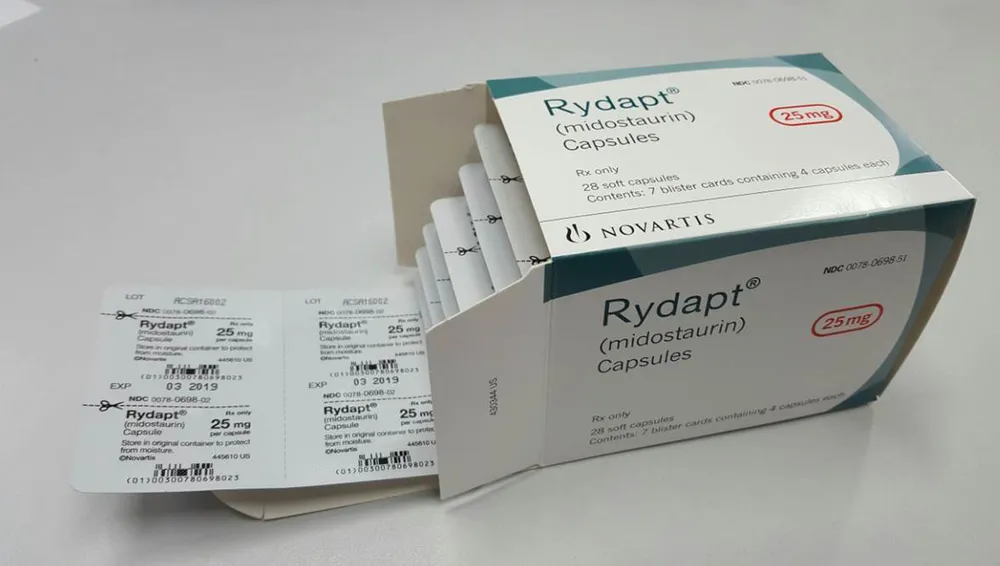
Table of Contents
Patient Information Leaflet
Rydapt 25 mg soft capsules
midostaurin
Please read all of this leaflet carefully before you start taking this medicine because it contains important information for you.
- Keep this leaflet. You may need to read it again.
- If you have any questions, ask your doctor, pharmacist or nurse.
- This medicine has been prescribed for you only. Do not give it to other people, even if they have the same symptoms as yours, because it may be harmful.
- If you experience any side effects, including those not listed in this leaflet, contact your doctor, pharmacist or nurse. See section 4.
Contents of this leaflet
- What Rydapt is and what it is used for
- What you need to know before taking Rydapt
- How to take Rydapt
- Possible side effects
- How to store Rydapt
- Contents of the pack and other information
1. What Rydapt is and what it is used for
What Rydapt is
Rydapt contains the active substance midostaurin. It belongs to a class of medicines called
protein kinase inhibitors.
What Rydapt is used for
Rydapt is used to treat acute myeloid leukaemia (AML) in adults who have a mutation in a gene called FLT3. Acute myeloid leukaemia is a type of cancer affecting certain white blood cells (called myeloid cells) in which the body overproduces an abnormal type of these cells.
Rydapt is also used in adults to treat aggressive systemic mastocytosis (ASM), systemic mastocytosis associated with haematological neoplasm (SM-AHN), or mast cell leukaemia (MCL). These are disorders in which the body produces too many mast cells, a type of white blood cell. Symptoms occur when too many mast cells infiltrate organs such as the liver, bone marrow or spleen and release substances like histamine into the blood.
How Rydapt works
Midostaurin blocks the action of certain enzymes (kinases) in abnormal cells and stops their division and growth.
In AML, Rydapt is initially always used in combination with chemotherapy medicines (medicines used to treat cancer).
If you have any questions about how Rydapt works or why this medicine has been prescribed for you, ask your doctor, pharmacist or nurse.
2. What you need to know before taking Rydapt
Follow your doctor's instructions carefully. These instructions may differ from the general information in this leaflet.
Do not take Rydapt
- if you are allergic to midostaurin or to any of the other ingredients of this medicine (listed in section 6). If you think you may be allergic, consult your doctor.
- if you are already taking any of the following medicines:
- medicines used to treat tuberculosis, such as rifampicin;
- medicines used to treat epilepsy, such as carbamazepine or phenytoin;
- enzalutamide, a medicine used to treat prostate cancer;
- St. John’s wort (also known as Hypericum perforatum), a herbal medicine used to treat depression. These medicines must be avoided during treatment with Rydapt. Please consult your doctor if you are told to start taking any of these medicines during treatment with Rydapt.
Warnings and precautions
Talk to your doctor, pharmacist, or nurse before taking Rydapt:
- if you have infections.
- if you have heart disease.
- if you have lung problems or breathing difficulties.
- if you have kidney problems.
Immediately inform your doctor, pharmacist, or nurse if you experience any of the following symptoms during treatment with Rydapt:
- if you have fever, sore throat, or mouth ulcers, as these may indicate that your white blood cell count is low.
- if you develop new or worsening symptoms such as fever, cough with or without mucus, chest pain, difficulty breathing, or shortness of breath, as these may be signs of lung problems.
- if you have or develop chest pain or discomfort, dizziness, fainting, lightheadedness, bluish discoloration of lips, hands, or feet, shortness of breath, or swelling of the lower limbs (edema) or skin, as these may be signs of heart problems. Your doctor may need to adjust, temporarily suspend, or completely discontinue treatment with Rydapt.
Monitoring during treatment with Rydapt
Your doctor will perform regular blood tests during treatment with Rydapt to monitor your blood cell counts (white blood cells, red blood cells, and platelets) and electrolyte levels (such as calcium, potassium, and magnesium). Your heart and lung function will also be monitored regularly.
Children and adolescents
Rydapt must not be used in children and adolescents under 18 years of age who are also receiving other chemotherapy, as it may cause a severe reduction in certain types of blood cells.
Other medicines and Rydapt
Inform your doctor or pharmacist if you are taking, have recently taken, or might take any other medicines. This is because Rydapt can affect how some medicines work. Some other medicines may also affect the activity of Rydapt.
The following medicines must be avoided during treatment with Rydapt:
- medicines used to treat tuberculosis, such as rifampicin;
- medicines used to treat epilepsy, such as carbamazepine or phenytoin;
- enzalutamide, a medicine used to treat prostate cancer;
- St. John’s wort (also known as Hypericum perforatum), a herbal medicine used to treat depression.
Inform your doctor or pharmacist if you are taking any of the following medicines:
- certain medicines used to treat infections, such as ketoconazole or clarithromycin;
- certain medicines used to treat HIV, such as ritonavir or efavirenz;
- certain medicines used to treat depression, such as nefazodone or bupropion;
- certain medicines used to control blood lipid levels, such as atorvastatin or rosuvastatin;
- tizanidine, a medicine used to relax muscles;
- chlorzoxazone, a medicine used to treat discomfort caused by muscle spasms.
If you are taking any of these medicines, your doctor may prescribe you a different medicine during treatment with Rydapt.
You must also inform your doctor if you are already taking Rydapt and are prescribed a new medicine that you have not taken before during treatment with Rydapt.
Ask your doctor or pharmacist if you are unsure whether the medicine you are taking is one of the medicines listed above.
Pregnancy and breastfeeding
Rydapt may be harmful to the unborn baby and is not recommended during pregnancy. If you are pregnant, suspect you may be pregnant, or are planning a pregnancy, consult your doctor before taking this medicine.
Rydapt may be harmful to the baby. You must not breastfeed during treatment with Rydapt and for at least 4 months after stopping treatment.
Contraception in women
Becoming pregnant during treatment with Rydapt may be harmful to the baby. Your doctor will ask you to take a pregnancy test before starting treatment with Rydapt to ensure you are not pregnant. You must use an effective method of contraception during treatment with Rydapt and for at least 4 months after stopping treatment. Your doctor will discuss with you the most suitable contraceptive method to use.
If you become pregnant or think you may be pregnant, inform your doctor immediately.
Fertility
Rydapt may reduce fertility in both men and women. Discuss this with your doctor before starting treatment.
Driving and using machines
Exercise particular caution when driving or operating machinery, as you may experience dizziness or vertigo while taking Rydapt.
Rydapt contains anhydrous ethanol (alcohol)
This medicine contains 666 mg of alcohol (ethanol) in each 200 mg dose (maximum daily dose), equivalent to 14 vol. % anhydrous ethanol. The amount in a 200 mg dose of this medicine is equivalent to 17 mL of beer or 7 mL of wine. The small amount of alcohol in this medicine is unlikely to cause significant effects. However, alcohol may be harmful if you have alcohol-related problems, epilepsy, or liver problems, or if you are pregnant or breastfeeding.
Rydapt contains macrogol glycerol hydroxystearate (castor oil)
This medicine contains macrogol glycerol hydroxystearate, which may cause stomach discomfort and diarrhea.
3. How to take Rydapt
Take this medicine exactly as your doctor or pharmacist has told you. If
you have any doubts, consult your doctor or pharmacist.
Do not exceed the dose prescribed by your doctor.
How much Rydapt to take
Your doctor will tell you exactly how many capsules you should take.
- Patients with AML The usual daily dose is 50 mg (2 capsules) twice a day.
- Patients with ASM, SM-AHN or MCL The usual daily dose is 100 mg (4 capsules) twice a day.
Depending on how you respond to Rydapt, your doctor may reduce the dose or temporarily
interrupt treatment.
How to take the medicine
- Taking Rydapt at the same time each day will help you remember to take your medicine.
- Take Rydapt twice daily, approximately 12 hours apart (for example, with breakfast and with the evening meal).
- Take Rydapt with food.
- Swallow the capsules whole with a glass of water. Do not open, crush, or chew the capsules to ensure proper dosing and to avoid the unpleasant taste of the capsule contents.
- For patients with AML, Rydapt is taken together with chemotherapy medicines. It is very important to follow your doctor’s instructions.
- If you vomit after swallowing the capsules, do not take another dose until your next scheduled dose.
How long to take Rydapt
- Continue taking Rydapt for as long as your doctor has prescribed. Your doctor will regularly monitor your condition to check that the treatment is having the desired effect.
- If you are being treated for AML, after completing Rydapt in combination with chemotherapy medicines, you will receive Rydapt alone for up to 12 months.
- If you are being treated for ASM, SM-AHN or MCL, you will receive Rydapt as a long-term treatment, possibly lasting for months or years. If you have any questions about how long you should take Rydapt, speak with your doctor or pharmacist.
If you take more Rydapt than you should
If you take more capsules than prescribed, or if someone else takes your medicine, contact a doctor or
go immediately to a hospital, taking the pack with you, as medical treatment may be necessary.
If you forget to take Rydapt
If you forget to take Rydapt, skip the missed dose and take the next dose at the usual time.
Do not take a double dose to make up for a forgotten dose. Instead, wait until it is time for your next dose.
If you stop taking Rydapt
Stopping treatment with Rydapt may cause your condition to worsen. Do not
stop treatment unless your doctor tells you to do so.
If you have any questions about using this medicine, consult your doctor or pharmacist.
4. Possible side effects
Like all medicines, this medicine can cause side effects, although not everybody gets them.
Stop taking Rydapt and inform your doctor immediately if you notice any of the following,
as they may be signs of an allergic reaction:
- difficulty breathing or swallowing
- dizziness
- swelling of the face, lips, tongue or throat
- severe skin itching, with red rash or skin swellings
Some side effects in patients with AML can be serious
Inform your doctor, pharmacist or nurse immediately if you notice any of the following:
- weakness, spontaneous bleeding or bruising, frequent infections with signs such as fever, chills, sore throat or mouth ulcers (signs of low blood cell counts)
- fever, cough with or without mucus, chest pain, difficulty breathing or shortness of breath (signs of non-infectious interstitial lung disease or pneumonia)
- severe shortness of breath, rapid and unusually laboured breathing, dizziness, lightheadedness, confusion and extreme fatigue (signs of acute respiratory distress syndrome)
- infections, fever, low blood pressure, reduced urine output, rapid pulse, rapid breathing (signs of sepsis or neutropenic sepsis)
Other possible side effects in patients with AML
Other side effects include those listed below. If any of these side effects become severe, inform your doctor or pharmacist.
Most side effects are mild to moderate and generally disappear after a few weeks of treatment.
Very common (may affect more than 1 in 10 people)
- catheter site infection
- small red or purple flat spots under the skin (petechiae)
- difficulty falling asleep (insomnia)
- headache
- shortness of breath, laboured breathing (dyspnoea)
- abnormal electrocardiogram (ECG) results which may indicate to your doctor that you have an abnormality in the heart's electrical activity known as QT prolongation
- dizziness, lightheadedness (low blood pressure)
- nosebleeds
- sore throat (laryngeal pain)
- mouth ulcers (stomatitis)
- nausea, vomiting
- upper abdominal pain
- haemorrhoids
- excessive sweating
- skin rash with peeling or flaking (exfoliative dermatitis)
- back pain
- joint pain (arthralgia)
- fever
- thirst, increased urination, dark urine, dry red skin (signs of high blood sugar levels, known as hyperglycaemia)
- muscle weakness, drowsiness, confusion, seizures, altered consciousness (signs of high sodium levels in the blood, known as hypernatraemia)
- bruising and bleeding (impaired blood clotting)
- abnormal blood test results which may indicate to your doctor how well certain body organs are functioning: elevated levels of alanine aminotransferase (ALT) and/or aspartate aminotransferase (AST) (indicators of liver function)
Common (may affect up to 1 in 10 people)
- upper respiratory tract infection
- nausea, vomiting, constipation, stomach ache, increased frequency of urination, thirst, muscle weakness and spasms (signs of high calcium levels in the blood, known as hypercalcaemia)
- fainting
- uncontrollable tremor of the body
- headache, dizziness (high blood pressure)
- rapid heartbeat (sinus tachycardia)
- fluid accumulation around the heart, which, if severe, may reduce the heart's ability to pump blood (pericardial effusion)
- fluid accumulation in the lungs/chest cavity, which if severe can cause breathlessness (pleural effusion)
- sore throat and runny nose
- eyelid swelling
- discomfort in the anus and rectum
- abdominal pain, nausea, vomiting, constipation (abdominal discomfort)
- dry skin
- eye pain, blurred vision, light sensitivity (keratitis)
- neck pain
- bone pain
- limb pain
- weight gain
- blood clot in the catheter
- abnormal blood test results which may indicate to your doctor how well certain body organs are functioning: high levels of uric acid
Not known (frequency cannot be estimated from the available data)
- Raised, painful red to dark red-purple skin spots or ulcers, mainly appearing on arms, legs, face and neck, accompanied by fever (signs of acute febrile neutrophilic dermatosis)
Some side effects in patients with ASM, SM-AHN and MCL can be serious
Inform your doctor, pharmacist or nurse immediately if you notice any of the following:
- weakness, spontaneous bleeding or bruising, frequent infections with signs such as fever, chills, sore throat or mouth ulcers (signs of low blood cell counts)
- fever, cough, difficulty or painful breathing, wheezing, chest pain during breathing (signs of pneumonia)
- fever, cough with or without mucus, chest pain, difficulty breathing or shortness of breath (signs of non-infectious interstitial lung disease or pneumonia)
- infections, fever, dizziness, lightheadedness, reduced urine output, rapid pulse, rapid breathing (signs of sepsis or neutropenic sepsis)
- vomiting blood, black or bloody stools (signs of gastrointestinal bleeding)
Other possible side effects in patients with ASM, SM-AHN and MCL
Other side effects include those listed below. If any of these side effects become severe, inform your doctor or pharmacist.
Most side effects are mild to moderate and generally disappear after a few weeks of treatment.
Very common (may affect more than 1 in 10 people)
- urinary tract infection
- upper respiratory tract infection
- headache
- dizziness
- shortness of breath, laboured breathing (dyspnoea)
- cough
- fluid accumulation in the lungs/chest cavity, which if severe can cause breathlessness (pleural effusion)
- abnormal electrocardiogram (ECG) results which may indicate to your doctor that you have an abnormality in the heart's electrical activity known as QT prolongation
- nosebleeds
- nausea, vomiting
- diarrhoea
- constipation
- swelling of limbs (calves and ankles)
- feeling of tiredness (fatigue)
- fever
- thirst, increased urination, dark urine, dry red skin (signs of high blood sugar levels, known as hyperglycaemia)
- yellowing of the skin and eyes (signs of elevated bilirubin in the blood)
- abnormal blood test results indicating possible problems with the pancreas (elevated levels of lipase or amylase) and liver (elevated levels of alanine aminotransferase (ALT) or aspartate aminotransferase (AST))
Common (may affect up to 1 in 10 people)
- uncontrollable tremor of the body
- cough with mucus, chest pain, fever (bronchitis)
- painful mouth ulcers due to viral infection (oral herpes)
- frequent and painful urination (cystitis)
- feeling of pressure or pain in the cheeks and forehead (sinusitis)
- painful skin rash with redness and swelling on any part of the skin (erysipelas)
- shingles (herpes zoster)
- attention disorders
- sensation of dizziness or "spinning" (vertigo)
- bruising (haematomas)
- stomach discomfort, indigestion
- feeling of weakness (asthenia)
- chills
- generalised swelling (oedema)
- weight gain
- contusions (bruises)
- falls
- dizziness, lightheadedness (low blood pressure)
- sore throat
- rapid weight gain
Reporting of side effects
If you experience any side effects, including those not listed in this leaflet, talk to your doctor or pharmacist. You can also report side effects directly via the national reporting system listed in Annex V. Reporting side effects can help provide more information on the safety of this medicine.
5. How to store Rydapt
- Keep this medicine out of the sight and reach of children.
- Do not use this medicine after the expiry date which is stated on the carton and blister after EXP. The expiry date refers to the last day of that month.
- This medicine does not require any special storage temperature. Store in the original packaging to protect the medicine from moisture.
- Do not use this medicine if you notice any damage to the packaging or any signs of tampering.
- Do not dispose of any medicine via wastewater or household waste. Ask your pharmacist how to dispose of medicines you no longer use. This will help protect the environment.
6. Package contents and other information
What Rydapt contains
- The active substance is midostaurin. Each soft capsule contains 25 mg of midostaurin.
- The other components are: macrogol glycerol hydroxystearate (see “Rydapt contains macrogol glycerol hydroxystearate (castor oil)” in section 2), gelatin, macrogol, glycerol, anhydrous ethanol (see “Rydapt contains anhydrous ethanol (alcohol)” in section 2), mono-di-triglycerides of maize oil, titanium dioxide (E171), dl-alpha-tocopherol, yellow iron oxide (E172), red iron oxide (E172), carmine (E120), hypromellose, propylene glycol, purified water.
Description of the appearance of Rydapt and pack contents
Rydapt 25 mg soft capsules are oblong, light orange capsules with a red "PKC NVR" imprint.
The capsules are supplied in blisters and are available in packs containing 56 capsules (2 packs of 28 capsules) or 112 capsules (4 packs of 28 capsules). Not all pack sizes may be marketed in your country.
Marketing Authorisation Holder
Novartis Europharm Limited
Vista Building
Elm Park, Merrion Road
Dublin 4
Ireland
Manufacturer
Novartis Pharma GmbH
Roonstrasse 25
90429 Nuremberg
Germany
Novartis Farmacéutica S.A.
Gran Via de les Corts Catalanes, 764
08013 Barcelona
Spain
Novartis Pharma GmbH
Sophie-Germain-Strasse 10
90443 Nuremberg
Germany
For further information about this medicinal product, please contact the local representative of the Marketing Authorisation Holder:
België/Belgique/Belgien Lietuva
Novartis Pharma N.V. SIA Novartis Baltics Lietuvos filialas
Tél/Tel: +32 2 246 16 11 Tel: +370 5 269 16 50
България Luxembourg/Luxemburg
Novartis Bulgaria EOOD Novartis Pharma N.V.
Тел: +359 2 489 98 28 Tél/Tel: +32 2 246 16 11
Česká republika Magyarország
Novartis s.r.o. Novartis Hungária Kft.
Tel: +420 225 775 111 Tel.: +36 1 457 65 00
Danmark Malta
Novartis Healthcare A/S Novartis Pharma Services Inc.
Tlf: +45 39 16 84 00 Tel: +356 2122 2872
Deutschland Nederland
Novartis Pharma GmbH Novartis Pharma B.V.
Tel: +49 911 273 0 Tel: +31 88 04 52 555
Eesti Norge
SIA Novartis Baltics Eesti filiaal Novartis Norge AS
Tel: +372 66 30 810 Tlf: +47 23 05 20 00
Ελλάδα Österreich
Novartis (Hellas) A.E.B.E. Novartis Pharma GmbH
Τηλ: +30 210 281 17 12 Tel: +43 1 86 6570
España Polska
Novartis Farmacéutica, S.A. Novartis Poland Sp. z o.o.
Tel: +34 93 306 42 00 Tel.: +48 22 375 4888
France Portugal
Novartis Pharma S.A.S. Novartis Farma - Produtos Farmacêuticos, S.A.
Tél: +33 1 55 47 66 00 Tel: +351 21 000 8600
Hrvatska România
Novartis Hrvatska d.o.o. Novartis Pharma Services Romania SRL
Tel. +385 1 6274 220 Tel: +40 21 31299 01
Ireland Slovenija
Novartis Ireland Limited Novartis Pharma Services Inc.
Tel: +353 1 260 12 55 Tel: +386 1 300 75 50
Ísland Slovenská republika
Vistor hf. Novartis Slovakia s.r.o.
Sími: +354 535 7000 Tel: +421 2 5542 5439
Italia Suomi/Finland
Novartis Farma S.p.A. Novartis Finland Oy
Tel: +39 02 96 54 1 Puh/Tel: +358 (0)10 6133 200
Κύπρος Sverige
Novartis Pharma Services Inc. Novartis Sverige AB
Τηλ: +357 22 690 690 Tel: +46 8 732 32 00
Latvija
SIA Novartis Baltics
Tel: +371 67 887 070
Other sources of information
More detailed information on this medicinal product is available on the website of the European Medicines Agency: http://www.ema.europa.eu/ .