Rozlytrek
Italy
Table of Contents
- Patient Information Leaflet
- Rozlytrek 100 mg hard capsules, 200 mg hard capsules
- 1. What is Rozlytrek and what is it used for
- 2. What you should know before taking Rozlytrek
- 3. How to take Rozlytrek
- 4. Possible side effects
- 5. How to store Rozlytrek
- 6. Package contents and other information
- 7. Instructions for use
- Rozlytrek
- Patient information leaflet
- Rozlytrek 50 mg coated granules in sachet
- 1. What Rozlytrek is and what it is used for
- 2. What you should know before taking Rozlytrek
- 3. How to take Rozlytrek
- 4. Possible side effects
- 5. How to store Rozlytrek
- 6. Package contents and other information
- 7. Instructions for use
- Rozlytrek
Patient Information Leaflet
Rozlytrek 100 mg hard capsules, 200 mg hard capsules
entrectinib
This medicinal product is subject to additional monitoring. This will allow any new safety information to be identified quickly. You can help by reporting any side effects you experience while taking this medicine. See the end of section 4 for information on how to report side effects.
Please read all of this leaflet carefully before you start taking this medicine, because it contains important information for you.
- Keep this leaflet. You may need to read it again.
- If you have any questions, ask your doctor, pharmacist, or nurse.
- This medicine has been prescribed for you only. Do not give it to other people, even if their symptoms are the same as yours, as it may be harmful.
- If you experience any side effect, including those not listed in this leaflet, tell your doctor, pharmacist, or nurse. See section 4.
- This leaflet has been written as if the person reading it is the patient. If you are administering this medicine to a child, replace “you” with “the child” throughout the document.
Contents of this leaflet
- What Rozlytrek is and what it is used for
- What you need to know before taking Rozlytrek
- How to take Rozlytrek
- Possible side effects
- How to store Rozlytrek
- Contents of the pack and other information
- Instructions for use
1. What is Rozlytrek and what is it used for
What is Rozlytrek
Rozlytrek is an anticancer medicine that contains the active substance "entrectinib".
What Rozlytrek is used for
Rozlytrek is used to treat:
- adults, adolescents, and children older than 1 month with solid tumours in various parts of the body caused by an alteration in a gene called "neurotrophic tyrosine kinase receptor" (NTRK), or
- adults with a type of lung cancer called "non-small cell lung cancer" (NSCLC) caused by an alteration in a gene called "ROS1".
This medicine is used for solid tumours when:
- a test has shown that tumour cells have an alteration in genes called "NTRK" (see section "How Rozlytrek works" below), and
- the tumour has spread within the affected organ or to other organs in the body, or surgical removal of the tumour would likely result in serious complications, and
- you have not previously been treated with medicines called "NTRK inhibitors", and
- other treatments have not been effective or are not suitable for you.
This medicine is used if the lung cancer (NSCLC):
- is "ROS1-positive", meaning that tumour cells have an alteration in the gene called "ROS1" (see section "How Rozlytrek works" below), and
- is advanced, for example, has spread to other parts of the body (metastatic), and
- you have not previously been treated with medicines called "ROS1 inhibitors".
How Rozlytrek works
Rozlytrek works by blocking the action of abnormal enzymes caused by alterations in the NTRK or ROS1 genes that produce these enzymes. The defective enzymes stimulate the proliferation of tumour cells.
Rozlytrek can slow down or stop tumour growth and may also help reduce tumour size.
2. What you should know before taking Rozlytrek
Do not take Rozlytrek
- if you are allergic to entrectinib or any of the other ingredients of this medicine (listed in section 6).
If you have any doubts, consult your doctor, pharmacist, or nurse before taking Rozlytrek.
Warnings and precautions
Talk to your doctor, pharmacist, or nurse before taking Rozlytrek if:
- you have recently experienced memory loss, confusion, hallucinations, or changes in mental status;
- you have had bone fractures or are prone to conditions that may increase the risk of bone breakage, known as “osteoporosis” or “osteopenia”;
- you are taking medicines to reduce uric acid levels in the blood;
- you suffer from heart failure (the heart’s inability to pump blood adequately to supply oxygen to the body), signs of which may include cough, shortness of breath, or swelling in the legs or arms;
- you have or have had a heart condition or a problem with the heart’s electrical conduction system called “QTc interval prolongation,” which may be detected on an “electrocardiogram” (ECG) or due to low levels of electrolytes in the blood;
- you have a hereditary condition called “galactose intolerance,” “congenital lactase deficiency,” or “glucose-galactose malabsorption.”
If any of the above conditions apply to you (or if you have any doubts), consult your doctor, pharmacist, or nurse before taking Rozlytrek.
Other medicines and Rozlytrek
Inform your doctor or pharmacist if you are taking, have recently taken, or might take any other medicine. Rozlytrek may affect how some other medicines work and vice versa.
In particular, inform your doctor or pharmacist if you are taking any of the following medicines used for:
- treating fungal infections (antifungals), such as ketoconazole, itraconazole, voriconazole, posaconazole;
- treating AIDS/HIV, such as ritonavir or saquinavir;
- treating depression, such as paroxetine, fluvoxamine, or a herbal remedy – St. John’s wort;
- stopping seizures or epileptic fits, such as phenytoin, carbamazepine, or phenobarbital;
- treating tuberculosis, such as rifampicin or rifabutin;
- treating solid tumours and blood cancers, such as topotecan, lapatinib, mitoxantrone, apalutamide, or methotrexate;
- treating joint inflammation or autoimmune joint diseases (rheumatoid arthritis) – methotrexate;
- treating migraines – ergotamine;
- treating severe pain – fentanyl;
- treating mental illnesses (psychosis) or Tourette’s syndrome – pimozide;
- treating irregular heart rate – quinidine;
- preventing blood clots, such as warfarin or dabigatran etexilate;
- treating gastric reflux (heartburn), such as cisapride or omeprazole;
- lowering cholesterol levels in the blood, such as atorvastatin, pravastatin, or rosuvastatin;
- suppressing the body’s immune system or preventing organ transplant rejection, such as sirolimus, tacrolimus, or ciclosporin;
- lowering blood sugar levels, such as repaglinide or tolbutamide;
- treating high blood pressure, such as bosentan, felodipine, nifedipine, or verapamil;
- treating inflammation or nausea – dexamethasone.
If any of the above situations apply to you (or if you have any doubts), consult your doctor or pharmacist before taking Rozlytrek.
Rozlytrek with food and drinks
Do not consume grapefruit, grapefruit juice, or Seville oranges during treatment with this medicine, as they may increase the amount of medicine in your blood to dangerous levels.
Women and contraception
Avoid becoming pregnant during treatment with this medicine, as it could be harmful to the unborn child. If you are a woman of childbearing potential, you must use highly effective contraceptive methods:
- during treatment, and
- for at least 5 weeks after stopping treatment.
It is not known whether Rozlytrek may reduce the effectiveness of contraceptives (birth control pills or hormonal implants). You should use another reliable method of contraception, such as a barrier method (e.g. condom).
Consult your doctor to find out which contraceptive methods are suitable for you and your partner.
Men and contraception
Your partner must avoid becoming pregnant during your treatment with this medicine, as it could be harmful to the unborn child. If your partner is a woman of childbearing potential, she must use highly effective contraceptive methods:
- during treatment, and
- for at least 3 months after stopping treatment.
Consult your doctor to find out which contraceptive methods are suitable for you and your partner.
Pregnancy
- Do not take Rozlytrek if you are pregnant, as it could be harmful to the unborn child.
- If you become pregnant during treatment with this medicine or within 5 weeks after the last dose, inform your doctor immediately.
Breast-feeding
Do not breast-feed during treatment with this medicine, as it is not known whether Rozlytrek may pass into breast milk and could therefore be harmful to the infant.
Driving, cycling, and using machines
Rozlytrek may affect your ability to drive, cycle, or operate machinery.
Rozlytrek may cause:
- blurred vision;
- tiredness, dizziness, or fainting;
- changes in mental status, confusion, or seeing things that are not real (hallucinations).
If you experience these symptoms, you should avoid driving, cycling, or operating heavy machinery until you feel better. Consult your doctor or pharmacist to determine whether you can drive, cycle, or use machinery.
Rozlytrek contains:
- lactose (a type of sugar). If your doctor has informed you that you have an intolerance to certain sugars, contact them before taking this medicine;
- sunset yellow FCF (E110) only in the 200 mg hard capsule formulation, a dye which may cause allergic reactions.
3. How to take Rozlytrek
Take this medicine exactly as instructed by your doctor or pharmacist. If you have any doubts, consult your doctor or pharmacist.
How much Rozlytrek to take
For adults:
- The recommended dose is 3 capsules of 200 mg once daily (for a total of 600 mg).
- If you do not feel well, your doctor may reduce the dose or temporarily or permanently interrupt treatment.
For adolescents and children older than 1 month:
- Your child's doctor will determine the correct dose based on the child's height and weight.
- Your child's doctor will review and adjust the dose as necessary.
Rozlytrek is also available as film-coated granules in sachets for patients unable to swallow capsules but able to ingest soft foods.
How to take Rozlytrek
Rozlytrek can be taken with or without food.
There are two ways your doctor may instruct you to take Rozlytrek capsules:
- By swallowing each capsule whole by mouth, without breaking or chewing it.
- By taking the capsules prepared as an oral suspension (with the help of an oral syringe) or via a feeding tube.
Read the “Instructions for use” at the end of this leaflet
Carefully read and follow the “Instructions for use” at the end of this leaflet on how to take or administer Rozlytrek. These instructions provide further details on how to prepare, measure, and take or administer Rozlytrek when prepared as an oral suspension:
- by mouth, or
- via a feeding tube (e.g. gastric or nasogastric tube).
If you vomit after taking Rozlytrek
For whole capsules
If you vomit immediately after taking a dose of Rozlytrek, take another dose.
For capsules administered as oral suspension
If the dose is completely or partially vomited/spit out by the patient immediately after administration, consult the patient's doctor or pharmacist for advice on how to proceed.
If you take more Rozlytrek than you should
If you take more Rozlytrek than you should, contact a doctor or go to hospital immediately.
Take the medicine pack and this leaflet with you.
If you forget to take Rozlytrek
- If more than 12 hours remain until the next dose, take the missed dose as soon as you remember.
- If less than 12 hours remain until the next dose, do not take the missed dose. Take the next dose at the usual time.
- Do not take a double dose to make up for a forgotten dose.
If you stop taking Rozlytrek
Do not stop treatment with this medicine without first consulting your doctor. It is important to take Rozlytrek every day for the entire duration of the treatment prescribed by your doctor.
If you have any doubts about how to use this medicine, consult your doctor, pharmacist, or nurse.
4. Possible side effects
Like all medicines, this medicine can cause side effects, although not everybody gets them. The following side effects may occur with this medicine.
Serious side effects
Tell your doctor immediately if you notice any of the following serious side effects. Your doctor may reduce the dose or temporarily or permanently stop treatment if you experience:
- cough, shortness of breath, or swelling in the legs or arms (fluid retention), which may be signs of heart problems (congestive heart failure);
- confusion, mood changes, memory problems, or seeing things that are not there (hallucinations);
- dizziness or feeling faint, or irregular or fast heartbeat, which could be signs of heart rhythm abnormalities;
- joint pain, bone pain, deformities, or changes in mobility, as these could be signs of fractures;
- kidney problems or arthritis, which could result from high levels of uric acid in the blood.
Tell your doctor immediately if you notice any of the above side effects.
Other side effects
Tell your doctor, pharmacist, or nurse if you notice any of the following side effects:
Very common: may affect more than 1 in 10 people:
- feeling tired;
- changes in taste sensation;
- feeling unsteady or dizziness;
- blurred vision;
- swelling;
- diarrhoea or constipation;
- nausea;
- difficulty swallowing;
- abnormal sense of touch, such as itching, tingling, or burning sensations;
- skin rash;
- shortness of breath;
- cough or fever;
- headache;
- weight gain;
- vomiting;
- muscle pain or weakness;
- pain, including back pain, neck pain, musculoskeletal pain, limb pain;
- stomach ache;
- joint pain;
- unpleasant abnormal sensations in the arms or legs;
- loss of muscle coordination, unsteadiness when walking;
- disturbances in normal sleep-wake rhythm;
- lung infection;
- urinary tract infection;
- inability to completely empty the bladder;
- loss of appetite;
- low blood pressure;
- reduction in the number of a type of white blood cells called neutrophils;
- too few red blood cells (anaemia);
- increased levels of certain liver enzymes (AST/ALT) in the blood;
- increased levels of creatinine (a substance normally removed from the body by the kidneys in urine) in the blood.
Common: may affect up to 1 in 10 people:
- mood disorders;
- dehydration;
- fluid accumulation around the lungs;
- fainting;
- increased sensitivity of the skin to sunlight.
Uncommon: may affect less than 1 in 100 people:
- changes in certain chemicals in the blood caused by rapid breakdown of tumour cells, which may damage organs including the kidneys, heart, and liver;
- inflammation of the heart muscle.
Tell your doctor, pharmacist, or nurse if you notice any of the side effects listed above.
Reporting of side effects
If you get any side effects, including ones not listed in this leaflet, talk to your doctor, pharmacist, or nurse. You can also report side effects directly through the national reporting system listed in Annex V. By reporting side effects, you can help provide more information on the safety of this medicine.
5. How to store Rozlytrek
- Keep this medicine out of the sight and reach of children.
- Do not use this medicine after the expiry date which is stated on the carton and on the bottle after “Exp.”. The expiry date refers to the last day of that month.
- Store the capsules in the original packaging and keep the bottle tightly closed to protect from moisture.
- After preparing the oral suspension, store the suspension at temperatures below 30 °C and use it within 2 hours of preparation.
- Do not dispose of any medicine via wastewater. Ask your pharmacist how to dispose of medicines you no longer use. This will help protect the environment.
6. Package contents and other information
What Rozlytrek contains
The active substance is entrectinib.
Rozlytrek 100 mg: each capsule contains 100 mg of entrectinib.
Rozlytrek 200 mg: each capsule contains 200 mg of entrectinib.
The other components are:
- capsule contents: tartaric acid (E334), lactose (see section 2 “Rozlytrek contains lactose”), hypromellose (E464), crospovidone (E1202), microcrystalline cellulose (E460), colloidal anhydrous silica (E551), magnesium stearate (E470b);
- capsule shell: hypromellose (E464), titanium dioxide (E171), iron oxide yellow (E172; Rozlytrek 100 mg capsule), sunset yellow FCF (E110; Rozlytrek 200 mg capsule). See section 2 “Rozlytrek contains sunset yellow FCF (E110)”;
- printing ink: shellac, propylene glycol, indigo carmine aluminium lake (E132).
Description of the appearance of Rozlytrek and package contents
Rozlytrek 100 mg hard capsules are opaque yellow with "ENT 100" printed in blue on the body.
Rozlytrek 200 mg hard capsules are opaque orange with "ENT 200" printed in blue on the body.
The capsules are supplied in bottles containing:
- 30 hard capsules of Rozlytrek 100 mg, or
- 90 hard capsules of Rozlytrek 200 mg.
Marketing Authorisation Holder
Roche Registration GmbH
Emil-Barell-Strasse 1
79639 Grenzach-Wyhlen
Germany
Manufacturer
Roche Pharma AG
Emil-Barell-Strasse 1
79639 Grenzach-Wyhlen
Germany
For further information about this medicinal product, please contact the local representative of the Marketing Authorisation Holder:
België/Belgique/Belgien Latvija
Luxembourg/Luxemburg Roche Latvija SIA
N.V. Roche S.A. Tel: +371 - 6 7039831
België/Belgique/Belgien
Tél/Tel: +32 (0) 2 525 82 11
Lietuva
UAB “Roche Lietuva”
Tel: +370 5 2546799
Nederland
Roche Nederland B.V.
България Tel: +31 (0) 348 438050
Рош България ЕООД )
Тел: +359 2 474 5444
Česká republika Magyarország
Roche s. r. o. Roche (Magyarország) Kft.
Tel: +420 - 2 20382111 Tel: +36 - 1 279 4500
Danmark Malta
Roche Pharmaceuticals A/S (See Ireland)
Tlf: +45 - 36 39 99 99
Deutschland
Roche Pharma AG
Tel: +49 (0) 7624 140
Eesti Norge
Roche Eesti OÜ Roche Norge AS
Tel: +372 - 6 177 380 Tlf: +47 - 22 78 90 00
Ελλάδα, Κύπρος Österreich
Roche (Hellas) A.E. Roche Austria GmbH
Τηλ: +30 210 61 66 100 Tel: +43 (0) 1 27739
España Polska
Roche Farma S.A. Roche Polska Sp.z o.o.
Tel: +34 - 91 324 81 00 Tel: +48 - 22 345 18 88
France Portugal
Roche Roche Farmacêutica Química, Lda
Tél: +33 (0) 1 47 61 40 00 Tel: +351 - 21 425 70 00
Hrvatska România
Roche d.o.o. Roche România S.R.L.
Tel: +385 1 4722 333 Tel: +40 21 206 47 01
Ireland Slovenija
Roche Products (Ireland) Ltd. Roche farmacevtska družba d.o.o.
Tel: +353 (0) 1 469 0700 Tel: +386 - 1 360 26 00
Ísland Slovenská republika
Roche Pharmaceuticals A/S Roche Slovensko, s.r.o.
c/o Icepharma hf Tel: +421 - 2 52638201
Sími: +354 540 8000
Italia Suomi/Finland
Roche S.p.A. Roche Oy
Tel: +39 - 039 2471 Puh/Tel: +358 (0) 10 554 500
Sverige
Roche AB
Tel: +46 (0) 8 726 1200
This medicinal product has been granted a conditional marketing authorisation. This means that further data on this medicinal product are required.
The European Medicines Agency will review new information on this medicinal product at least annually, and this patient information leaflet will be updated as necessary.
Other sources of information
More detailed information on this medicinal product is available on the European Medicines Agency website: http://www.ema.europa.eu.
7. Instructions for use
Rozlytrek
(entrectinib)
Oral Capsules
(administered as intact capsules or as an oral suspension)
These instructions for use contain information on how to prepare, take, and administer
Rozlytrek capsules.
Rozlytrek capsules may be swallowed whole or prepared as a suspension and taken or
administered orally or via a gastric or nasogastric tube.
Before starting
Read these instructions for use before taking or administering Rozlytrek capsules.
- Ask your healthcare provider to show you how to use Rozlytrek before starting treatment.
- If you have any questions about the use of Rozlytrek, consult your healthcare provider.
Important information you should know before preparing, taking, or
administering Rozlytrek
- Your healthcare provider must show you how to properly prepare, take, or administer a dose of Rozlytrek capsules. Always take or administer Rozlytrek capsules exactly as instructed by your healthcare provider.
- Do not take or administer Rozlytrek to another person unless they have been shown how to properly prepare, take, or administer Rozlytrek.
- Wash your hands before and after using Rozlytrek. Do not touch your eyes, nose, or mouth during the preparation of the oral suspension.
- Before use, check the expiration date and whether the product is damaged. Do not use the medicine if it has expired or is damaged.
- For whole capsules: if you vomit immediately after taking a dose of Rozlytrek, take another dose.
- For capsules administered as oral suspension: if the patient vomits or partially or completely spits out the administered dose immediately after intake, consult the patient’s doctor or pharmacist for guidance on what to do.
- The oral suspension must be administered within 2 hours of preparation.
Administration of Rozlytrek as whole capsules by mouth
Your healthcare provider will determine the correct daily dose of Rozlytrek for you or the child.
- Swallow the capsules whole, with or without food, with a glass of drinking water, as directed by your healthcare provider.
- Do not break or chew the capsules.
Administration of Rozlytrek as liquid suspension, orally or via gastric/nasogastric tube
If you/the child cannot swallow whole capsules, Rozlytrek capsules may be
prepared as a suspension (in water or milk) and taken or administered orally or via a
feeding tube.
Your healthcare provider will inform you of the number of capsules to use, the exact volume of liquid (water or
milk) to mix with the content of the capsule(s) needed to prepare the suspension, and the
exact volume of suspension (mL) to withdraw to obtain the correct dose of Rozlytrek to be taken
or administered.
Table 1 shows the prescribed dose, the number and strength of capsules required, the volume of
water or milk to mix with the capsule contents to prepare the suspension, and the volume of
suspension to withdraw to obtain the prescribed dose to be taken or administered.
To take or administer the correct prescribed dose of Rozlytrek, you may need to
withdraw a smaller volume of suspension than the total amount prepared.
Table 1. Preparation of Rozlytrek capsules as a suspension
| Prescribed dose of | Number of required | Volume of water or | Volume of |
| Rozlytrek to be | 100 mg or 200 mg | milk to mix with the | suspension to |
| administered | capsules | capsule content to | withdraw to |
| | | prepare the | obtain the |
| | | suspension | prescribed dose |
| 20 mg | One 100 mg capsule | 5 mL | 1 mL |
| 30 mg | One 100 mg capsule | 5 mL | 1.5 mL |
| 40 mg | One 100 mg capsule | 5 mL | 2 mL |
| 50 mg | One 100 mg capsule | 5 mL | 2.5 mL |
| 60 mg | One 100 mg capsule | 5 mL | 3 mL |
| 70 mg | One 100 mg capsule | 5 mL | 3.5 mL |
| 80 mg | One 100 mg capsule | 5 mL | 4 mL |
| 90 mg | One 100 mg capsule | 5 mL | 4.5 mL |
| 100 mg | One 100 mg capsule | 5 mL | 5 mL |
| 110 mg | One 200 mg capsule | 10 mL | 5.5 mL |
| 120 mg | One 200 mg capsule | 10 mL | 6 mL |
| 130 mg | One 200 mg capsule | 10 mL | 6.5 mL |
| 140 mg | One 200 mg capsule | 10 mL | 7 mL |
| 150 mg | One 200 mg capsule | 10 mL | 7.5 mL |
| 200 mg | One 200 mg capsule | 10 mL | 10 mL |
| 300 mg | Three 100 mg capsules | 15 mL | 15 mL |
| 400 mg | Two 200 mg capsules | 20 mL | 20 mL |
| 600 mg | Three 200 mg capsules | 30 mL | 30 mL |
To prepare the suspension, you will need:
- The number of capsules specified by your healthcare provider;
- One clean empty glass (not included in the package);
- A glass of drinking water or milk at room temperature (below 30°C);
- An oral syringe (provided by the pharmacist), graduated in 0.5 mL increments;
- A paper towel.
Preparation of Rozlytrek suspension
| Step 1. Wash your hands. | |
Step 2. Count the number of capsules indicated by your healthcare provider to prepare the suspension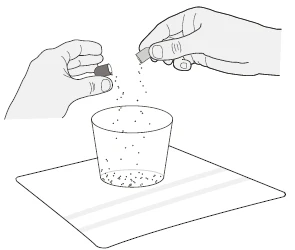 | |
| Step 3. Place a clean, empty glass on a paper towel. | Figure A |
| Step 4. Tap the capsule gently to loosen its contents. | |
| Step 5. Hold the capsule over the clean, empty glass to avoid spills. | |
| Step 6. Open the capsule by gently pressing on it and separating the two ends with a slight twisting motion. Pour the contents into the clean glass (Figure A). | |
Step 7. Tap both parts of the capsule shell and check that all the contents have been emptied into the glass. •If you accidentally spilled the capsule contents outside the glass, discard the contents of the glass and use another capsule. Proceed to Step C1 for cleaning instructions, then repeat the procedure starting from Step 1.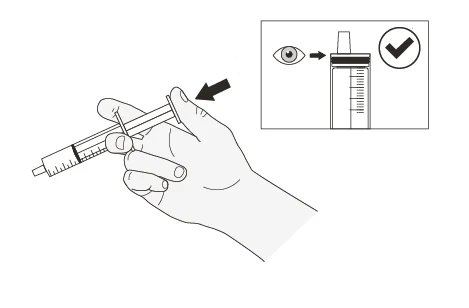 | |
| Step 8. Push the plunger of the oral syringe all the way in to remove any air inside the syringe (Figure B). | Figure B |
| Step 9. Take the glass of drinking water or milk at room temperature (below 30°C). Using the syringe, draw up the exact amount* of drinking water or milk at room temperature from the glass (Figure C). *Your healthcare provider will tell you how much liquid to draw up. Do not use any other type of liquid. | Figure C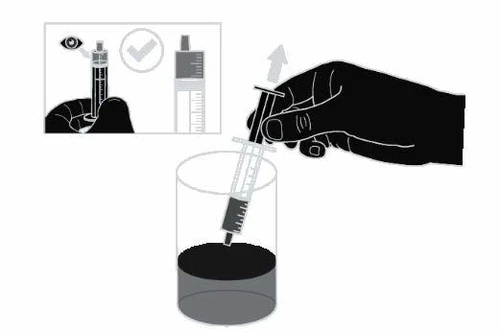 |
| Step 10. Add the water or milk drawn up with the syringe into the glass where you poured the capsule contents (Figure D). | Figure D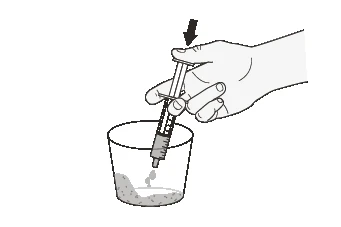 |
| Step 11. Let the suspension stand for 15 minutes (Figure E). Note: This step is important to obtain a homogeneous suspension. Otherwise, you may not receive the correct dose. | Figure E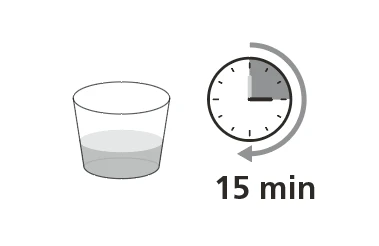 |
| Step 12. Swirl the suspension several times to mix the medicine evenly in the liquid (Figure F). Note: If water was used, the suspension will appear cloudy. | Figure F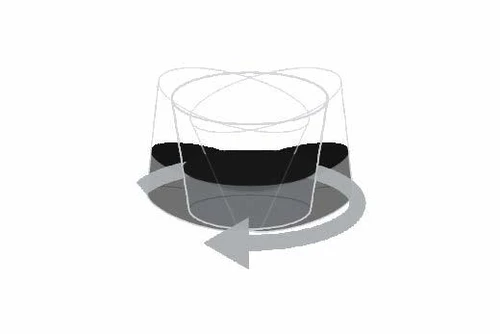 |
| Step 13. Push the plunger of the syringe all the way in to remove any air inside the syringe (Figure G). | Figure G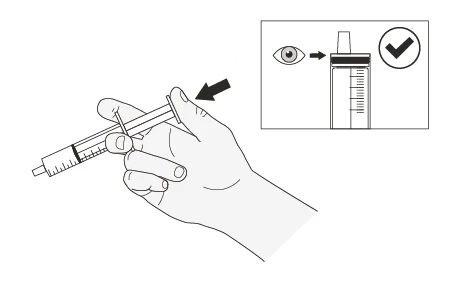 |
| Step 14. Swirl the medicine glass again before inserting the syringe into it (Figure H). | Figure H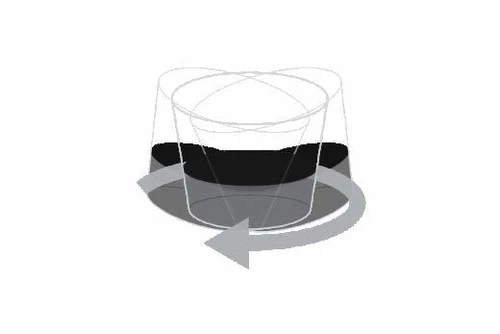 |
| Step 15. Immediately insert the syringe into the glass, slowly pull back the plunger, and draw up the exact amount of suspension corresponding to your prescribed dose of Rozlytrek (Figure I). •Your healthcare provider will tell you how much suspension to draw up for your prescribed dose. •Do not delay drawing up the suspension. If left too long, the medicine may settle at the bottom, and you may not receive the correct dose. | Figure I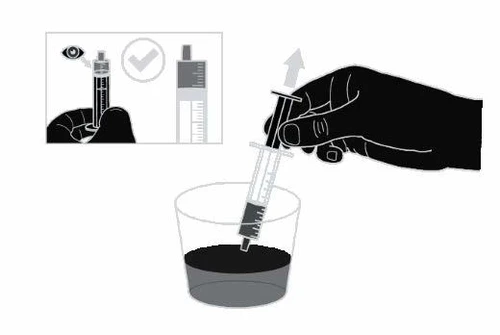 |
| Step 16. Check the amount of liquid in the syringe (Figure J). With the tip of the syringe pointing upward, verify: •that you have drawn up the correct amount of suspension; •that there are no large bubbles. Note: If you did not draw up the correct amount or if large bubbles are present: •reinsert the syringe into the glass; •allow the medicine to flow back into the glass; •draw up the medicine again (follow steps from Step 15). Shake the syringe briskly. Administer Rozlytrek immediately after drawing it into the syringe. If not administered within 2 hours, discard the medicine in the syringe. Proceed to Step C1 for cleaning instructions, then repeat the procedure starting from Step 2 to mix a new dose. | Figure J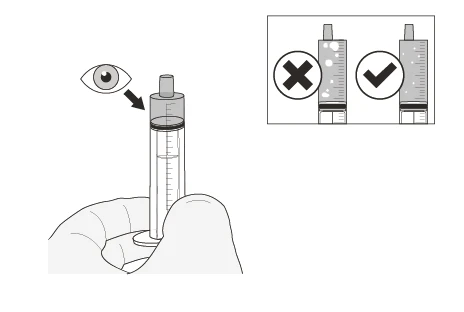 |
Oral administration
| Step A1. The patient should be seated with a straight back when administering an oral dose of Rozlytrek (Figure K). Insert the oral syringe into the mouth with the tip placed along one of the cheeks. Slowly push the plunger all the way down. Note: administering Rozlytrek too quickly may cause choking. | Figure K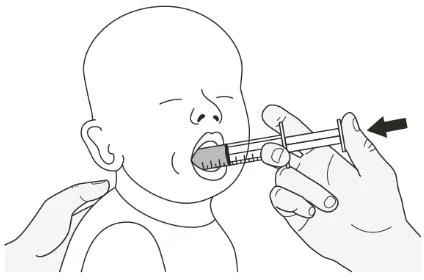 |
| Step A2. Check that no more medicine remains in the oral syringe (Figure L). If any suspension remains in the oral syringe, repeat the steps in Step A1. | Figure L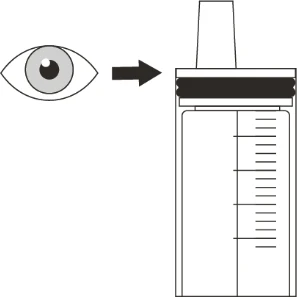 |
| Step A3. Administer a small amount of water immediately after giving the prescribed dose of Rozlytrek. If a strong aftertaste occurs, breastfeeding or giving milk to the child is possible. | |
Administration via gastric or nasogastric tube
| You may take or administer the suspension through a gastric or nasogastric tube placed by a healthcare provider. Check the manufacturer's instructions for the appropriate type and size of the enteral tube. Ensure that the tube has a diameter of at least 8 French or larger to prevent clogging when administering doses equal to or greater than 3 mL. For doses of Rozlytrek equal to or greater than 3 mL, divide the dose and administer it in at least two parts. Flush the tube with the same volume of water or milk after each part is administered. Neonates and children with fluid restrictions may require minimal flush volumes between 1 mL and 3 mL when administering Rozlytrek; adjust the aliquots accordingly. For doses of Rozlytrek of 30 mL, divide the dose into at least three 10 mL portions. Flush the tube with the same volume of water or milk after each portion. The tube must be flushed with water or milk after administration of Rozlytrek. If you have any doubts, consult your healthcare provider. | ||
| Step B1. Insert the tip of the syringe into the nasogastric/gastric tube. Slowly push the plunger all the way down to administer the full dose of Rozlytrek (Figures M1 and M2). | Figure M1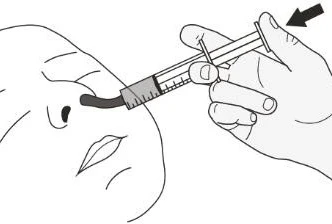 | Figure M2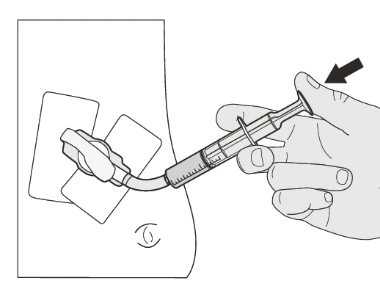 |
| Step B2. Check that no medicine remains in the syringe (Figure N). | Figure N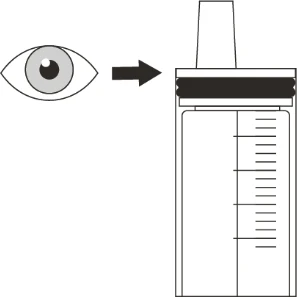 | |
| Step B3. Flush the nasogastric/gastric tube with water or milk* immediately after administering the prescribed dose (Figures O1 and O2). *Your healthcare provider will advise you on the amount of water or milk to use | Figure O1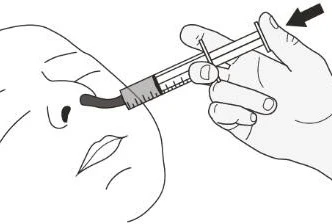 | Figure O2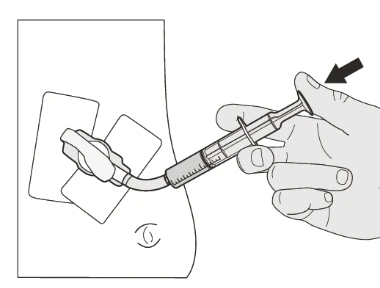 |
| for flushing. | ||
| Step C1. •Wash your hands and clean all materials used to administer Rozlytrek. •Remove the syringe plunger from the syringe barrel. •Use only clean water to rinse the syringe components and the glass used to prepare the suspension. Allow all materials to air dry before next use. •Reinsert the syringe plunger into the barrel once dry. •Any unused medicine and waste materials, including leftover (unadministered) suspension, must be disposed of in accordance with local regulations. Leftover (unadministered) suspension must not be disposed of via wastewater. •Ask your pharmacist how to properly dispose of medicines you no longer use. This will help protect the environment. | ||
Storage of Rozlytrek
- Store the medicine at temperatures below 30 °C in the original packaging and keep the bottle tightly closed to protect it from moisture.
- Rozlytrek must be discarded if it has been exposed to temperatures above 30 °C; follow the disposal instructions provided in section C1 and paragraph 5 of the package leaflet.
- After preparation as an oral suspension, store the suspension at temperatures below 30 °C and use it within 2 hours of preparation.
- Always keep Rozlytrek out of the sight and reach of children.
Patient information leaflet
Rozlytrek 50 mg coated granules in sachet
entrectinib
This medicinal product is subject to additional monitoring. This will allow for rapid identification of new safety information. You can help by reporting any side effects you experience while taking this medicine. See the end of section 4 for information on how to report side effects.
Please read this leaflet carefully before taking this medicine because it contains important information for you.
- Keep this leaflet. You may need to read it again.
- If you have any questions, ask your doctor, pharmacist, or nurse.
- This medicine has been prescribed for you only. Do not give it to other people, even if their symptoms are the same as yours, as it may be harmful.
- If you experience any side effect, including those not listed in this leaflet, inform your doctor, pharmacist, or nurse. See section 4.
- This leaflet has been written as if the person reading it is the patient. If you are administering this medicine to a child, replace "you" with "the child" throughout the document.
Contents of this leaflet
- What Rozlytrek is and what it is used for
- What you need to know before taking Rozlytrek
- How to take Rozlytrek
- Possible side effects
- How to store Rozlytrek
- Contents of the pack and other information
- Instructions for use
1. What Rozlytrek is and what it is used for
What Rozlytrek is
Rozlytrek is an anticancer medicine that contains the active substance “entrectinib”.
What Rozlytrek is used for
Rozlytrek is used to treat:
- adults, adolescents, and children over 1 month of age with solid tumours in various parts of the body caused by a genetic alteration known as “neurotrophic tyrosine kinase receptor” (NTRK), or
- adults with a type of lung cancer called “non-small cell lung cancer” (NSCLC) caused by a genetic alteration known as “ROS1”.
This medicine is used for solid tumours when:
- a test has shown that tumour cells have an alteration in genes called “NTRK” (see section “How Rozlytrek works” below), and
- the tumour has spread within the affected organ or to other organs of the body, or surgical removal of the tumour would likely result in serious complications, and
- you have not previously been treated with medicines called “NTRK inhibitors”, and
- other treatments have not been effective or are not suitable for you.
This medicine is used if the lung cancer (NSCLC):
- is “ROS1-positive”, meaning that tumour cells have an alteration in the gene called “ROS1” (see section “How Rozlytrek works” below), and
- is advanced, for example, has spread to other parts of the body (metastatic), and
- you have not previously been treated with medicines called “ROS1 inhibitors”.
How Rozlytrek works
Rozlytrek works by blocking the activity of abnormal enzymes caused by alterations in the NTRK or ROS1 genes that produce these enzymes. Defective enzymes stimulate the proliferation of tumour cells.
Rozlytrek can slow down or stop tumour growth and may also help reduce tumour size.
2. What you should know before taking Rozlytrek
Do not take Rozlytrek
- if you are allergic to entrectinib or to any of the other ingredients of this medicine (listed in section 6).
If you have any doubts, consult your doctor, pharmacist, or nurse before taking Rozlytrek.
Warnings and precautions
Talk to your doctor, pharmacist, or nurse before taking Rozlytrek if:
- you have recently experienced memory loss, confusion, hallucinations, or changes in mental status;
- you have had bone fractures or are prone to conditions that may increase the risk of bone breakage, known as “osteoporosis” or “osteopenia”;
- you are taking medicines to lower uric acid levels in the blood;
- you have or have had heart failure (the heart’s inability to pump blood adequately to supply oxygen to the body), signs of which may include cough, shortness of breath, or swelling in the legs or arms;
- you have or have had a heart condition or a problem with the heart’s electrical conduction system called “QTc interval prolongation,” which may be detected by an “electrocardiogram” (ECG) or due to low levels of electrolytes in the blood;
- you have a hereditary condition called “galactose intolerance,” “congenital lactase deficiency,” or “glucose-galactose malabsorption.”
If any of the above situations apply to you (or if you have any doubts), consult your doctor,
pharmacist, or nurse before taking Rozlytrek.
Other medicines and Rozlytrek
Tell your doctor or pharmacist if you are taking, have recently taken, or might take any other
medicines. Rozlytrek may affect how some other medicines work and vice versa.
In particular, inform your doctor or pharmacist if you are taking any of the following medicines used for:
- treating fungal infections (antifungals), such as ketoconazole, itraconazole, voriconazole, posaconazole;
- treating AIDS/HIV, such as ritonavir or saquinavir;
- treating depression, such as paroxetine, fluvoxamine, or a herbal remedy – St. John’s wort;
- stopping seizures or epileptic fits, such as phenytoin, carbamazepine, or phenobarbital;
- treating tuberculosis, such as rifampicin or rifabutin;
- treating solid tumours and blood cancers, such as topotecan, lapatinib, mitoxantrone, apalutamide, or methotrexate;
- treating joint inflammation or autoimmune joint diseases (rheumatoid arthritis) – methotrexate;
- treating migraines – ergotamine;
- treating severe pain – fentanyl;
- treating mental illnesses (psychosis) or Tourette syndrome – pimozide;
- treating irregular heart rhythm – quinidine;
- preventing blood clots, such as warfarin or dabigatran etexilate;
- treating gastric reflux (heartburn), such as cisapride or omeprazole;
- lowering cholesterol levels in the blood, such as atorvastatin, pravastatin, or rosuvastatin;
- suppressing the body’s immune system or preventing organ transplant rejection, such as sirolimus, tacrolimus, or ciclosporin;
- lowering blood sugar levels, such as repaglinide or tolbutamide;
- treating high blood pressure, such as bosentan, felodipine, nifedipine, or verapamil;
- treating inflammation or nausea – dexamethasone.
If any of the above situations apply to you (or if you have any doubts), consult your doctor or
pharmacist before taking Rozlytrek.
Rozlytrek with food and drinks
Do not consume grapefruit, grapefruit juice, or bitter oranges during treatment with this
medicine, as they may increase the amount of medicine in your blood to potentially dangerous levels.
Women and contraception
Avoid becoming pregnant during treatment with this medicine, as it could be harmful to the unborn child. If you are a woman of childbearing age, you must use highly effective contraceptive methods:
- during treatment, and
- for at least 5 weeks after stopping treatment.
It is not known whether Rozlytrek may reduce the effectiveness of contraceptives (birth control pills or hormonal implants). You should use another reliable contraceptive method, such as a barrier method (e.g. condom).
Consult your doctor to determine which contraceptive methods are suitable for you and your partner.
Men and contraception
Your partner must avoid becoming pregnant during your treatment with this medicine, as it could be harmful to the unborn child. If your partner is a woman of childbearing age, she must use highly effective contraceptive methods:
- during your treatment, and
- for at least 3 months after stopping treatment.
Consult your doctor to determine which contraceptive methods are suitable for you and your partner.
Pregnancy
- Do not take Rozlytrek if you are pregnant, as it could be harmful to the unborn child.
- If you become pregnant during treatment with this medicine or within 5 weeks after the last dose, inform your doctor immediately.
Breastfeeding
Do not breastfeed during treatment with this medicine, as it is not known whether Rozlytrek may pass into breast milk and could therefore be harmful to the infant.
Driving, cycling, and using machines
Rozlytrek may affect your ability to drive, cycle, or operate machinery. Rozlytrek may cause:
- blurred vision;
- tiredness, dizziness, or fainting;
- changes in mental status, confusion, or seeing things that are not there (hallucinations).
If you experience these symptoms, you must avoid driving, cycling, or operating heavy machinery until you feel better. Consult your doctor or pharmacist to determine whether you can drive, cycle, or use machinery.
Rozlytrek contains sodium
This medicine contains less than 1 mmol (23 mg) of sodium per 600 mg dose, i.e. it is essentially “sodium-free”.
3. How to take Rozlytrek
Take this medicine exactly as directed by your doctor or pharmacist. If you have any doubts, consult your doctor or pharmacist.
How much Rozlytrek to take
For adults:
- The recommended dose is 12 sachets once daily (for a total of 600 mg). The sachets are 50 mg each.
- If you do not feel well, your doctor may reduce the dose or temporarily or permanently discontinue treatment.
For adolescents and children older than 1 month:
- The child's doctor will determine the correct dose based on the child's height and weight.
- The child's doctor will review and adjust the dose as necessary.
Rozlytrek is also available in hard capsules for patients able to swallow capsules whole. The capsules can also be prepared as an oral suspension for patients unable to swallow soft foods or who require a feeding tube.
How to take Rozlytrek
Take the film-coated granules of Rozlytrek by mouth, sprinkled on soft food.
- Do not divide the contents of a sachet of film-coated granules to prepare a lower dose.
- The film-coated granules should be sprinkled onto one or more spoonfuls of soft food (e.g., apple sauce, yogurt, or pudding) and taken within 20 minutes of mixing.
- Do not crush or chew the film-coated granules to avoid a bitter taste.
- Drink water after taking the medicine.
- The film-coated granules must not be used with a feeding tube, as they may cause blockage.
Read the “Instructions for Use” at the end of this leaflet
Read and carefully follow the “Instructions for Use” at the end of this leaflet on how to take or administer Rozlytrek. These instructions provide further details on how to prepare a dose using the film-coated granules and soft food.
If you vomit after taking Rozlytrek
If the patient vomits or spits out all or part of the dose shortly after administration, consult the patient's doctor or pharmacist for advice on what to do next.
If you take more Rozlytrek than you should
If you take more Rozlytrek than you should, contact a doctor or go to hospital immediately. Take the medicine pack and this leaflet with you.
If you forget to take Rozlytrek
- If there are more than 12 hours until the next dose, take the missed dose as soon as you remember.
- If there are less than 12 hours until the next dose, do not take the missed dose. Take the next dose at the usual time.
- Do not take a double dose to make up for a forgotten dose.
If you stop taking Rozlytrek
Do not stop treatment with this medicine without first consulting your doctor. It is important to take Rozlytrek every day for the entire duration of the prescribed treatment.
If you have any questions about how to use this medicine, ask your doctor, pharmacist, or nurse.
4. Possible side effects
Like all medicines, this medicine can cause side effects, although not everyone experiences them. The following side effects may occur with this medicine.
Serious side effects
Contact your doctor immediately if you notice any of the following serious side effects. Your doctor may reduce the dose or temporarily or permanently stop treatment if:
- cough, shortness of breath, or swelling in the legs or arms (fluid retention), which may be signs of heart problems (congestive heart failure);
- confusion, mood changes, memory problems, or seeing things that are not there (hallucinations);
- dizziness or lightheadedness, or irregular or rapid heartbeat, which could be signs of heart rhythm abnormalities;
- joint pain, bone pain, deformities, or changes in mobility, as these could be signs of fractures;
- kidney problems or arthritis, which could result from high levels of uric acid in the blood.
Contact your doctor immediately if you notice any of the above side effects.
Other side effects
Tell your doctor, pharmacist, or nurse if you notice any of the following side effects:
Very common: may affect more than 1 in 10 people:
- feeling tired;
- changes in taste;
- feeling unsteady or dizzy;
- blurred vision;
- swelling;
- diarrhoea or constipation;
- nausea;
- difficulty swallowing;
- abnormal sense of touch, such as itching, tingling, or burning sensations;
- skin rash;
- shortness of breath;
- cough or fever;
- headache;
- weight gain;
- vomiting;
- muscle pain or weakness;
- pain, including back pain, neck pain, musculoskeletal pain, limb pain;
- stomach ache;
- joint pain;
- unpleasant abnormal sensations in arms or legs;
- loss of muscle coordination, unsteadiness when walking;
- disturbances in normal sleep-wake rhythm;
- lung infection;
- urinary tract infection;
- inability to completely empty the bladder;
- loss of appetite;
- low blood pressure;
- decrease in the number of a type of white blood cells called neutrophils;
- too few red blood cells (anaemia);
- increased levels of certain liver enzymes (AST/ALT) in the blood;
- increased levels of creatinine (a substance normally removed from the body by the kidneys in urine) in the blood.
Common: may affect up to 1 in 10 people:
- mood disorders;
- dehydration;
- fluid accumulation around the lungs;
- fainting;
- increased sensitivity of the skin to sunlight.
Uncommon: may affect less than 1 in 100 people:
- changes in certain chemicals in the blood caused by the rapid destruction of tumour cells, which may damage organs including the kidneys, heart, and liver;
- inflammation of the heart muscle.
Tell your doctor, pharmacist, or nurse if you notice any of the side effects listed above.
Reporting of side effects
If you experience any side effects, including those not listed in this leaflet, talk to your doctor, pharmacist, or nurse. You can also report side effects directly via the national reporting system listed in Annex V. By reporting side effects, you can help provide more information on the safety of this medicine.
5. How to store Rozlytrek
- Keep this medicine out of the sight and reach of children.
- Do not use this medicine after the expiry date which is stated on the carton and bottle after "Exp.". The expiry date refers to the last day of that month.
- Keep the film-coated granules in the original packaging to protect them from moisture.
- After mixing the medicine with soft food, use it within 20 minutes of preparation.
- Do not dispose of any medicine via wastewater. Ask your pharmacist how to dispose of medicines no longer in use. This will help protect the environment.
6. Package contents and other information
What Rozlytrek contains
The active substance is entrectinib. Each sachet contains 50 mg of entrectinib.
The other components are:
- Granule core: microcrystalline cellulose (E460), tartaric acid (E334), colloidal anhydrous silica (E551), croscarmellose sodium (E468), sodium stearyl fumarate, mannitol (E421), magnesium stearate (E470b);
- Film coating: titanium dioxide (E171), talc, yellow iron oxide (E172), red iron oxide (E172), black iron oxide (E172), polyethylene glycol 3350, polyvinyl alcohol (partially hydrolysed).
Description of the appearance of Rozlytrek and the contents of the pack
The 50 mg film-coated granules of Rozlytrek are brownish-orange or greyish-orange granules contained in sachets. Each box contains 42 sachets.
Marketing Authorisation Holder
Roche Registration GmbH
Emil-Barell-Strasse 1
79639 Grenzach-Wyhlen
Germany
Manufacturer
Roche Pharma AG
Emil-Barell-Strasse 1
79639 Grenzach-Wyhlen
Germany
For further information about this medicine, please contact the local representative of the marketing authorisation holder:
België/Belgique/Belgien Latvija
Luxembourg/Luxemburg Roche Latvija SIA
N.V. Roche S.A. Tel: +371 - 6 7039831
België/Belgique/Belgien
Tél/Tel: +32 (0) 2 525 82 11 Lietuva
UAB “Roche Lietuva”
Tel: +370 5 2546799
България )
Рош България ЕООД
Тел: +359 2 474 5444
Česká republika Magyarország
Roche s. r. O. Roche (Magyarország) Kft.
Tel: +420 - 2 20382111 Tel: +36 - 1 279 4500
Danmark
Roche Pharmaceuticals A/S
Tlf: +45 - 36 39 99 99
Deutschland Nederland
Roche Pharma AG Roche Nederland B.V.
Tel: +49 (0) 7624 140 Tel: +31 (0) 348 438050
Eesti Norge
Roche Eesti OÜ Roche Norge AS
Tel: + 372 - 6 177 380 Tlf: +47 - 22 78 90 00
Ελλάδα, , Κύπρος Österreich
Roche (Hellas) A.E. Roche Austria GmbH
Ελλάδα Tel: +43 (0) 1 27739
Τηλ: +30 210 61 66 100
España Polska
Roche Farma S.A. Roche Polska Sp.z o.o.
Tel: +34 - 91 324 81 00 Tel: +48 - 22 345 18 88
France Portugal
Roche Roche Farmacêutica Química, Lda
Tél: +33 (0) 1 47 61 40 00 Tel: +351 - 21 425 70 00
Hrvatska România
Roche d.o.o. Roche România S.R.L.
Tel: +385 1 4722 333 Tel: +40 21 206 47 01
Ireland, Malta Slovenija
Roche Products (Ireland) Ltd. Roche farmacevtska družba d.o.o.
Ireland/L-Irlanda Tel: +386 - 1 360 26 00
Tel: +353 (0) 1 469 0700
Ísland Slovenská republika
Roche Pharmaceuticals A/S Roche Slovensko, s.r.o.
c/o Icepharma hf Tel: +421 - 2 52638201
Sími: +354 540 8000
Italia Suomi/Finland
Roche S.p.A. Roche Oy
Tel: +39 - 039 2471 Puh/Tel: +358 (0) 10 554 500
Κύπρος Sverige
Roche (Hellas) A.E. Roche AB
Τηλ: +30 210 61 66 100 Tel: +46 (0) 8 726 1200
Latvija
Roche Latvija SIA
Tel: +371 - 6 7039831
This medicine has been granted a marketing authorisation under exceptional circumstances. This means that further data on this medicine will be provided.
The European Medicines Agency will review new information on this medicine at least annually, and this package leaflet will be updated if necessary.
Other sources of information
More detailed information on this medicine is available on the website of the European Medicines Agency: http://www.ema.europa.eu .
7. Instructions for use
Rozlytrek
(entrectinib)
Film-coated granules for oral use
These instructions for use contain information on how to prepare, take, and administer
Rozlytrek film-coated granules.
Before you start
Read these instructions for use before taking or administering Rozlytrek film-coated granules.
- Ask your healthcare provider to show you how to use Rozlytrek before starting treatment.
- If you have any doubts about the use of Rozlytrek, consult your healthcare provider.
Important information you should know before preparing, taking, or administering Rozlytrek
- Your healthcare provider must show you how to correctly prepare, take, or administer a daily dose of Rozlytrek film-coated granules. Always take or administer Rozlytrek film-coated granules exactly as instructed by your healthcare provider.
- Do not give or administer Rozlytrek to another person unless they have been shown how to properly prepare, take, or administer Rozlytrek.
- Wash your hands before and after handling Rozlytrek.
- Before use, check the expiration date and whether the product is damaged. Do not use the medicine if it has expired or is damaged.
- If the patient vomits or partially or completely spits out the administered dose shortly after taking it, consult the patient’s doctor or pharmacist for advice on what to do.
- Administer the medicine within 20 minutes of preparation.
Administration of Rozlytrek film-coated granules
Your healthcare provider will determine the correct dose of Rozlytrek for you or the child.
- Each sachet contains 50 mg of Rozlytrek.
- Do not divide the contents of a sachet of film-coated granules to prepare a lower dose.
- Take Rozlytrek film-coated granules by mouth, sprinkled on soft food. The film-coated granules should be sprinkled on one or more spoonfuls of soft food (e.g., apple puree, yogurt, or pudding) and taken within 20 minutes of preparation.
- Do not crush or chew the film-coated granules to avoid a bitter taste.
- Drink water after taking the medicine.
- The film-coated granules must not be used with a feeding tube, as they may cause blockage.
Preparation for administration of Rozlytrek
| Step 1. Wash your hands. | |
Step 2. To administer a dose, you will need: • the number of sachets required for the prescribed dose; • a clean paper towel or clean plate; • a clean spoon; • soft food (for example, applesauce, yogurt, or pudding).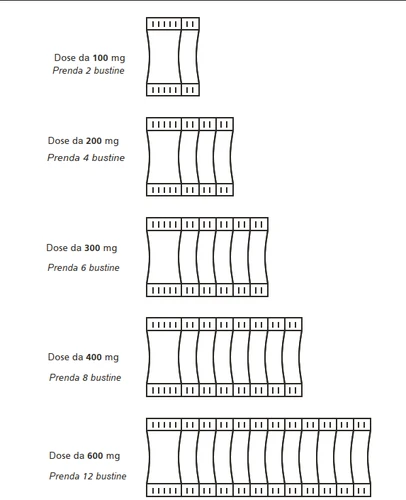 | |
| Step 3. Count the number of sachets (each containing 50 mg) needed to administer the prescribed dose (Figure A). | Figure A |
| Step 4. Tap the sachet gently to ensure that the film-coated granules accumulate on one side. Hold the sachet on the side where the film-coated granules have collected, and open the sachet with your hand or with scissors (Figure B). Note: Be careful not to cut the film-coated granules with the scissors. | Figure B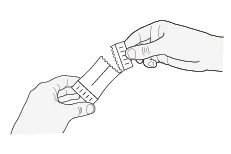 |
| Step 5. Take a spoonful of soft food and hold the spoon over the paper towel or clean plate. Sprinkle the prescribed number of sachets onto the spoonful of soft food (Figure C). Tap the sachets gently to ensure all the film-coated granules are dispersed onto the food. Note: You may need to use more than | 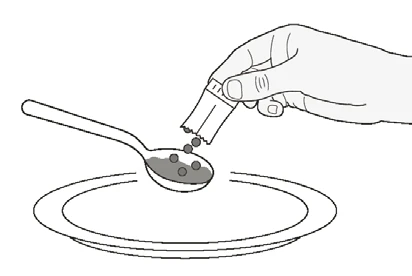 |
| 1 spoonful of soft food to administer the prescribed dose. | Figure C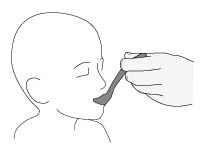 |
| Step 6. Take or administer the spoonful of soft food with the sprinkled film-coated granules immediately (Figure D). If you cannot take or administer it immediately, do so within 20 minutes after sprinkling the film-coated granules onto the food. Note: Do not crush or chew, to avoid a bitter taste. If the film-coated granules are left in the soft food for too long, the coating may dissolve, resulting in a bitter taste. If not taken within 20 minutes, discard the soft food with the film-coated granules and prepare a new dose (starting from Step 2). | Figure D |
| Step 7. Give patients a small amount of water after administering Rozlytrek to ensure that all the film-coated granules have been swallowed (Figure E). Patients may be given a meal or a beverage of their choice after administration of Rozlytrek to improve taste. | Figure E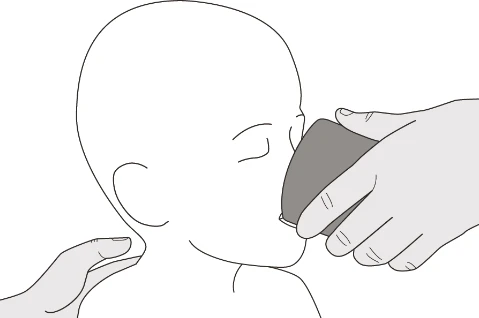 |
| Step 8. Check the mouth to ensure that all the film-coated granules have been properly swallowed (Figure F). If any film-coated granules remain, give a small amount of water. | Figure F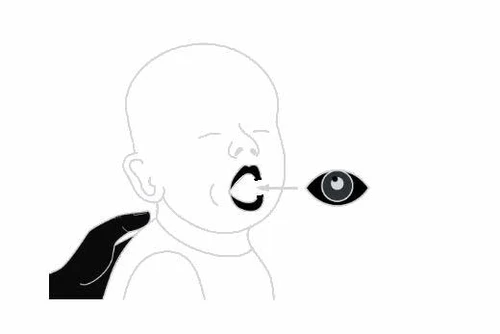 |
| Step 9. Wash your hands and clean any materials used to administer Rozlytrek. Dispose of single-use materials according to local regulations. | |
Storage of Rozlytrek
- Store the medicine at temperatures below 30 °C and keep the film-coated granules in the original packaging to protect them from moisture.
- Rozlytrek must be discarded if it has been exposed to temperatures above 30 °C; refer to section 5 of the package leaflet.
- Always keep Rozlytrek out of the sight and reach of children.
ANNEX IV
SCIENTIFIC CONCLUSIONS AND REASONS FOR THE CHANGE IN THE TERMS OF THE
MARKETING AUTHORISATION(S)
Scientific conclusions
Taking into account the PRAC assessment report on the PSURs for entrectinib, the PRAC's scientific conclusions are as follows:
In light of the available data on myocarditis from clinical studies, the literature, and spontaneous reports—including nine cases showing a close temporal relationship and a positive dechallenge—the PRAC considers that a causal relationship between entrectinib and myocarditis is at least a reasonable possibility. The PRAC concluded that the product information for medicines containing entrectinib should be amended accordingly.
After reviewing the PRAC's recommendation, the CHMP agrees with the PRAC's overall conclusions and the reasons for the recommendation.
Reasons for the change in the terms of the marketing authorisation(s)
Based on the scientific conclusions regarding entrectinib, the CHMP is of the opinion that the benefit-risk balance of the medicinal product containing entrectinib remains unchanged, subject to the proposed amendments to the product information.
The CHMP recommends that the terms of the marketing authorisation(s) be amended.