Romvimza
Italy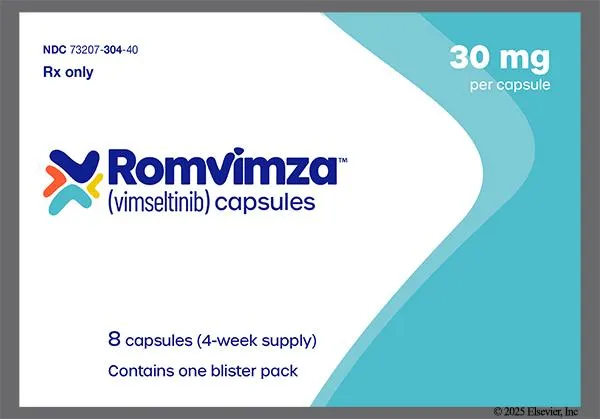
Table of Contents
- Package leaflet: Information for the patient
- ROMVIMZA 14 mg hard capsules, 20 mg hard capsules, 30 mg hard capsules
- 1. What ROMVIMZA is and what it is used for
- 2. What you should know before taking ROMVIMZA
- 3. How to take ROMVIMZA
- 4. Possible side effects
- 5. How to store ROMVIMZA
- 6. Package contents and other information
Package leaflet: Information for the patient
ROMVIMZA 14 mg hard capsules, 20 mg hard capsules, 30 mg hard capsules
vimseltinib
This medicinal product is subject to additional monitoring. This will allow for rapid identification of new safety information. You can help by reporting any side effects you experience while taking this medicine. See the end of section 4 for information on how to report side effects.
Please read this leaflet carefully before taking this medicine, as it contains important information for you.
- Keep this leaflet. You may need to read it again.
- If you have any questions, ask your doctor or pharmacist.
- This medicine has been prescribed for you only. Do not give it to other people, even if their symptoms are the same as yours, as it may be harmful.
- If you experience any side effect, including those not listed in this leaflet, tell your doctor or pharmacist. See section 4.
Contents of this leaflet
- What ROMVIMZA is and what it is used for
- What you need to know before taking ROMVIMZA
- How to take ROMVIMZA
- Possible side effects
- How to store ROMVIMZA
- Contents of the pack and other information
1. What ROMVIMZA is and what it is used for
ROMVIMZA contains the active substance vimseltinib, a kinase inhibitor.
It is used in adults to treat tenosynovial giant cell tumours (TGCT) when they cause
physical functional problems and when surgery could lead to severe complications or
disability.
TGCTs are rare tumours affecting the joints. Although typically non-malignant, these tumours are locally aggressive and may sometimes grow and damage the joints and surrounding tissues. In very rare cases, TGCTs can become malignant tumours.
The active substance in ROMVIMZA, vimseltinib, blocks the activity of certain proteins involved in the growth of TGCT.
2. What you should know before taking ROMVIMZA
Do not take ROMVIMZA:
- if you are allergic to vimseltinib or to any of the other ingredients of this medicine (listed in section 6);
- if you are pregnant (for more information, see section “Pregnancy and contraception”).
Warnings and precautions
Long-term safety
ROMVIMZA is a new medicine and its long-term effects are still being studied. It may
affect the liver, skin, brain, and other parts of the body.
Some of the reported side effects include changes in blood tests, skin reactions, and increased blood pressure. There may also be a risk of memory problems, but there is uncertainty about this risk over the long term.
Talk to your doctor, pharmacist, or nurse before taking ROMVIMZA:
- if you have high blood pressure. Treatment with ROMVIMZA may increase blood pressure.
- if you are pregnant or planning to become pregnant. This medicine may be harmful to the unborn baby. Women who could become pregnant must use effective birth control methods (contraception) during treatment with ROMVIMZA and for 30 days after the last dose. For more information, see “Pregnancy and contraception”.
- if your kidneys or liver are not working properly. Your doctor will need to decide whether this medicine is suitable for you. In clinical studies, treatment with ROMVIMZA often led to increased levels of a substance called creatinine, which may be a sign of kidney problems. However, there is not yet enough information to fully understand how this might affect your health.
- if you have severe itching of the skin. Your doctor may temporarily interrupt treatment or prescribe a lower dose of ROMVIMZA.
- if you know you have high levels of enzymes in your blood or high bilirubin levels, or if you have liver disease or bile duct disease. Your doctor will need to decide whether this medicine is suitable for you.
Regular blood tests
Before starting treatment with ROMVIMZA, your doctor will check your liver health with
blood tests. These tests will be performed once a month for the first two months, then once
every three months during the first year of treatment. After that, the tests will be performed as needed based on your health condition. Blood tests help maintain stable liver health throughout treatment. This monitoring helps detect any early signs of liver problems. If you have concerns, talk to your doctor, pharmacist, or nurse.
Children and adolescents
This medicine must not be given to children or adolescents under 18 years of age,
as there is no information available on its use in this age group.
Other medicines and ROMVIMZA
Tell your doctor or pharmacist if you are taking, have recently taken, or might take
any other medicines. This includes medicines obtained without a prescription,
vitamins, and herbal supplements. These may alter the effect of ROMVIMZA or cause
side effects.
Tell your doctor if you are taking any of the following medicines. Taking
these medicines together with ROMVIMZA may increase their concentrations in the body and increase the risk of side effects associated with these medicines:
- rosuvastatin (used to lower cholesterol)
- metformin (used to treat type 2 diabetes by controlling blood sugar levels)
- dabigatran (a blood thinner used to treat and prevent blood clots and to prevent stroke in people with atrial fibrillation, a common heart rhythm disorder)
- digoxin (used to treat heart rhythm disorders and heart failure)
It is preferable not to take these medicines together with ROMVIMZA. However, if your doctor decides
you must take these medicines, consult them about the best way to take them.
Pregnancy and contraception
ROMVIMZA may be harmful to the unborn baby. If you are pregnant, suspect you may be pregnant, or are planning a pregnancy, consult your doctor before taking this medicine.
Do not take ROMVIMZA if you are pregnant. If you are a woman of childbearing potential, you must use effective contraception during treatment with ROMVIMZA and for 30 days after the last dose. If you use hormonal contraceptives, add a barrier method of contraception (such as condoms).
If you are a woman of childbearing potential, you will be asked to undergo a pregnancy test before starting treatment with ROMVIMZA.
Fertility
In animal studies, this medicine has been shown to reduce sperm quality. It is not known whether this effect occurs in humans. Talk to your doctor if you have concerns about fertility.
Breast-feeding
Do not breast-feed during treatment with ROMVIMZA. It is not known whether this medicine passes into breast milk; therefore, there may be a risk to the breast-fed infant.
Driving and using machines
ROMVIMZA has a minor effect on the ability to drive and use machines. If you experience extreme tiredness, lack of energy, or blurred vision, do not drive, operate tools, or use machinery until you feel better.
ROMVIMZA 14 mg, 20 mg and 30 mg hard capsules contain lactose monohydrate
If your doctor has diagnosed you with an intolerance to certain sugars, contact them before taking
this medicine.
ROMVIMZA 14 mg hard capsules contain the azo dye sunset yellow FCF (E 110)
It may cause allergic reactions.
ROMVIMZA 20 mg hard capsules contain the azo dye sunset yellow FCF (E 110) and
tartrazine (E 102)
They may cause allergic reactions.
3. How to take ROMVIMZA
Your treatment will be initiated by a physician experienced in the treatment of the diseases for which
ROMVIMZA is indicated. Take this medicine exactly as instructed by your physician. If you have any doubts, consult your physician.
The recommended dose is one 30 mg capsule twice weekly, with at least 72 hours between doses.
Capsules may be taken regardless of meals.
Swallow the capsules whole with a glass of water, without opening, breaking, or chewing them. Do not take any capsules that are broken, cracked, or damaged. The effects associated with taking broken capsules are unknown.
Taking a lower dose
- If you experience intolerable adverse effects after a 30 mg dose, your physician will temporarily discontinue the medicine. When your physician considers that your condition has improved, a reduced dose (20 mg) will be prescribed.
- If you need to take a 20 mg dose, you must take one 20 mg capsule twice weekly, at least 72 hours apart, regardless of meals.
- If you do not tolerate the 20 mg dose, a 14 mg dose will be administered. You will need to take one 14 mg capsule twice weekly, at least 72 hours apart, regardless of meals.
- If you do not tolerate the lowest dose of 14 mg, or if your physician considers it unsuitable for your condition, treatment with ROMVIMZA will be permanently discontinued.
If you take more ROMVIMZA than you should
If you or someone else accidentally takes too many capsules, seek urgent medical attention and do not forget to bring the medicine package and this leaflet with you.
If you forget to take ROMVIMZA
What to do if you miss a dose depends on how long it has been since you were supposed to take the medicine. If:
- less than 48 hours have passed since the scheduled dose: take the missed dose as soon as you remember, then take the next dose as planned.
- more than 48 hours have passed since the scheduled dose: skip the missed dose and take the next dose as planned. Do not take a double dose to make up for the missed dose.
If you stop treatment with ROMVIMZA
Do not stop taking this medicine without consulting your physician. It is important to continue taking ROMVIMZA even if symptoms improve, and until your physician decides to discontinue treatment.
If you have any doubts about how to use this medicine, consult your physician.
4. Possible side effects
Like all medicines, this medicine can cause side effects, although not everybody gets them.
The following side effects may occur with this medicine:
Very common (may affect more than 1 in 10 people):
- nerve damage (neuropathy), including damage to nerves in the arms and legs, causing pain or numbness, burning, and tingling; reduced sensitivity to touch, pain, and temperature;
- swelling around the eye or eyes (periorbital edema), including eyelids;
- watery eye or eyes (increased lacrimation);
- high blood pressure (hypertension);
- skin rash, including raised and/or flat red rashes; itchy rash; small raised acne-like nodules; skin redness;
- dry skin;
- skin itching;
- fatigue;
- facial swelling (facial edema);
- swelling of the arms, legs, or ankles (peripheral edema);
- general swelling;
- abnormal blood test results showing high levels of creatine phosphokinase in the blood;
- abnormal blood test results showing high levels of liver enzymes in the blood;
- abnormal blood test results showing high levels of creatinine in the blood;
- abnormal blood test results showing excessive levels of a fatty substance called cholesterol in the blood;
- blood tests showing low levels of white blood cells (neutrophils).
Common (may affect up to 1 in 10 people):
- dry eye;
- blurred vision.
Reporting of side effects
If you experience any side effects, including those not listed in this leaflet, talk to your doctor or pharmacist. You can also report side effects directly via the national reporting system listed in Annex V. Reporting side effects can help provide more information on the safety of this medicine.
5. How to store ROMVIMZA
Keep this medicine out of the sight and reach of children.
Do not use this medicine after the expiry date which is stated on the packaging after "Exp". The expiry date refers to the last day of that month.
This medicine does not require any special storage temperature. Store in the original packaging to protect the medicine from moisture.
Do not dispose of medicines via wastewater or household waste. Ask your pharmacist how to dispose of medicines you no longer use. This will help protect the environment.
6. Package contents and other information
What ROMVIMZA contains
ROMVIMZA 14 mg hard capsules
- The active substance is vimseltinib. Each hard capsule contains 14 mg of vimseltinib (as dihydrate).
- The other components are: Capsule contents: monohydrate lactose, crospovidone (E 1202) and magnesium stearate (E 470b). See section 2 “ROMVIMZA hard capsules contain monohydrate lactose” for excipients with known effects. Capsule coating: gelatin, titanium dioxide (E 171) and sunset yellow FCF (E 110). See section 2 “ROMVIMZA 14 mg hard capsules contain the azo dye sunset yellow FCF (E 110)” for excipients with known effects. Printing ink: shellac (E 904), propylene glycol (E 1520), potassium hydroxide (E 525), black iron oxide (E 172).
ROMVIMZA 20 mg hard capsules
-
The active substance is vimseltinib. Each hard capsule contains 20 mg of vimseltinib (as dihydrate).
-
The other components are: Capsule contents: monohydrate lactose, crospovidone (E 1202) and magnesium stearate (E 470b). See section 2 “ROMVIMZA hard capsules contain monohydrate lactose” for excipients with known effects. Capsule coating: gelatin, titanium dioxide (E 171), sunset yellow FCF (E 110) and
tartrazine (E 102). See section 2 “ROMVIMZA 20 mg hard capsules contain the azo dyes sunset yellow FCF (E 110) and tartrazine (E 102)” for excipients with known effects.
Printing ink: shellac (E 904), propylene glycol (E 1520), potassium hydroxide (E 525), black iron oxide (E 172).
ROMVIMZA 30 mg hard capsules -
The active substance is vimseltinib. Each hard capsule contains 30 mg of vimseltinib (as dihydrate).
-
The other components are: Capsule contents: monohydrate lactose, crospovidone (E 1202) and magnesium stearate (E 470b). See section 2 “ROMVIMZA hard capsules contain monohydrate lactose” for excipients with known effects. Capsule coating: gelatin, titanium dioxide (E 171), brilliant blue FCF (E 133) and erythrosine (E 127). Printing ink: shellac (E 904), propylene glycol (E 1520), potassium hydroxide (E 525), black iron oxide (E 172).
Description of the appearance of ROMVIMZA and contents of the pack
ROMVIMZA 14 mg hard capsules
The hard capsule has an opaque orange cap and an opaque white body. It is approximately 14 mm long and marked with the inscription “DCV14” in black ink. The plastic and aluminium blister contains 8 sealed capsules in a cardboard carton inside a box, sufficient for four weeks of treatment.
ROMVIMZA 20 mg hard capsules
The hard capsule has an opaque yellow cap and an opaque white body. It is approximately 18 mm long and marked with the inscription “DCV20” in black ink. The plastic and aluminium blister contains 8 sealed capsules in a cardboard carton inside a box, sufficient for four weeks of treatment.
ROMVIMZA 30 mg hard capsules
The hard capsule has an opaque blue cap and an opaque white body. It is approximately 19 mm long and marked with the inscription “DCV30” in black ink. The plastic and aluminium blister contains 8 sealed capsules in a cardboard carton inside a box, sufficient for four weeks of treatment.
Marketing Authorisation Holder and Manufacturer
Deciphera Pharmaceuticals (Netherlands) B.V.
Atrium Building, 4th Floor
Strawinskylaan 3051
1077 ZX, Amsterdam
The Netherlands
For further information about this medicinal product, please contact the Marketing Authorisation Holder.
Other sources of information
More detailed information about this medicinal product is available on the website of the European Medicines Agency, https://www.ema.europa.eu.