Rixubis
Italy
Table of Contents
- Package leaflet: Information for the user
- RIXUBIS 250 IU powder and solvent for solution for injection, 500 IU powder and solvent for solution for injection, 1000 IU powder and solvent for solution for injection, 2000 IU powder and solvent for solution for injection, 3000 IU powder and solvent for solution for injection
- 1. What RIXUBIS is and what it is used for
- 2. What you need to know before using RIXUBIS
- 3. How to use RIXUBIS
- 4. Possible side effects
- 5. How to store RIXUBIS
- 6. Package contents and other information
- The following information is intended for healthcare professionals only:
Package leaflet: Information for the user
RIXUBIS 250 IU powder and solvent for solution for injection, 500 IU powder and solvent for solution for injection, 1000 IU powder and solvent for solution for injection, 2000 IU powder and solvent for solution for injection, 3000 IU powder and solvent for solution for injection
nonacog gamma (recombinant human coagulation factor IX)
Please read all of this leaflet carefully before you start using this medicine, as it contains important information for you.
- Keep this leaflet. You may need to read it again.
- If you have any questions, ask your doctor or pharmacist.
- This medicine has been prescribed for you only. Do not give it to others, even if their symptoms are the same as yours, as it could be harmful.
- If you experience any side effects, including those not listed in this leaflet, tell your doctor or pharmacist. See section 4.
Contents of this leaflet
- What RIXUBIS is and what it is used for
- What you need to know before using RIXUBIS
- How to use RIXUBIS
- Possible side effects
- How to store RIXUBIS
- Contents of the pack and other information
1. What RIXUBIS is and what it is used for
RIXUBIS contains the active substance nonacog gamma and is a coagulation factor IX. Factor IX is a normal component of human blood required for effective blood clotting. RIXUBIS is used in patients with haemophilia B (Christmas disease, a hereditary bleeding disorder caused by a deficiency of factor IX). It acts as a replacement for the missing factor IX, enabling the patient's blood to clot.
RIXUBIS is used for the treatment and prevention of bleeding in patients with haemophilia B of all age groups.
2. What you need to know before using RIXUBIS
Do not use RIXUBIS
- if you are allergic to nonacog gamma or to any of the other ingredients of this medicine (listed in section 6)
- if you are allergic to hamster proteins
Warnings and precautions
Allergic-type hypersensitivity reactions may occur with RIXUBIS. Stop the infusion and contact your
doctor or go immediately to an emergency department if you experience early signs of hypersensitivity/allergic
reactions such as hives, skin rash, chest tightness, wheezing, low blood pressure, or anaphylaxis (a severe
allergic reaction that may cause difficulty swallowing and/or breathing, redness or swelling of the face and/or
hands). Your doctor may need to treat you promptly for these reactions. Your doctor may also perform a blood
test to check whether you have developed antibodies that neutralize the activity (inhibitors) of this medicine,
as allergies may develop in the presence of inhibitors. Patients with factor IX inhibitors may be at higher risk
of anaphylaxis during future treatment with factor IX.
Contact your doctor immediately if bleeding does not stop as expected or if a significantly higher amount of
RIXUBIS is required to control bleeding. Your doctor will perform a blood test to check whether you have
developed antibodies that neutralize the activity (inhibitors) of RIXUBIS. The risk of developing inhibitors is
highest in patients who have not previously been treated with a factor IX replacement medicine or during the
initial stages of treatment, particularly in young children.
Factor IX production in the body is controlled by the factor IX gene. Patients with specific mutations of the
factor IX gene, such as large deletions, may have an increased likelihood of developing factor IX inhibitors
and allergic reactions during the initial phase of administration of any factor IX concentrate. Therefore, if such
a mutation is known, your doctor will monitor you more closely for signs of allergic reaction.
If you have liver or heart disease or have recently undergone major surgery, inform your doctor, as there is an
increased risk of blood clotting complications.
Kidney disorders (nephrotic syndrome) have been reported following high doses of factor IX in patients with
haemophilia B who have factor IX inhibitors and a history of allergic reactions.
Whenever possible, record (e.g. in a diary) the name and batch number of the product each time you use
RIXUBIS, in order to keep track of the products and batches used.
Other medicines and RIXUBIS
Inform your doctor if you are taking, have recently taken, or might take any other medicines. No interactions
between RIXUBIS and other medicines are known.
Pregnancy, breast-feeding and fertility
If you are pregnant, think you might be pregnant, are planning a pregnancy, or are breast-feeding, consult
your doctor before using this medicine. Haemophilia B is very rare in women.
Driving and using machines
RIXUBIS does not impair the ability to drive or operate machinery.
RIXUBIS contains sodium
This medicine contains less than 1 mmol (23 mg) of sodium per vial, i.e. it is essentially “sodium-free”.
However, depending on your body weight and your dose of RIXUBIS, you may receive more than one vial.
This should be taken into account if you are on a controlled sodium diet.
3. How to use RIXUBIS
Treatment with RIXUBIS should be initiated by a physician experienced in the management of patients with haemophilia B.
Use this medicine exactly as prescribed by your doctor. If you have any doubts, consult your doctor.
Your doctor will determine the dose of RIXUBIS you will receive. The dose and duration of treatment will depend on the severity of your factor IX deficiency, the site and extent of bleeding, your clinical condition, your age, and the rate at which your body clears factor IX, which must be monitored regularly.
RIXUBIS must be administered by a physician or nurse as an intravenous (IV) infusion after reconstitution of the powder with the solvent supplied. RIXUBIS may also be administered by injection either by you or by another person, but only after proper training has been received.
Reconstitution and administration
- For reconstitution, use only the solvent and reconstitution device (BAXJECT II) supplied in the package.
- A luer-lock syringe is required for administration.
- Do not use if the BAXJECT II device, its sterile barrier, or its packaging is damaged or shows signs of deterioration.
Reconstitution
Use aseptic technique
- If the product has been stored in the refrigerator, remove both the powder and solvent vials of RIXUBIS and allow them to reach room temperature (between 15 °C and 30 °C).
- Wash your hands thoroughly with soap and warm water.
- Remove the caps from the powder and solvent vials.
- Clean the stoppers with alcohol swabs. Place the vials on a clean, flat surface.
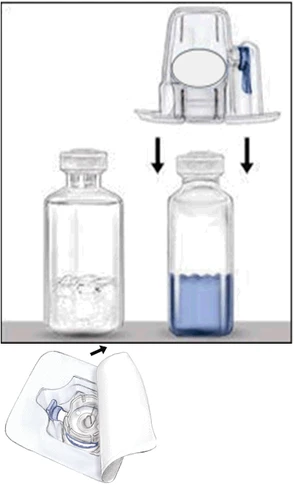
- Open the BAXJECT II device package by removing the top cover without touching the inner surface (Fig. a). Do not remove the device from the package.
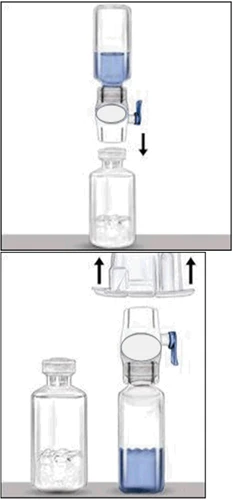
- Invert the package and insert the transparent plastic spike through the solvent vial stopper. Hold the package and pull it away from the BAXJECT II (Fig. b). Do not remove the blue cap from the BAXJECT II device.
- With the BAXJECT II attached to the solvent vial, invert the system so that the solvent vial is above the device. Insert the white plastic spike through the stopper of the RIXUBIS vial. The vacuum will draw the solvent into the RIXUBIS vial (Fig. c).
- Gently swirl until the substance is completely dissolved. The product dissolves rapidly (within 2 minutes). Ensure that all the RIXUBIS powder is completely dissolved; otherwise, not all of the reconstituted solution may pass through the device filter. Reconstituted medicinal products should be inspected visually for particulate matter and discoloration prior to administration. The solution should be clear or slightly opalescent. Do not use solutions that are cloudy or contain deposits.
Fig. a Fig. b Fig. c
Do not refrigerate the solution after reconstitution.
Use immediately.
Administration
Use aseptic technique
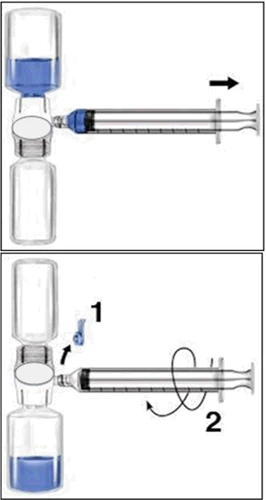
- Remove the blue cap from the BAXJECT II device. Do not draw air into the syringe. Attach the syringe to the BAXJECT II device (Fig. d).
- Invert the system (the vial with reconstituted solution should be above). Slowly draw the reconstituted solution into the syringe by pulling back the plunger gently (Fig. e).
- Disconnect the syringe.
- Attach a butterfly needle to the syringe. Administer intravenously. The solution should be infused slowly at a rate determined by patient comfort, not exceeding 10 ml per minute.
Fig. d Fig. e
Whenever possible, record (e.g., in a diary) the name and batch number of the product each time RIXUBIS is used, to maintain traceability of the products and batches used.
Any unused medicine and waste material derived from this medicine must be disposed of in accordance with local regulations.
If you use more RIXUBIS than you should
Always use RIXUBIS exactly as prescribed by your doctor. If you have any doubts, consult your doctor.
If you have injected more RIXUBIS than recommended, contact your doctor as soon as possible.
If you forget to use RIXUBIS
Do not inject a double dose to make up for a forgotten dose. Proceed with the next scheduled injection and continue as directed by your doctor.
If you stop using RIXUBIS
Do not stop using RIXUBIS without consulting your doctor.
If you have any questions about the use of this medicine, consult your doctor or pharmacist.
4. Possible side effects
Like all medicines, this medicine can cause side effects, although not everybody gets them.
Allergic-type hypersensitivity reactions are possible with RIXUBIS. These reactions may include
burning and irritation at the infusion site, chills, flushing, lethargy, restlessness, tingling, hives, itching,
rash, low blood pressure, rapid heartbeat, tightness in the chest, wheezing, throat swelling, anaphylaxis
(severe allergic reaction), headache, nausea and vomiting. If you experience any of these signs, contact
your doctor immediately. Your doctor may need to treat you promptly for these reactions (see
section 2, "Warnings and precautions").
The following side effects have been observed with RIXUBIS:
Common side effects (may affect up to 1 in 10 people):
- altered taste
- limb pain
Side effects with unknown frequency (frequency cannot be estimated from the available data):
- allergic reactions (hypersensitivity)
Thromboembolic events (problems related to excessive blood clotting) have not been reported with this
medicine, although they may occur with any factor IX-containing product. Such events may include
heart attack, formation of blood clots in veins or lungs.
Reporting of side effects
If you experience any side effect, including those not listed in this leaflet, talk to your doctor or
pharmacist. You can also report side effects directly via the national reporting system detailed in
Annex V. By reporting side effects, you can help provide more information on the safety of this
medicine.
5. How to store RIXUBIS
Keep this medicine out of the sight and reach of children.
Do not use this medicine after the expiry date which is stated on the outer carton and on the label
of the vial after Exp. The expiry date refers to the last day of that month.
Store in a refrigerator at a temperature below 30 °C.
Do not freeze.
Use the reconstituted solution immediately.
Do not use RIXUBIS if the solution is not clear and colourless.
Do not dispose of any medicine via wastewater or household waste. Ask your pharmacist how
to dispose of medicines you no longer require. This will help protect the environment.
6. Package contents and other information
What RIXUBIS contains
- The active substance is nonacog gamma (recombinant human coagulation factor IX). Each vial of powder contains nominally 250, 500, 1000, 2000 or 3000 IU, corresponding to a concentration of 50, 100, 200, 400 or 600 IU/ml after reconstitution with 5 ml of solvent.
- The other components of the powder are sucrose, mannitol, sodium chloride, calcium chloride, L-histidine, polysorbate 80.
Solvent vial: 5 ml of sterile water for injections.
Description of the appearance of RIXUBIS and contents of the pack
RIXUBIS is supplied as a powder and solvent for solution for injection.
The pack contains:
- one vial of RIXUBIS 250, 500, 1000, 2000 or 3000 IU powder, glass vial with rubber stopper
- one vial of 5 ml sterile water for injections, glass vial with rubber stopper
- one BAXJECT II device (needle-free reconstitution device)
Marketing Authorisation Holder
Baxalta Innovations GmbH
Industriestrasse 67
A-1221 Vienna
Austria
Manufacturer:
Baxalta Belgium Manufacturing SA
Boulevard René Branquart 80
B-7860 Lessines
Belgium
For further information on this medicinal product, please contact the local representative of the Marketing Authorisation Holder:
België/Belgique/Belgien Lietuva
Takeda Belgium NV Takeda, UAB
Tél/Tel: +32 2 464 06 11 Tel: +370 521 09 070
[email protected] [email protected]
България Luxembourg/Luxemburg
Такеда България ЕООД Takeda Belgium NV
Тел.: +359 2 958 27 36 Tél/Tel: +32 2 464 06 11
[email protected] [email protected]
Česká republika Magyarország
Takeda Pharmaceuticals Czech Republic s.r.o. Takeda Pharma Kft.
Tel: +420 234 722 722 Tel: +36 1 270 7030
[email protected] [email protected]
Danmark Malta
Takeda Pharma A/S Drugsales Ltd
Tlf: +45 46 77 10 10 Tel: +356 21419070
[email protected] [email protected]
Deutschland Nederland
Takeda GmbH Takeda Nederland B.V.
Tel: +49 (0)800 825 3325 Tel: +31 20 203 5492
[email protected] [email protected]
Eesti Norge
Takeda Pharma AS Takeda AS
Tel: +372 6177 669 Tlf: +47 800 800 30
[email protected] [email protected]
Ελλάδα Österreich
Takeda ΕΛΛΑΣ Α.Ε. Takeda Pharma Ges.m.b.H.
Tηλ: +30 210 6387800 Tel: +43 (0) 800-20 80 50
[email protected] [email protected]
España Polska
Takeda Farmacéutica España S.A Takeda Pharma Sp. z o.o.
Tel: +34 917 90 42 22 Tel: +48223062447
[email protected] [email protected]
France Portugal
Takeda France SAS Takeda Farmacêuticos Portugal, Lda.
Tél: +33 1 40 67 33 00 Tel: +351 21 120 1457
[email protected] [email protected]
Hrvatska România
Takeda Pharmaceuticals Croatia d.o.o. Takeda Pharmaceuticals SRL
Tel: +385 1 377 88 96 Tel: +40 21 335 03 91
[email protected] [email protected]
Ireland Slovenija
Takeda Products Ireland Ltd Takeda Pharmaceuticals farmacevtska družba d.o.o.
Tel: 1800 937 970 Tel: +386 (0) 59 082 480
[email protected] [email protected]
Ísland Slovenská republika
Vistor hf. Takeda Pharmaceuticals Slovakia s.r.o.
Sími: +354 535 7000 Tel: +421 (2) 20 602 600
[email protected] [email protected]
Italia Suomi/Finland
Takeda Italia S.p.A. Takeda Oy
Tel: +39 06 502601 Puh/Tel: 0800 774 051
[email protected] [email protected]
Κύπρος Sverige
Takeda ΕΛΛΑΣ Α.Ε. Takeda Pharma AB
Τηλ: +30 210 6387800 Tel: 020 795 079
[email protected] [email protected]
Latvija United Kingdom (Northern Ireland)
Takeda Latvia SIA Takeda UK Ltd
Tel: +371 67840082 Tel: +44 (0) 2830 640 902
[email protected] [email protected]
More detailed information on this medicinal product is available on the website of the European Medicines Agency: http://www.ema.europa.eu/.
The following information is intended for healthcare professionals only:
Treatment Monitoring
During treatment, appropriate measurement of factor IX levels is recommended to determine the dose and frequency of infusions. Individual patient response to factor IX may vary, with differences in half-life and recovery levels. The dose calculated according to body weight may require adjustment in underweight or overweight patients. Particularly during major surgical procedures, careful monitoring of replacement therapy is essential, using coagulation assays (plasma factor IX activity).
To ensure the desired plasma factor IX activity level has been achieved, close monitoring using an appropriate factor IX activity assay is advised; if necessary, appropriate adjustments to the dose and infusion frequency should be made. When using a one-stage in vitro coagulation assay based on activated partial thromboplastin time (aPTT) to determine factor IX activity in patient blood samples, the results may be significantly influenced by both the type of aPTT reagent and the reference standards used in the assay. This is particularly important when changing laboratories and/or reagents.
Dosage
The dose and duration of replacement therapy depend on the severity of factor IX deficiency, the site and extent of bleeding, the patient's clinical condition, age, and pharmacokinetic parameters of factor IX, such as incremental recovery and half-life.
The number of factor IX units administered is expressed in International Units (IU), referenced to the current WHO standard for factor IX-containing products. Plasma factor IX activity is expressed both as a percentage (relative to normal human plasma) and in International Units (referenced to the international standard for plasma factor IX).
One International Unit of factor IX activity is equivalent to the amount of factor IX present in 1 ml of normal human plasma.
Adult Population
On-demand treatment:
The calculation of the required factor IX dose is based on the empirical assumption that 1 International Unit of factor IX per kg of body weight increases plasma factor IX activity by 0.9 IU/dL (range: 0.5 to 1.4 IU/dL) or 0.9% of normal activity in patients aged 12 years and older (for further information, see section 5.2).
The required dose is determined using the following formula:
Required Units = body weight (kg) × desired increase of factor IX activity (%) or (IU/dL) × reciprocal of observed recovery (dl/kg)
For an incremental recovery of 0.9 IU/dL per IU/kg, the dose is calculated as follows:
Required Units = body weight (kg) × desired increase of factor IX activity (%) or (IU/dL) × 1.1 dl/kg
The amount to be administered and the frequency of administration should always be based on the clinical response in each individual case.
In the event of the following bleeding episodes, factor IX activity should not fall below the plasma activity level (expressed as % of normal or in IU/dL) indicated for the corresponding period. The following table may be used as a reference for dosing in bleeding episodes and surgery:
| Bleeding severity/Surgical procedure type | Necessary factor IX level (%) or (IU/dl) | Dosing frequency (hours)/Duration of therapy (days) |
| BleedingEarly haemarthrosis, muscle bleeding, or oral cavity bleedingMore extensive haemarthrosis, muscle bleeding, or haematomaPotentially life-threatening haemorrhages. | 20 – 4030 – 6060 – 100 | Repeat every 24 hours. At least 1 day, until resolution of the bleeding episode as indicated by pain or until healing is achieved.Repeat infusion every 24 hours for 3–4 days or more until resolution of pain and acute disability.Repeat infusion every 8–24 hours until resolution of the threat. |
| Surgical procedureMinor surgery, including dental extraction | 30 – 60 | Every 24 hours, at least 1 day, until healing is achieved. |
| Major surgery | 80 – 100(pre- and post-operative) | Repeat infusion every 8–24 hours until adequate wound healing, then continue therapy for at least another 7 days to maintain factor IX activity at 30%–60% (IU/dl). |
Careful monitoring of replacement therapy is particularly important in cases of major surgery or potentially life-threatening bleeding.
Prophylaxis
For long-term prophylaxis of bleeding in patients with severe haemophilia B, the usual doses are 40 - 60 IU of factor IX per kilogram of body weight administered at intervals of 3 - 4 days for patients aged 12 years and older. In some cases, depending on pharmacokinetics, age, bleeding phenotype, and level of physical activity of the individual patient, shorter administration intervals or higher doses may be required.
Continuous infusion
Do not administer RIXUBIS by continuous infusion.
Paediatric population
Patients aged 12 to 17 years:
The dosage is the same for adults and for paediatric patients aged 12 to 17 years.
Patients under 12 years of age:
On-demand treatment
The calculation of the required dose of factor IX is based on the empirical observation that 1 International Unit (IU) of factor IX per kg of body weight increases plasma factor IX activity by 0.7 IU/dl (range from 0.31 to 1.0 IU/dl) or 0.7% of normal activity in patients under 12 years of age (for further information see section 5.2).
The required dose is determined using the following formula:
Patients under 12 years of age:
Required units = body weight (kg) × desired increase × reciprocal of
of factor IX (%) or (IU/dl) observed recovery (dl/kg)
For an incremental recovery of 0.7 IU/dl per IU/kg, the dose is calculated as follows:
Required units = body weight (kg) × desired increase × 1.4 dl/kg
of factor IX (%) or (IU/dl)
The same adult dosing table (see above) may be used as a reference for dosing during bleeding episodes and surgery.
Prophylaxis:
The recommended dose for paediatric patients under 12 years of age ranges from 40 to 80 IU/kg administered at intervals of 3 - 4 days. In some cases, depending on pharmacokinetics, age, bleeding phenotype, and level of physical activity of the individual patient, shorter administration intervals or higher doses may be required.