RiaSTAP
Italy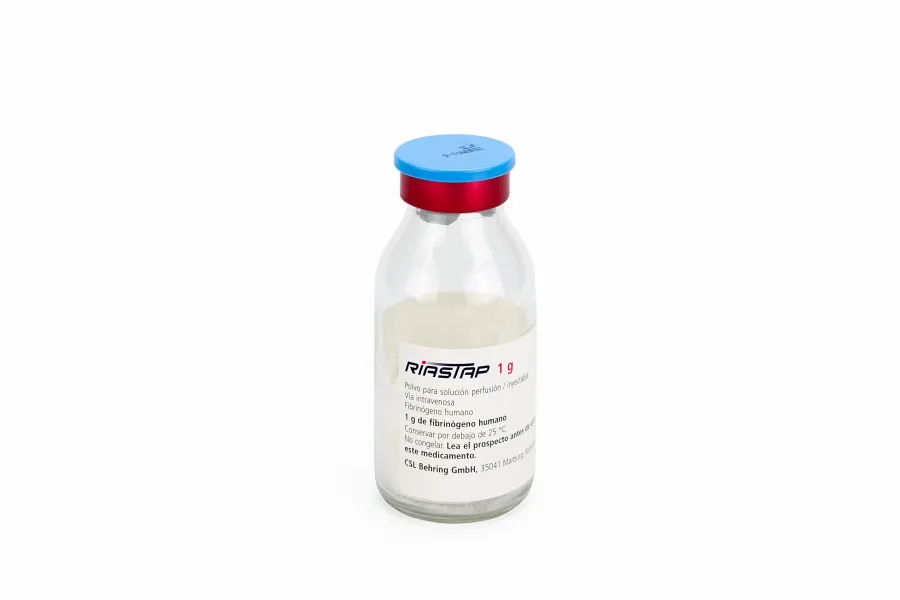
Table of Contents
- Package Leaflet: Information for the User
- Riastap 1 g
- 1. What Riastap is and what it is used for
- 2. What you need to know before using Riastap
- 3. How to use Riastap
- 4. Possible side effects
- 5. How to store Riastap
- 6. Package contents and other information
- The following information is intended for healthcare professionals only
Package Leaflet: Information for the User
Riastap 1 g
Powder for solution for injection or infusion
Human fibrinogen
Please read all of this leaflet carefully before taking this medicine because it contains important information for you.
- Keep this leaflet. You may need to read it again.
- If you have any questions, ask your doctor or pharmacist.
- This medicine has been prescribed for you only. Never give it to other people, even if they have the same symptoms as yours, because it may be harmful.
- If you experience any side effects, including those not listed in this leaflet, inform your doctor or pharmacist. See section 4.
Contents of this leaflet:
- What Riastap is and what it is used for
- What you need to know before using Riastap
- How to use Riastap
- Possible side effects
- How to store Riastap
- Contents of the pack and other information
1. What Riastap is and what it is used for
What Riastap is
Riastap contains human fibrinogen. Human fibrinogen is a protein important for blood clotting.
A deficiency of fibrinogen means that the blood has a reduced ability to clot, resulting in an increased tendency to bleed.
Replacement of human fibrinogen with Riastap normalizes blood coagulation mechanisms.
What Riastap is used for
Riastap is indicated for the treatment of bleeding in patients with congenital fibrinogen deficiency (hypo- or afibrinogenemia) who have a tendency to bleed.
2. What you need to know before using Riastap
The following sections contain information that your treating physician should consider before administering Riastap to you.
Do not use Riastap:
- If you are allergic to human fibrinogen or to any of the other components of this medicine (listed in section 6); Inform your doctor if you are allergic to any medicines or foods.
Warnings and precautions
- if you have previously experienced allergic reactions to Riastap. If your doctor considers it necessary, they may administer antihistamines and corticosteroids preventively.
- if an allergic or anaphylactic reaction (a severe allergic reaction causing severe breathing difficulties or dizziness) occurs, Riastap administration must be stopped immediately.
- Special caution is required if there is a risk of increased blood clot formation in blood vessels (thrombosis):
- when high or repeated doses are administered;
- if you have had a heart attack (a history of coronary heart disease or myocardial infarction);
- if you suffer from liver disease;
- if you have recently undergone surgery (patients in the post-operative period);
- if surgery is scheduled in the near future (patients in the pre-operative period);
- in newborns;
- if you have a higher-than-normal tendency to form blood clots (patients at risk of thromboembolic events or disseminated intravascular coagulation).
Your doctor will carefully evaluate the benefit-risk ratio of treatment with Riastap versus the risks associated with these complications.
Viral safety
When medicines are prepared from human blood or plasma, specific measures are implemented to prevent transmission of infections to patients. These measures include:
- careful selection of blood and plasma donors to ensure potentially infected donors are excluded, and
- testing of each donation and plasma pool to detect possible presence of viruses/infections.
Manufacturers of these medicines also incorporate steps in the manufacturing process capable of inactivating or removing viruses. Despite these measures, when administering medicines prepared from human blood or plasma, the possibility of transmitting an infection cannot be completely ruled out. This also applies to emerging or unknown viruses or other infectious agents.
The measures taken are considered effective against enveloped viruses such as human immunodeficiency virus (HIV, the AIDS virus), hepatitis B virus, hepatitis C virus (liver inflammation), and against non-enveloped viruses such as hepatitis A (liver inflammation) and parvovirus B19.
If you regularly or repeatedly use products derived from human plasma, your doctor may recommend considering vaccination against hepatitis A and B.
It is strongly recommended to record the date of administration, the name, and the batch number of the product each time a dose of Riastap is administered, in order to maintain documentation of the batch used.
Other medicines and Riastap
- Inform your doctor or pharmacist if you are taking, have recently taken, or might take any other medicines.
- Riastap must not be mixed with other medicinal products except those mentioned in the section “The following information is intended exclusively for healthcare professionals/Rconstitution”.
Pregnancy and breastfeeding
- If you are pregnant or breastfeeding, think you may be pregnant, or are planning to have a baby, consult your doctor or pharmacist before taking this medicine.
- During pregnancy or breastfeeding, Riastap should be used only if clearly indicated.
Driving and operating machinery
Riastap does not affect, or affects negligibly, the ability to drive vehicles or operate machinery.
Important information about some of the components of Riastap
Riastap contains up to 164 mg (7.1 mmol) of sodium per vial, equivalent to 11.5 mg (0.5 mmol) of sodium per 1 kg of body weight if the patient is administered an initial dose of 70 mg/kg body weight. This should be taken into consideration if you are on a controlled-sodium diet.
3. How to use Riastap
Treatment must be initiated under the supervision of a physician experienced in the treatment of
these conditions.
Posology
The required amount of human fibrinogen and the duration of therapy depend on the following factors:
the severity of your condition;
the location and extent of bleeding;
your clinical status.
If you use more Riastap than you should
During treatment, your doctor must regularly monitor your coagulation status. In case of overdose, the risk of thromboembolic complications increases.
Method of administration
If you have any questions about the use of this medicine, consult your doctor or pharmacist (see the
section: “The following information is intended exclusively for healthcare professionals” ).
4. Possible side effects
Like all medicines, this medicine can cause side effects, although not everybody will experience them.
Contact your doctor immediately
- if any of the side effects occur;
- if you notice side effects not described in this leaflet.
The following side effect has been observed very commonly (may affect more than 1 in 10 people):
- increase in body temperature;
The following side effect has been observed uncommonly (may affect more than 1 in 100 people):
- sudden allergic reaction (for example, skin flushing, widespread skin rash, sudden drop in blood pressure, breathing difficulties).
The following side effect has been observed commonly (may affect up to 1 in 10 people, although incidence is higher in patients not previously treated with fibrinogen):
- risk of increased blood clot formation (see section: 2 “What you should know before using Riastap" ).
Reporting of side effects
If you experience any side effect, including those not listed in this leaflet, consult your doctor or pharmacist. Side effects can also be reported directly via the national reporting system at the following website
https://www.aifa.gov.it/content/segnalazioni-reazioni-avverse .
Reporting side effects helps provide more information on the safety of this medicine.
5. How to store Riastap
Keep this medicine out of the sight and reach of children.
Do not use this medicine after the expiry date stated on the label and packaging.
The expiry date refers to the last day of that month.
- Do not store above 25 °C.
- Do not freeze.
- Keep the vial in the outer cardboard box to protect it from light.
- Once reconstituted, the product should preferably be administered immediately.
- If the reconstituted product is not administered immediately, it may be stored at room temperature (not above 25°C) for a maximum of 8 hours.
- The reconstituted product must not be refrigerated.
6. Package contents and other information
What Riastap contains
The active substance is:
Human fibrinogen (1 g/vial; approximately 20 mg/mL after reconstitution with 50 mL of water for
injections).
For further information, see section: "The following information is intended exclusively for healthcare
professionals."
The other components are:
Human albumin, sodium chloride, L-arginine hydrochloride, sodium citrate, sodium hydroxide (for pH
adjustment).
See the last part of section 2: "Important information regarding some of the components of Riastap."
Description of the appearance of Riastap and contents of the pack
Riastap is a white powder.
After reconstitution with water for injections, the resulting solution should be clear or slightly opalescent, meaning it may show slight shimmering when examined against the light; however, it must not contain visible particles.
Presentation
Pack containing 1 g (Figure 1)
- One infusion vial containing 1 g of human fibrinogen
- Filter: Pall syringe filter
- Transfer device: Mini-Spike Dispensing Pin
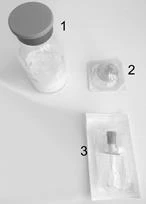
Figure 1
Marketing Authorisation Holder and Manufacturer
CSL Behring GmbH
Emil-von-Behring-Strasse 76
35041 Marburg
Germany
This medicinal product is authorised in the European Economic Area Member States under the following
names:
Riastap 1 g powder for solution for injection/infusion – United Kingdom
Riastap 1g, poudre pour solution injectable/perfusion – France
Riastap 1g prašek za raztopino za injiciranje ali infundiranje – Slovenia
Riastap 1g – Germany, Ireland
Riastap – Belgium, Cyprus, Denmark, Finland, Greece, Iceland, Italy, Luxembourg, Malta, Norway,
Poland, Slovakia, Spain, Sweden.
This Patient Information Leaflet was last reviewed on:
The following information is intended for healthcare professionals only
Dosage
To calculate the appropriate dose for individual patients, the fibrinogen level (functional) must be determined. The amount to be administered and the frequency of administration should be individually adjusted based on regular measurements of plasma fibrinogen levels, with continuous monitoring of the patient's clinical condition and other concomitant replacement therapies.
The normal plasma fibrinogen level ranges from 1.5 to 4.5 g/L. The critical plasma fibrinogen level, below which bleeding episodes may occur, is approximately 0.5–1.0 g/L. In cases of major surgery, careful monitoring of replacement therapy using coagulation tests is essential.
Initial dose
If the patient's fibrinogen level is unknown, intravenous administration of a dose of 70 mg per kg of body weight (b.w.) is recommended.
Subsequent doses
The target level (1 g/L) should be maintained for at least three days in cases of minor bleeding episodes (e.g. epistaxis, intramuscular bleeding, or menorrhagia). In cases of more severe bleeding episodes (e.g. head trauma or intracranial hemorrhage), the target level (1.5 g/L) should be maintained for 7 days.
Fibrinogen dose = [target level (g/L) – measured quantity (g/L)]
(mg/kg b.w.) 0.017 (g/L per mg/kg b.w.)
Dosage in neonates, children, and adolescents
Limited clinical study data are available regarding the pediatric use of Riastap. Based on results from these studies and on years of clinical experience with fibrinogen-containing products, the recommended dosage for pediatric patients is the same as that recommended for adult patients.
Administration method
General instructions
- Reconstitution and withdrawal must be performed under aseptic conditions.
- After reconstitution, the solution should be visually inspected before administration to ensure the absence of particles or discoloration.
- The solution should be practically colorless or slightly yellowish, clear or slightly opalescent, and have a neutral pH. Do not use cloudy solutions or those containing residues.
Reconstitution
- Without opening the vials, warm both the solvent and the active substance powder to body temperature or room temperature (not exceeding 37°C).
- Reconstitute Riastap using water for injections (50 mL, not included).
- Wash hands or wear gloves before reconstituting the product.
- Remove the aluminum cap from the Riastap vial to expose the central area of the stopper for infusion.
- Disinfect the stopper surface with an antiseptic solution and allow it to dry.
- Using a suitable transfer device, transfer the solvent into the infusion vial. Ensure that the powder is completely wetted by the solvent.
- Gently rotate the vial until reconstitution is complete; the solution is then ready for administration. Do not shake vigorously to avoid foam formation. Typically, the lyophilized powder dissolves within approximately 5 minutes. Complete dissolution should not take longer than 15 minutes.
- Open the plastic blister containing the transfer device (Mini-Spike Dispensing Pin) supplied with Riastap (Figure 2).
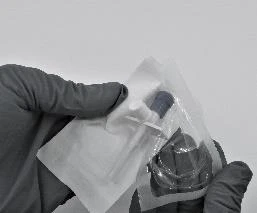
Figure 2
- Take the supplied transfer device and insert it into the stopper of the vial containing the reconstituted product (Figure 3).
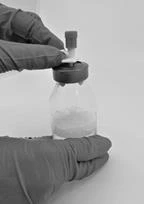
Figure 3
- After inserting the transfer device, remove the cap. After cap removal, do not touch the exposed surface.
- Open the blister containing the filter (Pall syringe filter) supplied with Riastap (Figure 4).
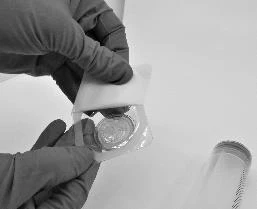
Figure 4
- Screw the syringe onto the filter (Figure 5).
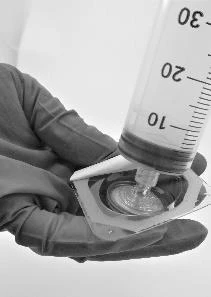
Figure 5
- Screw the syringe with the attached filter onto the transfer device (Figure 6).
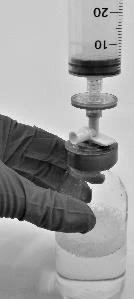
Figure 6
- Draw the reconstituted product into the syringe (Figure 7).
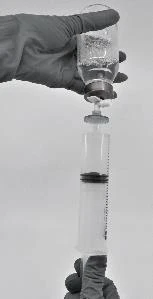
Figure 7
- Then remove the filter, transfer device, and empty vial from the syringe, dispose of them properly, and proceed with administration as usual.
- The reconstituted product should be administered immediately, using a separate injection/infusion line.
- Take care to avoid blood entering syringes filled with the product.
Unused medicine and waste material derived from this medicine must be disposed of in accordance with local regulations.
Administration
The use of a standard infusion set is recommended for intravenous administration of the reconstituted solution at room temperature. The reconstituted solution should be injected or infused slowly, at a rate acceptable to the patient. The injection or infusion rate should not exceed approximately 5 mL per minute.