Rhesonativ
Italy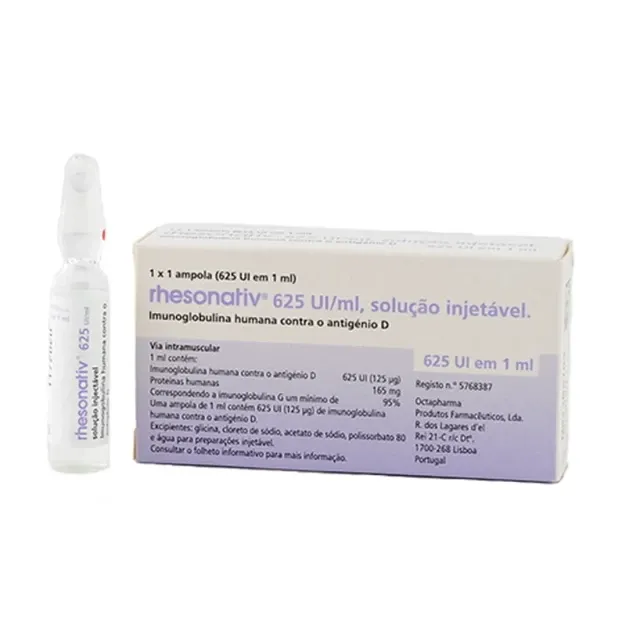
Table of Contents
Package leaflet: Information for the user
Rhesonativ
625 UI/mL, solution for injection
Human anti-D immunoglobulin
Please read all of this leaflet carefully before you use this medicine because it contains important information for you.
- Keep this leaflet. You may need to read it again.
- If you have any questions, ask your doctor, pharmacist, or nurse.
- This medicine has been prescribed for you only. Do not give it to other people, even if they have the same symptoms as yours, because it could be harmful.
- If you experience any side effects, including those not listed in this leaflet, tell your doctor or pharmacist. See section 4.
Contents of this leaflet:
-
What Rhesonativ is and what it is used for
-
What you need to know before using Rhesonativ
-
How to use Rhesonativ
-
Possible side effects
-
How to store Rhesonativ
-
Contents of the pack and other information
-
What Rhesonativ is and what it is used for
Rhesonativ is an immunoglobulin and contains antibodies against the Rhesus factor. If a woman who lacks the Rhesus factor in her own red blood cells (i.e. a Rh-negative woman) is pregnant with a fetus that has the Rhesus factor (i.e. a Rh-positive fetus), her immune system may be stimulated to produce antibodies against the Rhesus factor. These antibodies can be dangerous to the fetus, especially in subsequent pregnancies. Rhesonativ is used to prevent immunization of Rh-negative women during pregnancy and childbirth, thereby avoiding harm to the fetus. Rhesonativ is used in Rh-negative women in the following cases:
- Anti-D prophylactic treatment for pregnant women who are Rh-negative
- Birth of a Rh-positive baby
- Miscarriage/threatened miscarriage (spontaneous abortion/threatened spontaneous abortion)
- Ectopic pregnancy, formation of abnormal tissue masses in the uterus (molar pregnancy), or fetal-maternal hemorrhage (transfer of fetal blood into the mother's circulation) or fetal death in late pregnancy
- Invasive procedures during pregnancy, such as amniocentesis (removal of amniotic fluid with a syringe), fetal blood sampling from the umbilical vein, biopsy, or other obstetric manipulative procedures (e.g. manual rotation of the fetus into correct position in the uterus), or abdominal trauma, fetal surgery in utero
Rhesonativ may also be used in Rh-negative individuals who have accidentally received a transfusion of Rh-positive blood.
2. What you need to know before using Rhesonativ
Do not use Rhesonativ
if you are allergic to human immunoglobulin or to any of the other ingredients of this
medicine (listed in section 6).
Warnings and precautions
Talk to your doctor, pharmacist, or nurse before using Rhesonativ.
If you suffer from any other disorder, inform your doctor.
Rhesonativ is not intended for use in Rh(D)-positive individuals or in individuals already
immunized against the Rh(D) antigen.
True hypersensitivity reactions (allergic reactions) are rare but may occur.
If you suspect an allergy or experience a severe allergic reaction (anaphylactic reaction), inform your
doctor or nurse immediately. Symptoms may include dizziness, palpitations,
lowering of blood pressure, difficulty breathing or swallowing, chest tightness, itching, generalized hives (urticaria), swelling of the face, tongue, or throat, collapse, and skin rash. All of these conditions require immediate treatment.
If you experience symptoms such as shortness of breath, pain and swelling in a limb, or chest pain,
contact your doctor or nurse immediately, as these may be signs of a blood clot.
Children
There are no data available on the use of Rhesonativ in children.
Overweight patients
In overweight or obese patients, consideration should be given to using an intravenous anti-D product.
Viral safety
When medicines are prepared from human blood or plasma, specific measures are taken to prevent the risk of transmitting infections to patients. These include:
- careful selection of blood and plasma donors to ensure exclusion of individuals at risk of carrying infectious diseases
- testing of each individual donation and pooled plasma for signs of viruses/infections
- inclusion of processing steps in the manufacturing of blood or plasma that can inactivate or remove viruses. Despite these measures, when administering medicinal products prepared from human blood or plasma, it cannot be completely ruled out that infectious agents may be transmitted. This also applies to viruses of unknown nature or emerging viruses, or other types of infections.
The measures taken are considered effective against enveloped viruses such as the human immunodeficiency virus (HIV), hepatitis B virus, hepatitis C virus, and against the non-enveloped hepatitis A virus.
The measures taken may have limited effectiveness against non-enveloped viruses, such as parvovirus B19.
Immunoglobulins have not been associated with hepatitis A or parvovirus B19 infections, probably because the antibodies against these infections contained in the medicine are protective.
For each administration of Rhesonativ, it is recommended to record the patient's name and the product batch number, in order to maintain a record of the batches used.
Other medicines and Rhesonativ
Inform your doctor or pharmacist if you are taking, have recently taken, or might take any other medicines.
Rhesonativ may reduce the effectiveness of vaccines such as those against measles, rubella, mumps, and varicella. This applies both to vaccines administered approximately 2–4 weeks before receiving an anti-D antibody injection, and to vaccinations given afterwards. After treatment with Rhesonativ, a period of three months must elapse before vaccination with any of these vaccines. Therefore, it is important that the doctor administering the vaccination is aware that you are receiving or have received treatment with Rhesonativ.
When a blood sample is taken from you, inform the doctor that you are receiving immunoglobulin, as this treatment may affect test results.
Pregnancy and breastfeeding
Rhesonativ is intended for use during pregnancy and may be used during breastfeeding.
Driving and using machines
No effects on the ability to drive or operate machinery have been observed.
Rhesonativ contains sodium
This medicine contains less than 1 mmol of sodium (23 mg) per 1 mL of solution (625 IU), meaning it is essentially “sodium-free”.
3. How to use Rhesonativ
Your doctor will decide whether and at what dose Rhesonativ should be administered to you. Rhesonativ
is administered as an intramuscular injection (into a muscle) by medical personnel.
4. Possible side effects
Like all medicines, this medicine can cause side effects, although not everyone will experience them.
The frequency of the following side effects is unknown (the frequency cannot be determined from the available data): headache, palpitations, low blood pressure, shortness of breath, vomiting, nausea, skin reactions, joint pain, lower back pain, dizziness, fever, feeling unwell including chest pain, chills, local reactions at the injection site such as swelling and pain, breakdown of red blood cells, and severe allergic reactions including anaphylactic shock.
If you notice symptoms of an anaphylactic reaction such as dizziness, nausea, vomiting, stomach cramps, coughing, difficulty breathing or swallowing, cyanosis (bluish skin), itching, pruritus, hives, skin rash, rapid heartbeat, drop in blood pressure, swelling of the face, tongue or throat, collapse or chest pain, contact your doctor immediately, as all these conditions require immediate treatment.
Reporting of side effects
If you experience any side effect, including those not listed in this leaflet, talk to your doctor, pharmacist or nurse.
You may also report side effects directly via the national reporting system at the following website:
https://www.aifa.gov.it/content/segnalazioni-reazioni-avverse.
By reporting side effects, you can help provide more information on the safety of this medicine.
5. How to store Rhesonativ
Keep this medicine out of the sight and reach of children.
Store in a refrigerator (2 °C – 8 °C). Do not freeze. Keep the vials in the outer packaging to protect them from light.
Within the shelf life, the product may be stored at a temperature below 25 °C for up to 1 month, without the need for further refrigeration during this period, and must be discarded if not used after this time.
Do not use this medicine after the expiry date which is stated on the label and on the carton after “Exp”. The expiry date refers to the last day of the month.
Do not dispose of any medicine via wastewater or household waste. Ask your pharmacist how to dispose of medicines no longer in use. This will help protect the environment.
6. Pack contents and other information
What Rhesonativ contains
The active substance is human anti-D immunoglobulin.
1 mL contains 625 IU (125 μg) of human anti-D immunoglobulin.
1 vial of 1 mL contains 625 IU (125 μg) of human anti-D immunoglobulin. 1 vial of
2 mL contains 1250 IU (250 µg) of human anti-D immunoglobulin.
The total human protein content is 165 mg/mL, of which immunoglobulin G
represents at least 95%.
The excipients are: glycine, sodium chloride, sodium acetate, polysorbate 80, and water for
injections.
Description of the appearance of Rhesonativ and pack contents
Rhesonativ is an injectable solution (625 IU/mL or 1250 IU/2 mL per vial).
Pack sizes: 1x1 mL, 1x2 mL and 10x2 mL.
The solution may vary in colour from colourless to pale yellow or light brown.
Not all pack sizes may be marketed.
This medicinal product is authorised in the European Economic Area Member States
under the following names:
| Member State | Medicinal product name |
| Austria | Rhesonativ 625 I.E./mL Injection solution |
| Bulgaria | Rhesonativ 625 IU/mL, solution for injection |
| Cyprus | Rhesonativ 625 IU/mL, solution for injection |
| Denmark | Rhesonativ, Injection solution, solution Ü |
| Estonia | Rhesonativ, 625 RÜ/mL, injection solution |
| Finland | Rhesonativ 625 IU/mL injection solution, solution |
| France | Rhesonativ 625 UI/mL, solution injectable |
| Ireland | Rhesonativ 625 IU/mL, solution for injection |
| Iceland | Rhesonativ 625 a.e./mL, injection liquid, solution |
| Italy | Rhesonativ 625 IU/mL Injectable solution |
| Latvia | Rhesonativ 625 SV/mL solution for injection |
| Lithuania | Rhesonativ 625 TV/mL injection solution |
| Luxembourg | Rhesonativ 625 UI/mL, solution injectable |
| Malta | Rhesonativ 625 IU/mL, solution for injection |
| Norway | Rhesonativ 625 IE/mL injection liquid, solution |
| Netherlands | Rhesonativ 625 IE/mL, solution for injection |
| Poland | Rhesonativ, 625 j.m./mL, solution for injections |
| Portugal | Rhesonativ 625 UI/mL, solution for injection |
| Czech Republic | Rhesonativ 625 IU/mL, injection solution |
| Romania | Rhesonativ 625 UI/mL, solution for injection |
| Slovakia | Rhesonativ 625 IU/mL injection solution |
| Slovenia | Rhesonativ 625 i.e./mL, solution for injection |
| Sweden | Rhesonativ 625 IE/mL injection liquid, solution |
| Hungary | Rhesonativ 625 NE/mL solution for injection |
Marketing Authorization Holder
OCTAPHARMA ITALY S.p.A.
Via Cisanello, 145
56100 Pisa
Italy
Manufacturer
Octapharma AB
SE-112 75 Stockholm, Sweden
The following information is intended exclusively for healthcare professionals
professionals:
The product should be brought to room or body temperature before use.
Do not use cloudy solutions or those containing deposits.
The contents of an opened vial must be used immediately. Any unused medicinal product and
waste material derived from this medicine must be disposed of in accordance with local regulations.
Injections must be administered intramuscularly, and care must be taken to withdraw the syringe
plunger before injection to ensure that the needle is not within a blood vessel.
If intramuscular administration is contraindicated (e.g. bleeding disorders), the injection may
be given subcutaneously if no intravenous product is available. After injection, firm manual
pressure with a swab should be applied to the injection site.
If a large volume is required (>2 mL in children or >5 mL in adults), it is recommended to divide
the dose into multiple injections at different sites.
This medicinal product must not be mixed with other medicinal products.
Due to a potential lack of efficacy following intramuscular administration in overweight/obese
patients, the use of an intravenous anti-D product is recommended.