Rezzayo
Italy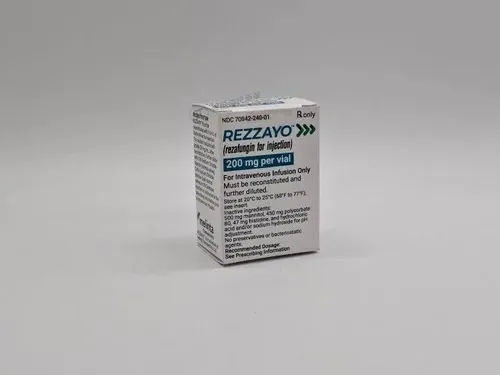
Table of Contents
- Package leaflet: Information for the patient
- REZZAYO 200 mg powder for concentrate for solution for infusion
- 1. What REZZAYO is and what it is used for
- 2. What you need to know before using REZZAYO
- 3. How to use REZZAYO
- 4. Possible side effects
- 5. How to store REZZAYO
- 6. Package contents and other information
- REZZAYO must be reconstituted and diluted before administration.
Package leaflet: Information for the patient
REZZAYO 200 mg powder for concentrate for solution for infusion
rezafungin
This medicinal product is subject to additional monitoring. This will allow for rapid identification of new safety information. You can help by reporting any adverse reactions you experience while taking this medicine. See the end of section 4 for information on how to report adverse reactions.
Please read all of this leaflet carefully before you start using this medicine because it contains important information for you.
- Keep this leaflet. You may need to read it again.
- If you have any questions, ask your doctor, pharmacist, or nurse.
- If you get any side effects, including those not listed in this leaflet, talk to your doctor, pharmacist, or nurse. See section 4.
Contents of this leaflet
- What REZZAYO is and what it is used for
- What you need to know before using REZZAYO
- How to use REZZAYO
- Possible side effects
- How to store REZZAYO
- Contents of the pack and other information
1. What REZZAYO is and what it is used for
What REZZAYO is
REZZAYO contains the active substance rezafungin, which is an antifungal agent. Rezafungin belongs to a
class of medicines called echinocandins.
What REZZAYO is used for
This medicine is given to adults to treat invasive candidiasis, a serious fungal infection in tissues and organs caused by a type of yeast called Candida.
How REZZAYO works
This medicine blocks the action of an enzyme (a type of protein) that fungal cells need to produce a molecule essential for strengthening their cell walls. This makes the fungal cells fragile and inhibits fungal growth. This effect prevents the infection from spreading and allows the body's natural defences to eliminate the infection.
2. What you need to know before using REZZAYO
Do not use REZZAYO
- if you are allergic to rezafungin, to other echinocandins (such as caspofungin, anidulafungin), or to any of the other ingredients of this medicine (listed in section 6).
Warnings and precautions
Talk to your doctor, pharmacist, or nurse before using REZZAYO.
Effects on the liver
Your doctor may decide to monitor your liver function more closely if you develop liver problems during treatment.
Infusion-related reactions
REZZAYO may cause infusion-related reactions, which may include skin flushing, feeling of warmth, nausea (feeling unwell), and chest tightness. Your doctor may decide to monitor you during the infusion to detect signs of an infusion-related reaction. If an infusion-related reaction occurs, your doctor may decide to slow down the infusion rate (intravenous infusion).
Sensitivity to light
REZZAYO may increase the risk of phototoxicity (a condition in which the skin or eyes become highly sensitive to sunlight or other forms of light). During treatment and for 7 days after administration of the last dose of this medicine, you must avoid exposure to sunlight or artificial tanning lamps without protection (e.g., sunscreen).
Other medicines and REZZAYO
Inform your doctor or pharmacist if you are taking, have recently taken, or might take any other medicines.
Pregnancy, breastfeeding, and fertility
Do not use this medicine unless specifically prescribed by your doctor. If you are pregnant, suspect you may be pregnant, or are breastfeeding, consult your doctor or pharmacist before taking this medicine. If you are a woman of childbearing potential, your doctor may advise you to use a contraceptive method during treatment with REZZAYO.
The effect of REZZAYO in pregnant or breastfeeding women is unknown.
Driving and using machines
It is unlikely that this medicine will affect your ability to drive or operate machinery.
REZZAYO contains sodium
This medicine contains less than 1 mmol (23 mg) of sodium per dose, i.e., essentially “sodium-free”.
3. How to use REZZAYO
This medicine will be prepared and administered by a doctor or healthcare professional.
Recommended dose
Treatment will begin with a “loading dose” (an initial dose of a medicine that is higher than the
maintenance dose) of 400 mg on day 1, followed by a maintenance dose of 200 mg on day 8 of treatment and thereafter once weekly.
REZZAYO must be administered once weekly by intravenous infusion (intravenous drip). The infusion duration will be at least 1 hour. The doctor will determine the infusion duration and may extend it up to 3 hours to prevent infusion-related reactions.
The doctor will also decide for how long you should continue treatment based on your response to the medicine and your clinical condition.
In general, treatment will continue for at least 14 days after the last day on which Candida was detected in the blood.
If symptoms of invasive candidiasis recur, contact your doctor or another healthcare professional immediately.
If you use more REZZAYO than you should
You must not receive this medicine more than once a week. If you are concerned that you have received an excessive amount of REZZAYO, inform your doctor or another healthcare professional immediately.
If you miss a dose of REZZAYO
Since this medicine will be administered under close medical supervision, it is unlikely that a dose will be missed. However, if you miss an appointment to receive the medicine, contact your doctor or another healthcare professional as soon as possible to schedule a new appointment.
If you stop treatment with REZZAYO
Your doctor will monitor your response and clinical condition to determine when to discontinue treatment with this medicine. There will be no adverse effects after stopping.
If you have further questions about the use of this medicine, consult your doctor, pharmacist, or nurse.
4. Possible side effects
Like all medicines, this medicine can cause side effects, although not everybody gets them.
Serious side effects – inform your doctor or another healthcare professional immediately if you
experience any of the following side effects:
- skin redness, feeling of warmth, nausea (feeling unwell), chest tightness – these may be signs that you are having an infusion-related reaction (common, may affect up to 1 in 10 people).
Other side effects
Very common (may affect more than 1 in 10 people)
- low potassium levels (hypokalaemia)
- diarrhoea
- fever (pyrexia)
- decrease in red blood cells in the blood (anaemia)
Common (may affect up to 1 in 10 people)
- low levels of magnesium in the blood (hypomagnesaemia)
- low levels of phosphate in the blood (hypophosphataemia)
- low blood pressure (hypotension)
- wheezing
- vomiting
- feeling unwell (nausea)
- stomach (abdominal) pain
- constipation
- skin redness (erythema)
- skin rash
- increased blood levels of alkaline phosphatase, an enzyme (protein) produced in the liver, bones, kidneys and intestine
- increased levels of liver enzymes (including alanine aminotransferase and aspartate aminotransferase)
- increased blood levels of bilirubin, a waste product from red blood cells
Uncommon (may affect up to 1 in 100 people)
- high blood levels of phosphate (hyperphosphataemia)
- low levels of sodium in the blood (hyponatraemia)
- skin or eyes becoming very sensitive to sunlight or other forms of light (phototoxicity)
- tremor
- high blood levels of eosinophils (a type of white blood cells)
Not known (frequency cannot be estimated from the available data)
- urticaria
Reporting of side effects
If you get any side effects, including any not listed in this leaflet, talk to your doctor, pharmacist or nurse.
You can also report side effects directly via the national reporting system listed in Annex V. By reporting side effects, you can help provide more information on the safety of this medicine.
5. How to store REZZAYO
Keep this medicine out of the sight and reach of children.
Do not use this medicine after the expiry date which is stated on the carton and on the label of the
vial after Exp. The expiry date refers to the last day of that month.
Do not store above 25 °C.
Keep the vial in the outer packaging to protect the medicine from light.
Only a trained healthcare professional who has read the full instructions should prepare this
medicine for use. In general, REZZAYO should be used immediately after preparation. However, the reconstituted and diluted infusion solution may be stored for up to
24 hours in a refrigerator.
Do not dispose of any medicine via wastewater or household waste. Ask your pharmacist how to dispose of medicines you no longer use. This will help protect the environment.
6. Package contents and other information
What REZZAYO contains
- The active substance is rezafungin. Each vial contains 200 mg of rezafungin (as acetate).
- The other components are mannitol, histidine, polysorbate 80, hydrochloric acid, sodium hydroxide (see section 2 “REZZAYO contains sodium”).
Description of the appearance of REZZAYO and package contents
REZZAYO is a powder for concentrate for solution for infusion (powder for concentrate) in a glass vial with a rubber stopper and an aluminum seal with a plastic flip-off cap. It is a white to pale yellow powder. Each pack contains 1 vial.
Marketing Authorization Holder
Mundipharma GmbH,
De-Saint-Exupery-Strasse 10,
Frankfurt Am Main,
Germany
Tel: +49 69506029-000
E-mail: [email protected]
Manufacturer
Fareva Mirabel
Route de Marsat Riom
Clermont-Ferrand
France
OR
Mundipharma DC B.V.
Leusderend 16
Leusden
Utrecht
3832 RC
The Netherlands
Other sources of information
More detailed information on this medicinal product is available on the website of the European Medicines Agency, http://www.ema.europa.eu.
This leaflet is available in all languages of the European Union/European Economic Area on the European Medicines Agency website.
The following information is intended for healthcare professionals only:
REZZAYO must be administered as a single agent by intravenous infusion in a 9 mg/mL (0.9%) sodium chloride injection solution, a 4.5 mg/mL (0.45%) sodium chloride injection solution, or 5% glucose.
INSTRUCTIONS FOR USE IN ADULT PATIENTS
REZZAYO must be reconstituted and diluted before administration.
From a microbiological standpoint, the reconstituted solution and the diluted infusion solution
should be used immediately. If not used immediately, the storage conditions during use prior to
administration are the responsibility of the user and, in general, should not exceed 24 hours at 2–8°C
from the time of first opening, unless reconstitution and dilution have been carried out under controlled
and validated aseptic conditions.
Using aseptic techniques, reconstitute each vial with 9.5 mL of Water for Injections. The concentration
of the reconstituted vial will be 20 mg/mL. Do not use 9 mg/mL (0.9%) Sodium Chloride Injection
solution to reconstitute the vial—only Water for Injections.
To minimize foam formation, do not shake or mix vigorously. The white to pale yellow powder will
dissolve completely. Mix gently by swirling for up to 5 minutes until a clear, colorless to pale yellow,
reconstituted solution is obtained.
The reconstituted solution should be inspected visually for particulate matter and discoloration. If
any irregularities are observed, do not use the vial.
The vial is for single use only. Therefore, any unused reconstituted concentrate must be discarded
immediately.
For the 400 mg loading dose, the reconstitution step must be repeated for the additional REZZAYO
vial (refer to the dosing table).
The total volume to be infused must be 250 mL; therefore, the volume of the infusion bag (or vial) must
be adjusted accordingly, as indicated in the dosing table.
Aseptically transfer 10 mL from each reconstituted vial into an intravenous infusion bag (or vial)
containing 9 mg/mL (0.9%) Sodium Chloride Injection, 4.5 mg/mL (0.45%) Sodium Chloride solution,
or 5% Glucose solution. The total volume of reconstituted solution to be added to the infusion bag or
vial is indicated in the dosing table.
Gently mix the solution by inverting the intravenous infusion bag (or vial) several times.
Avoid excessive shaking.
After dilution, if particulate matter or discoloration is observed, the solution must be discarded
immediately.
DOSING TABLE – PREPARATION OF INFUSION SOLUTION
IN ADULTS
| Dose (mg) | Number of vials | Volume to be removed from the 250 mL intravenous infusion bag/bottle (mL) | Volume of water for injection to be added to each vial (mL) | Total reconstituted volume to be added to the intravenous infusion bag/bottle (mL) | Total infusion volume (mL) | Final infusion solution concentration (mg/mL) |
| 400 | 2 | 20 | 9.5 | 20* | 250 | 1.6 |
| 200 | 1 | 10 | 9.5 | 10 | 250 | 0.8 |
*10 mL from each of the two vials for a total of 20 mL.