Revestive
Italy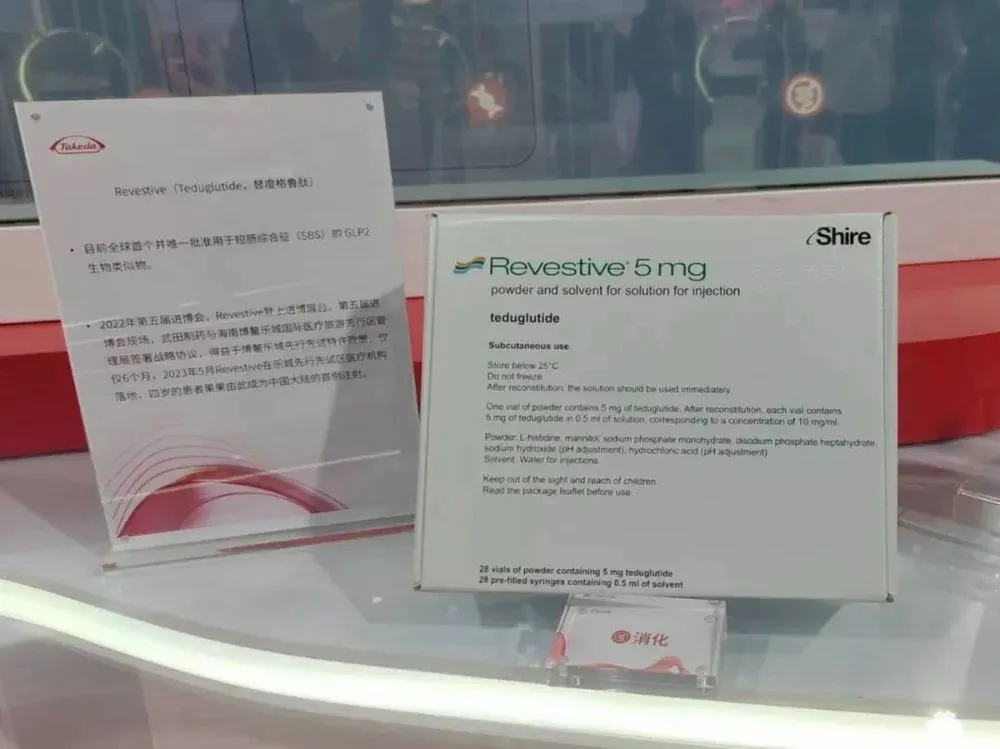
Table of Contents
- Package leaflet: Information for the patient
- Revestive 1.25 mg powder and solvent for injectable solution
- 1. What Revestive is and what it is used for
- 2. What you should know before using Revestive
- 3. How to use Revestive
- 4. Possible side effects
- 5. How to store Revestive
- 6. Package contents and other information
- 1. Assemble the pre-filled syringe
- 2. Dissolving the powder
- 3. Prepare the syringe for injection
- 4. Injecting the solution
- Package leaflet: Information for the patient
- Revestive 5 mg powder and solvent for injectable solution
- 1. What Revestive is and what it is used for
- 2. What you need to know before using Revestive
- 3. How to use Revestive
- 4. Possible side effects
- 5. How to store Revestive
- 6. Package contents and other information
- 1. Assemble the pre-filled syringe
- 2. Dissolving the powder
- 3. Prepare the syringe for injection
- 4. Inject the solution
Package leaflet: Information for the patient
Revestive 1.25 mg powder and solvent for injectable solution
teduglutide
For children and adolescents
This medicinal product is subject to additional monitoring. This will allow rapid identification of new safety information. You can help by reporting any side effects you observe while taking this medicine. See the end of section 4 for information on how to report side effects.
Please read this leaflet carefully before using this medicine because it contains important information for you.
- Keep this leaflet. You may need to read it again.
- If you have any questions, consult the child’s doctor, pharmacist, or nurse.
- This medicine has been prescribed only for this child. Do not give it to others, even if their symptoms are the same, because it could be harmful.
- If the child experiences any side effects, including those not listed in this leaflet, consult the child’s doctor, pharmacist, or nurse. See section 4.
Contents of this leaflet
- What Revestive is and what it is used for
- What you need to know before using Revestive
- How to use Revestive
- Possible side effects
- How to store Revestive
- Contents of the pack and other information
1. What Revestive is and what it is used for
Revestive contains the active substance teduglutide, which improves the absorption of nutrients and fluids by the remaining gastrointestinal tract (intestine).
Revestive is used to treat children and adolescents (from 4 months of age) with short bowel syndrome. Short bowel syndrome is a condition caused by the inability to absorb nutrients and fluids from food through the intestine. It is often due to surgical removal of all or part of the small intestine.
2. What you should know before using Revestive
Do not use Revestive
- if the child is allergic to teduglutide or to any of the other ingredients of this medicine (listed in section 6) or to trace residues of tetracycline.
- if the child has cancer or is suspected to have cancer.
- if the child has had cancer in the gastrointestinal tract, including the liver, gallbladder, bile ducts, or pancreas, within the past five years.
Warnings and precautions
Talk to the child’s doctor before using Revestive:
- if the child has severely reduced liver function. The doctor will consider this when prescribing this medicine.
- if the child suffers from certain cardiovascular diseases (affecting the heart and/or blood vessels), such as high blood pressure (hypertension), or has weak heart function (heart failure). Signs and symptoms include sudden weight gain, facial swelling, swelling of the ankles, and/or shortness of breath.
- if the child has other serious diseases that are not well controlled. The doctor will consider this when prescribing this medicine.
- if the child has reduced kidney function. The doctor may prescribe a lower dose of this medicine.
At the beginning and during treatment with Revestive, the doctor may adjust the amount of fluids or
nutrition the child receives intravenously.
Medical checks before and during treatment with Revestive
Before starting treatment with this medicine, the child will need to undergo a test to check for blood in
the stool. The child will also need to have a colonoscopy (a procedure to examine the inside of the
colon and rectum, to check for polyps (small abnormal growths) and remove them) if there is blood in
the stool without an explanation. If polyps are found before treatment with Revestive, the doctor will
decide whether the child should use this medicine. Revestive must not be used if a tumour is detected
during the colonoscopy. The doctor will perform further colonoscopies if the child continues treatment
with Revestive. The doctor will monitor the child’s body fluids and electrolytes, as imbalances could
lead to fluid overload or dehydration.
The doctor will pay special attention and monitor the function of the child’s small intestine and will
closely watch for signs and symptoms indicating problems affecting the gallbladder, bile ducts, and
pancreas.
Children and adolescents
Children under 4 months of age
This medicine must not be used in children under 4 months of age, as experience with Revestive in
this age group is limited.
Other medicines and Revestive
Tell the doctor, pharmacist, or nurse if the child is taking, has recently taken, or might take any other
medicines.
Revestive may interfere with how other medicines are absorbed from the intestine and thus affect their
effectiveness. The doctor may need to adjust the dose of other medicines the child is taking.
Pregnancy and breastfeeding
If your daughter is pregnant or breastfeeding, the use of Revestive is not recommended.
If your daughter is pregnant, suspects she may be pregnant, is planning a pregnancy, or is breastfeeding,
please consult the doctor, pharmacist, or nurse before using this medicine.
Driving vehicles and using bicycles and machinery
This medicine may cause dizziness. If this occurs, the child must not drive vehicles, ride a bicycle, or
operate machinery until feeling better.
Important information on some ingredients of Revestive
This medicine contains less than 1 mmol (23 mg) of sodium per dose, i.e. essentially ‘sodium-free’.
Caution is required if the child has hypersensitivity to tetracycline (see section "Do not use Revestive").
3. How to use Revestive
Use this medicine exactly as your doctor has told you. If you have any doubts, consult the child's doctor, pharmacist, or nurse.
Dose
The recommended daily dose for the child is 0.05 mg per kg of body weight. The dose will be given in millilitres (mL) of solution.
The doctor will determine the correct dose for the child based on body weight. The doctor will tell you the amount to inject. If you have any doubts, consult the doctor, pharmacist, or nurse.
How to use Revestive
Revestive is injected under the skin (subcutaneously) once daily. The child may self-administer the injection or have it administered by someone else, for example, the child's doctor, assistant, or nurse. If you or the person caring for the child is to inject the medicine, you or that person must be properly trained by the doctor or nurse. Detailed instructions on the injection procedure can be found at the end of this leaflet.
Each time your child receives a dose of Revestive, it is strongly recommended to record the name and batch number of the medicine to maintain documentation of the batches used.
If you use more Revestive than you should
If you inject more Revestive than prescribed by the child's doctor, you must contact the doctor, pharmacist, or nurse.
If you forget to use Revestive
If you forget to inject this medicine (or cannot inject it at the usual time), administer it as soon as possible on the same day. Never give more than one injection in the same day. Do not inject a double dose to make up for a forgotten dose.
If you stop using Revestive
Continue using this medicine for as long as the child's doctor prescribes it. Do not stop using this medicine without consulting the doctor, as sudden discontinuation may cause disturbances in the child's fluid balance.
If you have any questions about the use of this medicine, consult the child's doctor, pharmacist, or nurse.
4. Possible side effects
Like all medicines, this medicine can cause side effects, although not everyone gets them.
Contact your doctor immediately if any of the following side effects occur:
Common (may affect up to 1 in 10 people):
- Congestive heart failure. Contact your doctor if the child experiences fatigue, shortness of breath, or swelling in the ankles, legs, face, or swelling of the face.
- Inflammation of the pancreas (pancreatitis). Contact your doctor or go to the emergency room if the child has severe stomach pain and fever.
- Intestinal obstruction (blockage of the intestine). Contact your doctor or go to the emergency room if the child has severe stomach pain, vomiting, and constipation.
- Reduced bile flow from the gallbladder and/or inflammation of the gallbladder. Contact your doctor or go to the emergency room if the child develops yellowing of the skin and whites of the eyes, itching, dark urine, pale stools, or pain in the upper right or central part of the stomach area.
Uncommon (may affect up to 1 in 100 people):
- Fainting. If heartbeat and breathing are normal and the child recovers quickly, contact the doctor. In all other cases, seek emergency help as soon as possible.
Other side effects include:
Very common (may affect more than 1 in 10 people):
- Respiratory tract infections (any infection of the nasal passages, throat, airways, or lungs)
- Headache
- Stomach pain, bloating, nausea, stoma swelling (a surgically created opening for fecal elimination), vomiting
- Redness, pain, or swelling at the injection site
Common (may affect up to 1 in 10 people):
- Influenza or flu-like symptoms
- Decreased appetite
- Swelling of the hands and/or feet
- Sleep disorders, anxiety
- Cough, shortness of breath
- Polyps (small abnormal growths) in the large intestine
- Intestinal gas (flatulence)
- Narrowing or blockage of the pancreatic duct, which may cause inflammation of the pancreas
- Inflammation of the gallbladder
Uncommon (may affect up to 1 in 100 people):
- Polyps (small abnormal growths) in the small intestine
Not known (frequency cannot be estimated from the available data):
- Allergic reaction (hypersensitivity)
- Fluid retention
- Polyps (small abnormal growths) in the stomach
Use in children and adolescents
In general, side effects in children and adolescents are similar to those observed in adults.
Experience with the use of this medicine in children under 4 months of age is limited.
Reporting of side effects
If the child experiences any side effect, including those not listed in this leaflet, contact the child’s doctor or pharmacist. You may also report side effects directly via the national reporting system listed in Annex V. By reporting side effects, you can help provide more information on the safety of this medicine.
5. How to store Revestive
Keep this medicine out of the sight and reach of children.
Do not use this medicine after the expiry date which is stated on the carton after "Exp", on the vial and on the prefilled syringe after "EXP". The expiry date refers to the last day of that month.
Store in a refrigerator (2 °C – 8 °C). Do not freeze.
From a microbiological standpoint, the solution should be used immediately after reconstitution. However, chemical and physical stability has been demonstrated for 24 hours at 25 °C.
Do not use this medicine if you notice that the solution is cloudy or contains visible particles.
Do not dispose of any medicine via wastewater or household waste. Ask your pharmacist how to dispose of medicines you no longer use. This will help protect the environment.
Dispose of all needles and syringes in a sharps and cutting instruments disposal container.
6. Package contents and other information
What Revestive contains
- The active substance is teduglutide. One vial contains 1.25 mg of teduglutide. After reconstitution, each vial contains 1.25 mg of teduglutide in 0.5 mL of solution, corresponding to a concentration of 2.5 mg/mL.
- The other components are L-histidine, mannitol, monosodium phosphate monohydrate, and disodium phosphate heptahydrate.
- The solvent contains water for injections.
Description of the appearance of Revestive and contents of the pack
Revestive is a powder and solvent for injectable solution (1.25 mg of teduglutide in the vial,
0.5 mL of solvent in the pre-filled syringe).
The powder is white and the solvent is clear and colourless.
Revestive is available in packs of 28 vials of powder with 28 pre-filled syringes.
Marketing Authorisation Holder and Manufacturer
Marketing Authorisation Holder
Takeda Pharmaceuticals International AG Ireland Branch
Block 2 Miesian Plaza
50 – 58 Baggot Street Lower
Dublin 2, D02 HW68
Ireland
Manufacturer
Takeda Pharmaceuticals International AG Ireland Branch
Block 2 Miesian Plaza
50 – 58 Baggot Street Lower
Dublin 2, D02 HW68
Ireland
Shire Pharmaceuticals Ireland Limited
Block 2 & 3 Miesian Plaza
50 – 58 Baggot Street Lower
Dublin 2
Ireland
For further information about this medicinal product, please contact the local representative of the Marketing Authorisation Holder:
België/Belgique/Belgien Lietuva
Takeda Belgium NV Takeda, UAB
Tél/Tel: +32 2 464 06 11 Tel: +370 521 09 070
[email protected] [email protected]
България Luxembourg/Luxemburg
Такеда България ЕООД Takeda Belgium NV
Тел.: +359 2 958 27 36 Tél/Tel: +32 2 464 06 11
[email protected] [email protected]
Česká republika Magyarország
Takeda Pharmaceuticals Czech Republic s.r.o. Takeda Pharma Kft.
Tel: +420 234 722 722 Tel.: +36 1 270 7030
[email protected] [email protected]
Danmark Malta
Takeda Pharma A/S Drugsales Ltd
Tlf.: +45 46 77 10 10 Tel: +356 21419070
[email protected] [email protected]
Deutschland Nederland
Takeda GmbH Takeda Nederland B.V.
Tel: +49 (0)800 825 3325 Tel: +31 20 203 5492
[email protected] [email protected]
Eesti Norge
Takeda Pharma OÜ Takeda AS
Tel: +372 6177 669 Tlf: +47 800 800 30
[email protected] [email protected]
Ελλάδα Österreich
Takeda ΕΛΛΑΣ Α.Ε. Takeda Pharma Ges.m.b.H.
Tηλ: +30 210 6387800 Tel: +43 (0) 800-20 80 50
[email protected] [email protected]
España Polska
Takeda Farmacéutica España, S.A. Takeda Pharma Sp. z o.o.
Tel: +34 917 90 42 22 Tel.: +48223062447
[email protected] [email protected]
France Portugal
Takeda France SAS Takeda Farmacêuticos Portugal, Lda.
Tél: +33 1 40 67 33 00 Tel: +351 21 120 1457
[email protected] [email protected]
Hrvatska România
Takeda Pharmaceuticals Croatia d.o.o. Takeda Pharmaceuticals SRL
Tel: +385 1 377 88 96 Tel: +40 21 335 03 91
[email protected] [email protected]
Ireland Slovenija
Takeda Products Ireland Ltd Takeda Pharmaceuticals farmacevtska družba d.o.o.
Tel: 1800 937 970 Tel: +386 (0) 59 082 480
[email protected] [email protected]
Ísland Slovenská republika
Vistor ehf. Takeda Pharmaceuticals Slovakia s.r.o.
Sími: +354 535 7000 Tel: +421 (2) 20 602 600
[email protected] [email protected]
Italia Suomi/Finland
Takeda Italia S.p.A. Takeda Oy
Tel: +39 06 502601 Puh/Tel: 0800 774 051
[email protected] [email protected]
Κύπρος Sverige
A.POTAMITIS MEDICARE LTD Takeda Pharma AB
Τηλ: +357 22583333 Tel: 020 795 079
[email protected] [email protected]
Latvija
Takeda Latvia SIA
Tel: +371 67840082
[email protected]
More detailed information on this medicinal product is available on the website of the European Medicines Agency: https://www.ema.europa.eu.
Instructions for the preparation and injection of Revestive
Important information:
- Read the package leaflet before using Revestive.
- Revestive is intended for subcutaneous injection (injection under the skin).
- Do not inject Revestive into a vein (intravenous route) or into muscle (intramuscular route).
- Keep Revestive out of the sight and reach of children.
- Do not use Revestive after the expiry date stated on the pack, vial, and pre-filled syringe. The expiry date refers to the last day of the month indicated.
- Store in a refrigerator (2 °C - 8 °C).
- Do not freeze.
- From a microbiological standpoint, the solution should be used immediately after reconstitution. However, chemical and physical in-use stability has been demonstrated for 24 hours at 25 ºC.
- Do not use Revestive if the solution is cloudy or contains visible particles.
- Do not dispose of any medicinal product via wastewater or household waste. Ask your pharmacist how to dispose of medicines no longer required. This will help protect the environment.
- Dispose of all needles and syringes in a sharps disposal container.
Materials supplied in the pack:
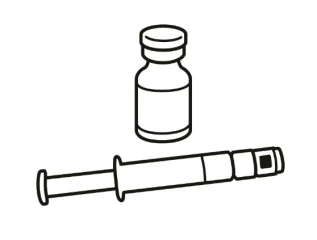
- 28 vials containing 1.25 mg of teduglutide as powder
- 28 pre-filled syringes containing solvent
Materials required but not included in the pack:
- Needles for reconstitution (22 G, 1½” (0.7 x 40 mm) length)
- 0.5 mL or 1 mL syringes for injection (with graduations of 0.02 mL or smaller). For children, a 0.5 mL (or smaller) injection syringe may be used
- Thin injection needles for subcutaneous injection (e.g., 26 G, 5/8” (0.45 x 16 mm) length, or smaller gauge needles for children as appropriate)
- Alcohol swabs
- Alcohol wipes
- Puncture-resistant container for safe disposal of used syringes and needles
NOTE: Before starting, ensure that the work surface is clean and that you have washed your hands.
1. Assemble the pre-filled syringe
Once all materials are ready, you need to assemble the pre-filled syringe. The following
procedure shows how to do it.
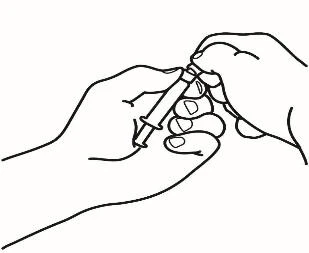
1.1 Take the pre-filled syringe with the solvent and remove the
upper part of the white plastic cap so that it is ready for
inserting the reconstitution needle.
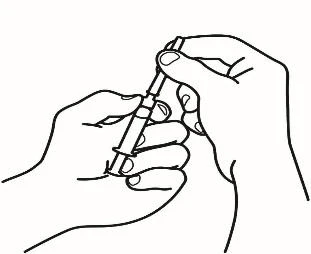
1.2 Insert the reconstitution needle (22 G, 1½” (0.7 x 40 mm)) onto the
pre-filled syringe by screwing it in clockwise direction.
2. Dissolving the powder
The powder can now be dissolved with the solvent.
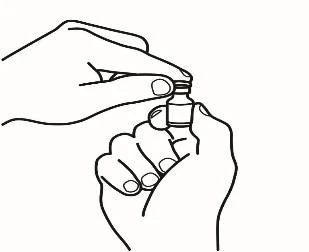
2.1 Remove the blue flip-off cap from the vial containing the powder, clean
the top with an alcohol swab, and allow it to dry.
Do not touch the top of the vial.
2.2 Remove the protective cover from the reconstitution needle of the
prefilled syringe containing the solvent, without touching the tip of the needle.
2.3 Take the vial of powder, insert the reconstitution needle attached to the prefilled syringe
centrally through the rubber stopper, and gently push the plunger fully down to inject all the
solvent into the vial.
2.4 Leave the reconstitution needle and the empty syringe in the vial.
Allow the vial to stand for approximately 30 seconds.
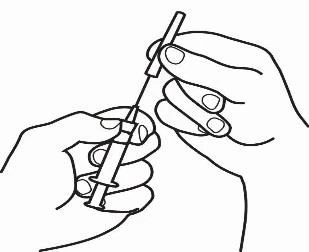
2.5 Gently roll the vial between your palms for about 15 seconds. Then gently invert the vial
once, while keeping the reconstitution needle and empty syringe still inserted in the vial.
NOTE: Do not shake the vial. Shaking may cause foaming, which makes it difficult to withdraw the solution from the vial.
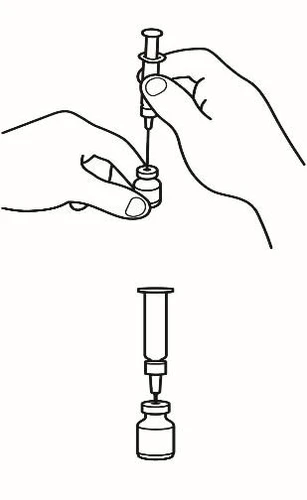
2.6 Allow the vial to stand for approximately two minutes.
2.7 Check whether any undissolved powder remains in the vial. If powder is still present,
repeat steps 2.5 and 2.6. Do not shake the vial. If undissolved powder remains after repeating
the steps, discard the vial and repeat the preparation from the beginning using a new vial.
NOTE: The final solution must be clear. If the solution is cloudy or contains particles, it must not be injected.
NOTE: Once prepared, the solution must be used immediately. It should be stored at a temperature below 25 °C and may be kept for a maximum of twenty-four hours.
3. Prepare the syringe for injection
3.1 Remove the reconstitution syringe from the reconstitution needle
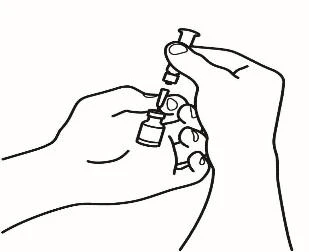
still in the vial and discard the reconstitution syringe.
3.2 Take the injection syringe and attach it to the reconstitution needle
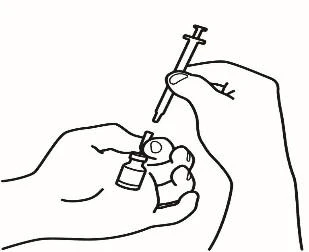
still in the vial.
3.3 Invert the vial, move the tip of the reconstitution needle close to the rubber stopper, and allow the
medication to fill the syringe by gently pulling back the plunger.
NOTE: If the child's doctor has prescribed two vials, prepare a second pre-filled solvent syringe and a second powder vial as described in steps 1 and 2. Draw the solution from the second vial into the same injection syringe by repeating step 3.
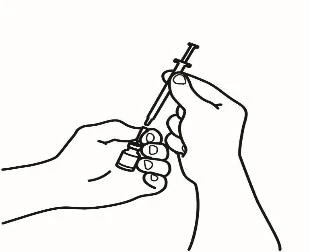
3.4 Remove the injection syringe from the reconstitution needle, leaving the needle in the vial. Discard the vial and the reconstitution needle together into the sharps disposal container.
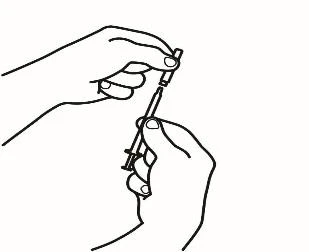
3.5 Take the injection needle, without removing the plastic needle cap. Attach the injection needle to the syringe containing the medication.
3.6 Check for air bubbles. If present, gently tap
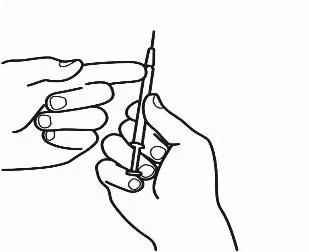
the syringe until the bubbles rise to the surface. Then gently push the plunger to expel them.
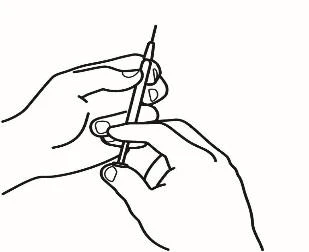
3.7 The dose in mL for the child has been calculated by the child's doctor. Remove any excess volume from the syringe while the needle cap is still attached, until the prescribed dose is achieved.
4. Injecting the solution
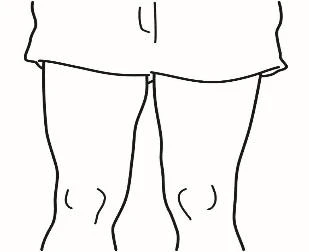
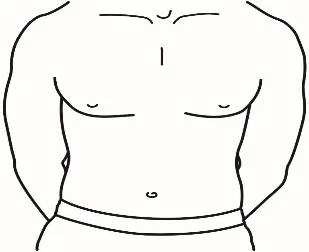
4.1 Identify an area on the child’s abdomen,
or, if there is pain or thickening of the
abdominal tissue, on the thigh where it is
easier to administer the injection (see figure).
NOTE: Do not use the same site every day for each injection – alternate injection sites (use the upper, lower, left, and right areas of the child’s abdomen) to avoid discomfort.
Avoid areas that are inflamed, swollen, scarred, or covered by a mole, birthmark, or other lesion.
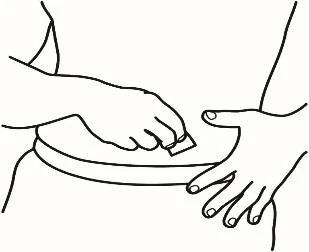
4.2 Clean the identified injection site on the child’s skin using an alcohol swab, using a circular motion from the inside outward. Allow the area to air dry.
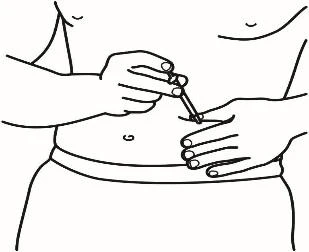
4.3 Remove the plastic cap from the needle of the syringe prepared for injection. Gently pinch with one hand the disinfected skin at the injection site. With the other hand, hold the syringe like a pencil. Bend the wrist backward and quickly insert the needle at a 45° angle.
4.4 Gently pull back the plunger. If blood appears in the syringe, remove the needle and replace it on the syringe for injection with another clean needle of the same size. The medication already in the syringe may still be used. Try injecting it at another point within the disinfected area.
4.5 Inject the medication slowly by steadily pushing the plunger until all the medication has been injected and the syringe is empty.
4.6 Remove the needle from the skin and dispose of both the needle and syringe in a sharps container. Mild bleeding may occur. If needed, gently press the injection site with an alcohol swab or a 2x2 gauze pad until bleeding stops.
4.7 Dispose of all needles and syringes in a sharps container or in a puncture-resistant container (e.g., a detergent bottle with a cap). This container must be puncture-resistant (both at the tip and on the sides). If you need a sharps disposal container, contact the child’s doctor.
Package leaflet: Information for the patient
Revestive 5 mg powder and solvent for injectable solution
teduglutide
This medicinal product is subject to additional monitoring. This will allow for the rapid identification of new safety information. You can help by reporting any adverse reactions you experience while taking this medicine. See the end of section 4 for information on how to report adverse reactions.
Please read this leaflet carefully before using this medicine, as it contains important information for you.
- Keep this leaflet. You may need to read it again.
- If you have any questions, consult your doctor, pharmacist, or nurse.
- This medicine has been prescribed for you only. Do not give it to others, even if their symptoms are the same as yours, as it may be harmful.
- If you experience any adverse reaction, including those not listed in this leaflet, consult your doctor, pharmacist, or nurse. See section 4.
Contents of this leaflet
- What Revestive is and what it is used for
- What you need to know before using Revestive
- How to use Revestive
- Possible adverse reactions
- How to store Revestive
- Contents of the pack and other information
1. What Revestive is and what it is used for
Revestive contains the active substance teduglutide, which improves the absorption of nutrients and fluids by the remaining gastrointestinal tract (intestine).
Revestive is used to treat adults, children, and adolescents (from 4 months of age onwards) who have short bowel syndrome. Short bowel syndrome is a condition caused by the inability to absorb nutrients and fluids from food through the intestine. It is often due to surgical removal of all or part of the small intestine.
2. What you need to know before using Revestive
Do not use Revestive
- if you are allergic to teduglutide or to any of the other ingredients of this medicine (listed in section 6), or to trace residues of tetracycline.
- if you have or suspect you have cancer.
- if you have had cancer in the gastrointestinal tract, including liver, gallbladder, bile ducts, or pancreas, within the past five years.
Warnings and precautions
Talk to your doctor before using Revestive:
- if you have severely reduced liver function. Your doctor will take this into account when prescribing this medicine.
- if you have certain cardiovascular diseases (affecting the heart and/or blood vessels), such as high blood pressure (hypertension), or if you have weak heart function (heart failure). Signs and symptoms include sudden weight gain, facial swelling, swelling of the ankles and/or shortness of breath.
- if you have other serious diseases that are not well controlled. Your doctor will consider this when prescribing this medicine.
- if you have reduced kidney function. Your doctor may prescribe you a lower dose of this medicine.
At the beginning and during treatment with Revestive, your doctor may adjust the amount of fluids or
nutritional support you receive intravenously.
Medical checks before and during treatment with Revestive
Before starting treatment with this medicine, your doctor will perform a colonoscopy
(a procedure to examine the inside of the colon and rectum) to check for polyps (small abnormal growths) and remove them. It is recommended that your doctor perform these examinations once a year for the first 2 years after starting treatment, and thereafter at least every five years. If polyps are found before or during treatment with Revestive, your doctor will decide whether you should continue using this medicine. Revestive must not be used if cancer is detected during colonoscopy. Your doctor will monitor your body fluids and electrolytes, as imbalances could lead to fluid overload or dehydration.
Your doctor will pay particular attention and monitor the function of your small intestine and will watch for signs and symptoms indicating problems affecting the gallbladder, bile ducts, and pancreas.
Children and adolescents
Medical checks before and during treatment with Revestive
Before starting treatment with this medicine, you will need to undergo a test to check for blood in the stool. You will also need to have a colonoscopy (a procedure to examine the inside of the colon and rectum) to check for polyps (small abnormal growths) and have them removed if unexplained blood in the stool is present. If polyps are found before treatment with Revestive, your doctor will decide whether you should use this medicine. Revestive must not be used if a tumour is detected during colonoscopy. Your doctor will perform additional colonoscopies if treatment with Revestive continues. Your doctor will monitor the child's body fluids and electrolytes, as imbalances could lead to fluid overload or dehydration.
Children under 4 months of age
This medicine must not be used in children under 4 months of age, as experience with Revestive in this age group is limited.
Other medicines and Revestive
Inform your doctor, pharmacist, or nurse if you are taking, have recently taken, or might take any other medicines.
Revestive may interfere with how other medicines are absorbed from the intestine and thus affect their effectiveness. Your doctor may need to adjust the dose of other medicines.
Pregnancy and breastfeeding
Use of Revestive is not recommended if you are pregnant or breastfeeding.
If you are pregnant, suspect you may be pregnant, are planning a pregnancy, or are breastfeeding, consult your doctor, pharmacist, or nurse before using this medicine.
Driving and using machines
This medicine may cause dizziness. If this occurs, do not drive or operate machinery until you feel better.
Important information about some of the ingredients of Revestive
This medicine contains less than 1 mmol (23 mg) of sodium per dose, i.e. essentially ‘sodium-free’.
Caution is required if you have hypersensitivity to tetracycline (see section “Do not use Revestive”).
3. How to use Revestive
Use this medicine exactly as instructed by your doctor. If you have any doubts, consult your
doctor, pharmacist, or nurse.
Dosage
The recommended daily dose is 0.05 mg per kg of body weight. The dose will be given in millilitres
(mL) of solution.
Your doctor will determine the correct dose for you based on your body weight. Your doctor will inform you of the dose to be injected. If you have any doubts, consult your doctor, pharmacist, or nurse.
Use in children and adolescents
Revestive can be used in children and adolescents (from 4 months of age onwards). Use this
medicine exactly as instructed by your doctor.
How to use Revestive
Revestive is injected under the skin (subcutaneously) once daily. You may self-administer the injection or have it administered by another person, for example, your doctor, your assistant, or your nurse. If you self-inject or have someone else administer the injection, you or the person caring for you must be properly trained by your doctor or nurse. Detailed instructions on the injection procedure can be found at the end of this leaflet.
Each time you or your child receives a dose of Revestive, it is strongly recommended to record the
name and batch number of the medicine in order to maintain documentation of the batches used.
If you use more Revestive than you should
If you inject more Revestive than prescribed by your doctor, you must contact your doctor,
pharmacist, or nurse.
If you forget to use Revestive
If you forget to inject this medicine (or cannot inject it at the usual time), use it as soon as possible on the same day. Never administer more than one injection in the same day. Do not inject a double dose to make up for a forgotten dose.
If you stop using Revestive
Continue using this medicine for as long as your doctor prescribes it. Do not stop using this medicine without consulting your doctor, as sudden discontinuation may cause disturbances in fluid balance.
If you have any questions about the use of this medicine, consult your doctor, pharmacist, or nurse.
4. Possible side effects
Like all medicines, this medicine can cause side effects, although not everybody gets them.
Contact your doctor immediately if you experience any of the following side effects:
Common (may affect up to 1 in 10 people):
- Congestive heart failure. Contact your doctor if you experience fatigue, shortness of breath, or swelling in the ankles or legs, or swelling of the face.
- Inflammation of the pancreas (pancreatitis). Contact your doctor or go to the emergency room if you experience severe stomach pain and fever.
- Intestinal obstruction (blockage of the intestine). Contact your doctor or go to the emergency room if you experience severe stomach pain, vomiting, and constipation.
- Reduced bile flow from the gallbladder and/or inflammation of the gallbladder. Contact your doctor or go to the emergency room if you notice yellowing of the skin and whites of the eyes, itching, dark urine and pale stools, or pain in the upper right or central area of the stomach.
Uncommon (may affect up to 1 in 100 people):
- Fainting. If your heart rate and breathing are normal and you recover quickly, contact your doctor. In all other cases, seek medical help as soon as possible.
Other side effects include:
Very common (may affect more than 1 in 10 people):
- Respiratory tract infections (any infection of the nasal passages, throat, airways, or lungs)
- Headache
- Stomach pain, bloating, nausea, stoma swelling (a surgical opening for the elimination of faeces), vomiting
- Redness, pain, or swelling at the injection site
Common (may affect up to 1 in 10 people):
- Influenza or flu-like symptoms
- Decreased appetite
- Swelling of the hands and/or feet
- Sleep disorders, anxiety
- Cough, shortness of breath
- Polyps (small abnormal growths) in the large intestine
- Intestinal gas (flatulence)
- Narrowing or blockage of the pancreatic duct, which may cause inflammation of the pancreas
- Inflammation of the gallbladder
Uncommon (may affect up to 1 in 100 people):
- Polyps (small abnormal growths) in the small intestine
Not known (frequency cannot be estimated from the available data):
- Allergic reaction (hypersensitivity)
- Fluid retention
- Polyps (small abnormal growths) in the stomach
Use in children and adolescents
In general, side effects in children and adolescents are similar to those observed in adults.
Experience with the use of this medicine in children under 4 months of age is limited.
Reporting of side effects
If you experience any side effects, including those not listed in this leaflet, talk to your doctor or pharmacist. You can also report side effects directly via the national reporting system listed in Annex V. By reporting side effects, you can help provide more information on the safety of this medicine.
5. How to store Revestive
Keep this medicine out of the sight and reach of children.
Do not use this medicine after the expiry date stated on the carton, vial, and pre-filled syringe after Exp. The expiry date refers to the last day of that month.
Store below 25 °C.
Do not freeze.
From a microbiological standpoint, the solution should be used immediately after reconstitution. However, chemical and physical stability have been demonstrated for 3 hours at 25 °C.
Do not use this medicine if you notice that the solution is cloudy or contains visible particles.
Do not dispose of any medicine via wastewater or household waste. Ask your pharmacist how to dispose of medicines no longer used. This will help protect the environment.
Dispose of all needles and syringes in a sharps and cutting objects disposal container.
6. Package contents and other information
What Revestive contains
- The active substance is teduglutide. One vial of powder contains 5 mg of teduglutide. After reconstitution, each vial contains 5 mg of teduglutide in 0.5 mL of solution, corresponding to a concentration of 10 mg/mL.
- The other components are L-histidine, mannitol, monosodium phosphate monohydrate, disodium phosphate heptahydrate, sodium hydroxide (for pH adjustment), hydrochloric acid (for pH adjustment).
- The solvent contains water for injections.
Description of the appearance of Revestive and contents of the pack
Revestive is a powder and solvent for injectable solution (5 mg of teduglutide in the vial,
0.5 mL of solvent in the pre-filled syringe).
The powder is white and the solvent is clear and colourless.
Revestive is available in packs containing 1 vial of powder with 1 pre-filled syringe or
28 vials of powder with 28 pre-filled syringes.
Not all pack sizes may be available.
Marketing Authorisation Holder and Manufacturer
Marketing Authorisation Holder
Takeda Pharmaceuticals International AG Ireland Branch
Block 2 Miesian Plaza
50 – 58 Baggot Street Lower
Dublin 2, D02 HW68
Ireland
Manufacturer
Takeda Pharmaceuticals International AG Ireland Branch
Block 2 Miesian Plaza
50 – 58 Baggot Street Lower
Dublin 2, D02 HW68
Ireland
Shire Pharmaceuticals Ireland Limited
Block 2 & 3 Miesian Plaza
50 – 58 Baggot Street Lower
Dublin 2
Ireland
For further information about this medicine, please contact the local representative of the Marketing Authorisation Holder:
België/Belgique/Belgien Lietuva
Takeda Belgium NV Takeda, UAB
Tél/Tel: +32 2 464 06 11 Tel: +370 521 09 070
[email protected] [email protected]
България Luxembourg/Luxemburg
Такеда България ЕООД Takeda Belgium NV
Тел.: +359 2 958 27 36 Tél/Tel: +32 2 464 06 11
[email protected] [email protected]
Česká republika Magyarország
Takeda Pharmaceuticals Czech Republic s.r.o. Takeda Pharma Kft.
Tel: +420 234 722 722 Tel.: +36 1 270 7030
[email protected] [email protected]
Danmark Malta
Takeda Pharma A/S Drugsales Ltd
Tlf.: +45 46 77 10 10 Tel: +356 21419070
[email protected] [email protected]
Deutschland Nederland
Takeda GmbH Takeda Nederland B.V.
Tel: +49 (0)800 825 3325 Tel: +31 20 203 5492
[email protected] [email protected]
Eesti Norge
Takeda Pharma OÜ Takeda AS
Tel: +372 6177 669 Tlf: +47 800 800 30
[email protected] [email protected]
Ελλάδα Österreich
Takeda ΕΛΛΑΣ Α.Ε. Takeda Pharma Ges.m.b.H.
Tηλ: +30 210 6387800 Tel: +43 (0) 800-20 80 50
[email protected] [email protected]
España Polska
Takeda Farmacéutica España, S.A. Takeda Pharma Sp. z o.o.
Tel: +34 917 90 42 22 Tel.: +48223062447
[email protected] [email protected]
France Portugal
Takeda France SAS Takeda Farmacêuticos Portugal, Lda.
Tél: +33 1 40 67 33 00 Tel: +351 21 120 1457
[email protected] [email protected]
Hrvatska România
Takeda Pharmaceuticals Croatia d.o.o. Takeda Pharmaceuticals SRL
Tel: +385 1 377 88 96 Tel: +40 21 335 03 91
[email protected] [email protected]
Ireland Slovenija
Takeda Products Ireland Ltd Takeda Pharmaceuticals farmacevtska družba d.o.o.
Tel: 1800 937 970 Tel: +386 (0) 59 082 480
[email protected] [email protected]
Ísland Slovenská republika
Vistor ehf. Takeda Pharmaceuticals Slovakia s.r.o.
Sími: +354 535 7000 Tel: +421 (2) 20 602 600
[email protected] [email protected]
Italia Suomi/Finland
Takeda Italia S.p.A. Takeda Oy
Tel: +39 06 502601 Puh/Tel: 0800 774 051
[email protected] [email protected]
Κύπρος Sverige
A.POTAMITIS MEDICARE LTD Takeda Pharma AB
Τηλ: +357 22583333 Tel: 020 795 079
[email protected] [email protected]
Latvija
Takeda Latvia SIA
Tel: +371 67840082
[email protected]
More detailed information on this medicine is available on the European Medicines Agency website: https://www.ema.europa.eu.
Instructions for the preparation and injection of Revestive
Important information:
- Read the package leaflet before using Revestive.
- Revestive is intended for injection under the skin (subcutaneous injection).
- Do not inject Revestive into a vein (intravenous) or into muscle (intramuscular).
- Keep Revestive out of the sight and reach of children.
- Do not use Revestive after the expiry date stated on the pack, vial, and pre-filled syringe. The expiry date refers to the last day of the month indicated.
- Store below 25 °C.
- Do not freeze.
- From a microbiological standpoint, the solution should be used immediately after reconstitution. However, chemical and physical stability has been demonstrated for 3 hours at 25 °C.
- Do not use Revestive if the solution is cloudy or contains visible particles.
- Do not dispose of medicines via wastewater or household waste. Ask your pharmacist how to dispose of medicines no longer required. This will help protect the environment.
- Dispose of all needles and syringes in a sharps container.
Materials supplied in the pack:
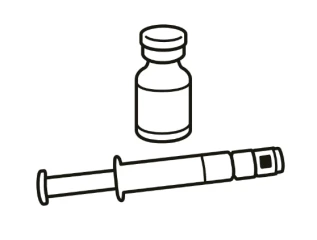
- 1 or 28 vials containing 5 mg of teduglutide as powder
- 1 or 28 pre-filled syringes containing solvent
Materials required but not included in the pack:
- Needles for reconstitution (22 G, 1½” (0.7 x 40 mm) length)
- 0.5 mL or 1 mL syringes for injection (with scale increments of 0.02 mL or smaller). For children, a 0.5 mL (or smaller) injection syringe may be used
- Thin injection needles for subcutaneous injection (e.g. 26 G, 5/8” (0.45 x 16 mm) length), or smaller gauge needles for children as appropriate
- Alcohol swabs
- Alcohol pads
- Non-punctureable container for the safe disposal of used syringes and needles
NOTE: Before starting, ensure that the work surface is clean and that you have washed your hands.
1. Assemble the pre-filled syringe
Once all materials are ready, you need to assemble the pre-filled syringe.
The following procedure shows how to do it.
1.1 Take the pre-filled syringe with the solvent and remove the
upper part of the white plastic cap on the pre-filled syringe
so that it is ready for attaching the reconstitution needle.
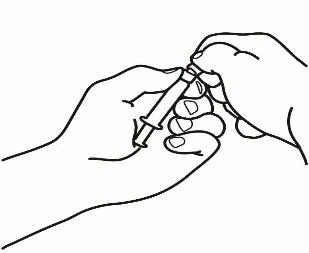
1.2 Attach the reconstitution needle (22 G, 1½” (0.7 x 40 mm)) to the
pre-filled syringe by screwing it on clockwise.
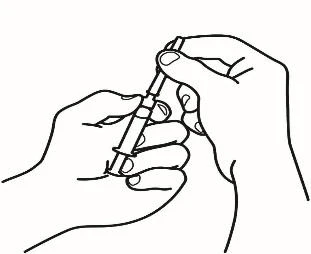
2. Dissolving the powder
The powder can now be dissolved using the solvent.
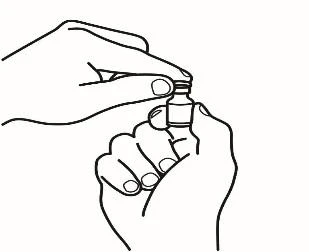
2.1 Remove the green flip-off cap from the vial containing the powder, clean
the top with an alcohol swab, and allow it to dry.
Do not touch the top of the vial.
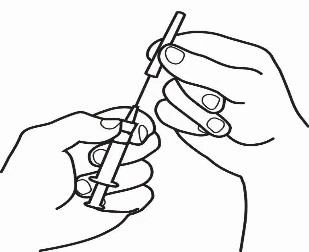
2.2 Remove the protective cover from the reconstitution needle attached to the pre-filled syringe
containing the solvent, without touching the tip of the needle.
2.3 Take the vial with the powder, insert the reconstitution needle
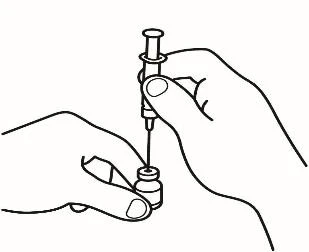
connected to the pre-filled syringe into the center of the rubber stopper, and
gently push the plunger fully to inject all the solvent into the vial.
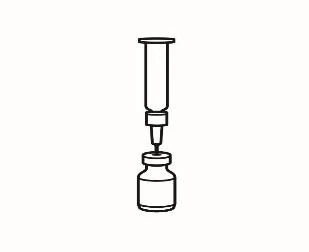
2.4 Leave the reconstitution needle and the empty syringe in the vial.
Allow the vial to stand for approximately 30 seconds.
2.5 Gently roll the vial between the palms of your hands for about
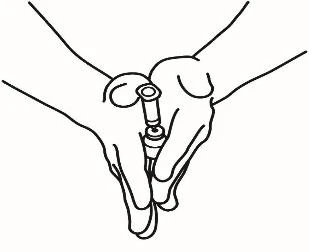
15 seconds. Then gently invert the vial once, keeping the reconstitution needle and the empty syringe still inserted in the vial.
NOTE: Do not shake the vial. Shaking may cause foaming, which makes it difficult to withdraw the solution from the vial.
2.6 Allow the vial to stand for approximately two minutes.
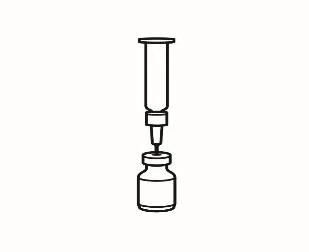
2.7 Check that no undissolved powder remains in the vial. If any powder remains, repeat steps 2.5 and 2.6. Do not shake the vial. If undissolved powder is still present, discard the vial and repeat the preparation from the beginning using a new vial.
NOTE: The final solution must be clear. If the solution is cloudy or contains particles, it must not be injected.
NOTE: Once prepared, the solution must be used immediately. It should be kept at a temperature below 25°C and may be stored for a maximum of three hours.
3. Prepare the syringe for injection
3.1 Remove the reconstitution syringe from the reconstitution needle
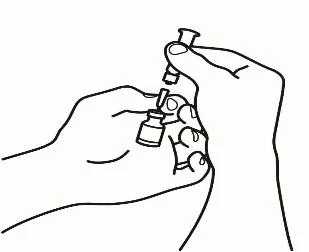
still in the vial and discard the reconstitution syringe.
3.2 Take the injection syringe and attach it to the reconstitution needle
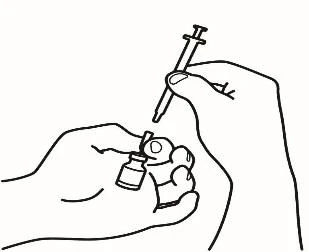
still in the vial.
3.3 Invert the vial, move the tip of the reconstitution needle close to the rubber stopper, and allow all the
medicinal product to fill the syringe by gently pulling back the plunger.
NOTE: If your doctor has prescribed two vials, prepare a second pre-filled solvent syringe and a second powder vial as described in steps 1 and 2. Draw the solution from the second vial into the same injection syringe by repeating step 3.
3.4 Remove the injection syringe from the reconstitution needle
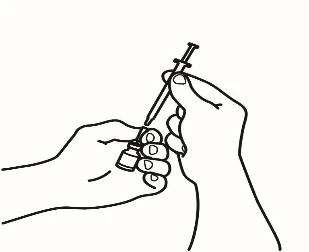
leaving the needle in the vial. Discard the vial and the reconstitution needle together into a sharps disposal container.
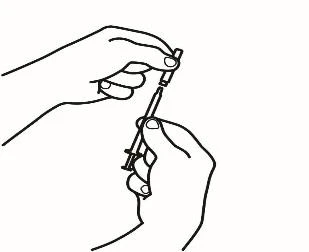
3.5 Take the injection needle, without removing the plastic needle cap. Attach the injection needle to the syringe containing the medicinal product.
3.6 Check for air bubbles. If present, gently tap
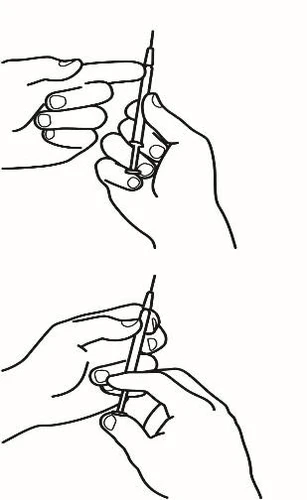
the syringe until the bubbles rise to the surface. Then gently push the plunger to expel them.
3.7 The prescribed dose in mL has been determined by your doctor. Remove any excess volume from the syringe while the needle cap is still attached, until the prescribed dose remains.
4. Inject the solution
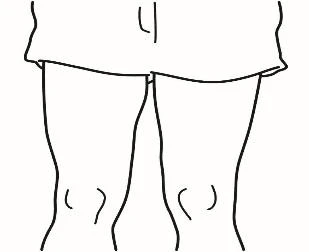
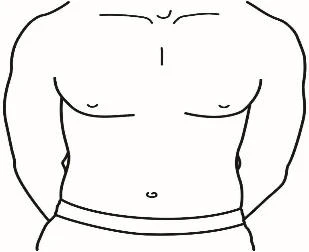
4.1 Identify an area on the abdomen, or if there is pain or thickening of the abdominal tissue, on the thigh, where it is easier to administer the injection (see figure).
NOTE: Do not use the same site every day for each injection – alternate injection sites (use upper, lower, left, and right areas of the abdomen) to avoid discomfort. Avoid inflamed, swollen areas, or those with scars, or covered by a mole, birthmark, or other lesion.
4.2 Clean the identified injection site on the skin with an alcohol swab, using a circular motion from the inside outward. Allow the area to air dry.
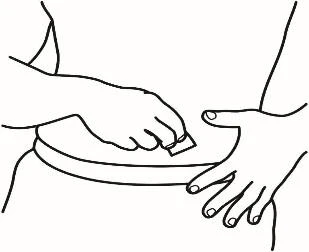
4.3 Remove the plastic cap from the needle of the syringe prepared for injection. With one hand, gently pinch the disinfected skin at the injection site. With the other hand, hold the syringe like a pencil. Bend the wrist backward and quickly insert the needle at a 45° angle.
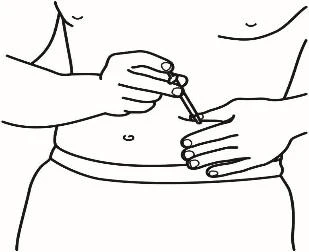
4.4 Gently pull back the plunger. If blood appears in the syringe, remove the needle and replace it with a clean needle of the same size on the syringe. The medication already in the syringe may still be used. Try injecting at another site within the disinfected area.
4.5 Inject the medication slowly by steadily pushing the plunger until all the medication has been injected and the syringe is empty.
4.6 Remove the needle from the skin and dispose of both the needle and syringe in a sharps disposal container. Mild bleeding may occur. If needed, gently press a cotton swab soaked in alcohol or a 2x2 gauze pad over the injection site until bleeding stops.
4.7 Dispose of all needles and syringes in a sharps container or in a puncture-resistant container (for example, a detergent bottle with a cap). This container must be puncture-resistant (both at the top and sides). If you need a sharps disposal container, contact your doctor.