Repatha
Italy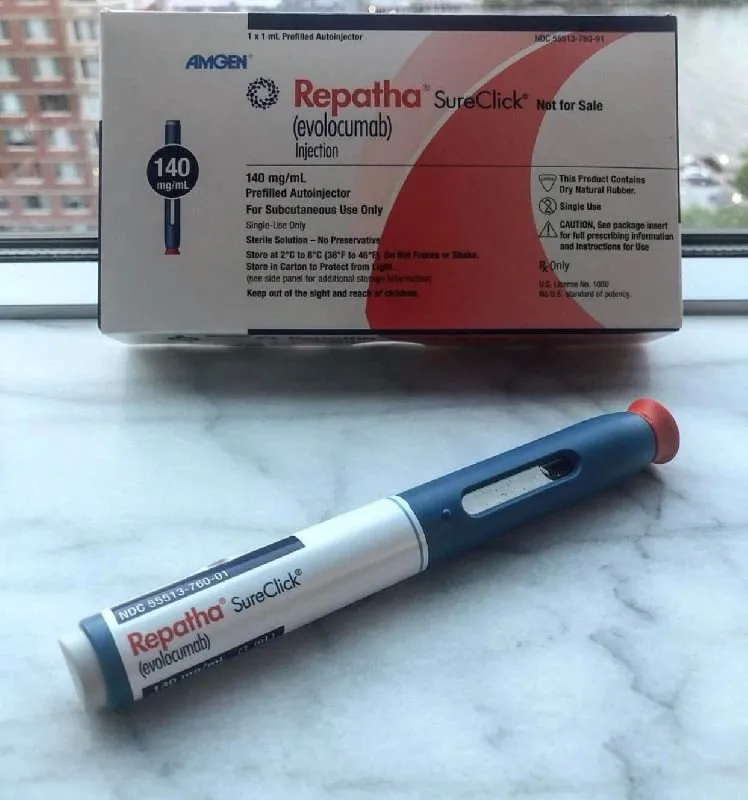
Instructions for Use
Table of Contents
- Repatha 140 mg solution for injection in pre-filled syringe
- 1. What is Repatha and what is it used for
- 2. What you need to know before using Repatha
- 3. How to use Repatha
- 4. Possible side effects
- 5. How to store Repatha
- 6. Package contents and other information
- Instructions for use:
- Repatha, single-use pre-filled syringe
- Package leaflet: Information for the user
- Repatha 140 mg solution for injection in a pre-filled pen
- 1. What is Repatha and what is it used for
- 2. What you need to know before using Repatha
- 3. How to use Repatha
- 4. Possible side effects
- 5. How to store Repatha
- 6. Package contents and other information
- Instructions for use:
- Repatha, single-use pre-filled SureClick pen
- Package leaflet: information for the user
- Repatha 420 mg solution for injection in cartridge
- 1. What is Repatha and what is it used for
- 2. What you need to know before using Repatha
- 3. How to use Repatha
- 4. Possible side effects
- 5. How to store Repatha
- 6. Package contents and other information
- Instructions for use:
Package leaflet: Information for the user
Repatha 140 mg solution for injection in pre-filled syringe
evolocumab
Please read all of this leaflet carefully before you start using this medicine because it contains important information for you.
- Keep this leaflet. You may need to read it again.
- If you have any questions, ask your doctor, pharmacist or nurse.
- This medicine has been prescribed for you only. Do not pass it on to other people, even if their symptoms are the same as yours, because it could be harmful.
- If you experience any side effects, including those not listed in this leaflet, tell your doctor, pharmacist or nurse. See section 4.
- The warnings and instructions contained in this document are intended for the person taking the medicine. Parents or caregivers responsible for administering the medicine to others, for example to a child, should follow the information accordingly.
Contents of this leaflet
- What Repatha is and what it is used for
- What you need to know before using Repatha
- How to use Repatha
- Possible side effects
- How to store Repatha
- Contents of the pack and other information
1. What is Repatha and what is it used for
What Repatha is and how it works
Repatha is a medicine that lowers levels of "bad" cholesterol, a type of fat present in the blood.
Repatha contains evolocumab as the active substance, a monoclonal antibody (a type of specialized protein designed to bind to a specific target substance in the human body). Evolocumab is designed to bind to a substance called PCSK9, which affects the liver's ability to remove cholesterol from the blood. By binding to and removing PCSK9, the medicine increases the amount of cholesterol taken up by the liver, thereby lowering cholesterol levels in the blood.
What Repatha is used for
Repatha is used in addition to diet to lower cholesterol:
- in adults with high blood cholesterol levels (primary hypercholesterolemia [heterozygous familial and non-familial] or mixed dyslipidemia). It is administered:
- together with a statin or another cholesterol-lowering medicine, if the maximum dose of a statin does not sufficiently reduce cholesterol levels.
- alone or together with other cholesterol-lowering medicines when statins are not effective or cannot be used.
- in children aged 10 years and older with high blood cholesterol levels caused by an inherited condition (heterozygous familial hypercholesterolemia or HeFH). It is administered alone or together with other cholesterol-lowering treatments.
- in adults and children aged 10 years and older with high blood cholesterol levels caused by an inherited condition (homozygous familial hypercholesterolemia or HoFH). It is administered together with other cholesterol-lowering treatments.
- in adults with high blood cholesterol levels and established atherosclerotic cardiovascular disease (history of heart attack, stroke, or blood vessel problems). It is administered:
- together with a statin or another cholesterol-lowering medicine, if the maximum dose of a statin does not sufficiently reduce cholesterol levels.
- alone or together with other cholesterol-lowering medicines when statins are not effective or cannot be used.
Repatha is used in patients who cannot adequately control their cholesterol levels through a cholesterol-lowering diet alone. While being treated with this medicine, you must continue to follow your cholesterol-lowering diet. Repatha may help prevent heart attacks, strokes, and certain heart procedures to restore blood flow to the heart due to the buildup of fatty deposits in the arteries (also known as atherosclerotic cardiovascular disease).
2. What you need to know before using Repatha
Do not use Repatha if you are allergic to evolocumab or to any of the other ingredients of this
medicinal product (listed in section 6).
Warnings and precautions
Talk to your doctor, pharmacist, or nurse before using Repatha if you have liver disease.
The needle cap of the pre-filled glass syringe contains dry natural rubber (a latex derivative), which may cause severe allergic reactions.
To improve traceability of this medicinal product, your doctor or pharmacist should record the
name and batch number of the product administered to you in your patient record. You may
also wish to note down these details, in case you are asked for this information in the future.
Children and adolescents
The use of Repatha has been studied in children aged 10 years and older who are being treated for
heterozygous or homozygous familial hypercholesterolemia.
The use of Repatha has not been studied in children under 10 years of age.
Other medicines and Repatha
Tell your doctor or pharmacist if you are taking, have recently taken, or might take any other
medicines.
Pregnancy and breastfeeding
If you are pregnant, think you might be pregnant, are planning a pregnancy, or are breastfeeding, ask your doctor or pharmacist for advice before taking this medicine.
Repatha has not been studied in pregnant women. It is not known whether Repatha is harmful to the unborn child.
It is not known whether Repatha passes into breast milk.
It is important that you inform your doctor if you are breastfeeding or planning to breastfeed. Your doctor will then help you decide whether to discontinue breastfeeding or discontinue/abstain from Repatha therapy, taking into account the benefits of breastfeeding for the child and the benefits of Repatha for the mother.
Driving and using machines
Repatha has no effect or negligible effect on the ability to drive vehicles or operate machinery.
Repatha contains sodium
This medicinal product contains less than 1 mmol of sodium (23 mg) per dose, i.e. essentially ‘sodium-free’.
3. How to use Repatha
Use this medicine exactly as your doctor has told you. If you are in any doubt, consult your doctor.
The recommended dose depends on your underlying condition:
- For adults with primary hypercholesterolemia and mixed dyslipidemia, the dose is 140 mg every two weeks or 420 mg once a month.
- For children aged 10 years and older with heterozygous familial hypercholesterolemia, the dose is 140 mg every two weeks or 420 mg once a month.
- For adults or children aged 10 years and older with homozygous familial hypercholesterolemia, the recommended starting dose is 420 mg once a month. After 12 weeks, your doctor may decide to increase the dose to 420 mg every two weeks. If you are also undergoing apheresis, a procedure similar to dialysis in which cholesterol and other fats are removed from the blood, your doctor may decide to start your treatment at a dose of 420 mg every two weeks, timed to coincide with your apheresis sessions.
- For adults with established atherosclerotic cardiovascular disease (a history of heart attack, stroke, or blood vessel problems), the dose is 140 mg every two weeks or 420 mg once a month.
Repatha is administered by subcutaneous injection (injected under the skin).
If your doctor prescribes a dose of 420 mg, you must use three pre-filled syringes, as each pre-filled syringe contains only 140 mg of the medicine. After reaching room temperature, all injections must be administered within 30 minutes.
If your doctor decides that you or a caregiver may administer the Repatha injections, you must be trained on how to properly prepare and inject the medicine. Do not attempt to inject Repatha until you have received instructions from your doctor or nurse on how to do so.
For instructions on storage, preparation, and administration of Repatha injections at home, see the “Instructions for Use” at the end of this leaflet.
Before starting treatment with Repatha, you must follow a cholesterol-lowering diet. You must continue this diet throughout your treatment with Repatha.
If Repatha has been prescribed together with another cholesterol-lowering medicine, follow your doctor’s instructions regarding the combined use of these medicines. In this case, also read the dosing instructions provided in the leaflet of that specific medicine.
If you use more Repatha than you should
Contact your doctor or pharmacist immediately.
If you forget to use Repatha
After a missed dose, take Repatha as soon as possible. Then contact your doctor, who will advise you on when to schedule your next dose, and follow their new instructions exactly.
4. Possible side effects
Like all medicines, this medicine can cause side effects, although not everyone experiences them.
Common (may affect up to 1 in 10 people)
- Influenza (high temperature, sore throat, runny nose, cough, and chills)
- Common cold, characterized by runny nose and sore throat, or sinus infection (nasopharyngitis or upper respiratory tract infections)
- Feeling unwell (nausea)
- Back pain
- Joint pain (arthralgia)
- Muscle pain
- Injection site reactions such as bruising, redness, bleeding, pain, or swelling
- Allergic reactions including rash
- Headache
Uncommon (may affect up to 1 in 100 people)
- Hives, characterized by red, itchy bumps appearing on the skin
- Influenza-like symptoms
Rare (may affect up to 1 in 1,000 people)
- Swelling of the face, mouth, tongue, or throat (angioedema)
Reporting of side effects
If you experience any side effect, including those not listed in this leaflet, talk to your doctor, pharmacist, or nurse. You can also report side effects directly through the national reporting system listed in Annex V. By reporting side effects, you can help provide more information on the safety of this medicine.
5. How to store Repatha
Keep this medicine out of the sight and reach of children.
Do not use this medicine after the expiry date stated on the label and carton after
Exp. The expiry date refers to the last day of that month.
Store in a refrigerator (2 °C–8 °C). Do not freeze.
Keep in the original packaging to protect the medicine from light.
Before injection, the pre-filled syringe may be removed from the refrigerator and allowed to reach room temperature (up to 25 °C). This will make the injection less uncomfortable. Once removed from the refrigerator, Repatha may be stored at room temperature (up to 25 °C) in the original carton and must be used within 1 month.
Do not use this medicine if you notice any changes in colour or the presence of large clumps, fragments, or coloured particles.
Do not dispose of medicines via wastewater or household waste.
Ask your pharmacist how to dispose of medicines you no longer use. This will help protect the environment.
6. Package contents and other information
What Repatha contains
- The active substance is evolocumab. Each pre-filled syringe contains 140 mg of evolocumab in 1 mL of solution.
- The other components are proline, glacial acetic acid, polysorbate 80, sodium hydroxide, water for injections.
Description of the appearance of Repatha and contents of the pack
Repatha is a solution that ranges from clear to opalescent, colourless to slightly yellow, and is almost free from particles.
Each pack contains one single-use pre-filled syringe.
Marketing Authorisation Holder and Manufacturer
Amgen Europe B.V.
Minervum 7061
4817 ZK Breda
The Netherlands
Marketing Authorisation Holder
Amgen Europe B.V.
Minervum 7061
4817 ZK Breda
The Netherlands
Manufacturer
Amgen Technology (Ireland) Unlimited Company
Pottery Road
Dun Laoghaire
Co Dublin
Ireland
Manufacturer
Amgen NV
Telecomlaan 5-7
1831 Diegem
Belgium
For further information about this medicinal product, please contact the local representative of the Marketing Authorisation Holder:
België/Belgique/Belgien Lietuva
s.a. Amgen n.v. Amgen Switzerland AG Vilniaus filialas
Tel/Tél: +32 (0)2 7752711 Tel: +370 5 219 7474
България Luxembourg/Luxemburg
Амджен България ЕООД s.a. Amgen
Тел.: +359 (0)2 424 7440 Belgique/Belgien
Tel/Tél: +32 (0)2 7752711
Česká republika Magyarország
Amgen s.r.o. Amgen Kft.
Tel: +420 221 773 500 Tel.: +36 1 35 44 700
Danmark Malta
Amgen, filial af Amgen AB, Sverige Amgen B.V.
Tlf: +45 39617500 The Netherlands
Tel: +31 (0)76 5732500
Deutschland Nederland
AMGEN GmbH Amgen B.V.
Tel.: +49 89 1490960 Tel: +31 (0)76 5732500
Eesti Norge
Amgen Switzerland AG Vilniaus filialas Amgen AB
Tel: +372 586 09553 Tel: +47 23308000
Ελλάδα Österreich
Amgen Ελλάς Φαρμακευτικά Ε.Π.Ε. Amgen GmbH
Τηλ.: +30 210 3447000 Tel: +43 (0)1 50 217
España Polska
Amgen S.A. Amgen Biotechnologia Sp. z o.o.
Tel: +34 93 600 18 60 Tel.: +48 22 581 3000
France Portugal
Amgen S.A.S. Amgen Biofarmacêutica, Lda.
Tél: +33 (0)9 69 363 363 Tel: +351 21 422 06 06
Hrvatska România
Amgen d.o.o. Amgen România SRL
Tel: +385 (0)1 562 57 20 Tel: +4021 527 3000
Ireland Slovenija
Amgen Ireland Limited AMGEN zdravila d.o.o.
Tel: +353 1 8527400 Tel: +386 (0)1 585 1767
Ísland Slovenská republika
Vistor hf. Amgen Slovakia s.r.o.
Sími: +354 535 7000 Tel: +421 2 321 114 49
Italia Suomi/Finland
Amgen S.r.l. Amgen AB, sivuliike Suomessa/Amgen AB, filial i Finland
Tel: +39 02 6241121 Puh/Tel: +358 (0)9 54900500
Kύπρος Sverige
C.A. Papaellinas Ltd Amgen AB
Τηλ.: +357 22741 741 Tel: +46 (0)8 6951100
Latvija United Kingdom (Northern Ireland)
Amgen Switzerland AG Rīgas filiāle Amgen Limited
Tel: +371 257 25888 Tel: +44 (0)1223 420305
Other sources of information
More detailed information on this medicinal product is available on the website of the European Medicines Agency, http://www.ema.europa.eu.
__________________________________________________________________________________
Instructions for use:
Repatha, single-use pre-filled syringe
| Parts Guide | ||
Before use | After use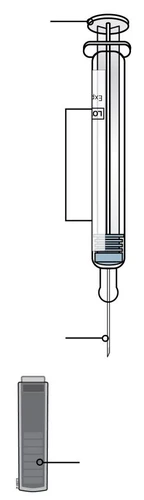 | |
| Plunger Medicinal Cylinder Syringe cylinder Gray needle cap inserted | Used plunger Used syringe cylinder Used needle Gray needle cap removed | |
 | The needle is inside. | |
Important
Before using a single-use pre-filled Repatha syringe, read these important
information:
- Do not freeze the pre-filled Repatha syringe or use a syringe that has been frozen.
- Do not use the pre-filled Repatha syringe if the packaging is open or damaged.
- Do not use a pre-filled Repatha syringe that has fallen onto a hard surface. Some parts of the syringe may have broken even if the damage is not visible. Use a new pre-filled Repatha syringe.
- Do not remove the grey needle cap from the pre-filled Repatha syringe unless you are ready to perform the injection.
| Step 1: Preparation | |
| A | Remove the Repatha pre-filled syringe from the refrigerator and wait 30 minutes. |
| Before proceeding with the injection, wait at least 30 minutes to allow the pre-filled syringe to naturally reach room temperature. Check that the box label shows the name Repatha. •Do not attempt to heat the Repatha pre-filled syringe using heat sources such as hot water or a microwave oven. | |
| |
| |
| B | Gather all necessary materials for administering the injection. |
| Wash your hands thoroughly with soap and water. On a flat, clean, and well-lit surface, prepare: • One Repatha pre-filled syringe in its packaging. • Alcohol swabs. • A cotton ball or gauze pad. • A plaster (bandage). • A sharps disposal container. •Do not use the Repatha pre-filled syringe after the expiration date printed on the packaging. | |
C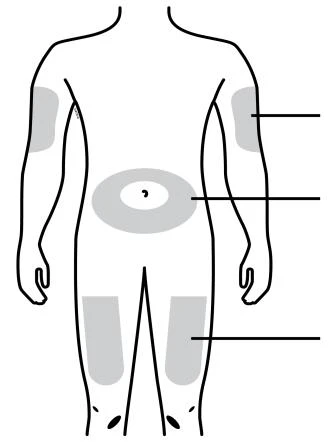 | Choose the injection site. |
Upper arm Abdomen Thigh You may use:• The thigh. • The abdomen, except for the area within 5 centimeters around the navel. • The outer upper arm (only if someone else is administering the injection). •Do not select areas where the skin is tender, bruised, red, or hardened. Avoid injecting in areas with scars or stretch marks. For each injection, choose a different site. If it is necessary to use the same injection site, ensure you do not inject in the exact same spot as the previous injection. | |
D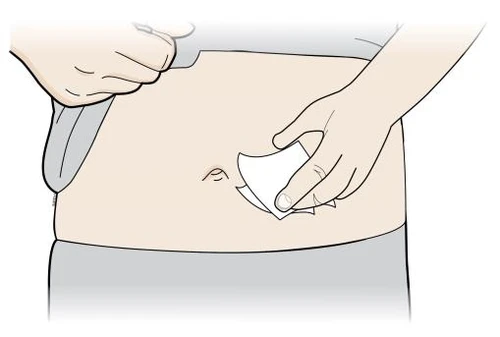 | Clean the injection site. |
| Before administering the injection, clean the site with an alcohol swab and allow it to dry. •Do not touch the disinfected area again before giving the injection. | |
E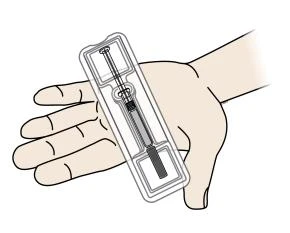 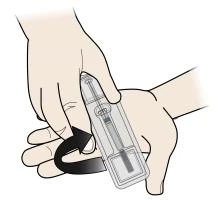 | Remove the pre-filled syringe from its packaging.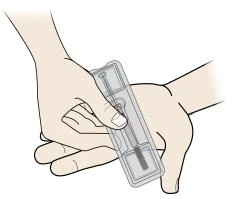 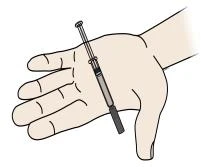 |
Invert the packaging Apply gentle pressure To remove the syringe: •Peel back the paper from the packaging. •Place the packaging in your hand. •Invert the packaging and apply gentle pressure to the center to release the syringe into your palm. •If you cannot remove the pre-filled syringe, apply gentle pressure to the back of the packaging. •Do not grasp or pull the Repatha pre-filled syringe by the plunger or the gray needle cap, as this may damage the syringe. •Do not remove the gray needle cap from the pre-filled syringe until you are ready to administer the injection. Always hold the pre-filled syringe by the barrel. | |
F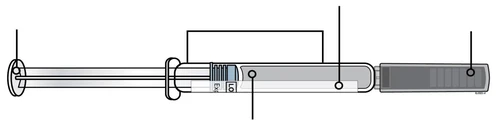 | Inspect the medication and syringe. |
| Plunger Syringe barrel Label with expiration date Gray needle cap in place Medication Always hold the pre-filled syringe by the barrel. Check that:• The name Repatha appears on the label of the pre-filled syringe. • The medication inside the pre-filled syringe is clear, colorless to slightly yellow. •Do not use the pre-filled syringe if any part of it appears cracked or broken.•Do not use the pre-filled syringe if the gray needle cap is missing or not securely attached.•Do not use the pre-filled syringe if the medication has changed color or contains large clumps, fragments, or colored particles. •Do not use the pre-filled syringe if the expiration date printed on it has passed. | |
| Step 2: Preparing for Injection | ||
A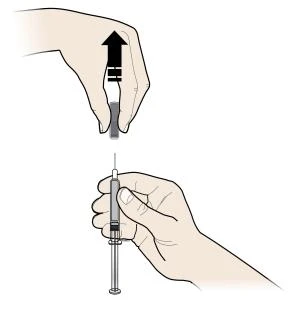 | Carefully remove the gray needle cap by pulling it upward and away from yourself. Do not leave the pre-filled syringe without the gray cap for more than 5 minutes. This could dry out the medication.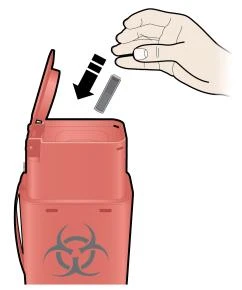 | |
| 1. It is normal to see a drop of medication at the tip of the needle. | 2. Immediately dispose of the cap in a sharps disposal container. | |
| ||
| B | Remove air bubbles/air pockets. |
Air bubbles/air pockets may be visible in the Repatha pre-filled syringe. If air bubbles/air pockets are present: • Hold the pre-filled syringe with the needle pointing upward. • Gently tap the syringe barrel with your fingers until the bubble/air pocket rises to the top end of the syringe. • Gently and slowly push the plunger to expel the air from the pre-filled syringe. Be very careful not to expel the medicine. • Do not tap the needle end of the syringe.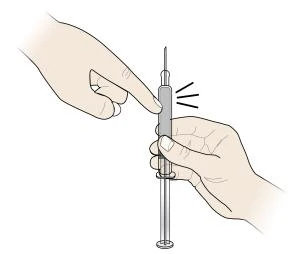 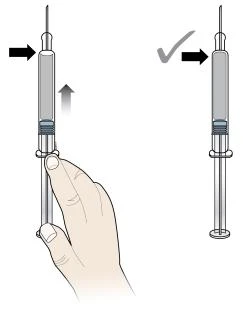 | |
| C | PIECE the injection site to create a stable surface.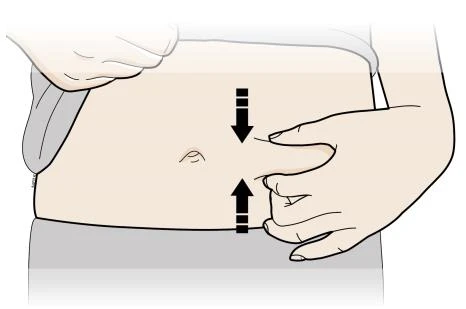 |
Firmly grasp a fold of skin with your thumb and other fingers, creating a skin fold approximately 5 centimeters wide. It is important to keep the skin lifted during the injection. | |
| Step 3: Injection | |
A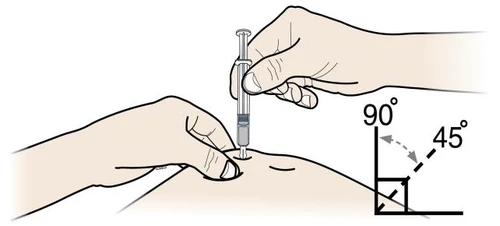 | Keep the skin pinched. Insert the needle into the skin at an angle of 45–90°. |
| |
| B | PUSH the plunger with slow and steady pressure until the syringe is empty. |
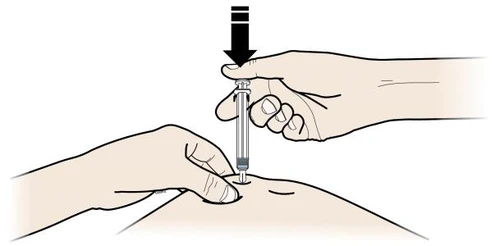 | |
| C | Once completed, RELEASE the thumb and gently remove the syringe from the skin. |
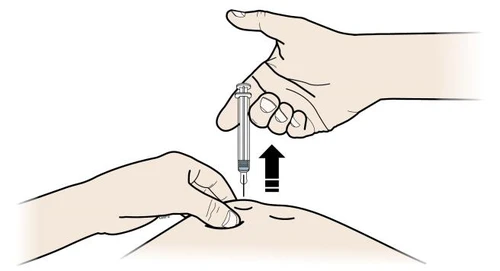 | |
| Step 4: Final phase | |
A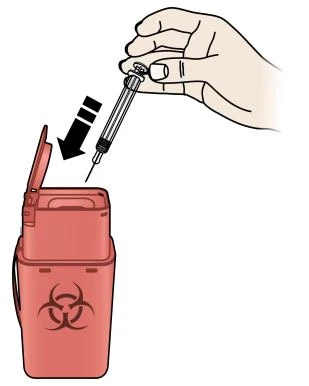 | Immediately dispose of the used syringe in a sharps disposal container. |
Ask your healthcare provider for proper disposal methods, as there may be specific local guidelines. • Do not reuse a used syringe. • Do not use any remaining medicine in a used syringe. • Do not recycle the syringe or the sharps disposal container, or throw them into household waste. Keep the used syringe and the sharps disposal container out of sight and reach of children. | |
| B | Examine the injection site. |
| If bleeding occurs, apply a cotton ball or gauze pad and apply gentle pressure to the injection site. If needed, apply a bandage. • Do not rub the injection site. | |
Package leaflet: Information for the user
Repatha 140 mg solution for injection in a pre-filled pen
evolocumab
Please read this leaflet carefully before using this medicine because it contains important information for you.
- Keep this leaflet. You may need to read it again.
- If you have any questions, ask your doctor, pharmacist, or nurse.
- This medicine has been prescribed for you only. Do not give it to other people, even if they have the same symptoms as you, because it could be harmful.
- If you experience any side effects, including those not listed in this leaflet, talk to your doctor, pharmacist, or nurse. See section 4.
- The warnings and instructions in this document are intended for the person taking the medicine. Parents or caregivers responsible for administering the medicine to others, for example to a child, should follow the information accordingly.
Contents of this leaflet
- What Repatha is and what it is used for
- What you need to know before using Repatha
- How to use Repatha
- Possible side effects
- How to store Repatha
- Contents of the pack and other information
1. What is Repatha and what is it used for
What is Repatha and how does it work
Repatha is a medicine that lowers levels of "bad" cholesterol, a type of fat present in the blood.
Repatha contains evolocumab as the active substance, a monoclonal antibody (a type of specialised protein designed to bind to a target substance in the human body). Evolocumab is designed to bind to a substance called PCSK9, which affects the liver's ability to remove cholesterol. By binding to and removing PCSK9, the medicine increases the amount of cholesterol taken up by the liver, thereby lowering cholesterol levels in the blood.
What Repatha is used for
Repatha is used in addition to diet to lower cholesterol:
- in adults with high levels of cholesterol in the blood (primary hypercholesterolaemia [heterozygous familial and non-familial] or mixed dyslipidaemia). It is administered:
- together with a statin or another cholesterol-lowering medicine, if the maximum dose of a statin does not sufficiently lower cholesterol levels.
- alone or together with other cholesterol-lowering medicines when statins are not effective or cannot be used.
- in children aged 10 years and older with high levels of cholesterol in the blood caused by an inherited condition (heterozygous familial hypercholesterolaemia or HeFH). It is administered alone or together with other cholesterol-lowering treatments.
- in adults and children aged 10 years and older with high levels of cholesterol in the blood caused by an inherited condition (homozygous familial hypercholesterolaemia or HoFH). It is administered together with other cholesterol-lowering treatments.
- in adults with high levels of cholesterol in the blood and established atherosclerotic cardiovascular disease (history of heart attack, stroke, or blood vessel problems). It is administered:
- together with a statin or another cholesterol-lowering medicine, if the maximum dose of a statin does not sufficiently lower cholesterol levels.
- alone or together with other cholesterol-lowering medicines when statins are not effective or cannot be used.
Repatha is used in patients who cannot control their cholesterol levels through a cholesterol-lowering diet alone. During treatment with this medicine, you must continue to follow your cholesterol-lowering diet. Repatha may help prevent heart attack, stroke, and certain heart procedures to restore blood flow to the heart due to the build-up of fatty deposits in the arteries (also known as atherosclerotic cardiovascular disease).
2. What you need to know before using Repatha
Do not use Repatha if you are allergic to evolocumab or to any of the other ingredients of this
medicine (listed in section 6).
Warnings and precautions
Talk to your doctor, pharmacist, or nurse before using Repatha if you have liver disease.
The needle cap of the pre-filled glass pen contains dry natural rubber (a derivative of latex), which may cause severe allergic reactions.
In order to improve traceability of this medicine, your doctor or pharmacist should record the name and batch number of the product you have been given in your patient record. You may also wish to note down these details, in case you are asked for this information in the future.
Children and adolescents
The use of Repatha has been studied in children aged 10 years and older being treated for heterozygous or homozygous familial hypercholesterolemia.
The use of Repatha has not been studied in children under 10 years of age.
Other medicines and Repatha
Tell your doctor or pharmacist if you are taking, have recently taken, or might take any other medicines.
Pregnancy and breastfeeding
If you are pregnant, think you might be pregnant, are planning to become pregnant, or are breastfeeding, ask your doctor or pharmacist for advice before taking this medicine.
Repatha has not been studied in pregnant women. It is not known whether Repatha is harmful to the unborn baby.
It is not known whether Repatha passes into breast milk.
It is important that you inform your doctor if you are breastfeeding or planning to breastfeed. Your doctor will then help you decide whether to stop breastfeeding or stop taking Repatha, taking into account the benefits of breastfeeding for the baby and the benefits of Repatha for the mother.
Driving and using machines
Repatha has no effect or negligible effect on the ability to drive vehicles or operate machinery.
Repatha contains sodium
This medicine contains less than 1 mmol of sodium (23 mg) per dose, i.e. essentially ‘sodium-free’.
3. How to use Repatha
Use this medicine exactly as instructed by your doctor. If you have any doubts, consult your doctor.
The recommended dose depends on your underlying condition:
- For adults with primary hypercholesterolemia and mixed dyslipidemia, the dose is 140 mg every two weeks or 420 mg once a month.
- For children aged 10 years and older with heterozygous familial hypercholesterolemia, the dose is 140 mg every two weeks or 420 mg once a month.
- For adults or children aged 10 years and older with homozygous familial hypercholesterolemia, the recommended starting dose is 420 mg once a month. After 12 weeks, your doctor may decide to increase the dose to 420 mg every two weeks. If you are also undergoing apheresis, a procedure similar to dialysis in which cholesterol and other fats are removed from the blood, your doctor may decide to start your treatment with a dose of 420 mg every two weeks, timed to coincide with apheresis.
- For adults with established atherosclerotic cardiovascular disease (a history of heart attack, stroke, or blood vessel problems), the dose is 140 mg every two weeks or 420 mg once a month.
Repatha is administered by subcutaneous injection (under the skin).
If your doctor prescribes a 420 mg dose, you must use three pre-filled pens, as each pre-filled pen contains only 140 mg of the medicine. After reaching room temperature, all injections must be administered within 30 minutes.
If your doctor decides that Repatha injections can be administered by you or by a caregiver, you must be trained on how to properly prepare and inject the medicine. Do not attempt to administer the Repatha injection before receiving instructions from your doctor or nurse.
For instructions on storage, preparation, and administration of Repatha injections at home, see the “Instructions for Use” at the end of this leaflet. If you are using the pre-filled pen, before administering the injection, place the correct end (yellow) of the pen against the skin.
Before starting treatment with Repatha, you must follow a cholesterol-lowering diet. You must continue this diet throughout your treatment with Repatha.
If Repatha has been prescribed together with another cholesterol-lowering medicine, follow your doctor’s instructions regarding the combined use of these medicines. In this case, also read the dosing instructions provided in the package leaflet of that specific medicine.
If you use more Repatha than you should
Contact your doctor or pharmacist immediately.
If you forget to take Repatha
After a missed dose, take Repatha as soon as possible. Then contact your doctor, who will advise you on when to schedule the next dose, and follow the new instructions exactly.
4. Possible side effects
Like all medicines, this medicine can cause side effects, although not everyone gets them.
Common (may affect up to 1 in 10 people)
- Influenza (high temperature, sore throat, runny nose, cough and chills)
- Common cold, characterized by runny nose and sore throat, or sinus infection (nasopharyngitis or upper respiratory tract infections)
- Feeling unwell (nausea)
- Back pain
- Joint pain (arthralgia)
- Muscle pain
- Reactions at the injection site such as bruising, redness, bleeding, pain or swelling
- Allergic reactions including skin rash
- Headache
Uncommon (may affect up to 1 in 100 people)
- Urticaria, characterized by red, itchy bumps appearing on the skin
- Influenza-like symptoms
Rare (may affect up to 1 in 1,000 people)
- Swelling of the face, mouth, tongue or throat (angioedema)
Reporting of side effects
If you get any side effects, including any not listed in this leaflet, talk to your doctor, pharmacist or nurse.
You can also report side effects directly via the national reporting system detailed in Annex V. By reporting side effects, you can help provide more information on the safety of this medicine.
5. How to store Repatha
Keep this medicine out of the sight and reach of children.
Do not use this medicine after the expiry date which is stated on the label and on the carton after
Exp. The expiry date refers to the last day of that month.
Store in a refrigerator (2 °C–8 °C). Do not freeze.
Keep in the original packaging to protect the medicine from light.
Before injection, the pre-filled pen may be removed from the refrigerator and allowed to reach room temperature (up to 25 °C). This will make the injection less uncomfortable. Once removed from the refrigerator, Repatha may be stored at room temperature (up to 25 °C) in the original carton and must be used within 1 month.
Do not use this medicine if you notice any changes in colour or the presence of large clumps, fragments, or coloured particles.
Do not dispose of any medicine via wastewater or household waste.
Ask your pharmacist how to dispose of medicines no longer required. This will help protect the environment.
6. Package contents and other information
What Repatha contains
- The active substance is evolocumab. Each SureClick pre-filled pen contains 140 mg of evolocumab in 1 mL of solution.
- The other components are proline, glacial acetic acid, polysorbate 80, sodium hydroxide, water for injections.
Description of the appearance of Repatha and contents of the pack
Repatha is a solution that ranges from clear to opalescent, colourless to slightly yellow, and is almost free of particles.
Each pack contains one, two, three, or six single-use pre-filled SureClick pens.
Marketing Authorisation Holder
Amgen Europe B.V.
Minervum 7061
4817 ZK Breda
The Netherlands
Marketing Authorisation Holder
Amgen Europe B.V.
Minervum 7061
4817 ZK Breda
The Netherlands
Manufacturer
Amgen Technology (Ireland) Unlimited Company
Pottery Road
Dun Laoghaire
Co Dublin
Ireland
Manufacturer
Amgen NV
Telecomlaan 5-7
1831 Diegem
Belgium
For further information on this medicinal product, please contact the local representative of the Marketing Authorisation Holder:
België/Belgique/Belgien Lietuva
s.a. Amgen n.v. Amgen Switzerland AG Vilniaus filialas
Tel/Tél: +32 (0)2 7752711 Tel: +370 5 219 7474
България Luxembourg/Luxemburg
Амджен България ЕООД s.a. Amgen
Тел.: +359 (0)2 424 7440 Belgique/Belgien
Tel/Tél: +32 (0)2 7752711
Česká republika Magyarország
Amgen s.r.o. Amgen Kft.
Tel: +420 221 773 500 Tel.: +36 1 35 44 700
Danmark Malta
Amgen, filial af Amgen AB, Sverige Amgen B.V.
Tlf: +45 39617500 The Netherlands
Tel: +31 (0)76 5732500
Deutschland Nederland
AMGEN GmbH Amgen B.V.
Tel.: +49 89 1490960 Tel: +31 (0)76 5732500
Eesti Norge
Amgen Switzerland AG Vilniaus filialas Amgen AB
Tel: +372 586 09553 Tel: +47 23308000
Ελλάδα Österreich
Amgen Ελλάς Φαρμακευτικά Ε.Π.Ε. Amgen GmbH
Τηλ.: +30 210 3447000 Tel: +43 (0)1 50 217
España Polska
Amgen S.A. Amgen Biotechnologia Sp. z o.o.
Tel: +34 93 600 18 60 Tel.: +48 22 581 3000
France Portugal
Amgen S.A.S. Amgen Biofarmacêutica, Lda.
Tél: +33 (0)9 69 363 363 Tel: +351 21 422 06 06
Hrvatska România
Amgen d.o.o. Amgen România SRL
Tel: +385 (0)1 562 57 20 Tel: +4021 527 3000
Ireland Slovenija
Amgen Ireland Limited AMGEN zdravila d.o.o.
Tel: +353 1 8527400 Tel: +386 (0)1 585 1767
Ísland Slovenská republika
Vistor hf. Amgen Slovakia s.r.o.
Sími: +354 535 7000 Tel: +421 2 321 114 49
Italia Suomi/Finland
Amgen S.r.l. Amgen AB, sivuliike Suomessa/Amgen AB, filial
Tel: +39 02 6241121 i Finland
Puh/Tel: +358 (0)9 54900500
Kύπρος Sverige
C.A. Papaellinas Ltd Amgen AB
Τηλ.: +357 22741 741 Tel: +46 (0)8 6951100
Latvija United Kingdom (Northern Ireland)
Amgen Switzerland AG Rīgas filiāle Amgen Limited
Tel: +371 257 25888 Tel: +44 (0)1223 420305
Other sources of information
More detailed information on this medicinal product is available on the website of the European Medicines Agency, http://www.ema.europa.eu.
__________________________________________________________________________________
Instructions for use:
Repatha, single-use pre-filled SureClick pen
| Parts Guide | ||
Before use Gray start button Expiration date Medication window Orange cap inserted Yellow safety device (needle inside)  | After use Expiration date Yellow window (injection completed) Yellow safety device (needle inside) Orange cap removed | |
| Important: The needle is inside the yellow safety device. | ||
Important
Before using the Repatha pre-filled pen, read the following important information:
- Do not freeze the Repatha pre-filled pen or use a pen that has been frozen.
- Do not remove the orange cap from the Repatha pre-filled pen unless you are ready to perform the injection.
- Do not use a Repatha pre-filled pen that has fallen on a hard surface. Some parts of the pen may have broken even if the damage is not visible.
Step 1: Preparation
A Remove a Repatha pre-filled pen from the pack.
- Carefully remove the pre-filled pen from the pack in an upright position.
- If the pack contains other unused pre-filled pens, return them to the refrigerator.
- Before proceeding with the injection, wait at least 30 minutes to allow the pre-filled pen to naturally reach room temperature.
- Do not attempt to warm the pre-filled pen using heat sources such as hot water or a microwave oven.
- Do not expose the pre-filled pen to direct sunlight.
- Do not shake the pre-filled pen.
- Do not remove the orange cap from the pre-filled pen.
| B | Check the Repatha pre-filled pen.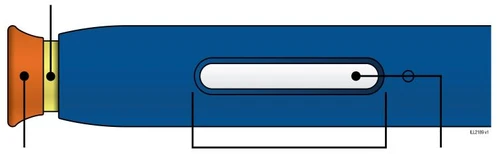 |
| Yellow safety device (needle inside) Orange cap attached Medication window Ensure the medicine in the viewing window is clear, colorless to slightly yellow. Check the expiration date. • Do not use the pre-filled pen if the medicine is cloudy, discolored, or contains large clumps, fragments, or particles. • Do not use the pre-filled pen if any part appears cracked or broken. • Do not use the pre-filled pen if it has been dropped. • Do not use the pre-filled pen if the orange cap is missing or not securely attached. • Do not use the pre-filled pen if the expiration date has passed. If any of these conditions apply, use a new pre-filled pen. | |
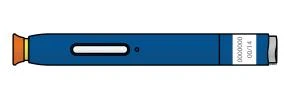
| C | Prepare all necessary items for the injection. |
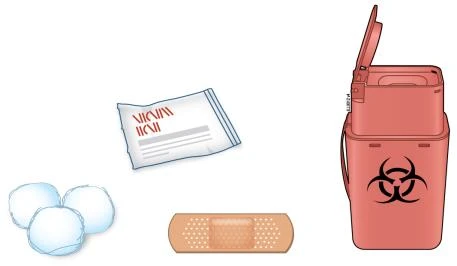
| Wash hands thoroughly with soap and water. On a clean, well-lit surface, prepare: • A new pre-filled pen • Alcohol swabs • A cotton ball or gauze pad • A bandage • A sharps disposal container | |
  | |
D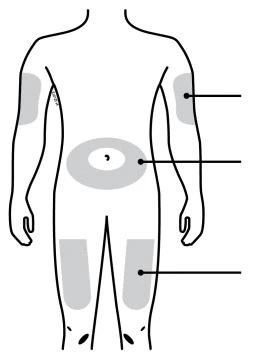 | Prepare and clean the injection site. |
| Upper arm Abdomen (stomach area) Thigh Use only these injection sites: • The thigh • The stomach area (abdomen), except for the area within 5 centimeters of the navel • The outer upper arm (only if someone else is administering the injection) Clean the site with an alcohol swab and allow it to dry. • Do not touch the cleaned area again before administering the injection. • For each injection, select a different site. If it is necessary to reuse the same general area, ensure the injection is not given at the exact same spot as the previous one. • Do not inject into areas where the skin is tender, bruised, red, or hardened. Avoid injecting into areas with scars or stretch marks. | |
| Step 2: Preparing for Injection | |
A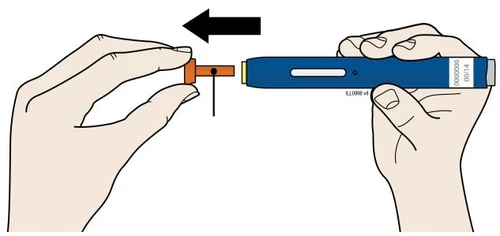 | Remove the orange cap by pulling it off horizontally only when ready to administer the injection. Do not leave the pre-filled pen without the orange cap for more than 5 minutes, as this may dry out the medicine. |
| Orange cap It is normal to see a drop of liquid at the tip of the needle or on the yellow safety device. • Do not twist, bend, or move the orange cap back and forth. • Do not reattach the orange cap to the pre-filled pen. • Do not touch the yellow safety device with fingers. Important: Do not remove the orange cap from the pre-filled pen unless you are ready to administer the injection. If you are unable to give the injection, contact your healthcare provider. | |
B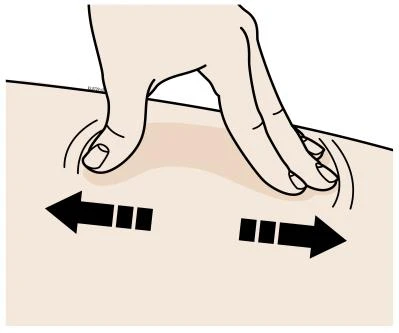 | Create a stable surface at the chosen injection site (thigh, stomach, or outer upper arm) using either the stretch method or the pinch method. |
| Stretch method Stretch the skin firmly by moving the thumb and fingers in opposite directions to create an area about 5 centimeters wide. OR Pinch method Firmly grasp a section of skin with the thumb and fingers to create a skin fold about 5 centimeters wide. Important: It is essential to keep the skin either stretched or pinched during the injection. 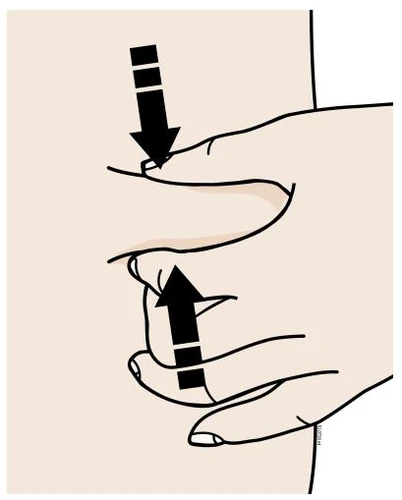 | |
| Step 3: Injection | |
| A | Continue to keep the skin stretched or pinched. After removing the orange cap, place the yellow safety device against the skin at a 90° angle. The needle is inside the yellow safety device. Do not press the grey start button yet.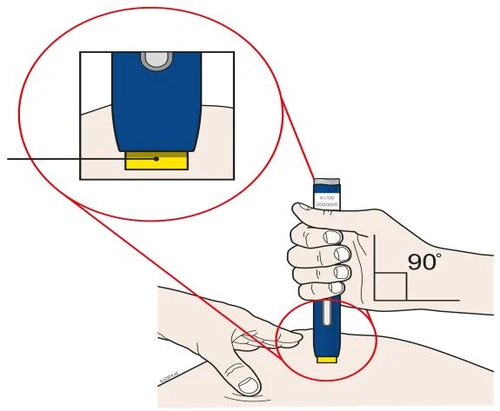 |
| Yellow safety device (needle inside) | |
| B | Firmly press the pre-filled pen against the skin until it stops moving. |
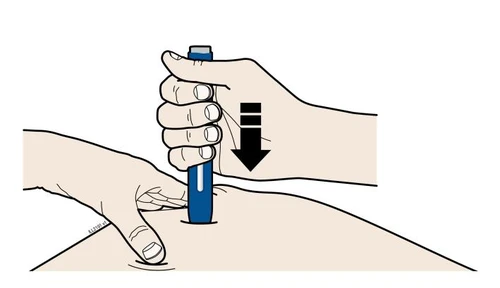 | |
| Important: Press down as far as possible, but do not press the grey button until you are ready to administer the injection. | |
| C | As soon as you are ready to administer the injection, press the grey button. You will hear a click. |
“click”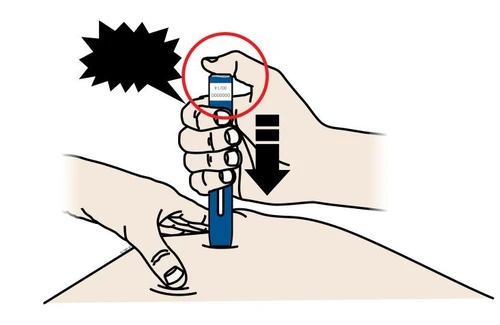 | |
| D | Continue pressing down on the skin. Then lift your thumb while keeping the pre-filled pen in place on the skin. The injection may take about 15 seconds.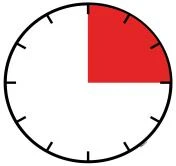 |
| “click” 15 seconds After the injection is complete, the viewing window will turn from clear to yellow. You may hear a second click. 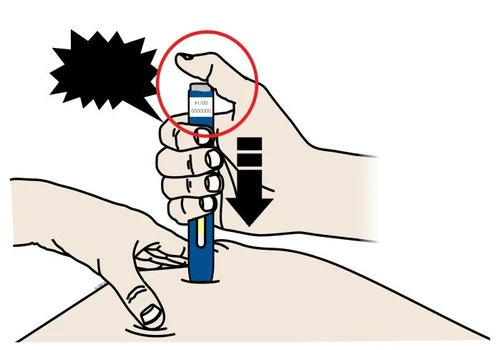 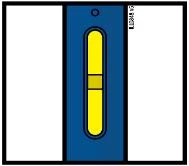 | |
NOTE: After lifting the pre-filled pen from the skin, the needle will automatically be covered.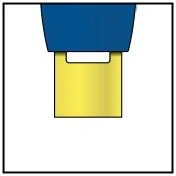 | |
Step 4: Final Step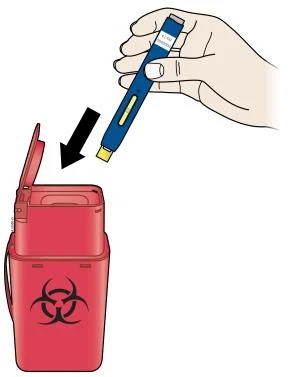 | |
| A | Dispose of the pre-filled pen and the orange needle cap. |
| Place the pre-filled pen and the orange needle cap into the sharps disposal container. Ask your healthcare provider for proper disposal methods, as local guidelines may apply. Keep the pre-filled pen and the sharps disposal container out of sight and reach of children. • Do not reuse the pre-filled pen. • Do not reattach the cap to the pre-filled pen or touch the yellow protective device with fingers. • Do not recycle the pre-filled pen or the sharps disposal container, or dispose of them in household waste. | |
| B | Examine the injection site. |
| If blood is present, press a cotton ball or gauze pad over the injection site. Do not rub the injection site. Apply a bandage if needed. | |
Package leaflet: information for the user
Repatha 420 mg solution for injection in cartridge
evolocumab
Please read this leaflet carefully before using this medicine because it contains important information for you.
- Keep this leaflet. You may need to read it again.
- If you have any questions, ask your doctor, pharmacist, or nurse.
- This medicine has been prescribed for you only. Do not give it to other people, even if their symptoms are the same as yours, as it may be harmful.
- If you experience any side effects, including those not listed in this leaflet, contact your doctor, pharmacist, or nurse. See section 4.
- The warnings and instructions contained in this document are intended for the person taking the medicine. Parents or caregivers responsible for administering the medicine to others, for example to a child, must follow the information accordingly.
Contents of this leaflet
- What Repatha is and what it is used for
- What you need to know before using Repatha
- How to use Repatha
- Possible side effects
- How to store Repatha
- Contents of the pack and other information
1. What is Repatha and what is it used for
What is Repatha and how does it work
Repatha is a medicine that lowers levels of "bad" cholesterol, a type of fat present in the blood.
Repatha contains evolocumab as the active substance, a monoclonal antibody (a type of specialised protein designed to bind to a specific target substance in the human body). Evolocumab is designed to bind to a substance called PCSK9, which affects the liver's ability to remove cholesterol. By binding to and removing PCSK9, the medicine increases the amount of cholesterol taken up by the liver, thereby lowering cholesterol levels in the blood.
What Repatha is used for
Repatha is used in addition to diet to lower cholesterol:
- in adults with high levels of cholesterol in the blood (primary hypercholesterolemia [heterozygous familial and non-familial] or mixed dyslipidemia). It is administered:
- together with a statin or another cholesterol-lowering medicine, if the maximum dose of a statin does not sufficiently lower cholesterol levels.
- alone or together with other cholesterol-lowering medicines when statins are not effective or cannot be used.
- in children aged 10 years and older with high levels of cholesterol in the blood caused by an inherited condition (heterozygous familial hypercholesterolemia or HeFH). It is administered alone or together with other cholesterol-lowering treatments.
- in adults and children aged 10 years and older with high levels of cholesterol in the blood caused by an inherited condition (homozygous familial hypercholesterolemia or HoFH). It is administered together with other cholesterol-lowering treatments.
- in adults with high levels of cholesterol in the blood and established atherosclerotic cardiovascular disease (history of heart attack, stroke, or problems with blood vessels). It is administered:
- together with a statin or another cholesterol-lowering medicine, if the maximum dose of a statin does not sufficiently lower cholesterol levels.
- alone or together with other cholesterol-lowering medicines when statins are not effective or cannot be used.
Repatha is used in patients who cannot adequately control their cholesterol levels through a cholesterol-lowering diet alone. While being treated with this medicine, you must continue to follow your cholesterol-lowering diet. Repatha may help prevent heart attack, stroke, and certain cardiac procedures to restore blood flow to the heart due to the buildup of fatty deposits in the arteries (also known as atherosclerotic cardiovascular disease).
2. What you need to know before using Repatha
Do not use Repatha if you are allergic to evolocumab or to any of the other ingredients of this
medicinal product (listed in section 6).
Warnings and precautions
Talk to your doctor, pharmacist, or nurse before using Repatha if you have liver disease.
In order to improve the traceability of this medicinal product, the doctor or pharmacist should record the
name and batch number of the product administered to you in your patient record. You may also note down
these details, in case you are asked for this information in the future.
Children and adolescents
The use of Repatha has been studied in children aged 10 years and older who are being treated for
heterozygous or homozygous familial hypercholesterolemia.
The use of Repatha has not been studied in children under 10 years of age.
Other medicines and Repatha
Tell your doctor or pharmacist if you are taking, have recently taken, or might take any other
medicines.
Pregnancy and breastfeeding
If you are pregnant, think you might be pregnant, planning to become pregnant, or are breastfeeding,
please consult your doctor or pharmacist before taking this medicinal product.
Repatha has not been studied in pregnant women. It is not known whether Repatha is harmful to the unborn
baby.
It is not known whether Repatha passes into breast milk.
It is important that you inform your doctor if you are breastfeeding or planning to breastfeed. Your doctor
will then help you decide whether to discontinue breastfeeding or discontinue/abstain from Repatha therapy,
taking into consideration the benefits of breastfeeding for the child and the benefits of Repatha for the mother.
Driving and using machines
Repatha has no effect or negligible effect on the ability to drive vehicles or operate machinery.
Repatha contains sodium
This medicinal product contains less than 1 mmol of sodium (23 mg) per dose, i.e. essentially ‘sodium-free’.
3. How to use Repatha
Use this medicine exactly as your doctor has instructed you. If you have any doubts, consult your
doctor.
The recommended dose depends on your underlying condition:
- for adults with primary hypercholesterolaemia and mixed dyslipidaemia, the dose is 140 mg every two weeks or 420 mg once a month.
- for children aged 10 years and older with heterozygous familial hypercholesterolaemia, the dose is 140 mg every two weeks or 420 mg once a month.
- for adults or children aged 10 years and older with homozygous familial hypercholesterolaemia, the recommended starting dose is 420 mg once a month. After 12 weeks, your doctor may decide to increase the dose to 420 mg every two weeks. If you are also undergoing apheresis, a procedure similar to dialysis in which cholesterol and other fats are removed from the blood, your doctor may decide to start your treatment at a dose of 420 mg every two weeks, timed to coincide with your apheresis sessions.
- for adults with established atherosclerotic cardiovascular disease (a history of heart attack, stroke, or blood vessel problems), the dose is 140 mg every two weeks or 420 mg once a month.
Repatha is administered by subcutaneous injection (under the skin).
If your doctor decides that Repatha injections can be given by you or by a caregiver using the autoinjector, you must be trained on how to properly prepare and inject the medicine. Do not attempt to use the autoinjector before receiving instructions on its use from your doctor or nurse. When the autoinjector is used by children aged between 10 and 13 years, adult supervision is recommended.
For instructions on storage, preparation, and use of the Repatha autoinjector at home, see the “Instructions for Use” at the end of this leaflet.
Before starting treatment with Repatha, you must follow a cholesterol-lowering diet. You must continue
this diet during treatment with Repatha.
If Repatha has been prescribed together with another cholesterol-lowering medicine, follow your
doctor’s instructions regarding the combined use of these medicines. In this case, also read the dosing
instructions provided in the package leaflet of that particular medicine.
If you use more Repatha than you should
Contact your doctor or pharmacist immediately.
If you forget to take Repatha
After a missed dose, take Repatha as soon as possible. Then contact your doctor, who will advise you on when to schedule the next dose, and follow the new instructions exactly.
4. Possible side effects
Like all medicines, this medicine can cause side effects, although not everyone experiences them.
Common (may affect up to 1 in 10 people)
- Influenza (high temperature, sore throat, runny nose, cough, and chills)
- Common cold, characterized by runny nose and sore throat, or sinus infection (nasopharyngitis or upper respiratory tract infections)
- Feeling unwell (nausea)
- Back pain
- Joint pain (arthralgia)
- Muscle pain
- Injection site reactions such as bruising, redness, bleeding, pain, or swelling
- Allergic reactions including skin rash
- Headache
Uncommon (may affect up to 1 in 100 people)
- Hives, characterized by red, itchy bumps appearing on the skin
- Flu-like symptoms
Rare (may affect up to 1 in 1,000 people)
- Swelling of the face, mouth, tongue, or throat (angioedema)
Reporting of side effects
If you experience any side effect, including those not listed in this leaflet, please inform your doctor, pharmacist, or nurse. You can also report side effects directly through the national reporting system detailed in Annex V. By reporting side effects, you can help provide more information on the safety of this medicine.
5. How to store Repatha
Keep this medicine out of the sight and reach of children.
Do not use this medicine after the expiry date stated on the label and carton following "Exp". The expiry date refers to the last day of that month.
Store in a refrigerator (2 °C – 8 °C). Do not freeze.
Keep in the original packaging to protect the medicine from light and moisture.
The medicine (cartridge and autoinjector) may be removed from the refrigerator and left at room temperature (up to 25 °C) before injection to allow it to reach room temperature. This will make the injection less uncomfortable. Once removed from the refrigerator, Repatha may be stored at room temperature (up to 25 °C) in the original carton and must be used within 1 month.
Do not use this medicine if you notice any change in colour or the presence of large clumps, fragments, or coloured particles.
Do not dispose of medicines via wastewater or household waste.
Ask your pharmacist how to dispose of medicines no longer required. This will help protect the environment.
6. Package contents and other information
What Repatha contains
- The active substance is evolocumab. Each cartridge contains 420 mg of evolocumab in 3.5 mL of solution (120 mg/mL).
- The other ingredients are proline, glacial acetic acid, polysorbate 80, sodium hydroxide, water for injections.
Description of the appearance of Repatha and contents of the pack
Repatha is a solution ranging from clear to opalescent, colourless to slightly yellow, and practically free from particles.
Each pack contains one single-use cartridge and one single-use automatic mini-injector.
Marketing Authorisation Holder and Manufacturer
Amgen Europe B.V.
Minervum 7061
4817 ZK Breda
The Netherlands
Marketing Authorisation Holder
Amgen Europe B.V.
Minervum 7061
4817 ZK Breda
The Netherlands
Manufacturer
Amgen Technology (Ireland) Unlimited Company
Pottery Road
Dun Laoghaire
Co Dublin
Ireland
Manufacturer
Amgen NV
Telecomlaan 5-7
1831 Diegem
Belgium
For further information on this medicinal product, please contact the local representative of the Marketing Authorisation Holder:
België/Belgique/Belgien Lietuva
s.a. Amgen n.v. Amgen Switzerland AG Vilniaus filialas
Tel/Tél: +32 (0)2 7752711 Tel: +370 5 219 7474
България Luxembourg/Luxemburg
Амджен България ЕООД s.a. Amgen
Тел.: +359 (0)2 424 7440 Belgique/Belgien
Tel/Tél: +32 (0)2 7752711
Česká republika Magyarország
Amgen s.r.o. Amgen Kft.
Tel: +420 221 773 500 Tel.: +36 1 35 44 700
Danmark Malta
Amgen, filial af Amgen AB, Sverige Amgen B.V.
Tlf: +45 39617500 The Netherlands
Tel: +31 (0)76 5732500
Deutschland Nederland
AMGEN GmbH Amgen B.V.
Tel.: +49 89 1490960 Tel: +31 (0)76 5732500
Eesti Norge
Amgen Switzerland AG Vilniaus filialas Amgen AB
Tel: +372 586 09553 Tel: +47 23308000
Ελλάδα Österreich
Amgen Ελλάς Φαρμακευτικά Ε.Π.Ε. Amgen GmbH
Τηλ.: +30 210 3447000 Tel: +43 (0)1 50 217
España Polska
Amgen S.A. Amgen Biotechnologia Sp. z o.o.
Tel: +34 93 600 18 60 Tel.: +48 22 581 3000
France Portugal
Amgen S.A.S. Amgen Biofarmacêutica, Lda.
Tél: +33 (0)9 69 363 363 Tel: +351 21 422 06 06
Hrvatska România
Amgen d.o.o. Amgen România SRL
Tel: +385 (0)1 562 57 20 Tel: +4021 527 3000
Ireland Slovenija
Amgen Ireland Limited AMGEN zdravila d.o.o.
Tel: +353 1 8527400 Tel: +386 (0)1 585 1767
Ísland Slovenská republika
Vistor hf. Amgen Slovakia s.r.o.
Sími: +354 535 7000 Tel: +421 2 321 114 49
Italia Suomi/Finland
Amgen S.r.l. Amgen AB, sivuliike Suomessa/Amgen AB, filial i Finland
Tel: +39 02 6241121 Puh/Tel: +358 (0)9 54900500
Kύπρος Sverige
C.A. Papaellinas Ltd Amgen AB
Τηλ.: +357 22741 741 Tel: +46 (0)8 6951100
Latvija United Kingdom (Northern Ireland)
Amgen Switzerland AG Rīgas filiāle Amgen Limited
Tel: +371 257 25888 Tel: +44 (0)1223 420305
Other sources of information
More detailed information on this medicinal product is available on the website of the European Medicines Agency, http://www.ema.europa.eu .
Instructions for use:
Repatha single-use autoinjector cartridge and mini-dosage device
Guide to parts
Cartridge
Top of the
cartridge
White plunger (Do not rotate)
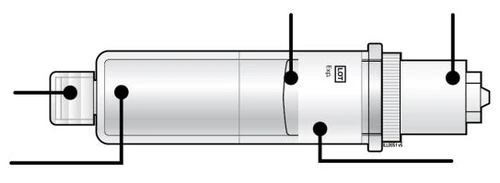
Bottom of the cartridge
Medicine Label of the
cartridge
Mini-dosage device
Front view Start button
(Do not press until
Skin indicator ready for injection)
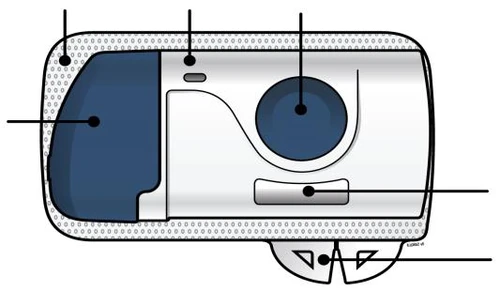
Cartridge door
(Do not close without the
cartridge) Medicine window
Tear tabs
Rear view Needle shield Adhesive paper
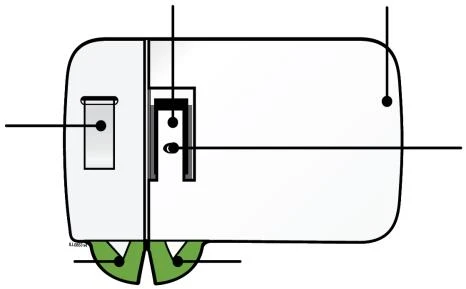
Battery strap
Needle inside
(Under the
needle shield)
Left tear tab Right tear tab
Important: the needle is inside.
Important
Before using the Repatha mini-dosage device and cartridge, read these important
information:
Storage of the mini-dosage device and cartridge
- Keep the mini-dosage device and cartridge out of sight and reach of children.
- Do not store the mini-dosage device and cartridge in extremely hot or cold places. For example, do not store them in the glove compartment or trunk of a car. Do not freeze. Use of the mini-dosage device and cartridge
- Do not shake the mini-dosage device or cartridge.
- Do not remove the mini-dosage device and cartridge from their packaging or transparent tray unless you are ready to administer the injection.
- Do not press the start button until the loaded mini-dosage device and cartridge are placed on the skin and you are ready to administer the injection.
- Adult supervision is recommended if the mini-dosage device and cartridge are used by children up to 13 years of age.
- The start button can be pressed only once. If a mistake occurs, the mini-dosage device cannot be reused. Use a new mini-dosage device and a new cartridge.
- Do not use the mini-dosage device and cartridge if they have been dropped on a hard surface. Some parts of the mini-dosage device and cartridge may be damaged even if there are no visible signs of damage. Use a new mini-dosage device and a new cartridge.
- Do not reuse the mini-dosage device and cartridge. The mini-dosage device and cartridge are for single use only.
- Do not wet the mini-dosage device and cartridge with water or any other liquid. They contain electronic components that must not get wet.
- The single-use subcutaneous injection mini-dosage device must be used exclusively with the cartridge. If any of the above situations occur, use a new mini-dosage device and a new cartridge. A healthcare professional familiar with Repatha will be able to answer your questions.
| Step 1: Preparation | |
| A | Remove the package containing the auto-injector and cartridge from the refrigerator. Wait 45 minutes. |
| Important: wait at least 45 minutes to allow the auto-injector and cartridge to naturally reach room temperature inside the package before injection. •Do not attempt to heat the cartridge using heat sources such as hot water or microwave. •Do not shake the auto-injector and cartridge. •Do not use if any part of the cartridge shows cracks or signs of breakage. •Do not use if the expiration date printed on the package label has passed. If any of the above situations occur, use a new auto-injector and a new cartridge. | |
| B | Open the package and remove the white paper label. Remove the auto-injector cover from the transparent tray. |
Transparent tray Cartridge Auto-injector Plastic cover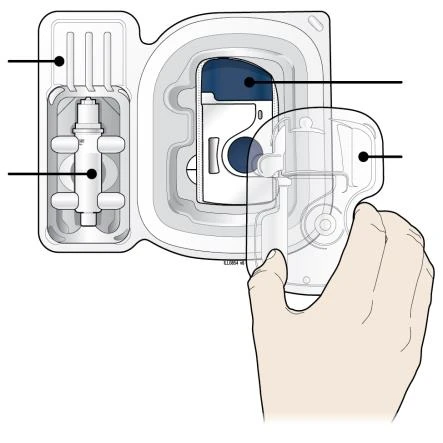 | |
| Leave the auto-injector and cartridge in the transparent tray until ready to perform the injection. •Do not press the activation button until the auto-injector is placed on the skin and you are ready to administer the injection. •Do not use if the white paper label is missing or damaged. | |
| C | Gather the materials needed for the injection and then wash your hands thoroughly with soap and water. |
| On a clean, well-lit surface, prepare the following: •The transparent tray with the auto-injector and cartridge •Alcohol swabs •A cotton ball or gauze pad •A bandage •Sharps disposal container 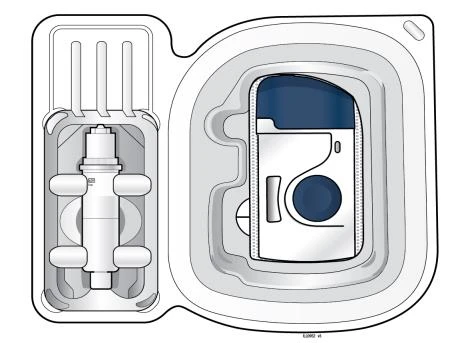 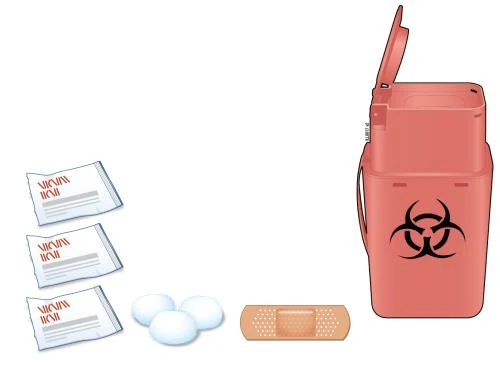 | |
D Choose where to place the auto-injector. Use the outer area of the upper arm only if
the injection is administered by another person.
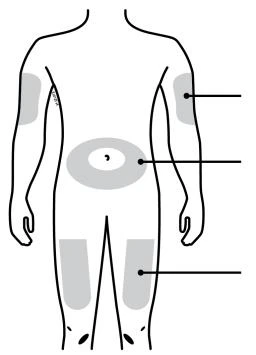
You may use:
- The thigh
- The abdomen, except for the 5 cm area around the navel
- The outer upper arm (only if the injection is administered by another person)
Thigh
Clean the injection site with an alcohol swab and allow it to dry.
- Do not touch the disinfected area again before administering the injection.
- Do not administer the injection into areas where the skin is tender, bruised, red, or hardened. Avoid injecting into areas with wrinkles, skin folds, scars, stretch marks, moles, or hair. If it is necessary to use the same injection site, make sure not to inject into the exact same spot as the previous injection.
Important: To ensure firm application of the auto-injector, it is important to use a firm and smooth skin surface.
| Step 2: Preparing for Injection | |
| E | Open the auto-injector by sliding the cartridge door to the right. Then leave the door open.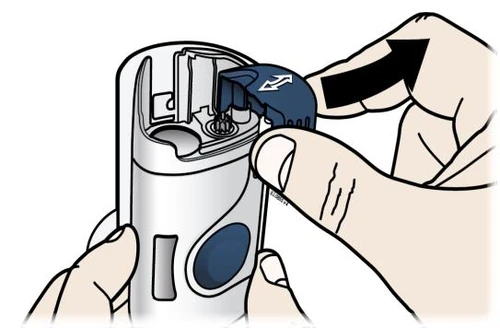 |
| Do not press the start button until you are ready to perform the injection. | |
F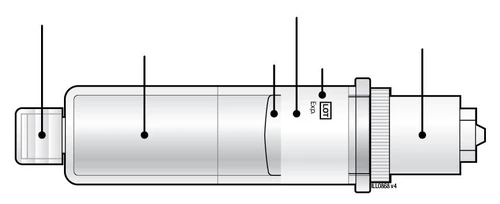 | Inspect the cartridge. |
| Bottom of the cartridge Medicinal product Label on the cartridge Top of the cartridge (do not rotate) White plunger Expiry date Check that the medicine in the cartridge is clear, colorless to slightly yellow. •Do not use if the medicine is cloudy, discolored, or contains flakes or particles. •Do not use if any part of the cartridge shows cracks or signs of damage. •Do not use if any parts of the cartridge are missing or not securely attached. •Do not use if the expiry date printed on the cartridge has passed. If any of the above conditions apply, use a new auto-injector and a new cartridge. | |
G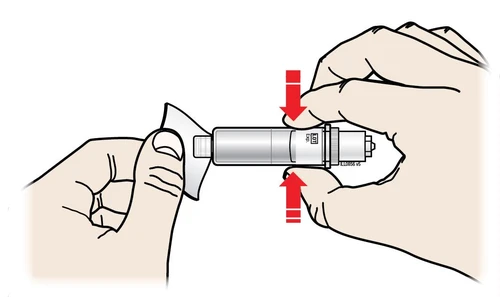 | Clean the bottom of the cartridge. |
| Hold the cartridge here With one hand, hold the cartridge cylinder and clean the bottom of the cartridge with an alcohol swab. •Do not touch the bottom of the cartridge after cleaning with an alcohol swab. •Do not remove or rotate the top or bottom parts of the cartridge. | |
| H | Insert the cleaned cartridge into the auto-injector and press firmly on the top until it clicks into place. |
Insert cartridge vertically Press firmly Insert the bottom of the cartridge first. •Do not insert the cartridge more than 5 minutes before injection. The medicine may dry out.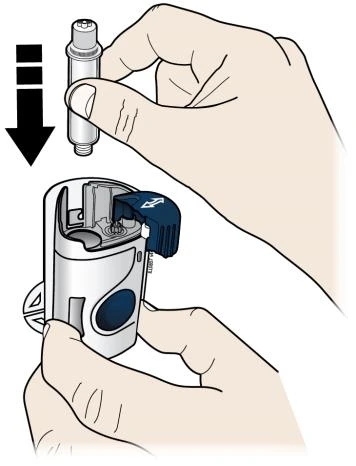 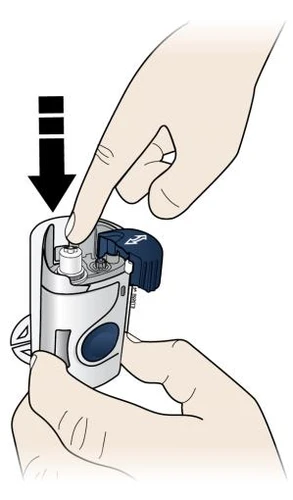 | |
| |
I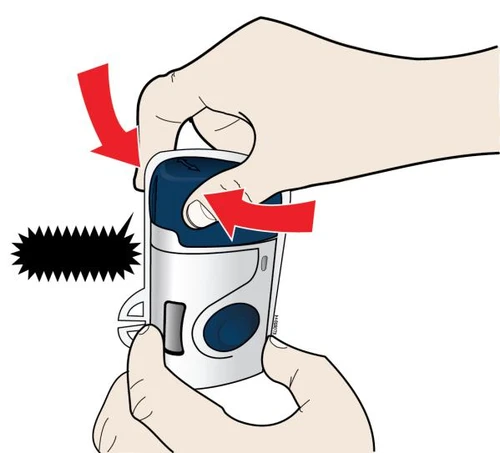 | Slide the door to the left. Then press firmly until it clicks into place. |
| Press firmly Click Before closing the door, ensure the cartridge is securely attached in the auto-injector. •Do not close the door if the cartridge is missing or not fully inserted. •Do not press the start button until the loaded auto-injector is placed on the skin. Important: After loading the auto-injector, proceed immediately to the next step. | |
Step 3: Injection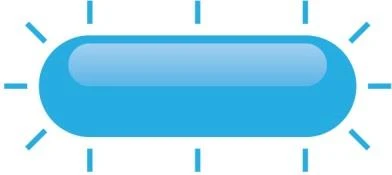 | |
J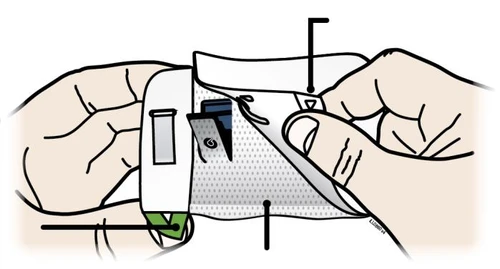 | Remove both green pull-tabs to expose the adhesive. The auto-injector turns on when the blue status light starts flashing. |
| Right pull-tab Flashing light Left pull-tab Skin adhesive Beep-beep-beep Both green pull-tabs must be removed to activate the loaded auto-injector. You will hear an audible beep and see a flashing blue light. •Do not touch the skin adhesive. •Do not press the start button until the loaded auto-injector is placed on the skin. •Do not touch or contaminate the needle cover area. •Do not place the loaded auto-injector on the body if the red light flashes for more than 5 seconds. •Do not remove the skin adhesive from the auto-injector. •Do not fold the skin adhesive onto itself. | |
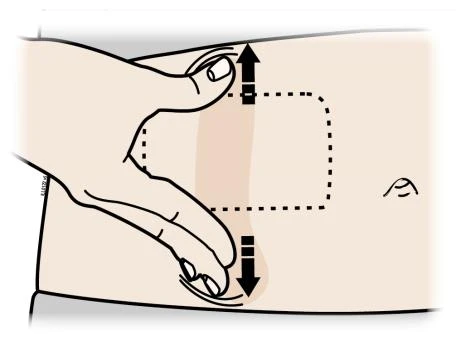
K To securely apply the automatic mini-doser, prepare and clean the injection site with minimal hair, or shave the area. Use a firm and smooth skin surface.
Application on the abdomen Application on the thigh
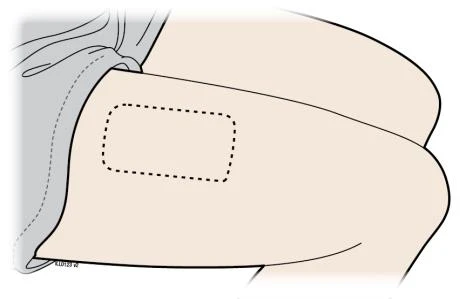
OR

Method for stretching the abdominal skin Do not stretch the skin of the thighs
Important: adjust body posture to avoid skin folds or bulges.
L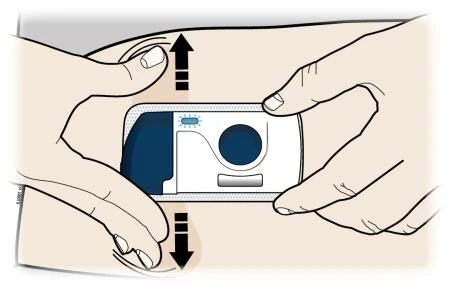  | When the blue indicator light flashes, the auto-injector is ready for use. Keep the skin stretched (only if using the abdomen for injection). Hold the loaded auto-injector so that the blue light is visible, and place it on the skin. You may hear audible signals (beeps).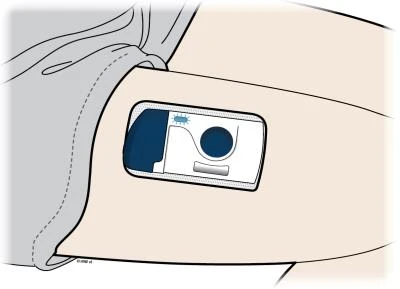 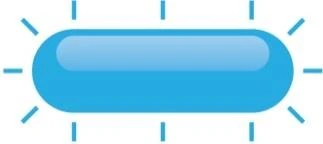 |
OR Flashing light Beep-beep-beep The loaded auto-injector will remain placed on the body. Make sure the adhesive patch adheres to the skin. Run your finger along the adhesive edges to secure it. Ensure clothing does not catch on the loaded auto-injector and that the blue light remains visible. •Do not attempt to reposition the loaded auto-injector after it has been applied to the skin. | |
M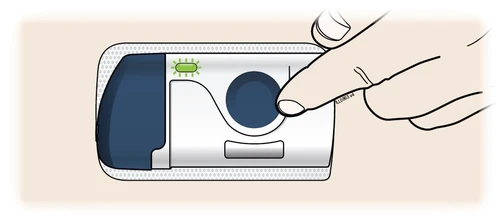 | Firmly press and release the start button. A flashing green light and a "click" sound indicate that the injection has started.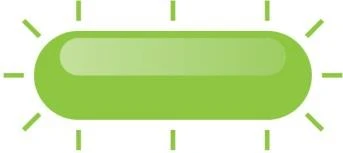 |
Flashing light Beep-beep-beep •You may hear a sound similar to that of a pump operating. •You may feel the needle insertion. •Ensure you can see the flashing green light. •You may hear a beep indicating the start of the injection. Important: If medication leaks from the loaded auto-injector, contact your doctor or pharmacist. | |
N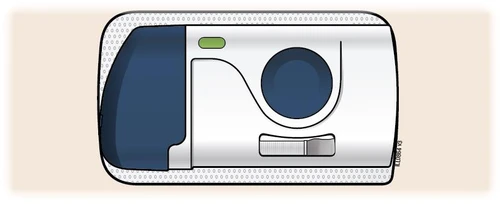 | The injection lasts approximately 5 minutes. When the injection is complete, the green status indicator light remains steadily illuminated and the device emits an audible beep.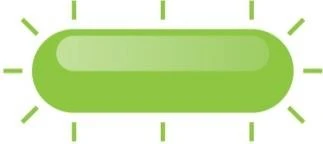 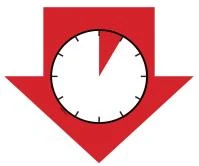 |
During the injection, it is normal to hear a sound similar to a pump starting and stopping. •You may perform moderate physical activities during the injection, such as walking, stretching, and bending. Flashing light 5 min Steady light The injection is complete when: •The green status indicator light becomes steady. •You hear several beeps. Beep-beep-beep  | |
Step 4: Final Procedures | |
O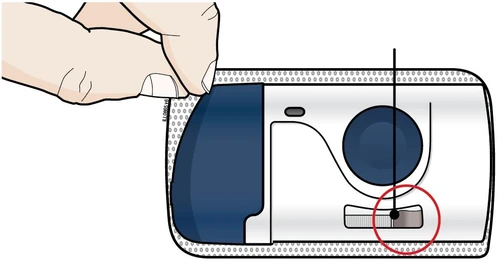 | After the injection is complete, use the skin patch to gently remove the auto-injector from the skin. After removal, check the medication window. The green light should now be off. |
| Used plunger Indicator off Beep-beep-beep Check that the used plunger fully occupies the medication window and that the green light is off. This indicates that all medication has been injected. If the plunger does not fill the window, contact your doctor. •The used auto-injector will emit an audible beep (beep) when removed from the skin. •It is normal to see a few drops of liquid on the skin after removing the used auto-injector. | |
| P | Dispose of the auto-injector in a sharps disposal container.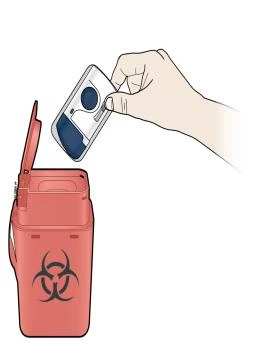 |
| |
| Q | Examine the injection site. |
| If blood is present, press a cotton ball or gauze pad firmly against the injection site. Do not rub the injection site. Apply a bandage if needed. | |
Troubleshooting
What to do if the light on the loaded auto-injector is red and continues to flash, and you hear
an audible signal (beep).
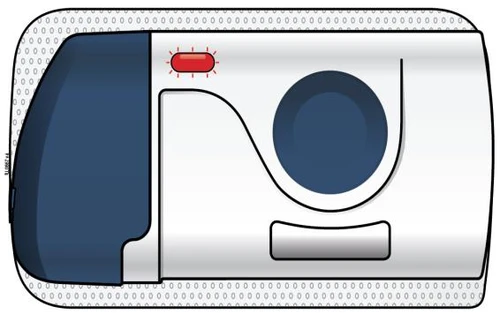
Flashing light
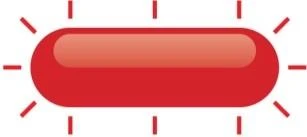
beep-beep-beep-beep-beep

Stop using the loaded auto-injector. If the auto-injector is applied
to the skin, remove it gently.
Additional environmental conditions
The relative humidity range is 15%–85%.
The altitude range is between -300 meters and 3,500 meters.
During injection, keep the auto-injector at least 30 cm away from other
electronic devices, such as mobile phones.
Warning: Do not modify the device.
The operating temperature range for the auto-injector is 15°C–40°C.
www.devicepatents.com
TABLE WITH SYMBOLS      | |||||
| Do not use if packaging is damaged | Store in a dry place | Consult Instructions for Use | BF-type applied part | Single-use | Sterilized with ethylene oxide |


Amgen Inc., One Amgen Center Drive, Thousand Oaks, CA, U.S.A.

Amgen Europe B.V., Minervum 7061, 4817 ZK, Breda, Netherlands
This page has been machine-translated and may contain inaccuracies. The original data is available in the manufacturing country's language.
Last data check: May 11, 2026 · Data source: Agenzia Italiana del Farmaco (AIFA)