Reomax
Italy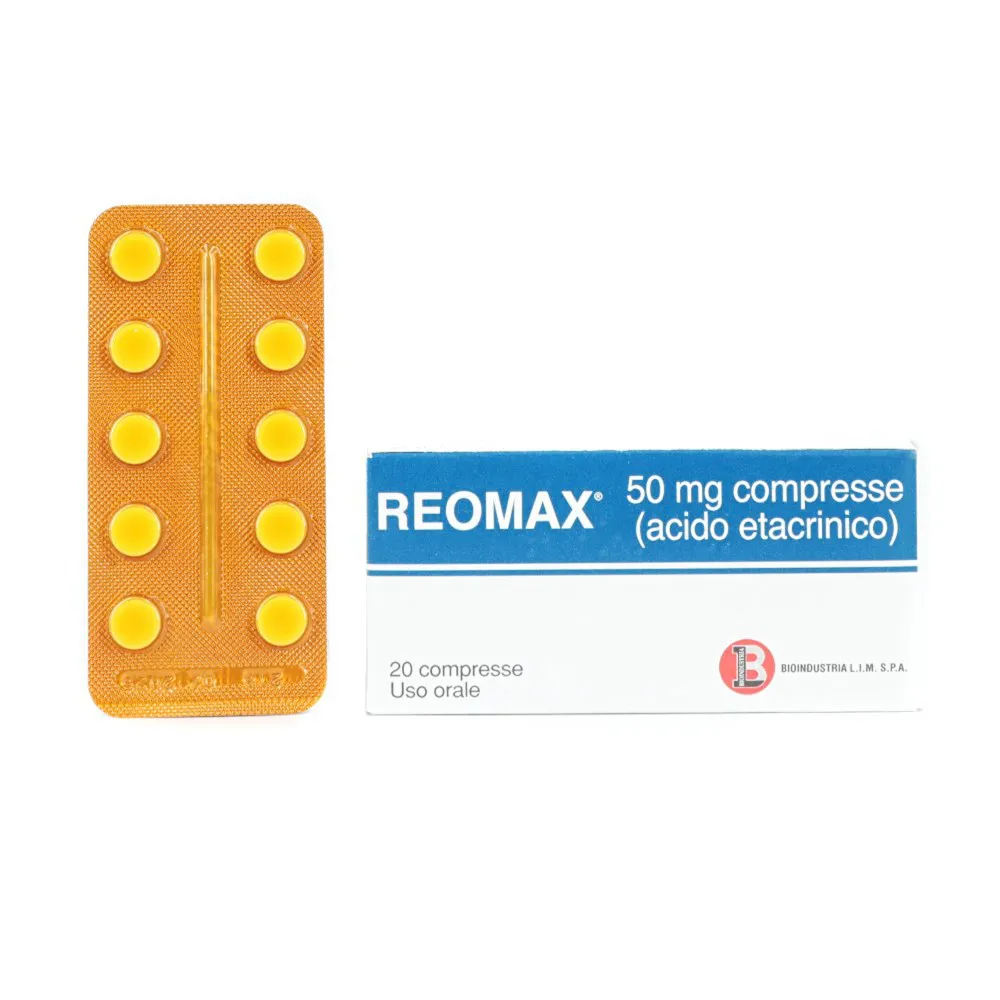
Table of Contents
- Package leaflet: Information for the patient
- REOMAX 50 mg tablets
- 1. What REOMAX is and what it is used for
- 2. What you need to know before taking REOMAX
- 3. How to take REOMAX
- 4. Possible side effects
- 5. How to store REOMAX
- 6. Package contents and other information
- Package leaflet: information for the user
- REOMAX 50 mg/20 ml powder and solvent for injectable solution
- 1. What REOMAX is and what it is used for
- 2. What you should know before using REOMAX
- 3. How to use REOMAX
- 4. Possible adverse reactions
- 5. How to store REOMAX
- 6. Pack contents and other information
Package leaflet: Information for the patient
REOMAX 50 mg tablets
etacrynic acid
Please read this leaflet carefully before taking this medicine because it contains important information for you.
- Keep this leaflet. You may need to read it again.
- If you have any questions, ask your doctor or pharmacist.
- This medicine has been prescribed for you only. Do not give it to other people, even if their symptoms are the same as yours, as it may be harmful.
- If you experience any side effect, including those not listed in this leaflet, please contact your doctor or pharmacist. See section 4.
Contents of this leaflet:
- What REOMAX is and what it is used for
- What you need to know before taking REOMAX
- How to take REOMAX
- Possible side effects
- How to store REOMAX
- Contents of the pack and other information
1. What REOMAX is and what it is used for
REOMAX contains the active substance etacrynic acid, which belongs to a group of medicines called
diuretics used to promote the elimination of excess fluids.
REOMAX is indicated to reduce the accumulation of fluids and salts in the body, particularly caused by:
- heart problems;
- kidney problems leading to reduced urine excretion and fluid accumulation (nephrotic forms and chronic renal failure);
- liver diseases (cirrhosis with ascites and ascitogenic liver diseases).
2. What you need to know before taking REOMAX
Do not take REOMAX
- if you are allergic to ethacrynic acid or to any of the other ingredients of this medicine (listed in section 6);
- if you have reduced urine production (anuria);
- if you suffer from low blood pressure (hypotension);
- if you are dehydrated and your doctor has told you that you have low sodium levels in the blood;
- if you have a blood pH imbalance (metabolic alkalosis) associated with low potassium levels (hypokalaemia);
- if during treatment you develop severe watery diarrhoea, if you produce little urine during the day (oliguria) and/or if your doctor tells you that your blood urea levels (azotemia) are increased and/or your blood levels of sodium, potassium and magnesium are altered (electrolyte imbalance);
- if you are pregnant or breastfeeding (see section “Pregnancy and breastfeeding”);
- if the person who is to take this medicine is a child under 2 years of age.
Warnings and precautions
Talk to your doctor or pharmacist before taking REOMAX.
Pay particular attention when using REOMAX and inform your doctor:
- if you notice very abundant diuresis (with excessive loss of fluids and minerals), which may manifest as weakness, muscle cramps, numbness in hands and feet (paraesthesia), thirst, loss of appetite (anorexia), electrolyte disturbances (reduced potassium and blood pH imbalance with reduced chloride levels), a marked drop in blood pressure, and subsequent weight loss;
- if you suffer from severe liver disease (advanced hepatic cirrhosis), as this medicine may lead to a state of unconsciousness due to liver problems (hepatic coma) and possibly death.
To prevent low potassium levels in the blood (hypokalaemia), your doctor may prescribe potassium supplements.
For individuals engaged in sports, using this medicine without therapeutic need constitutes doping and may lead to a positive result in anti-doping tests.
Children
The use of REOMAX is contraindicated in children under two years of age.
Other medicines and REOMAX
Inform your doctor or pharmacist if you are taking, have recently taken, or might take any other medicines.
Pay particular attention and inform your doctor if you are taking:
- medicines used for heart problems (digitalis glycosides), because REOMAX may increase their toxicity;
- medicines used to treat certain infections (aminoglycoside antibiotics), because REOMAX may increase their ototoxicity (toxicity to hearing);
- a medicine used to treat depression (lithium), because REOMAX increases its toxicity;
- medicines to lower blood pressure (antihypertensives), because dosage adjustment may be necessary to avoid dizziness upon standing due to a rapid drop in blood pressure (orthostatic hypotension);
- medicines to reduce blood glucose (insulin or oral antidiabetics), because REOMAX may reduce their effectiveness;
- non-steroidal anti-inflammatory drugs (NSAIDs), because they may increase the risk of developing severe kidney disease (renal failure);
- medicines used in the treatment of glaucoma (carbonic anhydrase inhibitors, e.g. acetazolamide, dichlorphenamide, methazolamide), because the dosage of REOMAX may need to be adjusted.
Pregnancy and breastfeeding
If you are pregnant, suspect you may be pregnant, planning to become pregnant, or are breastfeeding, consult your doctor or pharmacist before taking this medicine.
Do not take REOMAX if you are pregnant or breastfeeding (see section “Do not take REOMAX”).
Driving and using machines
REOMAX does not affect or has negligible effect on the ability to drive or use machinery.
REOMAX contains lactose
This medicine contains lactose. If your doctor has diagnosed you with an intolerance to certain sugars, contact him or her before taking this medicine.
3. How to take REOMAX
Take this medicine exactly as directed by your doctor or pharmacist. If you have any doubts,
consult your doctor or pharmacist.
Treatment must be carried out under medical supervision, and your doctor will adjust the dose according to the severity of your condition.
Unless otherwise prescribed by your doctor, the recommended dose, method, and frequency of administration are as follows:
The recommended initial dose is 1 tablet of 50 mg taken in the morning with food.
The effective daily dose usually ranges between 50–150 mg (corresponding to 1–3 tablets) of etacrynic acid, always taken after meals.
In particularly severe cases, your doctor may instruct you to gradually increase the daily dose up to a maximum of 200–250 mg of etacrynic acid (corresponding to 4–5 tablets).
For maintenance therapy, your doctor will instruct you to take REOMAX on alternate days or to alternate two or three days of treatment with two or three days of rest.
If you take more REOMAX than you should
In case of accidental overdose or ingestion, contact your doctor immediately or go to the nearest hospital.
If you forget to take REOMAX
Do not take a double dose to make up for the missed dose.
If you have any doubts about how to use this medicine, consult your doctor or pharmacist.
4. Possible side effects
Like all medicines, this medicine can cause side effects, although not everyone gets them.
If you experience stomach or intestinal problems such as abdominal pain, loss of appetite (anorexia), malaise, difficulty swallowing (dysphagia), nausea, vomiting, or diarrhoea, consult your doctor immediately, as they may consider stopping treatment.
If you develop severe and profuse watery diarrhoea, you must stop treatment and seek immediate medical advice.
The following side effects may occur:
- increased levels of uric acid in the blood (hyperuricaemia), reduced excretion of uric acid salts (urates) in the urine, and consequent joint inflammation (gout); decreased blood sugar levels (hypoglycaemia), particularly in patients with severe liver problems (decompensated hepatic cirrhosis);
- dizziness, hearing loss (deafness), persistent or intermittent ringing or noise in the ears (tinnitus). These symptoms have frequently occurred in patients with severe kidney problems (renal dysfunction) after taking doses higher than recommended. Hearing loss has usually been reversible and short-lived (from 1 to 24 hours), although in some patients taking other medicines toxic to hearing (ototoxic medicines), it has been permanent.
The following side effects have also been reported, with frequency not known (frequency cannot be estimated from the available data):
- bleeding in the stomach and intestines (gastrointestinal haemorrhage);
- inflammatory disease of the pancreas (acute necrotising pancreatitis);
- yellowish discoloration of the skin and eyes due to liver problems (jaundice);
- abnormal liver function tests;
- decrease in white blood cells in the blood (agranulocytosis and neutropenia);
- decrease in platelets in the blood (thrombocytopenia);
- inflammation of small blood vessels with appearance of red-purple spots (Schönlein-Henoch purpura), especially in patients with heart conditions (cardiorheumatic) receiving multiple medications;
- presence of blood in the urine (haematuria);
- skin irritation (cutaneous erythema);
- headache, fever, and chills;
- blurred vision;
- fatigue, anxiety, and confusion;
- abnormal liver laboratory tests.
Reporting of side effects
If you experience any side effect, including those not listed in this leaflet, talk to your doctor or pharmacist. You can also report side effects directly via the national reporting system at https://www.aifa.gov.it/content/segnalazioni-reazioni-avverse
By reporting side effects, you can help provide more information on the safety of this medicine.
5. How to store REOMAX
Keep this medicine out of the sight and reach of children.
Do not use this medicine after the expiry date stated on the packaging after "Exp". The expiry date refers to the last day of that month.
Do not dispose of any medicine via wastewater or household waste. Ask your pharmacist how to dispose of medicines you no longer use. This will help protect the environment.
6. Package contents and other information
What REOMAX 50 mg tablets contain
- The active substance is etacrynic acid. Each tablet contains 50 mg of etacrynic acid.
- The other ingredients are: lactose, corn starch, magnesium stearate.
Description of the appearance of REOMAX and package contents
Each pack of REOMAX contains 20 tablets.
Marketing Authorization Holder and Manufacturer
Bioindustria Laboratorio Italiano Medicinali S.p.A.
(Bioindustria L.I.M. S.p.A.)
Via De Ambrosiis 2, 15067 Novi Ligure (AL) - Italy
Package leaflet: information for the user
REOMAX 50 mg/20 ml powder and solvent for injectable solution
etacrynic acid
Please read this leaflet carefully before using this medicine because it contains important information for you.
- Keep this leaflet. You may need to read it again.
- If you have any questions, ask your doctor or pharmacist.
- This medicine has been prescribed for you only. Do not give it to others, even if their symptoms are the same as yours, as it could be harmful.
- If you experience any side effects, including those not listed in this leaflet, consult your doctor or pharmacist. See section 4.
Contents of this leaflet:
- What REOMAX is and what it is used for
- What you need to know before using REOMAX
- How to use REOMAX
- Possible side effects
- How to store REOMAX
- Package contents and other information
1. What REOMAX is and what it is used for
REOMAX contains the active substance etacrynic acid, which belongs to a group of medicines called
diuretics, used to promote the elimination of excess fluids.
REOMAX is indicated to reduce the accumulation of fluids and salts in the body, particularly caused by:
- heart problems;
- kidney problems causing reduced urine output (edema, nephrotic forms, and chronic renal failure);
- liver diseases (cirrhosis with ascites and ascites-forming liver diseases);
- a condition characterized by fluid accumulation in the lungs (acute pulmonary edema).
2. What you should know before using REOMAX
Do not use REOMAX
- if you are allergic to ethacrynic acid or to any of the other ingredients of this medicine (listed in section 6);
- if you have reduced urine production (anuria);
- if you have low blood pressure (hypotension);
- if you are dehydrated and your doctor has told you that you have low sodium levels in the blood;
- if you have a disturbance in blood pH (metabolic alkalosis) with low potassium levels (hypokalemia);
- if during treatment you develop severe watery diarrhea, if you produce little urine during the day (oliguria) and/or if your doctor tells you that your blood urea levels (azotemia) are elevated and/or your blood levels of sodium, potassium, and magnesium are altered (electrolyte imbalance);
- if you are pregnant or breastfeeding (see section “Pregnancy and breastfeeding”);
- if the person who is to use this medicine is a child under 2 years of age.
Warnings and precautions
Talk to your doctor or pharmacist before using REOMAX.
Pay particular attention when using REOMAX and inform your doctor:
-
if you experience very abundant diuresis (with excessive loss of fluids and minerals), which may manifest as weakness, muscle cramps; loss of sensation in hands and feet (paresthesia), thirst,
loss of appetite (anorexia), electrolyte disturbances (reduced potassium and altered blood pH with decreased chloride levels), a marked drop in blood pressure, and subsequent weight loss; -
if you have severe liver disease (advanced hepatic cirrhosis), because this medicine may lead to unconsciousness due to liver problems (hepatic coma) and death. To prevent low potassium levels in the blood (hypokalemia), your doctor may prescribe potassium supplements.
For those engaged in sports, using this medicine without therapeutic need constitutes doping and may result in a positive anti-doping test.
Children
The use of REOMAX is contraindicated in children under two years of age.
Other medicines and REOMAX
Inform your doctor or pharmacist if you are taking, have recently taken, or might take any other medicines.
Pay particular attention and inform your doctor if you are taking:
- medicines used for heart problems (digitalis glycosides), because REOMAX may increase their toxicity;
- medicines used to treat certain infections (aminoglycoside antibiotics), because REOMAX may increase their ototoxicity (toxicity to hearing);
- a medicine used to treat depression (lithium), because REOMAX increases its toxicity;
- medicines to lower blood pressure (antihypertensives), because dosage adjustment may be necessary to avoid dizziness upon standing due to a rapid drop in blood pressure (orthostatic hypotension);
- medicines to reduce blood glucose (insulin or oral antidiabetics), because REOMAX may reduce their effectiveness;
- anti-inflammatory medicines (NSAIDs), because they may increase the risk of developing severe kidney disease (renal failure);
- medicines used in the treatment of glaucoma (carbonic anhydrase inhibitors, e.g., acetazolamide, dichlorphenamide, methazolamide), because dosage adjustment of REOMAX may be necessary.
Pregnancy and breastfeeding
If you are pregnant, suspect you may be pregnant, plan to become pregnant, or are breastfeeding, consult your doctor or pharmacist before using this medicine.
Do not use REOMAX if you are pregnant or breastfeeding (see section “Do not take REOMAX”).
Driving and using machines
REOMAX does not affect or has a negligible effect on the ability to drive vehicles or operate machinery.
REOMAX contains sodium and methyl parahydroxybenzoate
This medicine contains methyl parahydroxybenzoate, which may cause allergic reactions (including delayed reactions) and, exceptionally, bronchospasm.
This medicine contains less than 23 mg (1 mmol) of sodium, i.e., it is practically sodium-free.
3. How to use REOMAX
Use this medicine exactly as directed by your doctor or pharmacist. If you have any doubts, consult your doctor or pharmacist.
Treatment must be carried out under medical supervision, and the physician will adjust the dosage according to the severity of the case. Unless otherwise prescribed by the doctor, the recommended dose, method, and frequency of administration are as follows:
The recommended dose for an adult of average weight is 50 mg (1 vial) or 0.5–1 mg per kg of body weight.
A second administration is rarely necessary; if required, it is advisable to change the injection site to avoid possible inflammation of the venous walls (thrombophlebitis).
Instructions for use:
Dissolve the lyophilized powder (vial A) in the glucose solution (vial B).
The resulting solution may be used for direct intravenous injection (diluted in 20 ml of glucose solution) or for slow intravenous infusion via an infusion set (intravenous drip; diluted in 20–40 ml of glucose solution).
If you use more REOMAX than you should
In case of accidental ingestion or overdose, contact your doctor immediately or go to the nearest hospital.
If you forget to use REOMAX
Do not use a double dose to make up for the missed dose.
If you have any doubts about the use of this medicine, consult your doctor or pharmacist.
4. Possible adverse reactions
Like all medicines, this medicine may cause adverse reactions, although not everybody gets them.
If you experience stomach or intestinal problems such as abdominal pain, loss of appetite (anorexia), malaise, difficulty swallowing (dysphagia), nausea, vomiting, or diarrhoea, you should immediately consult your doctor, who will assess whether treatment should possibly be discontinued.
If you experience severe and profuse watery diarrhoea, you must stop treatment and seek immediate medical advice.
The following adverse reactions may occur:
- increased levels of uric acid in the blood (hyperuricaemia), reduced excretion of uric acid salts (urates) in the urine, and consequent joint inflammation (gout); decreased blood sugar levels (hypoglycaemia), particularly in patients with severe liver problems (decompensated hepatic cirrhosis);
- dizziness, hearing loss (deafness), persistent or intermittent ringing or buzzing noises in the ear (tinnitus). These symptoms have often occurred in patients with severe kidney problems (renal dysfunction) after taking doses higher than those recommended. Hearing loss has usually been reversible and short-lived (from 1 to 24 hours), although in some patients taking other medicines toxic to hearing (ototoxic drugs) it has been permanent.
The following adverse reactions have also been reported with unknown frequency (frequency cannot be estimated from the available data):
- bleeding from the stomach and intestines (gastrointestinal haemorrhage);
- inflammatory disease of the pancreas (acute necrotising pancreatitis);
- yellowish discoloration of the skin and eyes due to liver problems (jaundice);
- abnormalities in certain liver function tests;
- decrease in white blood cells in the blood (agranulocytosis and neutropenia);
- decrease in blood platelets (thrombocytopenia);
- inflammation of small blood vessels with appearance of red-purple spots (Schönlein-Henoch purpura), especially in patients with heart conditions (cardiorheumatic) on multiple drug treatments;
- presence of blood in the urine (haematuria);
- skin irritation (cutaneous erythema);
- headache, fever, and chills;
- blurred vision;
- fatigue, anxiety, and confusion;
- abnormalities in liver laboratory tests;
- irritation at the injection site due to leakage of the injected fluid.
Reporting of adverse reactions
If you experience any adverse reaction, including those not listed in this leaflet, consult your doctor or pharmacist. You may also report adverse reactions directly via the national reporting system at the following website:
https://www.aifa.gov.it/content/segnalazioni-reazioni-avverse
By reporting adverse reactions, you can help provide more information on the safety of this medicine.
5. How to store REOMAX
Keep this medicine out of the sight and reach of children.
Do not use this medicine after the expiry date stated on the packaging after "Exp". The expiry date refers to the last day of that month.
Do not dispose of any medicine via wastewater or household waste. Ask your pharmacist how to dispose of medicines you no longer use. This will help protect the environment.
6. Pack contents and other information
What REOMAX 50 mg/20 ml powder and solvent for injectable solution contains
- The active substance is etacrynic acid. Each vial of lyophilized powder (A) contains 53.63 mg of sodium etacrynate equivalent to 50 mg of etacrynic acid.
- The other components of vial (A) are: mannitol, methyl parahydroxybenzoate.
- The component of vial (B) is 5% sterile glucose solution.
Description of the appearance of REOMAX and pack contents
Each REOMAX pack contains 1 vial (A) of 10 ml lyophilized powder + 1 vial (B) of 20 ml solvent.
Marketing Authorization Holder and Manufacturer
Bioindustria Laboratorio Italiano Medicinali S.p.A.
(Bioindustria L.I.M. S.p.A.)
Via De Ambrosiis 2, 15067 Novi Ligure (AL) – Italy