Regolint
Italy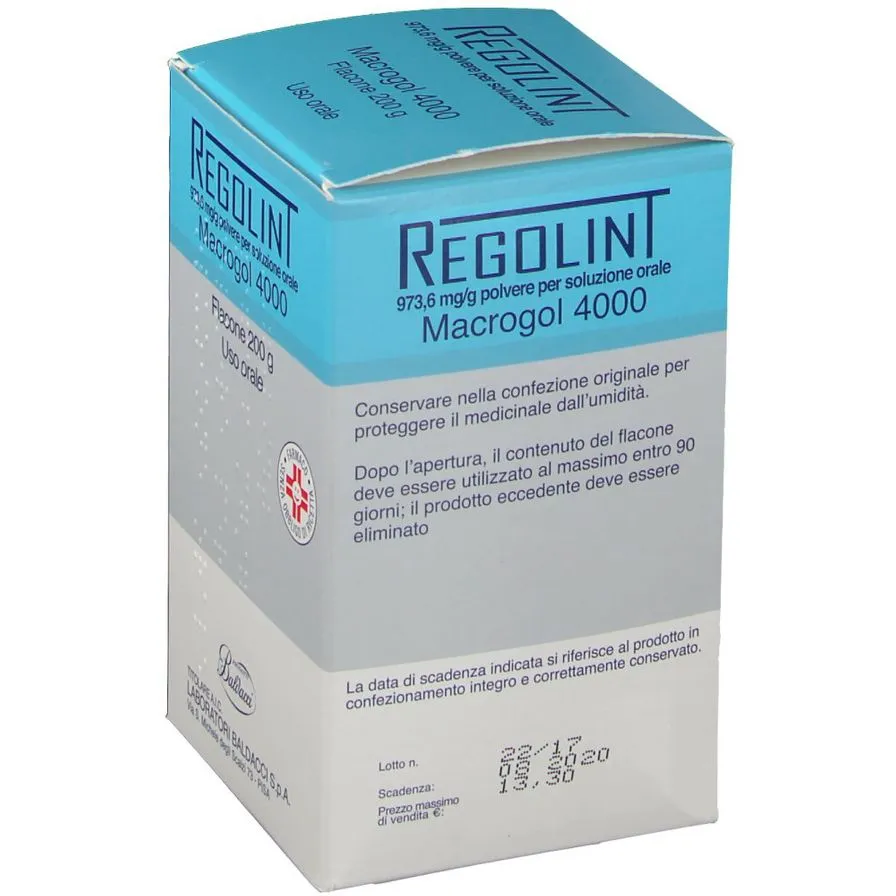
Table of Contents
- Package leaflet: Information for the patient
- REGOLINT 9.7 g powder for oral solution
- 1. What REGOLINT is and what it is used for
- 2. What you should know before taking REGOLINT
- 3. How to take REGOLINT
- 4. Possible side effects
- 5. How to store REGOLINT
- 6. Package contents and other information
- Patient Information Leaflet
- REGOLINT 973.6 mg/g oral solution powder
- 1. What REGOLINT is and what it is used for
- 2. What you need to know before taking REGOLINT
- 3. How to take REGOLINT
- 4. Possible side effects
- 5. How to store REGOLINT
- 6. Pack contents and other information
Package leaflet: Information for the patient
REGOLINT 9.7 g powder for oral solution
Macrogol 4000
Read this leaflet carefully before taking this medicine because it contains important information for you.
Always take this medicine exactly as described in this leaflet or as your doctor or pharmacist has instructed you.
- Keep this leaflet. You may need to read it again.
- If you need more information or advice, consult your pharmacist.
- If you experience any side effects, including those not listed in this leaflet, contact your doctor or pharmacist. See section 4.
- Contact your doctor if you do not notice any improvement or if your symptoms worsen after a few days.
Contents of this leaflet
- What REGOLINT is and what it is used for
- What you need to know before taking REGOLINT
- How to take REGOLINT
- Possible side effects
- How to store REGOLINT
- Contents of the pack and other information
1. What REGOLINT is and what it is used for
REGOLINT contains the active substance macrogol 4000, which belongs to a group of medicines called osmotic laxatives. These work by drawing water into the intestine, helping to form soft stools.
This medicine is indicated for the short-term treatment of occasional constipation.
Consult your doctor if you do not feel better or if you feel worse after a few days.
2. What you should know before taking REGOLINT
Do not use REGOLINT if:
- you are allergic to macrogol 4000 or to any of the other ingredients of this medicine (listed in section 6);
- you suffer from severe inflammatory bowel diseases (such as ulcerative colitis, Crohn's disease, or toxic megacolon associated with symptomatic stenosis);
- you have acute or unknown origin abdominal pain;
- you experience marked increase or decrease in intestinal motility (peristalsis), nausea or vomiting, bleeding from the lower part of the intestine (rectal bleeding);
- you have intestinal obstruction (ileus) or suspected obstruction, narrowing (stenosis) or perforation, or risk of intestinal perforation;
- you are in a condition characterized by excessive fluid loss (severe dehydration).
Warnings and precautions
Talk to your doctor or pharmacist before taking REGOLINT.
Before starting treatment, consult your doctor, who must ensure that your constipation is not due to other
underlying diseases. If you suffer from chronic or recurrent constipation, consult your doctor, who will advise
you on appropriate therapy and monitor your condition.
Also consult your doctor if the need for a laxative arises from any of the following conditions:
- your bowel habits (frequency and characteristics of bowel movements) have changed suddenly for more than 2 weeks;
- the laxative fails to produce an effect.
If you suffer from constipation, first correct your dietary habits and adopt a healthy lifestyle,
following a balanced diet rich in water and fiber, and engaging in regular physical activity.
Immediately stop treatment and inform your doctor if you experience allergic reactions such as
skin irritation (rash, hives), swelling of the face, lips, throat and/or tongue (edema), or severe
allergic reactions (anaphylactic shock).
Do not use laxative medicines if you have acute or unknown origin abdominal pain, nausea or
vomiting, marked increase or decrease in peristalsis, or rectal bleeding. In such cases, consult your
doctor, who will determine whether you may have diseases in which the use of laxatives is contraindicated (e.g.,
intestinal obstruction or suspected obstruction, intestinal stenosis or perforation, paralytic ileus, severe
inflammatory bowel diseases).
After approximately 3 months of treatment, it is recommended that you consult your doctor, as specific
checks are necessary and an appropriate therapy should be established.
If you take laxatives frequently, for a long time, or in high doses, you may develop prolonged diarrhea,
leading to loss of water, minerals (especially potassium), and other essential nutrients. In more
severe cases, excessive fluid loss (dehydration) may occur, accompanied by low blood potassium levels
(hypokalemia), which can cause problems with heart, nerve, and muscle function (cardiac or neuromuscular
dysfunctions). These effects may be more likely if you are also taking medicines that increase the heart's
contractile force (cardiac glycosides), promote urine elimination (diuretics), or treat allergies and
inflammations (corticosteroids).
Use with caution and inform your doctor if:
- you have liver problems (hepatic insufficiency);
- you have kidney problems (renal insufficiency);
- you have heart problems (cardiac insufficiency);
- you are elderly. In these cases, your doctor should periodically check your blood electrolyte levels (serum electrolytes).
If you misuse or overuse laxatives, especially certain types (stimulant laxatives), you may develop
dependence (possible need to progressively increase the dose), chronic constipation, and loss of normal
intestinal function (intestinal atony).
Health education notes
It should first be recognized that, in most cases, a balanced diet rich in water and fiber (bran, vegetables, and fruit) can durably resolve constipation.
Many people believe they suffer from constipation if they do not have a bowel movement every day.
This is a misconception, as this situation is completely normal for many individuals.
Constipation should instead be considered when bowel movements are reduced compared to your
personal habits and are associated with the passage of hard stools.
If episodes of constipation recur frequently, you should consult your doctor.
Children
In children, treatment with REGOLINT should only be started after consulting a doctor.
Other medicines and REGOLINT
Inform your doctor or pharmacist if you are taking, have recently taken, or might take any other
medicines, including those without a prescription.
Avoid taking this medicine simultaneously with other laxatives or together with other oral
medicines, as REGOLINT may reduce their effectiveness. Take REGOLINT at least 2 hours after taking another medicine.
Use REGOLINT with caution if you are taking medicines for epilepsy (antiepileptics), for heart rhythm disorders and other cardiac conditions (digoxin), or medicines used to treat immune system disorders (immunosuppressants).
If you need to thicken liquids to swallow them safely, REGOLINT may counteract the thickening agent's effect.
REGOLINT with food
Avoid consuming liquorice during treatment with REGOLINT, as it increases the risk of excessive reduction in blood potassium levels (hypokalemia).
Pregnancy and breastfeeding
If you are pregnant, suspect you may be pregnant, planning a pregnancy, or breastfeeding, consult your doctor or pharmacist before taking this medicine.
If you are pregnant or breastfeeding, take REGOLINT only when strictly necessary and under direct medical supervision.
Driving and using machines
No studies have been conducted on the ability to drive vehicles or operate machinery.
3. How to take REGOLINT
Take this medicine exactly as stated in this leaflet or as directed by your doctor or pharmacist. If you have any doubts, consult your doctor or pharmacist.
Adults and children over 8 years of age and weighing more than 20 kg
The recommended dose ranges from 1 sachet taken on alternate days (especially in children) up to 2 sachets per day.
Do not exceed the maximum daily dose of 20 g of macrogol.
The correct dose is the lowest dose sufficient to produce easy passage of soft stools.
It is advisable to initially use the lowest recommended doses.
Method of administration
The recommended dose is 1–2 sachets per day.
Depending on your response to treatment, your doctor will adjust the dose, ranging from 1 sachet on alternate days up to 2 sachets per day.
The daily dose of REGOLINT may be taken in one or two administrations, taken away from meals. If one daily dose is required, it is recommended to take it in the morning.
If multiple daily doses are needed, it is advisable to divide them between morning and evening.
Dissolve the contents of one sachet in a glass of water (125 ml), without adding any other ingredients.
Drink the resulting solution quickly (within a few minutes), avoiding prolonged sipping.
Usually, the effect of REGOLINT occurs within 1–2 days after taking the medicine, although it may take 2 days or longer to achieve the desired effect. In the latter case, continue treatment with this medicine, always keeping in mind that laxatives should be taken as infrequently as possible and for no longer than 7 days. If necessary, the indicated dose may be increased, but never exceeding the maximum recommended dose.
Long-term use requires a doctor's prescription following adequate evaluation of the individual case. In children, treatment should not exceed 3 months and must always be under close medical supervision.
A diet rich in fluids enhances the effect of the medicine. The normalization of intestinal motility induced by treatment should be maintained through a healthy lifestyle and proper diet.
If you take more REGOLINT than you should
In case of accidental ingestion/overdose of REGOLINT, inform your doctor immediately or go to the nearest hospital.
If you take this medicine too frequently, for too long, or in excessive amounts, abdominal pain, vomiting, and diarrhea may occur, leading to loss of fluids and electrolytes. Diarrhea resolves upon temporary interruption of treatment or reduction of the dose.
Cases of aspiration have been reported during administration via nasogastric tube of large volumes of polyethylene glycol and electrolytes. This may particularly occur in children with brain damage, who are unable to take this medicine orally (oromotor dysfunction) and are at risk of aspirating the medicine.
If you forget to take REGOLINT
Do not take a double dose to make up for the missed dose.
If you have any doubts about using this medicine, consult your doctor or pharmacist.
4. Possible side effects
Like all medicines, this medicine can cause side effects, although not everybody gets them.
The side effects that may occur are generally mild and temporary and mainly affect the gastrointestinal system. In case of hypersensitivity reactions, stop taking the medicine and consult a doctor immediately:
Common (may affect up to 1 in 10 people)
- abdominal pain;
- abdominal swelling (abdominal distension);
- diarrhoea;
- nausea.
Uncommon (may affect up to 1 in 100 people)
- vomiting;
- urgency to defecate;
- difficulty controlling bowel movements (faecal incontinence);
- irritation of the lower part of the intestine (rectal irritation).
Very rare (may affect up to 1 in 10,000 people)
- allergic reactions (hypersensitivity) such as itching, skin irritation (skin rashes, urticaria), swelling due to fluid accumulation (oedema), particularly in the face, lips, throat or hands (oedema, facial oedema, angioedema), breathing difficulties, severe allergic reaction that may be life-threatening (anaphylactic shock).
Frequency not known (frequency cannot be estimated from the available data)
- changes in body electrolyte levels, such as reduced levels of sodium and potassium in the blood (hyponatraemia, hypokalaemia);
- excessive fluid loss (dehydration), especially in elderly people.
Additional side effects in children
As in adults, the adverse reactions reported are generally mild and temporary and mainly affect the gastrointestinal system. In case of hypersensitivity reactions, stop taking the medicine and consult a doctor immediately:
Common (may affect up to 1 in 10 people)
- abdominal pain;
- diarrhoea, which may cause pain in the area around the anus (perianal).
Uncommon (may affect up to 1 in 100 people)
- vomiting;
- abdominal swelling (abdominal distension);
- nausea;
- irritation of the lower part of the intestine (rectum).
Frequency not known (frequency cannot be estimated from the available data)
- allergic reactions (hypersensitivity).
Reporting of side effects
If you experience any side effect, including those not listed in this leaflet, talk to your doctor or pharmacist. You can also report side effects directly via the national reporting system at www.aifa.gov.it/content/segnalazioni-reazioni-avverse. Reporting side effects helps provide more information on the safety of this medicine.
Following the instructions contained in this leaflet reduces the risk of side effects.
5. How to store REGOLINT
Keep this medicine out of the sight and reach of children.
Do not use this medicine after the expiry date stated on the packaging after "Exp.".
The expiry date refers to the last day of that month.
Store in the original packaging to protect the medicine from moisture.
Do not dispose of any medicine via wastewater or household waste. Ask your pharmacist how to dispose of medicines you no longer use. This will help protect the environment.
6. Package contents and other information
What REGOLINT contains
- The active substance is macrogol 4000. One sachet contains 9.736 g of macrogol 4000.
- The other ingredients are: acesulfame potassium, banana flavouring.
Description of the appearance of REGOLINT and contents of the pack
Powder for oral solution.
Pack containing 10 or 20 sachets.
Marketing Authorisation Holder and Manufacturer
Marketing Authorisation Holder
Laboratori Baldacci S.p.A. – Via S. Michele degli Scalzi 73 – 56124 Pisa – Italy
Manufacturer
Sigmar Italia S.r.l. – Via Sombreno, 11 – 24011 Almè (BG) – Italy
Patient Information Leaflet
REGOLINT 973.6 mg/g oral solution powder
Macrogol 4000
Please read this leaflet carefully before taking this medicine because it contains important information for you.
Always take this medicine exactly as described in this leaflet or as your doctor or pharmacist has instructed you.
- Keep this leaflet. You may need to read it again.
- If you need more information or advice, consult your pharmacist.
- If you experience any side effects, including those not listed in this leaflet, consult your doctor or pharmacist. See section 4.
- Consult your doctor if you do not notice any improvement or if your symptoms worsen after a few days.
Contents of this leaflet
- What REGOLINT is and what it is used for
- What you need to know before taking REGOLINT
- How to take REGOLINT
- Possible side effects
- How to store REGOLINT
- Contents of the pack and other information
1. What REGOLINT is and what it is used for
REGOLINT contains the active substance macrogol 4000, which belongs to a group of medicines called osmotic laxatives. These work by drawing water into the intestine and helping to form soft stools.
This medicine is indicated for the treatment of constipation in children.
Consult your doctor if the condition does not improve or worsens after a few days.
2. What you need to know before taking REGOLINT
Do not use REGOLINT if:
- you are allergic to macrogol 4000 or to any of the other ingredients of this medicine (listed in section 6);
- you suffer from severe inflammatory bowel diseases (such as ulcerative colitis, Crohn's disease) or toxic megacolon;
- you have acute abdominal pain or abdominal pain of unknown origin;
- you experience marked increase or decrease in intestinal activity (peristalsis), nausea or vomiting, bleeding from the lower part of the intestine (rectal bleeding);
- you have intestinal obstruction (ileus) or suspected obstruction, narrowing (stenosis) or perforation, or risk of intestinal perforation;
- you are in a condition characterized by excessive fluid loss (severe dehydration).
Warnings and precautions
Talk to your doctor or pharmacist before using REGOLINT.
Before starting treatment, consult your doctor, who must ensure that your constipation is not due to other
diseases. If you suffer from chronic or recurrent constipation, consult your doctor, who will recommend
appropriate therapy and monitor your condition.
Also consult your doctor if the need for a laxative arises from any of the following conditions:
- your bowel habits (frequency and characteristics of bowel movements) have changed suddenly for more than 2 weeks;
- the laxative fails to produce an effect.
If you suffer from constipation, first correct your dietary habits and adopt a healthy lifestyle,
following a balanced diet rich in water and fibre, and engaging in physical activity.
Immediately stop treatment and inform your doctor if you experience allergic reactions such as
skin irritation (rash, urticaria), swelling of the face, lips, throat and/or tongue
(edema), or severe allergic reactions (anaphylactic shock).
Do not use laxative medicines if you have acute abdominal pain or abdominal pain of unknown origin, nausea or
vomiting, marked increase or decrease in peristalsis, or rectal bleeding. In these cases, consult your
doctor, who will determine whether you have diseases in which the use of laxatives is contraindicated (e.g.:
intestinal obstruction or suspected intestinal obstruction, intestinal stenosis or perforation, paralytic ileus, severe
inflammatory bowel diseases).
After approximately 3 months of treatment, it is recommended to consult your doctor, as specific checks are needed and an appropriate therapy should be established.
If you frequently use laxatives for a long time or in high doses, you may develop prolonged diarrhoea,
leading to loss of water, minerals (especially potassium), and other essential nutrients. In
more severe cases, excessive fluid loss (dehydration) may occur, accompanied by
low potassium levels in the blood (hypokalaemia), which may cause problems with heart,
nerve, and muscle function (cardiac or neuromuscular dysfunction). These effects may be more likely
if you are also taking medicines that increase the force of heart contraction
(cardiac glycosides), promote urine elimination (diuretics), or are used to treat allergies and
inflammations (corticosteroids).
Use with caution and inform your doctor if:
- you have liver problems (hepatic insufficiency);
- you have kidney problems (renal insufficiency);
- you have heart problems (cardiac insufficiency);
- you are elderly. In these cases, your doctor should periodically check your blood electrolyte levels (serum electrolytes).
If you misuse or overuse laxatives (abuse), especially certain types of laxatives (stimulant laxatives),
you may develop dependence (possible need to progressively increase the dose),
chronic constipation, and loss of normal intestinal function (intestinal atony).
Children under 2 years of age
There is no available information on the effectiveness of this medicine in children under 2 years of age.
Other medicines and REGOLINT
Inform your doctor or pharmacist if you are taking, have recently taken, or might take any other
medicines, including those without a prescription.
Avoid taking this medicine simultaneously with other laxatives or together with other medicines.
Take REGOLINT at least 2 hours after taking another medicine.
Use REGOLINT with caution if you are taking medicines for the treatment of epilepsy (antiepileptics),
for treating irregular heartbeats and other heart conditions (digoxin), or medicines used to treat immune system disorders (immunosuppressants).
If you need to thicken liquids to swallow them safely, Regolint may interfere with the thickening agent's effect.
REGOLINT with food
Avoid consuming liquorice during treatment with REGOLINT, as it increases the risk of excessive reduction of potassium levels in the blood (hypokalaemia).
Pregnancy and breastfeeding
If you are pregnant, think you may be pregnant, planning a pregnancy, or breastfeeding,
consult your doctor or pharmacist before taking this medicine.
If you are pregnant or breastfeeding, take REGOLINT only when strictly necessary and under direct medical supervision.
Driving and using machines
No studies on the ability to drive and use machines have been conducted.
Regolint can be taken by diabetic patients or those on a galactose-free diet, as it contains no sugars or polyols.
3. How to take REGOLINT
Use this medicine exactly as described in this leaflet or as directed by your doctor or pharmacist. If you have any doubts, consult your doctor or pharmacist.
Method of administration
- Children over 2 years of age and weighing less than 20 kg: The recommended initial dose is 0.7 g per kg of body weight per day. The dosing cup measures 2.5 g at the marked line and 5 g when full. In particular, the dose can be calculated as indicated in the following table: Dose calculation table for Regolint in children up to 20 kg.
| Body weight (kg) | Daily dose | Number of scoops |
| 6-9 | 5 g | 1 |
| 10-12 | 7.5 g | 1 ½ |
| 13-16 | 10 g | 2 |
| 17-20 | 12.5 g | 2 ½ |
The correct dose is the smallest amount sufficient to produce easy passage of soft stools.
It is advisable to initially use the lowest recommended doses.
The indicated dose may be adjusted according to individual response to the medicine, by reducing or
increasing the dose (½ or 1 measuring cup at a time), without ever exceeding the maximum recommended dose.
- Children over 8 years of age and weighing more than 20 kg: The recommended dose is 2–4 full measuring cups per day.
The measuring cup holds 2.5 g to the mark and 5 g when full.
Do not exceed the maximum daily dose of 20 g of macrogol.
Method of administration
The daily dose of REGOLINT may be taken in one or two administrations, away from meals. If only one daily dose is required, it is recommended to take it in the morning.
If multiple daily doses are needed, it is advisable to divide them between morning and evening.
Dissolve the contents of one measuring cup (5 g) in at least half a glass of water (approximately 60 ml), without adding any other ingredients.
Take the resulting solution quickly (within a few minutes), avoiding sipping it slowly over a prolonged period.
The effect of REGOLINT appears within 1–2 days after taking the medicine; sometimes it may take 2 days or longer to achieve the desired effect.
Treatment in children should not last longer than 3 months and should always be under medical prescription.
A diet rich in fluids enhances the effect of the medicine. The regulation of intestinal motility induced by treatment should be maintained through a healthy lifestyle and proper nutrition.
If you take more REGOLINT than you should
In case of accidental ingestion/overdose of REGOLINT, contact your doctor immediately or go to the nearest hospital.
If you take this medicine too frequently, for too long, or in excessive amounts, abdominal pain, vomiting, and diarrhea may occur, leading to loss of fluids and mineral salts (electrolytes). Diarrhea resolves with temporary interruption of treatment or reduction of the dose.
Cases of aspiration have been reported during administration via nasogastric tube of large volumes of polyethylene glycol and electrolytes. This may particularly occur in children with brain damage that prevents oral administration of this medicine (oromotor dysfunction) and who are at risk of aspirating the medicine.
Moreover, if REGOLINT is administered in large quantities (from 4 to 11 liters) for bowel cleansing (colon) prior to a specific intestinal examination (colonoscopy) or in conditions characterized by involuntary fecal elimination (removal of fecal impaction in cases of encopresis), inflammation and pain in the area near the anus (perianal pain) may occur.
If you forget to take REGOLINT
Do not take a double dose to make up for the missed dose.
If you have any doubts about the use of this medicine, consult your doctor or pharmacist.
4. Possible side effects
Like all medicines, this medicine can cause side effects, although not everyone experiences them.
The side effects that may occur are generally mild and temporary and mainly affect the gastrointestinal system. In case of hypersensitivity reactions, discontinue use of the medicine and consult a doctor immediately:
Common (may affect up to 1 in 10 people)
- abdominal pain;
- diarrhoea, which may cause pain in the area around the anus (perianal).
Uncommon (may affect up to 1 in 100 people)
- vomiting;
- abdominal swelling (abdominal distension);
- nausea;
- irritation of the final part of the intestine (rectal irritation).
Frequency not known (frequency cannot be estimated from the available data)
Allergic reactions (hypersensitivity).
In addition, the following side effects have been reported in adults:
Common (may affect up to 1 in 10 people)
- abdominal swelling (abdominal distension);
- nausea.
Uncommon (may affect up to 1 in 100 people)
- urgency to defecate;
- difficulty in controlling bowel movements (faecal incontinence).
Very rare (may affect up to 1 in 10,000 people)
- allergic reactions (hypersensitivity) such as itching, skin irritation (skin rashes, urticaria), swelling due to fluid accumulation (oedema), particularly affecting the face, lips, throat, or hands (oedema, facial oedema, angioedema), difficulty breathing (dyspnoea), severe allergic reaction that may be life-threatening (anaphylactic shock).
Frequency not known (frequency cannot be estimated from the available data)
- changes in body electrolyte levels, such as reduced levels of sodium and potassium in the blood (hyponatraemia, hypokalaemia);
- excessive loss of body fluids (dehydration), especially in elderly people.
Reporting of side effects
If you experience any side effect, including those not listed in this leaflet, consult your doctor or pharmacist. You can also report side effects directly via the national reporting system at www.aifa.gov.it/content/segnalazioni-reazioni-avverse. By reporting side effects, you can help provide more information on the safety of this medicine.
Following the instructions provided in the leaflet reduces the risk of side effects.
5. How to store REGOLINT
Keep this medicine out of the sight and reach of children.
Do not use this medicine after the expiry date stated on the packaging after "Exp.:".
The expiry date refers to the last day of that month.
Store in the original packaging to protect the medicine from moisture.
Use the medicine within 90 days of first opening the bottle. Remember to record the date of first opening on the packaging.
Any unused product remaining after the 90-day period must be discarded.
Do not dispose of any medicine via wastewater or household waste. Ask your pharmacist how to dispose of medicines you no longer use. This will help protect the environment.
6. Pack contents and other information
What REGOLINT contains
- The active substance is macrogol 4000. 100 g of powder contain 97.36 g of macrogol 4000.
- The other ingredients are: acesulfame potassium, banana flavour.
Description of the appearance of REGOLINT and pack contents
Powder for oral solution.
Bottle of 200 g.
Marketing Authorization Holder and Manufacturer
Marketing Authorization Holder
Laboratori Baldacci S.p.A. – Via S. Michele degli Scalzi 73 – 56124 Pisa – Italy
Manufacturer
Sigmar Italia S.r.l. – Via Sombreno, 11 – 24011 Almè (BG) – Italy