Quviviq
Italy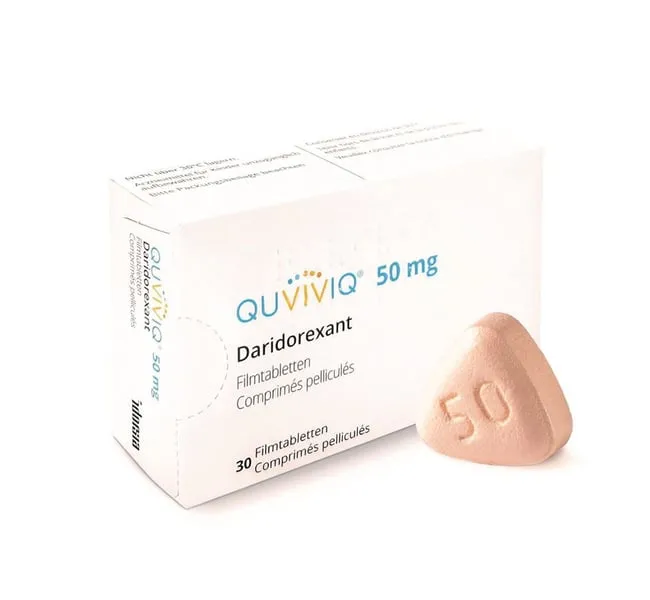
Table of Contents
- Package leaflet: Information for the user
- QUVIVIQ 25 mg film-coated tablets, 50 mg film-coated tablets
- 1. What QUVIVIQ is and what it is used for
- 2. What you should know before taking QUVIVIQ
- 3. How to take QUVIVIQ
- 4. Possible side effects
- 5. How to store QUVIVIQ
- 6. Package contents and other information
Package leaflet: Information for the user
QUVIVIQ 25 mg film-coated tablets, 50 mg film-coated tablets
daridorexant
This medicinal product is subject to additional monitoring. This will allow rapid identification of new safety information. You can help by reporting any side effects you experience while taking this medicine. See the end of section 4 for information on how to report side effects.
Please read all of this leaflet carefully before you start taking this medicine because it contains important information for you.
- Keep this leaflet. You may need to read it again.
- If you have any questions, ask your doctor or pharmacist.
- This medicine has been prescribed for you only. Do not give it to others, even if their symptoms are the same as yours, as it could be harmful.
- If you experience any side effects, including those not listed in this leaflet, talk to your doctor or pharmacist. See section 4.
Contents of this leaflet
- What QUVIVIQ is and what it is used for
- What you need to know before taking QUVIVIQ
- How to take QUVIVIQ
- Possible side effects
- How to store QUVIVIQ
- Contents of the pack and other information
1. What QUVIVIQ is and what it is used for
QUVIVIQ contains the active substance daridorexant, which belongs to a class of medicines called
"orexin receptor antagonists".
QUVIVIQ is used to treat insomnia in adults.
How QUVIVIQ works
Orexin is a substance produced by the brain that helps keep you awake. By blocking the action of orexin, QUVIVIQ helps you fall asleep faster, sleep longer, and improves your ability to carry out normal daytime activities.
2. What you should know before taking QUVIVIQ
Do not take QUVIVIQ
- if you are allergic to daridorexant or to any of the other ingredients of this medicine (listed in section 6)
- if you suffer from narcolepsy, a condition that causes sudden and unpredictable episodes of sleep at any time
- if you are taking medicines that can increase the levels of QUVIVIQ in your blood, such as:
- oral antifungal medications, for example ketoconazole, posaconazole, voriconazole, itraconazole
- certain antibiotics used to treat bacterial infections, such as clarithromycin, josamycin, telithromycin, troleandomycin
- certain medications used to treat HIV infection, such as ritonavir, elvitegravir, indinavir, saquinavir, telaprevir, danoprevir, lopinavir, nelfinavir, boceprevir
- certain cancer treatments, such as ceritinib, idelalisib, ribociclib, tucatinib.
Please consult your doctor to determine whether any of the medicines you are taking prevent you from taking QUVIVIQ.
Warnings and precautions
Talk to your doctor or pharmacist before taking QUVIVIQ if:
- you have depression or have previously had suicidal thoughts
- you have psychiatric disorders
- you are taking medicines that affect the brain, such as treatments for anxiety or depression
- you have regularly used drugs or have been dependent on drugs or alcohol
- you have liver problems: depending on their severity, QUVIVIQ may not be recommended or a lower dose may be required
- you have breathing difficulties (such as severe chronic obstructive pulmonary disease)
- you have a history of falls and are over 65 years of age (as there is generally a higher risk of falls in patients over 65 years old).
Your doctor may wish to monitor how this medicine affects you.
Contact your doctor immediately if you experience any of the following side effects while taking QUVIVIQ:
- sleep paralysis: a temporary inability to move or speak lasting several minutes upon falling asleep or waking up
- hallucinations: seeing or hearing vivid or disturbing things that are not real upon falling asleep or waking up.
If you have depression and experience worsening symptoms or have self-harming thoughts, contact your doctor immediately.
Children and adolescents
This medicine is not intended for children and adolescents under 18 years of age, as QUVIVIQ has not been studied in this age group.
Other medicines and QUVIVIQ
Inform your doctor or pharmacist if you are taking, have recently taken, or might take any other medicines because:
- certain antibiotics (erythromycin, ciprofloxacin, clarithromycin, rifampicin), immunosuppressants (cyclosporine), antifungal agents (itraconazole), cancer treatments (ceritinib), or HIV treatments (ritonavir, efavirenz) may increase or decrease the level of QUVIVIQ in the blood. Some of these medicines may be contraindicated with QUVIVIQ (see section “Do not take QUVIVIQ”). Your doctor can advise you.
- certain medicines acting on the brain (e.g. diazepam, alprazolam) may interact with QUVIVIQ. Your doctor can advise you.
- certain medicines used to treat blood clotting disorders, such as dabigatran, may interact with QUVIVIQ and therefore require certain precautions. Your doctor can advise you.
- certain medicines used to treat heart failure, such as digoxin, may interact with QUVIVIQ and therefore require certain precautions. Your doctor can advise you.
QUVIVIQ with food, drinks and alcohol
Drinking alcohol with QUVIVIQ may increase the risk of impaired balance and coordination.
Avoid grapefruit or grapefruit-containing fruit juices in the evening, as they may increase the level of QUVIVIQ in the blood.
Pregnancy, breastfeeding and fertility
If you are pregnant, think you may be pregnant, are planning a pregnancy, or are breastfeeding, consult your doctor before taking this medicine.
It is not known whether QUVIVIQ could harm the unborn baby.
A small amount of QUVIVIQ is excreted in breast milk. Please consult your doctor for advice on the best way to breastfeed while being treated with QUVIVIQ.
It is not known whether QUVIVIQ has effects on human fertility.
Driving and using machines
It is recommended to wait approximately 9 hours between taking QUVIVIQ and driving or operating machinery. Exercise caution when driving or using machines in the morning after taking QUVIVIQ. Do not engage in potentially dangerous activities if you do not feel fully alert, especially during the first days of treatment.
QUVIVIQ contains sodium
This medicine contains less than 1 mmol (23 mg) of sodium per tablet, i.e. it is essentially ‘sodium-free’.
3. How to take QUVIVIQ
Take this medicine exactly as instructed by your doctor. If you have any doubts, consult your doctor or pharmacist.
How much QUVIVIQ to take
Your doctor will determine the appropriate dose of QUVIVIQ for you.
The recommended dose is one 50 mg tablet of QUVIVIQ per night.
If you have liver problems or are taking certain other medicines, your doctor may prescribe a lower dose, i.e. one 25 mg tablet of QUVIVIQ per night.
The duration of treatment should be as short as possible. Your doctor will evaluate whether continuing treatment is necessary within 3 months after starting and periodically thereafter.
- Take QUVIVIQ by mouth once per night, half an hour before going to bed.
- You may take QUVIVIQ with or without food; however, it may take longer to work if taken immediately after a heavy meal.
If you take more QUVIVIQ than you should
If you take more QUVIVIQ than prescribed, you may experience excessive drowsiness and muscle weakness. Contact your doctor immediately.
If you forget to take QUVIVIQ
If you forget to take QUVIVIQ at bedtime, do not take it later during the night, otherwise you may experience drowsiness in the morning. Do not take a double dose to make up for the missed tablet.
If you stop taking QUVIVIQ
Treatment with QUVIVIQ can be stopped without the need to gradually reduce the dose and without harmful effects.
If you have any questions about the use of this medicine, consult your doctor or pharmacist.
4. Possible side effects
Like all medicines, this medicine can cause side effects, although not everybody gets them. The following side effects may occur with this medicine:
Common (may affect up to 1 in 10 people):
- headache
- excessive sleepiness
- dizziness
- fatigue
- nausea
Uncommon (may affect up to 1 in 100 people):
- temporary inability to move or speak (sleep paralysis) lasting up to several minutes when falling asleep or waking up (see section 2)
- seeing or hearing vivid or disturbing things that are not real (hallucinations; see section 2)
- allergic reactions (including skin rash, hives)
- abnormal dreams, nightmares
- sleepwalking
Consult your doctor if you experience any of these symptoms.
Reporting of side effects
If you experience any side effect, including those not listed in this leaflet, talk to your doctor or pharmacist. You can also report side effects directly via the national reporting system detailed in Annex V. By reporting side effects, you can help provide more information on the safety of this medicine.
5. How to store QUVIVIQ
Keep this medicine out of the sight and reach of children.
Do not use this medicine after the expiry date stated on the carton and blister after
Exp. The expiry date refers to the last day of that month.
This medicine does not require any special storage conditions.
Do not dispose of medicines via wastewater or household waste. Ask your pharmacist how to
dispose of medicines you no longer use. This will help protect the environment.
6. Package contents and other information
What QUVIVIQ contains
The active substance is daridorexant.
QUVIVIQ 25 mg film-coated tablets
Each tablet contains daridorexant hydrochloride equivalent to 25 mg of daridorexant.
QUVIVIQ 50 mg film-coated tablets
Each tablet contains daridorexant hydrochloride equivalent to 50 mg of daridorexant.
The other components are:
- tablet core: mannitol (E421), microcrystalline cellulose (E460), povidone, croscarmellose sodium (see section 2 “QUVIVIQ contains sodium”), silicon dioxide, magnesium stearate;
- film coating: hypromellose (E464), microcrystalline cellulose (E460), glycerol, talc (E553), titanium dioxide (E171), red iron oxide (E172), black iron oxide (E172), yellow iron oxide (E172; only in 50 mg tablets).
Description of the appearance of QUVIVIQ and the pack contents
Film-coated tablet (tablet)
QUVIVIQ 25 mg film-coated tablets
Triangular, light purple tablet, marked with "25" on one side and "i" (Idorsia logo) on the other side.
QUVIVIQ 50 mg film-coated tablets
Triangular, light orange tablet, marked with "50" on one side and "i" (Idorsia logo) on the other side.
QUVIVIQ is available in blister packs containing 10, 20 or 30 film-coated tablets.
Not all pack sizes may be marketed.
Marketing Authorization Holder
Idorsia Pharmaceuticals Deutschland GmbH
Marie-Curie-Strasse 8
79539 Lörrach
Germany
Manufacturer
Idorsia Pharmaceuticals Deutschland GmbH
Marie-Curie-Strasse 8
79539 Lörrach
Germany
PharmaKorell GmbH
Georges-Koehler-Str. 2
79539 Lörrach
Germany
More detailed information on this medicinal product is available on the European Medicines Agency website: http://www.ema.europa.eu .