Qutenza
Italy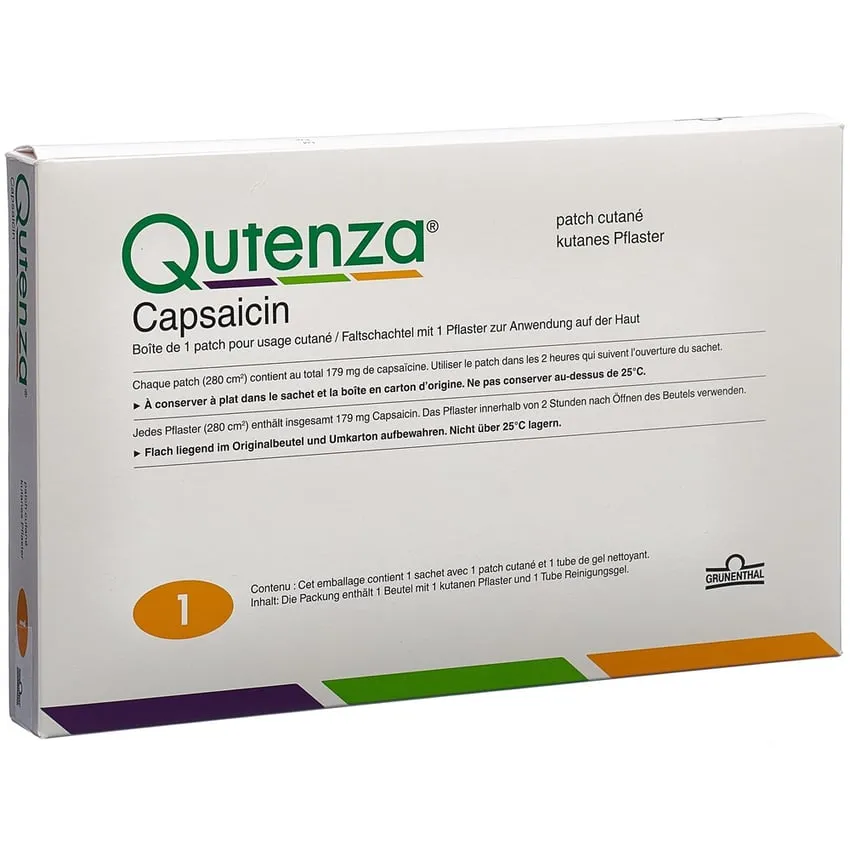
Table of Contents
Package leaflet: Information for the user
Qutenza 179 mg cutaneous patch
capsaicin
Read this entire leaflet carefully before using this medicine because it contains important information for you.
- Keep this leaflet. You may need to read it again.
- If you have any questions, consult your doctor.
- This medicine has been prescribed for you only. Do not give it to others, even if their symptoms are the same as yours, as it could be harmful.
- If you experience any adverse reaction, including those not listed in this leaflet, consult your doctor. See section 4.
Contents of this leaflet:
- What Qutenza is and what it is used for
- What you need to know before using Qutenza
- How to use Qutenza
- Possible side effects
- How to store Qutenza
- Contents of the pack and other information
1. What Qutenza is and what it is used for
Qutenza contains capsaicin and belongs to a group of medicines called anaesthetics.
Qutenza is indicated for the treatment of peripheral neuropathic pain in adults, either alone or in
combination with other pain medications.
Qutenza is used to relieve pain in people who have neuropathic pain due to nerve damage in the skin.
Nerve damage in the skin may result from a variety of conditions, such as post-herpetic neuralgia (shingles), HIV infection, diabetes, certain medications, and other medical conditions.
You may experience pain relief within one to three weeks after treatment.
2. What you need to know before using Qutenza
Do not use Qutenza
- if you are allergic to capsaicin (also present in chili peppers) or to any of the other ingredients of this medicine (listed in section 6)
Warnings and precautions
Talk to your doctor before using Qutenza.
Do not use Qutenza on areas of the head or face.
Do not use Qutenza on damaged skin or open wounds.
Avoid touching Qutenza or any materials that have come into contact with treated areas, as they may cause burning and stinging sensations. Do not touch your eyes, mouth, or other sensitive areas, as this may cause irritation and pain. If this occurs, rinse or wash with cold water.
Smelling or inhaling near Qutenza patches may cause coughing, throat irritation, or sneezing.
Usually, the skin will tingle, redden, or burn briefly during and after treatment with Qutenza. Due to pain, blood pressure may rise, so your doctor will monitor your blood pressure several times during treatment. If you experience significant pain, your doctor may apply local cooling or give you a pain-relieving medicine. If you experience severe pain, ask your doctor to remove the patch.
In general, after using capsaicin, short-term minor changes in the ability to sense heat or stinging have been observed.
If you have unstable or poorly controlled hypertension or a history of heart problems, your doctor will assess the risk of cardiovascular side effects or blood pressure changes due to the potential stress of the procedure before starting Qutenza treatment.
Children and adolescents
Treatment with Qutenza is not recommended in patients under 18 years of age.
Other medicines and Qutenza
Inform your doctor if you are taking, have recently taken, or might take any other medicines. Qutenza acts locally on the skin, and it is not expected to affect the action of other medicines.
Pregnancy and breastfeeding
Qutenza should be used with caution if you are pregnant.
Before starting treatment with Qutenza, you must stop breastfeeding. If you are pregnant, suspect you may be pregnant, plan to become pregnant, or are breastfeeding, consult your doctor before using this medicine.
Driving and using machines
No studies on the effects of Qutenza on the ability to drive or operate machinery are available. Only very small amounts of the active substance may enter the bloodstream for a very short time after using Qutenza. Therefore, it is unlikely that Qutenza will have direct effects on concentration or the ability to drive or use machinery.
The Qutenza cleansing gel contains butylated hydroxyanisole
The Qutenza cleansing gel contains butylated hydroxyanisole, which may cause local skin reactions (e.g. contact dermatitis) or irritation of the eyes and mucous membranes.
3. How to use Qutenza
Qutenza must be applied only by your doctor or by a nurse under the doctor's supervision.
No more than 4 patches should be used at the same time.
Qutenza is for use on the skin.
The doctor or nurse will outline the most painful areas on the skin with a pen or marker.
Before applying the Qutenza patches to the skin, the treatment areas are washed with water and soap and dried.
Hair in the treatment areas is trimmed.
Before applying the Qutenza patches, the doctor or nurse may apply an anaesthetic gel or cream, or give you an oral pain medication to help reduce the sensation of stinging. The gel or cream must be removed before applying Qutenza, and the skin must be thoroughly washed and dried.
The doctor or nurse must wear gloves, and sometimes a mask and protective goggles, when handling Qutenza patches. Do not smell or inhale near the Qutenza patches, as this may cause coughing or sneezing.
Qutenza may be cut into smaller pieces to fit the treatment area. The doctor or nurse will remove the patches after 30 minutes if treating nerve pain in the feet, or after 60 minutes if treating nerve pain in other parts of the body.
It may take 1 to 3 weeks before you experience pain relief with Qutenza. If you still have significant pain after this time, speak with your doctor.
Treatment with Qutenza may be repeated every 90 days, if needed. Consult your doctor if pain relief is inadequate or if pain returns earlier than expected.
You may be prescribed painkillers to take for pain caused by Qutenza treatment.
It is quite common to experience skin stinging, redness, or burning during treatment with Qutenza.
Disposable socks may be worn over the Qutenza patches if treatment is being applied to the feet.
Sometimes the doctor or nurse may apply a dressing over the Qutenza patch to help keep it in place.
Do not attempt to remove the patch yourself; let your doctor or nurse remove it.
After Qutenza treatment, the doctor or nurse will clean the treated skin with the cleansing gel provided in the tube included in the kit. The cleansing gel is left on the skin for one minute and then removed to eliminate any residual medication remaining on the skin after treatment.
After removing the cleansing gel, the area is gently washed with water and soap.
Do not touch the patch with your hands.
Do not touch your eyes, mouth, or other sensitive areas. If you accidentally touch the Qutenza patch or the treated skin before the cleansing gel is applied, you may experience burning and/or a stinging sensation. Contact your doctor immediately.
Do not take the Qutenza patches out of the clinic.
Do not use Qutenza patches at home.
If Qutenza is used for longer than prescribed:
Overdose is not expected to occur. However, if Qutenza is applied for longer than recommended, serious application site reactions such as pain, redness, and itching may occur.
If you have any doubts about how to use this product, consult your doctor or pharmacist.
4. Possible side effects
Like all medicines, this medicine can cause side effects, although not everyone gets them.
Contact your doctor immediately if you experience the following effects:
If you feel your heart beating too fast, too slow, or irregularly.
Uncommon: affects up to 1 in 100 people
Severe redness in the area where the patch was applied, blistering or oozing of the skin, skin becoming very painful to touch, swelling, moist or shiny skin. In a small number of cases, these may be signs of a burn requiring urgent medical treatment.
Frequency not known: frequency cannot be estimated based on available data
Call your doctor if you experience the following side effects or if they worsen:
Very common: may affect more than 1 in 10 people
- Redness or pain lasting for more than one day in the area where the patch was applied
Common: may affect up to 1 in 10 people
- Itching, swelling, blisters, swelling, dryness in the area where the patch was applied
- Burning sensation, high blood pressure, cough, nausea, itching, limb pain, muscle spasms, limb swelling
Uncommon: may affect up to 1 in 100 people
- Skin swellings, prickling sensation, inflammation, increased or decreased skin sensitivity, skin irritation reaction, bruising at the patch application site
- Decreased taste, reduced sensitivity in limbs, eye irritation, throat irritation, herpes zoster
Frequency not known: frequency cannot be estimated based on available data
- Accidental exposure (including eye pain, eye and throat irritation, cough)
Reporting of side effects
If you experience any side effect, including those not listed in this leaflet, tell your doctor.
You can also report side effects directly via the national reporting system listed in Annex V*. By reporting side effects, you can help provide more information on the safety of this medicine.
5. How to store Qutenza
Keep this medicine out of the sight and reach of children.
Do not use this medicine after the expiry date stated on the carton after "Exp." The expiry date refers to the last day of that month.
Qutenza cutaneous patch: Store flat in the pouch and in the original carton. Store below 25°C.
Cleaning gel: Store below 25°C.
After opening the pouch, Qutenza must be applied within 2 hours.
Disposal of used and unused Qutenza patches.
These items may cause a pricking sensation to fingers if touched. The doctor or nurse will place them in a polyethylene bag before safely disposing of them. Used Qutenza patches and treatment materials must be properly disposed of.
6. Package contents and other information
What Qutenza contains
The active substance is capsaicin. Each 280 cm patch contains a total of 179 mg of capsaicin, or
640 micrograms of capsaicin per cm of patch (8% w/w).
The excipients in Qutenza cutaneous patch are:
Matrix:
silicone adhesives
diethylene glycol monoethyl ether
silicone oil
ethylcellulose N50 (E462)
Backing layer
siliconized polyethylene terephthalate (PET) film, inner side
printing ink containing Pigment White 6
Removable protective layer (protective film)
fluoropolymer-coated polyester film
The Qutenza patch is supplied with a tube of cleansing gel which does not contain any active substances.
The cleansing gel contains:
macrogol 300
carbomer
purified water
sodium hydroxide (E524)
disodium edetate
butylated hydroxyanisole (E320)
Description of the appearance of Qutenza and contents of the pack
Qutenza is a cutaneous patch intended for use on the skin.
Each patch measures 14 cm x 20 cm (280 cm²) and consists of an adhesive side containing the active substance and a backing layer forming the outer surface. The adhesive side is covered by a transparent, unprinted, diagonally cut, removable protective film. The words ‘capsaicin 8%’ are printed on the outer surface of the backing layer.
Each Qutenza carton contains 1 or 2 sachets and 1 tube of cleansing gel (50 g). Not all pack sizes may be marketed.
Marketing Authorization Holder and Manufacturer
Grünenthal GmbH
Zieglerstraße 6
52078 Aachen
Germany
For further information about this medicinal product, please contact the local representative of the Marketing Authorization Holder:
België/Belgique/Belgien Lietuva
S.A. Grünenthal N.V. UAB “STADA – Nizhpharm – Baltija“
Lenneke Marelaan 8 Tel: +370 5 2603926
1932 Sint-Stevens-Woluwe
България Luxembourg/Luxemburg
STADA Pharma Bulgaria EOOD S.A. Grünenthal N.V.
25A, Cherni vrah Blvd, fl.4 Lenneke Marelaan 8
1421 Sofia, Bulgaria 1932 Sint-Stevens-Woluwe
Tel.: +359 29624626 België/Belgique/Belgien
Tél/Tel: + 32 (0)2 290 52 00
[email protected]
Česká republika Magyarország
STADA PHARMA CZ s.r.o. Hemopharm GmbH
Tel: +420 257888111 Németország
Tel.: +49 61729689
Danmark Malta
Grünenthal Denmark ApS Grünenthal GmbH
Tlf: +45 8888 3200 Il-Ġermanja
Tel.: +49-241-569-0
Deutschland Nederland
Grünenthal GmbH Grünenthal B.V.
Zieglerstr. 6 De Corridor 21K
DE-52078 Aachen NL-3621 ZA Breukelen
Tel: + 49 241 569-1111 Tel:+31 (0)30 6046370
[email protected] [email protected]
Eesti Norge
UAB “STADA – Nizhpharm – Baltija“ Grünenthal Norway AS
Leedu Tlf: +47 22 99 60 54
Tel: +370 5 2603926
Ελλάδα Österreich
ΒΙΑΝΕΞ Α.Ε. Grünenthal GmbH
Οδός Τατοΐου Campus 21, Liebermannstraße A01/501
GR-146 71 Νέα Ερυθραία 2345 Brunn am Gebirge
Τηλ: + 30 210 8009111-120 Tel: +43(0)2236 379 550-0
[email protected]
España Polska
Grünenthal Pharma, S.A. STADA Poland Sp. Z.o o.
C/Dr. Zamenhof, 36 Tel.: +48 227377920
E-28027 Madrid
Tel: +34 (91) 301 93 00
France Portugal
Laboratoires Grünenthal SAS Grünenthal, S.A.
Immeuble Eurêka Alameda Fernão Lopes, 12-8.º A
19 rue Ernest Renan P-1495 - 190 Algés
CS 90001 Tel: +351 / 214 72 63 00
F- 92024 Nanterre Cedex
Tél: + 33 (0)1 41 49 45 80
Hrvatska România
STADA d.o.o. S.C. STADA M&D S.R.L.
Hercegovačka 14 Spatiul Independentei 1b, sectorul 4
10 000 Zagreb Bucuresti
Tel: +385 1 37 64 111 Tel: +40 213160640
Ireland Slovenija
Grünenthal Pharma Ltd STADA d.o.o
4045 Kingswood Road, Dunajska cesta 156
Citywest Business Park 1000 Ljubljana
IRL – Citywest Co., Dublin Tel: +386 1589 6710
Tel: +44 (0)870 351 8960
[email protected]
Ísland Slovenská republika
Vistor hf. STADA PHARMA Slovakia, s.r.o.
Danmörk Tel: +421 252621933
Sími: +354 535 7000
Italia Suomi/Finland
Grünenthal Italia S.r.l. Grünenthal Finland Oy
Tel: +39 02 4305 1 Puh/Tel: +358 44 240 9190
Κύπρος Sverige
ΒΙΑΝΕΞ Α.Ε. Grunenthal Sweden AB
Οδός Τατοΐου Tel: +46 (0)8 643 40 60
GR-146 71 Νέα Ερυθραία-Ελλάδα
Τηλ: + 30 210 8009111-120
[email protected]
Latvija United Kingdom (Northern Ireland)
UAB “STADA – Nizhpharm – Baltija“ Grünenthal Pharma Ltd
Lietuva 4045 Kingswood Road,
Tel: +370 5 2603926 Citywest Business Park
IRL – Citywest Co., Dublin
Tel: +44 (0)870 351 8960
[email protected]
Other sources of information
More detailed information on this medicinal product is available on the website of the European Medicines Agency: http://www.ema.europa.eu
The following information is intended for healthcare professionals only.
The full product characteristics summary is provided together with this patient information leaflet.