Quinapril and hydrochlorothiazide Aurobindo
Italy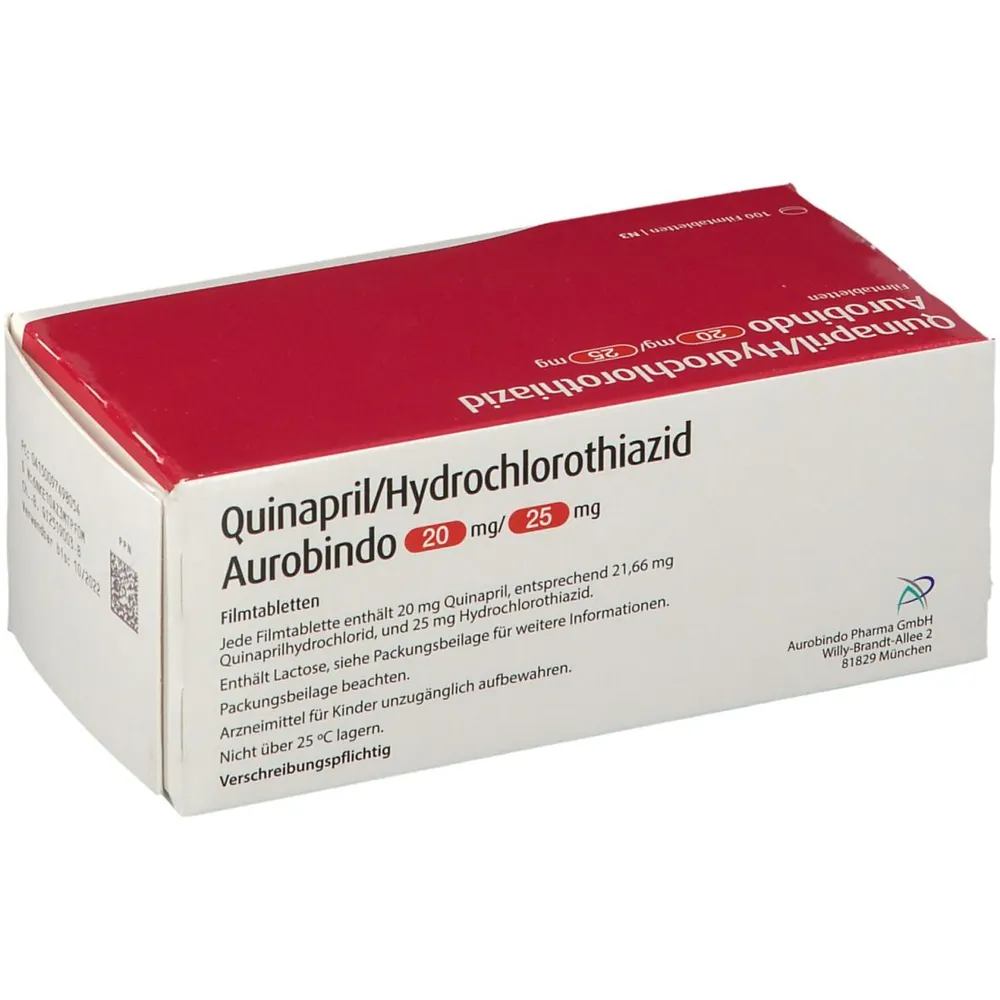
Table of Contents
- Package leaflet: Information for the user
- Quinapril Hydrochlorothiazide Aurobindo 10/12.5 mg film-coated tablets, 20/12.5 mg film-coated tablets, 20/25 mg film-coated tablets
- 1. What Quinapril Hydrochlorothiazide Aurobindo is and what it is used for
- 2. What you should know before taking Quinapril Hydrochlorothiazide Aurobindo
- 3. How to take Quinapril Hydrochlorothiazide Aurobindo
- 4. Possible side effects
- 5. How to store Quinapril Hydrochlorothiazide Aurobindo
- 6. Package contents and other information
Package leaflet: Information for the user
Quinapril Hydrochlorothiazide Aurobindo 10/12.5 mg film-coated tablets, 20/12.5 mg film-coated tablets, 20/25 mg film-coated tablets
Equivalent medicinal product
Read this entire leaflet carefully before taking this medicine, as it contains important information for you.
- Keep this leaflet. You may need to read it again.
- If you have any questions, ask your doctor or pharmacist.
- This medicine has been prescribed for you only. Do not give it to others, even if they have the same symptoms as yours, because it could be harmful.
- If you experience any adverse reaction, including those not listed in this leaflet, contact your doctor or pharmacist. See section 4.
Contents of this leaflet:
- What Quinapril Hydrochlorothiazide Aurobindo is and what it is used for
- What you need to know before taking Quinapril Hydrochlorothiazide Aurobindo
- How to take Quinapril Hydrochlorothiazide Aurobindo
- Possible side effects
- How to store Quinapril Hydrochlorothiazide Aurobindo
- Contents of the pack and other information
1. What Quinapril Hydrochlorothiazide Aurobindo is and what it is used for
Quinapril Hydrochlorothiazide Aurobindo film-coated tablets contain two medicines called (i) quinapril and (ii) hydrochlorothiazide. Both of these medicines help reduce blood pressure.
(i) Quinapril belongs to a class of medicines known as ACE inhibitors and helps relax blood vessels, thereby reducing blood pressure.
(ii) Hydrochlorothiazide belongs to a class of medicines known as thiazide diuretics (also known as "mild diuretics"). Hydrochlorothiazide inhibits the kidneys' ability to retain fluids, which leads to a reduction in blood pressure.
Quinapril Hydrochlorothiazide Aurobindo is used for the treatment of high blood pressure in patients who are already taking (i) quinapril and (ii) hydrochlorothiazide as separate tablets and who may benefit from a single tablet containing both active substances.
2. What you should know before taking Quinapril Hydrochlorothiazide Aurobindo
Do not take Quinapril Hydrochlorothiazide Aurobindo:
- If you are allergic to:
- quinapril hydrochloride;
- any other ACE inhibitor;
- hydrochlorothiazide;
- medicines containing sulfonamides;
- any of the other ingredients of Quinapril Hydrochlorothiazide Aurobindo (listed in section 6).
- If you have had severe allergic reactions following previous treatment with an ACE inhibitor. These reactions cause swelling of the face, hands or feet, tongue or throat – which may cause shortness of breath or difficulty breathing (angioedema).
- If you suffer from hereditary or unexplained swelling of the skin (angioedema).
- If you have severe kidney or liver problems.
- If you have aortic stenosis (a narrowing of the main blood vessel leaving the heart).
- If you are more than three months pregnant (it is best to avoid Quinapril Hydrochlorothiazide Aurobindo even in early pregnancy – see section “Pregnancy”).
- If you have diabetes or impaired kidney function and are being treated with a blood pressure-lowering medicine containing aliskiren.
- If you have taken or are currently taking sacubitril/valsartan, a medicine used to treat chronic heart failure in adults, as this increases the risk of angioedema (rapid swelling under the skin, such as in the throat).
- If you are taking any of the following medicines, the risk of angioedema may be increased:
- racecadotril, a medicine used to treat diarrhoea;
- medicines used to prevent rejection of transplanted organs and to treat cancer (such as temsirolimus, sirolimus, everolimus);
- vildagliptin, a medicine used to treat diabetes.
Warnings and precautions
Talk to your doctor or pharmacist before taking Quinapril Hydrochlorothiazide Aurobindo.
- If you have heart, liver or kidney problems.
- If you have lost significant amounts of salts or fluids (due to vomiting, diarrhoea, excessive sweating, a low-salt diet, prolonged use of diuretics, or if you are on dialysis).
- If you suffer from allergies or asthma.
- If you are about to undergo treatment to reduce your allergy to bee or wasp stings (desensitisation).
- If you have confirmed obstruction of blood flow from the heart.
- If you suffer from a connective tissue vascular disease such as scleroderma or systemic lupus erythematosus.
- If you are about to undergo a treatment called LDL apheresis for cholesterol removal.
- If you suffer from diabetes or gout.
- If you are of childbearing age, discuss appropriate contraception with your doctor.
- If you are breastfeeding or planning to start breastfeeding.
- If you are taking any of the following medicines used to treat high blood pressure:
- an “angiotensin II receptor antagonist” (AIIRA) (also known as sartans – for example valsartan, telmisartan, irbesartan), particularly if you have kidney problems related to diabetes;
- aliskiren.
- Your doctor may check your kidney function, blood pressure and levels of electrolytes (e.g. potassium) in your blood at regular intervals.
- If you are taking any of the following medicines, the risk of angioedema (rapid subcutaneous swelling, e.g. in the throat) is higher:
- sirolimus, everolimus and other medicines belonging to the class of mTOR inhibitors (used to prevent rejection of transplanted organs).
- If you have previously had skin cancer or develop an unexpected skin lesion during treatment. Treatment with hydrochlorothiazide, particularly long-term use at high doses, may increase the risk of certain types of non-melanoma skin cancer and lip cancer. Protect your skin from exposure to sunlight and UV radiation while using Quinapril Hydrochlorothiazide Aurobindo.
See also information under “Do not take Quinapril Hydrochlorothiazide Aurobindo”.
Contact your doctor immediately if you experience a decrease in vision or eye pain. These could be symptoms of fluid accumulation in the vascular layer of the eye (choroidal effusion) or increased intraocular pressure, which may occur from a few hours to several weeks after starting Quinapril Hydrochlorothiazide Aurobindo. This condition may lead to permanent vision loss if not treated. If you previously had an allergy to penicillin or sulfonamides, you may be at higher risk of developing an allergic reaction.
You must inform your doctor if you think you are pregnant (or if you are planning a pregnancy). Quinapril Hydrochlorothiazide Aurobindo is not recommended during early pregnancy and must not be taken if you are more than three months pregnant, as it may cause serious harm to the unborn child if taken during this period (see section “Pregnancy”).
More frequent medical checks may be needed at the beginning of treatment. Your doctor will decide how often these checks are required. Do not skip these visits, even if you feel well.
If your blood pressure drops too low and you feel faint, you should lie down. You may require medical assistance.
For athletes: using this medicine without therapeutic indication constitutes doping and may lead to a positive anti-doping test.
Other medicines and Quinapril Hydrochlorothiazide Aurobindo
Inform your doctor or pharmacist if you are taking, have recently taken, or might take any other medicines.
The effects of Quinapril Hydrochlorothiazide Aurobindo may be affected by, or may affect, the following medicines:
- Other medicines used to lower blood pressure.
- Diuretics.
- Potassium supplements (including salt substitutes), potassium-sparing diuretics, and other medicines that may increase potassium levels in the blood (such as trimethoprim and cotrimoxazole used to treat bacterial infections; cyclosporine, an immunosuppressant used to prevent rejection of transplanted organs; and heparin, a medicine used to thin the blood and prevent clotting).
- Lithium, used for mental health conditions.
- Medicines that have a sedative effect. These include alcoholic beverages and sleeping pills.
- Anti-inflammatory medicines such as hydrocortisone, prednisolone, ACTH.
- Non-steroidal anti-inflammatory drugs (e.g. aspirin or ibuprofen).
- Insulin or oral diabetes medicines used to control blood sugar.
- Antacids (medicines used for indigestion).
- Medicines used to relax muscles during surgery (e.g. tubocurarine).
- Procainamide and digoxin, used to treat heart problems.
- Allopurinol, used to treat gout.
- Cyclosporine and other medicines used to suppress the body’s immune response.
- Medicines used in cancer therapy.
- Tetracycline, an antibiotic.
- Medicines usually used to prevent rejection of transplanted organs (sirolimus, everolimus and other mTOR inhibitors). See section “Warnings and precautions”.
Surgery
- Remember to inform medical staff that you are taking Quinapril Hydrochlorothiazide Aurobindo. This is important if you are admitted to hospital for surgery, as your anaesthetist will need to know. Your doctor may consider it necessary to adjust the dose and/or take other precautions:
If you are taking an angiotensin II receptor antagonist (AIIRA) or aliskiren (see also information under “Do not take Quinapril Hydrochlorothiazide Aurobindo” and “Warnings and precautions”).
Quinapril Hydrochlorothiazide Aurobindo with food, drinks and alcohol
Quinapril Hydrochlorothiazide Aurobindo may be taken with or without food.
Pregnancy, breastfeeding and fertility
If you are pregnant, think you might be pregnant, planning a pregnancy, or breastfeeding, consult your doctor or pharmacist before taking this medicine.
Pregnancy
You must inform your doctor if you think you are pregnant (or if you are planning a pregnancy).
Your doctor will usually advise you to stop taking Quinapril Hydrochlorothiazide Aurobindo before starting a pregnancy or as soon as you know you are pregnant, and will recommend an alternative medicine.
Quinapril Hydrochlorothiazide Aurobindo is not recommended during pregnancy and must not be taken if you are more than three months pregnant, as it may cause serious harm to the unborn child if taken after the third month of pregnancy.
Breastfeeding
Inform your doctor if you are breastfeeding or planning to start breastfeeding.
Quinapril Hydrochlorothiazide Aurobindo is not recommended for women who are breastfeeding.
Driving and using machines
The tablets may cause dizziness. Therefore, you should exercise caution when driving or operating machinery.
Quinapril Hydrochlorothiazide Aurobindo contains lactose
Quinapril Hydrochlorothiazide Aurobindo film-coated tablets contain lactose (a type of sugar).
If your doctor has diagnosed you with an intolerance to certain sugars, contact him or her before taking this medicine.
3. How to take Quinapril Hydrochlorothiazide Aurobindo
Take this medicine exactly as prescribed by your doctor. Take the tablet with plenty of water. Tablets may be taken regardless of the morning meal. If you have any doubts, consult your doctor or pharmacist. The usual dose is:
Adults:
The initial dose is one tablet in the morning. Your doctor may increase the dose if they consider it necessary.
Renal impairment
The use of Quinapril Hydrochlorothiazide Aurobindo should be avoided if you have severely impaired renal function. In patients with renal impairment, your doctor may prescribe a lower dose.
Elderly:
If you are elderly, you must use Quinapril Hydrochlorothiazide Aurobindo with caution.
Your doctor will prescribe the lowest effective dose.
Children and adolescents (under 18 years of age)
The use of Quinapril Hydrochlorothiazide Aurobindo is not recommended in children and adolescents.
If you take more Quinapril Hydrochlorothiazide Aurobindo than you should
Contact a doctor or the nearest hospital emergency department immediately. Take the container and any remaining tablets with you. Signs and symptoms of overdose include dizziness and fainting caused by low blood pressure.
If you forget to take Quinapril Hydrochlorothiazide Aurobindo
If you forget a dose, take it as soon as you remember, unless it is almost time for the next dose. Do not take a double dose to make up for a forgotten dose.
If you stop taking Quinapril Hydrochlorothiazide Aurobindo
Do not stop taking Quinapril Hydrochlorothiazide Aurobindo without first consulting your doctor, even if you feel better.
If you have any doubts about how to use this medicine, ask your doctor or pharmacist.
4. Possible side effects
Like all medicines, this medicine can cause side effects, although not everybody gets them.
If you experience any of the following symptoms, stop taking Quinapril Hydrochlorothiazide Aurobindo and
contact your doctor or go immediately to the nearest emergency room:
- symptoms of an allergic (hypersensitivity) reaction (angioedema) such as:
- swelling of the skin, face and lips or larynx;
- swelling of the tongue and throat causing difficulty breathing or swallowing. If you are of black race, you are more likely to develop angioedema;
- severe abdominal pain causing discomfort (intestinal angioedema);
- heart attack (myocardial infarction); symptoms may include chest pain, chest tightness, shortness of breath and breathing difficulties;
- weakness in arms or legs, or difficulty speaking may be symptoms of a possible stroke (cerebrovascular accident);
- severe skin rash which may include hives, severe itching, blisters, skin peeling and swelling, mucosal inflammation (Stevens-Johnson syndrome).
Common (may affect up to 1 in 10 people):
- tiredness (fatigue), difficulty sleeping (insomnia), drowsiness;
- feeling of weakness (asthenia);
- dizziness;
- cough, bronchitis;
- infections of the nose or throat (upper respiratory tract infections, pharyngitis), itchy and runny nose (rhinitis);
- feeling unwell (nausea), discomfort (vomiting), diarrhoea, indigestion (dyspepsia);
- headache;
- abdominal pain, back pain, muscle pain (myalgia);
- abnormally high concentration of uric acid in the blood (hyperuricaemia);
- abnormally high concentration of potassium in the blood (hyperkalaemia);
- increases in creatinine and urea in the blood (which are indicators of kidney function);
- elevated levels of uric acid in the blood causing swelling and pain in the joints (gout);
- rapid heartbeat (tachycardia), awareness of heartbeat in the chest (palpitations);
- relaxation of blood vessels (vasodilation).
Uncommon (may affect up to 1 in 100 people):
- impaired glucose tolerance;
- low blood pressure (hypotension);
- nervousness;
- fainting (syncope), a sensation of dizziness or spinning (vertigo);
- mini-stroke (temporary bleeding or blockage of blood vessels in the brain);
- excess gas (flatulence), altered taste (dysgeusia);
- dry mouth;
- excessive sweating (hyperhidrosis);
- hair loss (alopecia);
- erectile dysfunction;
- viral infection, urinary tract infection;
- inflammation of the sinuses (sinusitis);
- fever (pyrexia);
- confusion;
- lazy eye (amblyopia);
- ringing in the ears (tinnitus);
- shortness of breath (dyspnoea);
- dry throat;
- joint pain (arthralgia);
- impaired kidney function;
- presence of excess serum proteins in urine (proteinuria).
Rare (may affect up to 1 in 1,000 people):
- lung inflammation which may cause breathlessness, cough and high temperature (eosinophilic pneumonia);
- balance disorders;
- skin disorders may be associated with: fever, inflamed blood vessels (vasculitis), muscle pain (myalgia), joint pain, inflammation (arthralgia/arthritis), a range of skin disorders (psoriasiform dermatitis) and changes in various laboratory tests;
- constipation;
- inflammation of the tongue (glossitis).
Very rare (may affect up to 1 in 10,000 people):
- temporary blurred vision;
- reduced intestinal movements (ileus).
Frequency not known (frequency cannot be estimated from the available data):
- allergic condition causing joint pain, skin rashes and fever (systemic lupus erythematosus);
- inflamed body tissues (serositis);
- abnormal increase in eosinophils (a type of white blood cell in the blood);
- mild reduction in the number of red blood cells in the blood (reduced haematocrit);
- increased levels of liver enzymes in the blood;
- increased levels of bilirubin in the blood;
- increased levels of antinuclear antibodies (ANA) in the blood;
- increases in cholesterol and triglycerides (types of fats) in the blood;
- inflammation of the kidneys (interstitial nephritis);
- inflamed liver (hepatitis);
- yellowing of the skin and whites of the eyes (jaundice, caused by blockage of bile flow);
- inflamed pancreas (pancreatitis);
- narrowing (constriction) of the lower airways (bronchospasm);
- sudden drop in blood pressure upon standing which may cause dizziness, mental confusion or fainting (orthostatic hypotension);
- irregular heartbeat (arrhythmia);
- allergic (anaphylactic) reactions;
- reduced number of white blood cells in the blood (neutropenia);
- severely reduced number of white blood cells leading to increased risk of infections (agranulocytosis);
- reduced number of red blood cells which may cause mild yellowing of the skin and lead to weakness or shortness of breath (haemolytic anaemia);
- reduced number of platelets in the blood increasing the risk of bleeding or bruising (thrombocytopenia);
- increased erythrocyte sedimentation rate (a non-specific measure of inflammation);
- cancer of the skin and lips (non-melanoma skin cancer);
- decreased vision or eye pain due to increased pressure (possible signs of fluid accumulation in the vascular layer of the eye (choroidal effusion) or acute angle-closure glaucoma).
Reporting of side effects
If you experience any side effect, including those not listed in this leaflet, talk to your doctor or pharmacist. You can also report side effects directly via the national reporting system at https://www.aifa.gov.it/content/segnalazioni-reazioni-avverse. By reporting side effects, you can help provide more information on the safety of this medicine.
5. How to store Quinapril Hydrochlorothiazide Aurobindo
Keep this medicine out of the sight and reach of children.
Do not use this medicine after the expiry date stated on the blister pack and carton after EXP. The expiry date refers to the last day of that month.
Store below 25 °C.
Do not dispose of this medicine via wastewater or household waste. Ask your pharmacist how to dispose of medicines you no longer use. This will help protect the environment.
6. Package contents and other information
What Quinapril Hydrochlorothiazide Aurobindo contains
The active substances are quinapril (as quinapril hydrochloride) and hydrochlorothiazide.
Quinapril Hydrochlorothiazide Aurobindo 10/12.5 mg film-coated tablets contain 10 mg of quinapril,
equivalent to 10.83 mg of quinapril hydrochloride, and 12.5 mg of hydrochlorothiazide.
Quinapril Hydrochlorothiazide Aurobindo 20/12.5 mg film-coated tablets contain 20 mg of quinapril,
equivalent to 21.66 mg of quinapril hydrochloride, and 12.5 mg of hydrochlorothiazide.
Quinapril Hydrochlorothiazide Aurobindo 20/25 mg film-coated tablets contain 20 mg of quinapril,
equivalent to 21.66 mg of quinapril hydrochloride, and 25 mg of hydrochlorothiazide.
The other components are:
Tablet core: monohydrate lactose, heavy magnesium carbonate, crospovidone (type A), povidone (K 30),
magnesium stearate.
Coating (Opadry pink): hypromellose, titanium dioxide (E171), hydroxypropylcellulose, macrogol 400, red iron oxide (E172), yellow iron oxide (E172).
Description of the appearance of Quinapril Hydrochlorothiazide Aurobindo and contents of the pack
Film-coated tablet.
10/12.5 mg:
Pink, oval, biconvex, film-coated tablets with a breakline, marked with “D” on one side and “18” on the other.
The score line on the tablet is intended to facilitate breaking the tablet for easier swallowing and is not intended to divide the tablet into equal doses.
20/12.5 mg:
Pink, triangular, biconvex, film-coated tablets marked with “D” on one side and “19” on both sides of the breakline on one side, and smooth on the other side.
The score line on the tablet is intended to facilitate breaking the tablet for easier swallowing and is not intended to divide the tablet into equal doses.
20/25 mg:
Pink, round, biconvex, film-coated tablets marked with “D” on one side and “20” on the other.
Quinapril Hydrochlorothiazide Aurobindo film-coated tablets are available in blisters containing 7, 10, 14, 20, 28, 30, 42, 50, 56, 60, 84, 90, 98, 100, 156, 250 and 500 film-coated tablets.
Not all pack sizes may be marketed.
Marketing Authorization Holder
Aurobindo Pharma (Italia) S.r.l.
Via San Giuseppe, 102
21047 - Saronno (VA)
Italy
Responsible person for batch release
Milpharm Limited
Ares, Odyssey Business Park, West End Road,
South Ruislip HA4 6QD
United Kingdom
APL Swift Services (Malta) Limited
HF26, Hal Far Industrial Estate, Hal Far, Birzebbugia, BBG 3000
Malta
This medicinal product is authorized in the European Economic Area countries under the following names:
France Quinapril/Hydrochlorothiazide Arrow Lab 20/12.5 mg film-coated tablets
Germany Quinapril/Hydrochlorothiazide Aurobindo 10/12.5 mg, 20/12.5 mg, 20/25 mg film-coated tablets
Italy Quinapril Hydrochlorothiazide Aurobindo
Spain Quinapril/Hydrochlorothiazide Aurobindo, 20/12.5 mg, film-coated tablets
United Kingdom Quinapril/Hydrochlorothiazide 10/12.5 mg film-coated tablets