Pylobactell
Italy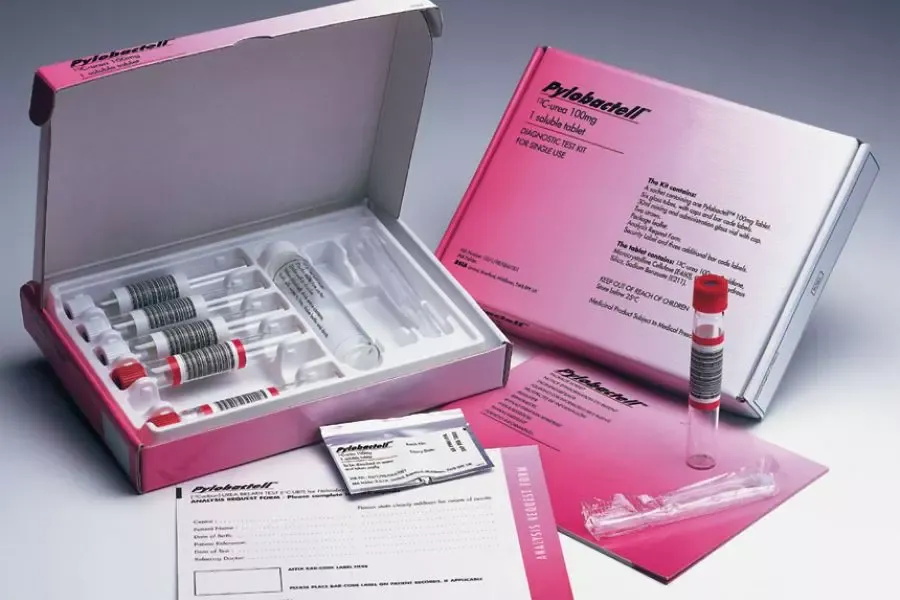
Table of Contents
- PACKAGE LEAFLET INFORMATION FOR THE USER
- Pylobactell, 100mg effervescent tablet
- 1. WHAT PYLOBACTELL IS AND WHAT IT IS USED FOR
- 2. WHAT YOU SHOULD KNOW BEFORE USING PYLOBACTELL
- 3. HOW TO USE PYLOBACTELL
- 4. POSSIBLE ADVERSE REACTIONS
- 5. HOW TO STORE PYLOBACTELL
- 6. PACK CONTENTS AND OTHER INFORMATION
- The following information is intended for laboratory use only.
PACKAGE LEAFLET INFORMATION FOR THE USER
Pylobactell, 100mg effervescent tablet
C-urea
Please read this leaflet carefully before taking this medicine because it contains important information for you.
- Keep this leaflet; you may need to read it again.
- If you have any questions, ask your doctor, pharmacist, or nurse.
- This medicine has been prescribed for you personally. Never give it to others. It could be harmful to other people, even if their symptoms are the same as yours.
- If any of the side effects worsens, or if you notice any side effects not listed in this leaflet, inform your doctor, pharmacist, or nurse. See section 4.
Contents of this leaflet:
- What Pylobactell is and what it is used for
- What you need to know before taking Pylobactell
- How to take Pylobactell
- Possible side effects
- How to store Pylobactell
- Contents of the pack and other information
1. WHAT PYLOBACTELL IS AND WHAT IT IS USED FOR
Pylobactell is a breath test. It is used to detect the bacterium Helicobacter pylori (H. pylori)
in the digestive system (stomach and adjacent intestine). This bacterium may be responsible
for your gastric condition.
Your doctor may recommend performing the C-urea breath test for one of the following
reasons:
- confirming Helicobacter pylori infection may assist in diagnosing the patient's condition;
- if Helicobacter pylori infection has already been diagnosed and eradication therapy has been completed, and the doctor wishes to verify its effectiveness.
This medicinal product is for diagnostic use only.
How does the test work?
All foods contain the carbon-13 isotope (¹³C) in varying amounts. This ¹³C can be detected
in exhaled carbon dioxide. The amount of ¹³C exhaled depends on the type of food ingested.
You will be asked to take a "test meal" to delay gastric emptying.
After the meal, 3 samples of exhaled air will be collected and analyzed to measure the normal level of ¹³C in the exhaled carbon dioxide.
You will then be given to drink the Pylobactell C-urea solution. If active H. pylori is present in your
stomach, it will break down the ¹³C-labeled urea, which will be detected in the exhaled carbon dioxide.
Another 3 samples of exhaled air will be collected 30 minutes later.
The amount of ¹³C in these samples will be compared with the normal baseline levels. A significant
increase in ¹³C suggests the presence of active Helicobacter pylori.
2. WHAT YOU SHOULD KNOW BEFORE USING PYLOBACTELL
Do not use Pylobactell:
- if you are allergic to urea C or to any of the other components of this medicine (listed in section 6).
- if you have any medical condition that may affect the test or vice versa.
Warnings and precautions
Talk to your doctor, pharmacist, or nurse before using Pylobactell if:
- you have undergone partial removal of the stomach (partial gastrectomy), as the reliability of the Pylobactell breath test has not been validated in such patients;
- you have or suspect a gastric infection;
- you have long-term stomach problems (atrophic gastritis), as the breath test may give false results and other tests may be needed to confirm the presence of H. pylori;
- fasting (not eating) could have medical implications for you;
- you are under 18 years of age.
Other medicines and Pylobactell
Tell your doctor, pharmacist, or nurse if you are taking, have recently taken, or might take any other medicines, including those not requiring a prescription.
Do not perform the test if:
- you have taken antibiotics or medications for the treatment of Helicobacter pylori within the last 28 days;
- you have taken proton pump inhibitors (to stop indigestion) within the last 14 days;
- you have taken H2-receptor antagonists or antacids (to relieve indigestion) on the same day as the test.
Do not stop taking any medication without consulting your doctor.
Taking Pylobactell with food and drink
You must fast for at least 4 hours before the test so that it is performed on an empty stomach. After a heavy meal, you will need to fast for 6 hours before performing the test.
During the fasting period, drinking water is allowed.
Inform your doctor, pharmacist, or nurse if fasting poses a problem (e.g., in diabetic patients).
Pregnancy and breastfeeding
Pylobactell may be used during pregnancy and breastfeeding.
Driving and using machines
The test does not affect your ability to drive or operate machinery.
3. HOW TO USE PYLOBACTELL
Use this medicine exactly as instructed by your doctor, pharmacist, or nurse. If you have any doubts, consult your doctor, pharmacist, or nurse.
The test lasts approximately 45 minutes. Drinking water will be required.
It is recommended that the breath test is performed while sitting in an upright position.
Do not smoke before or during the test.
The test procedure consists of the following steps:
(a brief description of these instructions is printed on the back of the test request form)
- Fasting: You must fast for at least 4 hours before the test (see section 2, Taking Pylobactell with food and drinks).
- Test meal: Drink the recommended test meal. This meal is not included in the kit but may be provided separately. If it has not been provided, the most suitable test meal consists of 200 ml of undiluted orange juice. If the recommended test meal cannot be taken, your doctor will advise you of an alternative.
- Wait 5 minutes
- Pre-test samples (3 tubes with white caps). i. Remove the cap from the tube. ii. Using a straw, breathe out from your mouth into the tube. iii. Slowly withdraw the straw from the tube as you exhale. iv. Close the tube immediately. v. Repeat with the remaining tubes with white caps.
Do not blow forcefully into the tubes; normal exhalation is sufficient. Close the tubes quickly.
Avoid allowing saliva to enter the tubes.
- Preparation of carbon- C-labelled urea solution ( C-urea) Open the sachet and pour the tablet into the mixing bottle. Add water up to the indicated level and cap the bottle. Shake the bottle to dissolve the tablet. Drink the solution. Record the time at which the product was taken. Refill the bottle with water up to the indicated level and drink.
- For correct test performance, wait 30 minutes after taking the solution. Do not smoke, eat, or drink at this point. This is important for the proper functioning of the test.
- Post-test samples (3 tubes with red caps). Using the tubes with red caps, collect breath samples following the procedure described above (see point 4).
- Test request form. Complete the request form with the patient details on the left side of the form and the name and address of the doctor on the right side.
- The test is now complete.
Place the breath collection tubes and the test request form into the provided container and send them to the address indicated by your doctor. Your doctor will inform you when the test results will be available and who to contact to obtain them.
Dispose of the empty sachet, the mixing bottle, and the straws as regular waste, but keep this leaflet for future reference.
If it is necessary to repeat the test, you must wait until the following day to perform it again.
If you have any doubts about how to use this medicine, consult your doctor, pharmacist, or nurse.
4. POSSIBLE ADVERSE REACTIONS
No side effects have been reported for Pylobactell.
Vitamin C and urea are harmless substances normally present in nature and in our body.
Reporting of adverse reactions
If you experience any adverse reaction, including those not listed in this leaflet, please contact your
doctor, pharmacist or nurse. You may also report adverse reactions directly through the national reporting system
referred to in Annex V. By reporting adverse reactions, you can help provide more information on the safety of this medicine.
5. HOW TO STORE PYLOBACTELL
Keep this medicine out of the sight and reach of children.
Store the kit at a temperature not exceeding 25°C.
The solution should be taken immediately after dissolution.
Do not use this medicine after the expiry date stated on the carton after EXP. The expiry date refers to the last day of that month.
6. PACK CONTENTS AND OTHER INFORMATION
What Pylobactell contains:
- The active substance is C-urea. Each tablet contains 100 mg of C-urea.
- The excipients are povidone (E1201), microcrystalline cellulose (E460i), colloidal anhydrous silica, sodium benzoate (E211).
Materials supplied in the Pylobactell breath test kit:
- one sachet containing 1 tablet;
- 6 glass tubes, of which 3 with white caps and 3 with red caps;
- one 30 ml mixing tube with cap;
- 2 straws;
- 1 patient information leaflet;
- 1 test request form;
- 1 safety label and 3 additional barcode labels.
The contents of the kit are sufficient for performing one single test only. If the test needs to be repeated, a new kit is required and the test must not be performed until the following day.
Marketing Authorisation Holder
Richen Europe S.R.L
VIA San Cristoforo
78-20090
Trezzano Sul Naviglio (MI)
Italy
Tel: +39 327 972 2938
Email: [email protected]
Manufacturer
J L Bragg Limited, 33-34 Boss Hall Road, Ipswich, Suffolk, IP1 5BN, United Kingdom.
More detailed information on this medicinal product is available on the website of the European Medicines Agency: http://www.ema.europa.eu.
The following information is intended for laboratory use only.
Analysis of Exhaled Air Samples and Test Specifications
The accuracy and precision of the test depend heavily on the quality of the analysis; therefore, only laboratories possessing the appropriate certification may be considered qualified to analyze air samples.
Satisfactory specificity and sensitivity have been demonstrated in clinical studies where exhaled air samples were analyzed using Isotope Ratio Mass Spectrometry (IRMS).
Air samples collected during a test must remain in their original containers prior to IRMS analysis.
The IRMS instrument configuration must be continuous flow or dual inlet.
Use a multi-position autosampler and a barcode reader to enable sample tracking during analysis.
Source parameters and IRMS tuning must be optimized daily.
The instrumentation must be linear over a wide range of CO concentrations (typically 1.0 – 6.0%) and should be regularly checked.
Internal analytical precision must be less than ±0.3‰ δ¹³C for 20 replicate analyses of the same reference gas sample and remain within 3SD of the mean for UBT analyses.
Sample transfer through the analytical system must be performed without isotopic fractionation.
The IRMS must be equipped with a triple collector assembly enabling simultaneous detection of ions with mass-to-charge ratios of 44, 45, and 46 for oxygen isotopic content.
Provision must be made for correction of instrumental drift during analysis.
Reference gases must be calibrated against an appropriate international standard to allow comparison of results across different laboratories.
Alternatively, any other suitable and approved method may be used, provided it is performed by an objectively qualified laboratory.
Interpretation of Results:
δ¹³C: Difference in parts per thousand (‰) relative to an accepted international standard.
Δδ¹³C (Excess δ¹³C): Difference between pre- and post-urea sample measurements.
H. pylori status:
<3.5 ‰ Δδ¹³C = Negative
≥3.5 ‰ Δδ¹³C = Positive
TEST REQUEST FORM
Pylobactell [¹³C]–UREA BREATH TEST (¹³C-UBT) for the detection of Helicobacter pylori
TEST REQUEST FORM – Please print clearly
Please clearly indicate the address for result reporting
Center:
Patient’s Name:
Date of Birth:
Patient Reference:
Test Date:
Requesting Physician:
APPLY BARCODE LABEL HERE
ATTACH BARCODE LABEL TO PATIENT RECORDS, IF REQUIRED
Marketing Authorization Number(s): EU/1/98/064/001
Marketing Authorization Holder:
Richen Europe S.R.L
Via San Cristoforo
78 - 20090
Trezzano Sul Naviglio (MI)
Italy
PATIENT CLINICAL DATA – TEST CHECKLIST
| Medical History | Test Time Points | Minutes | Time |
|----------------|------------------|---------|------|
| (i) Antibiotics in the last 28 days? | t = 0 | Annotate the time when the patient drinks the test meal. | |
| If yes, specify type and date of last administration. | | | |
| (ii) Proton pump inhibitors (PPIs) in the last 14 days? | t = 5 | Collection of pre-urea samples (white caps – 3 times). | |
| If yes, specify type and date of last administration. | | | |
| (iii) Eradication therapy in the last 28 days? | t = 10 | Patient drinks urea solution, then refills the bottle to the indicated mark and drinks again. | |
| If yes, specify when treatment ended. | | | |
| (iv) Other medications administered? | t = 40 | Collection of post-urea samples (red caps – 3 times). | |
| (v) Fasting status: Patient has been fasting for … hours | | Label all details on the test request form. | |
Note: Conditions (i)–(iii) may affect test outcome.
1 x pre/post sample reserved for storage.
2 x pre/post samples + this form to be returned to a specialized laboratory.
For Laboratory Use Only
Date of Receipt:
Comments:
Analytical File Reference:
Laboratory Code:
Samples Registered By: