Puregon
Italy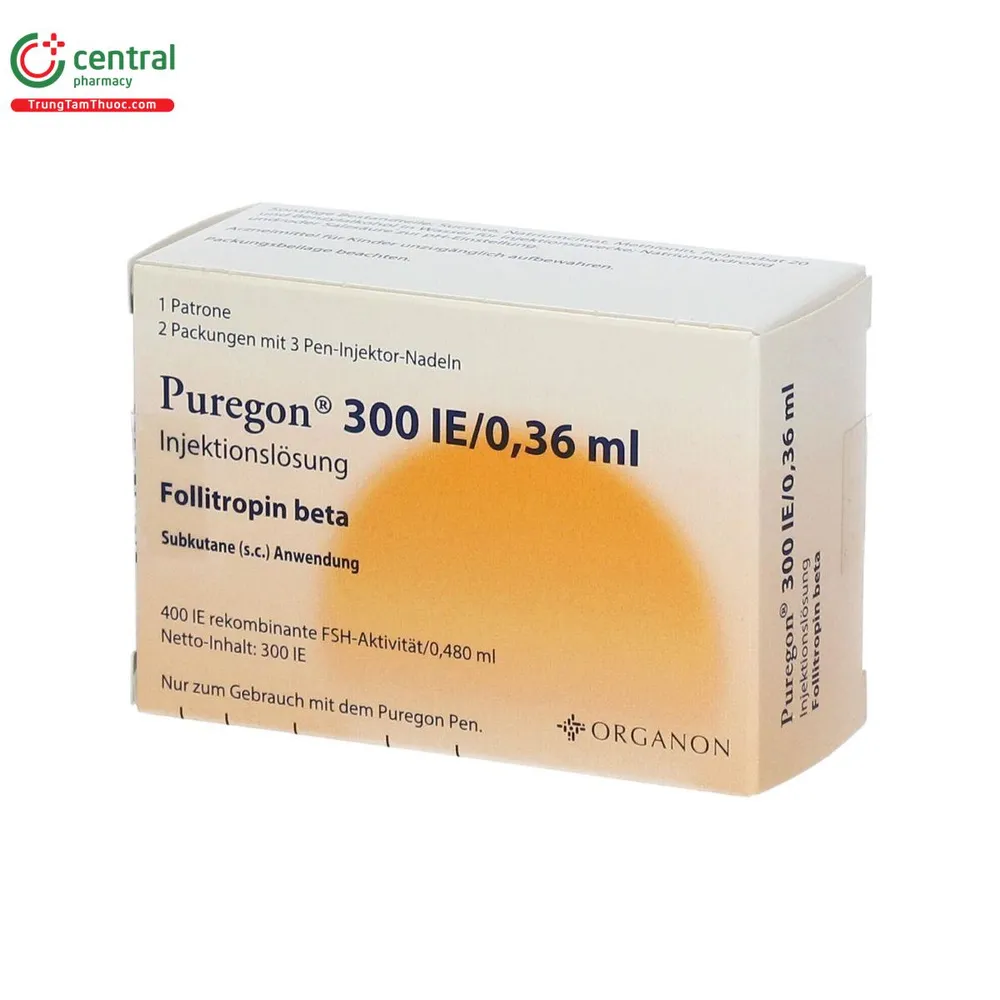
Table of Contents
- Package leaflet: Information for the user
- Puregon 150 IU/0.18 mL solution for injection, 300 IU/0.36 mL solution for injection, 600 IU/0.72 mL solution for injection, 900 IU/1.08 mL solution for injection
- 1. What Puregon is and what it is used for
- 2. What you should know before using Puregon
- 3. How to use Puregon
- 4. Possible side effects
- 5. How to store Puregon
- 6. Package contents and other information
Package leaflet: Information for the user
Puregon 150 IU/0.18 mL solution for injection, 300 IU/0.36 mL solution for injection, 600 IU/0.72 mL solution for injection, 900 IU/1.08 mL solution for injection
follitropin beta
Please read all of this leaflet carefully before you start using this medicine because it contains important information for you.
- Keep this leaflet. You may need to read it again.
- If you have any questions, ask your doctor or pharmacist.
- This medicine has been prescribed for you only. Do not pass it on to other people, even if their symptoms are the same as yours, as it may be harmful.
- If you experience any side effects, including those not listed in this leaflet, tell your doctor or pharmacist. See section 4.
Contents of this leaflet
- What Puregon is and what it is used for
- What you need to know before using Puregon
- How to use Puregon
- Possible side effects
- How to store Puregon
- Contents of the pack and other information
1. What Puregon is and what it is used for
Puregon solution for injection contains follitropin beta, a hormone known as follicle-stimulating hormone (FSH).
FSH belongs to the group of gonadotropins, which play an important role in human fertility and reproduction. In women, FSH is necessary for the growth and maturation of ovarian follicles. Follicles are small, round sacs that contain the egg cells. In men, FSH is required for sperm production.
Puregon is used in the treatment of infertility under any of the following conditions:
Women
In women who do not ovulate and who do not respond to treatment with clomiphene citrate, Puregon may be used to induce ovulation.
In women undergoing assisted reproductive techniques, including in vitro fertilization (IVF) and other procedures, Puregon can induce the development of multiple follicles.
Men
In men whose infertility is due to low hormone levels, Puregon may be used to stimulate sperm production.
2. What you should know before using Puregon
Do not use Puregon
If:
- you are allergic to follitropin beta or any of the other ingredients of Puregon (listed in section 6)
- you have a tumour of the ovary, breast, uterus, testicle, or brain (pituitary gland or hypothalamus)
- you have severe or irregular vaginal bleeding of unknown origin
- your ovaries do not work due to a condition called primary ovarian insufficiency
- you have ovarian cysts or enlarged ovaries not caused by polycystic ovary syndrome (PCOS)
- you have malformations of the reproductive organs that make a normal pregnancy impossible
- you have fibroid tumours of the uterus that make a normal pregnancy impossible
- you are a man and are infertile due to a condition called primary testicular insufficiency.
Warnings and precautions
Talk to your doctor before using Puregon if:
- you have previously had an allergic reaction to certain antibiotics (neomycin and/or streptomycin)
- you have uncontrolled pituitary gland function or hypothalamic disorders
- you have reduced activity of the thyroid gland (hypothyroidism)
- your adrenal glands do not function properly (adrenocortical insufficiency)
- you have high levels of prolactin in your blood (hyperprolactinaemia)
- you have any other medical condition (e.g., diabetes, heart disease, or any other long-term illness).
If you are a woman:
Ovarian hyperstimulation syndrome (OHSS)
Your doctor will regularly monitor the effects of treatment to determine the appropriate daily dose of Puregon. At regular intervals, your doctor may perform an ultrasound examination of your ovaries. Your doctor may also monitor hormone levels in your blood. This is very important because an excessive dose of FSH may cause rare but serious complications in which the ovaries become overstimulated and follicular growth exceeds normal levels. This serious medical condition is called ovarian hyperstimulation syndrome (OHSS). In rare cases, severe OHSS can be life-threatening. OHSS causes a sudden accumulation of fluid in the abdomen and chest cavity and may lead to blood clot formation. Contact your doctor immediately if you experience severe abdominal swelling, pain in the abdominal area, feeling unwell (nausea), vomiting, sudden weight gain due to fluid accumulation, diarrhoea, reduced urine output, or breathing difficulties (see also section 4 on Possible side effects).
→ Regular monitoring of the response to FSH treatment helps prevent ovarian hyperstimulation. Contact your doctor immediately if you experience abdominal pain, even if this occurs several days after the last injection.
Multiple pregnancy or congenital abnormalities
After treatment with gonadotropin-containing preparations, the likelihood of multiple pregnancies is increased, even when only one embryo is transferred to the uterus. Multiple pregnancies increase health risks for both the mother and the babies during the early stages of life. In addition, multiple pregnancies and characteristics of patients undergoing fertility treatment (e.g., maternal age, sperm characteristics, genetic background of both parents) may be associated with an increased risk of congenital abnormalities.
Pregnancy complications
The risk of an ectopic pregnancy (a pregnancy outside the uterus) is slightly increased. Therefore, your doctor must perform an early ultrasound examination to rule out an ectopic pregnancy.
In women undergoing infertility treatment, the risk of miscarriage may be slightly higher.
Blood clots (Thrombosis)
Treatment with Puregon, like pregnancy itself, may increase the risk of developing a blood clot (thrombosis). Thrombosis is the formation of a blood clot in a blood vessel.
Blood clots can lead to serious medical conditions such as:
- blockage in the lungs (pulmonary embolism)
- stroke
- heart attack
- problems with blood vessels (thrombophlebitis)
- reduced blood flow (deep vein thrombosis), which may result in loss of an arm or leg.
Before starting treatment, talk to your doctor, especially:
- if you already know you have an increased risk of thrombosis
- if you or a close family member has ever had a blood clot
- if you are significantly overweight.
Ovarian torsion
Ovarian torsion (twisting of an ovary) has occurred after treatment with gonadotropins, including Puregon. Ovarian torsion may interrupt blood flow to the ovary.
Before starting to use this medicine, inform your doctor if:
- you have ever had ovarian hyperstimulation syndrome (OHSS)
- you are pregnant or suspect you may be pregnant
- you have ever had abdominal surgery
- you have ever had ovarian torsion
- you have had or currently have ovarian cysts in one or both ovaries.
Ovarian tumours and other reproductive system tumours
Cases of ovarian tumours and other reproductive system tumours have been reported in women who have undergone infertility treatment. It is not known whether fertility medication treatment increases the risk of these tumours in infertile women.
Other medical conditions
Also, before starting to use this medicine, inform your doctor if:
- a doctor has told you that pregnancy could be dangerous for you.
If you are a man:
Men with high levels of FSH in the blood
Elevated plasma levels of FSH are a sign of testicular damage. Puregon is generally not effective in these situations. To monitor treatment effects, your doctor may request sperm samples for analysis four to six months after starting therapy.
Children and adolescents
Puregon is not indicated for use in children and adolescents.
Other medicines and Puregon
Tell your doctor or pharmacist if you are taking, have recently taken, or might take any other medicines.
Concomitant use of Puregon and clomiphene citrate may increase the effect of Puregon.
When a GnRH agonist (a medicine used to prevent premature ovulation) is administered, a higher dose of Puregon may be required.
Pregnancy and breastfeeding
Ask your doctor or pharmacist for advice before taking any medicine. You must not use Puregon if you are pregnant or suspect you may be pregnant.
Puregon may affect milk production. It is unlikely that Puregon passes into breast milk. If you are breastfeeding, inform your doctor before using Puregon.
Driving and using machines
It is unlikely that Puregon affects your ability to drive or operate machinery.
Puregon contains benzyl alcohol
This medicine contains 10 mg of benzyl alcohol per mL.
Benzyl alcohol may cause allergic reactions.
Ask your doctor or pharmacist for advice if you have liver or kidney disease. This is because large amounts of benzyl alcohol may accumulate in the body and cause undesirable effects (such as metabolic acidosis).
Ask your doctor or pharmacist for advice if you are pregnant or breastfeeding. This is because large amounts of benzyl alcohol may accumulate in the body and cause undesirable effects (such as metabolic acidosis).
Puregon contains sodium
This medicine contains less than 1 mmol (23 mg) of sodium per injection, i.e., essentially “sodium-free”.
3. How to use Puregon
Use this medicine exactly as instructed by your doctor. If you have any doubts, consult your doctor or pharmacist.
Dosage in women
Your doctor will determine the starting dose. This dose may be adjusted during the course of treatment. Further details on the treatment regimen are provided below.
There are considerable individual differences between women in ovarian response to FSH; therefore, it is impossible to define a single dosing regimen suitable for all patients. To determine the appropriate dose, your doctor will monitor follicular growth by ultrasound examination and by measuring blood levels of estradiol (a female sex hormone).
-
Women who do not ovulate
Your doctor will establish a starting dose. This dose is maintained for at least 7 days. If there is no ovarian response, the daily dose is gradually increased until follicular size and/or plasma estradiol levels indicate an appropriate response. The daily dosage is then maintained until a follicle of appropriate size is detected. Treatment usually lasts 7–14 days. Puregon treatment is then stopped, and ovulation is induced by administering human chorionic gonadotropin (hCG). -
Assisted reproduction programmes, e.g. IVF
Your doctor will establish a starting dose. This dose is maintained for at least the first four days. Thereafter, the dose may be adjusted according to ovarian response. When an appropriate number of follicles of adequate size are present, final maturation is triggered by administering hCG. Egg retrieval is performed 34–35 hours later.
Dosage in men
Puregon is usually prescribed at a dose of 450 IU per week, typically divided into three doses of 150 IU, in combination with administration of another hormone (hCG), for at least 3–4 months. The duration of treatment corresponds to the time required for sperm development and expected improvement. If sperm production has not started after this period, treatment may be continued for up to 18 months.
How the injection should be given
Puregon solution for injection in cartridges is designed for use with the Puregon Pen. Carefully follow the instructions for use of the pen device provided separately. Do not use the cartridge if the solution contains particles or is not clear.
Using the pen device, injections can be self-administered or given by your partner just under the skin (e.g. in the lower part of the abdomen). Your doctor will tell you when and how to give the injection. If you are injecting Puregon yourself, carefully follow the instructions to ensure appropriate administration with minimal discomfort.
The first injection of Puregon must be given under the supervision of a doctor or nurse.
A small amount of medicine may remain in the cartridge after completion of treatment with Puregon, even if all doses have been correctly administered. Do not attempt to use the remaining medicine. After administration of the last dose, the cartridge must be properly disposed of.
If you use more Puregon than you should
Tell your doctor immediately.
An overdose of Puregon may cause ovarian hyperstimulation syndrome (OHSS), which may present as stomach pain. Inform your doctor immediately if you experience abdominal pain. See also section 4 on Possible side effects.
If you forget to use Puregon
If you miss a dose, do not take a double dose to make up for the missed dose.
→ Contact your doctor.
If you have any doubts about the use of this medicine, consult your doctor.
4. Possible side effects
Like all medicines, this medicine can cause side effects, although not everybody gets them.
Contact your doctor immediately if you notice:
Signs of a severe allergic reaction (anaphylactic reaction), such as swelling of the face, lips, throat or tongue causing difficulty swallowing or breathing, shortness of breath, or a feeling of fainting.
Serious side effects in women
A complication of treatment with FSH is ovarian overstimulation. Excessive ovarian stimulation may lead to a medical condition called ovarian hyperstimulation syndrome (OHSS), which can be a serious medical problem. The risk can be reduced by careful monitoring of follicular development during treatment. Your doctor will perform ovarian ultrasounds to closely monitor the number of maturing follicles. Your doctor may also check hormone levels in your blood. Early symptoms include stomach pain, feeling unwell or diarrhoea. In more severe cases, symptoms may include enlarged ovaries, fluid accumulation in the abdomen and/or chest (which may cause a sudden increase in body weight due to fluid retention), and formation of blood clots in the circulation. See Warnings and precautions in section 2.
→ Contact your doctor immediately if you have stomach pain or any of the other symptoms of ovarian hyperstimulation, even if this occurs several days after the last injection.
If you are a woman:
Common side effects (may affect up to 1 in 10 people)
- Headache
- Injection site reactions (such as burning, pain, redness, swelling and itching)
- Ovarian hyperstimulation syndrome (OHSS)
- Pelvic pain
- Stomach pain and/or bloating
Uncommon side effects (may affect up to 1 in 100 people)
- Breast disorders (including tenderness)
- Diarrhoea, constipation or stomach discomfort
- Enlargement of the uterus
- Feeling unwell
- Hypersensitivity reactions (such as rash, redness, urticaria and itching)
- Ovarian cysts or enlarged ovaries
- Ovarian torsion (twisting of the ovaries)
- Vaginal bleeding
Rare side effects (may affect up to 1 in 1,000 people)
- Blood clots (this may occur even in the absence of unintentional overstimulation of the ovaries; see Warnings and precautions in section 2)
Side effects not known (cannot be estimated from available data):
- Allergic reactions:
- swelling of the face, lips, throat or tongue causing difficulty swallowing or breathing, shortness of breath
- pale skin, weak and rapid pulse, or feeling of fainting
Ectopic pregnancy (a pregnancy outside the uterus), miscarriage and multiple pregnancies have also been reported. These side effects are not considered to be related to the use of Puregon, but rather to assisted reproductive technology (ART) or the subsequent pregnancy.
If you are a man:
Common side effects (may affect up to 1 in 10 people)
- Acne
- Injection site reactions (such as hardening and pain)
- Headache
- Skin rash
- Enlargement of the breast gland
- Testicular cyst
Side effects not known (cannot be estimated from available data):
- Allergic reactions:
- swelling of the face, lips, throat or tongue causing difficulty swallowing or breathing, shortness of breath
- pale skin, weak and rapid pulse, or feeling of fainting
Reporting of side effects
If you experience any side effect, including those not listed in this leaflet, talk to your doctor or pharmacist. You can also report side effects directly via the national reporting system referred to in Annex V. By reporting side effects, you can help provide more information on the safety of this medicine.
5. How to store Puregon
Keep this medicine out of sight and reach of children.
Storage at the pharmacist's premises
Store at 2°C – 8°C (in the refrigerator). Do not freeze.
Storage at the patient's premises
You have two options:
- Store at 2°C – 8°C (in the refrigerator). Do not freeze.
- Store at a temperature not exceeding 25°C (room temperature) for a single period of up to 3 months only. Record the date when you start storing the product outside the refrigerator. Keep the cartridge in the outer packaging.
Once the rubber stopper of a cartridge has been pierced with a needle, the product may be stored for
a maximum of 28 days.
Please record on the registration card the date when you start using the cartridge, as described in
the Puregon Pen instruction manual.
Do not use Puregon after the expiry date stated on the label and carton after “EXP”. The expiry date refers to the last day of that month.
Dispose of used needles immediately after injection.
Do not mix any other medicine in the cartridges.
Empty cartridges must not be refilled.
Do not dispose of any medicine via wastewater or household waste. Ask your pharmacist how to dispose of medicines no longer required. This will help protect the environment.
6. Package contents and other information
What Puregon contains
- Each cartridge contains the active substance beta follitropin, a hormone known as follicle-stimulating hormone (FSH), in a dosage of 833 IU/mL aqueous solution.
- The other components are sucrose, sodium citrate, L-methionine, polysorbate 20, and benzyl alcohol in water for injections. The pH may have been adjusted with sodium hydroxide and/or hydrochloric acid.
Description of the appearance of Puregon and contents of the pack
Puregon injectable solution (injection preparation) is a clear, colourless liquid. It is supplied in a glass cartridge. It is available in packs of 1 cartridge.
Marketing Authorisation Holder and Manufacturer
N.V. Organon
Kloosterstraat 6
5349 AB Oss
The Netherlands
For further information about this medicinal product, please contact the local representative of the Marketing Authorisation Holder:
België/Belgique/Belgien Lietuva
Organon Belgium Organon Pharma B.V. Lithuania atstovybė
Tél/Tel: 0080066550123 (+32 2 2418100) Tel.: +370 52041693
[email protected] [email protected]
България Luxembourg/Luxemburg
Органон (И.А.) Б.В. - клон България Organon Belgium
Тел.: +359 2 806 3030 Tél/Tel: 0080066550123 (+32 2 2418100)
[email protected] [email protected]
Česká republika Magyarország
Organon Czech Republic s.r.o. Organon Hungary Kft.
Tel: +420 233 010 300 Tel.: +36 1 766 1963
[email protected] [email protected]
Danmark Malta
Organon Denmark ApS Organon Pharma B.V., Cyprus branch
Tlf: +45 4484 6800 Tel: +356 2277 8116
[email protected] [email protected]
Deutschland Nederland
Organon Healthcare GmbH N.V. Organon
Tel.: 0800 3384 726 (+49 (0) 89 2040022 10) Tel: 00800 66550123
[email protected] (+32 2 2418100)
[email protected]
Eesti Norge
Organon Pharma B.V. Estonian RO Organon Norway AS
Tel: +372 66 61 300 Tlf: +47 24 14 56 60
[email protected] [email protected]
Ελλάδα Österreich
BIANEΞ Α.Ε. Organon Healthcare GmbH
Τηλ: +30 210 80091 11 Tel: +49 (0) 89 2040022 10
[email protected] [email protected]
España Polska
Organon Salud, S.L. Organon Polska Sp. z o.o.
Tel: +34 91 591 12 79 Tel.: +48 22 105 50 01
[email protected] [email protected]
France Portugal
Organon France Organon Portugal, Sociedade Unipessoal Lda.
Tél: +33 (0) 1 57 77 32 00 Tel: +351 218705500
[email protected]
Hrvatska România
Organon Pharma d.o.o. Organon Biosciences S.R.L.
Tel: +385 1 638 4530 Tel: +40 21 527 29 90
[email protected] [email protected]
Ireland Slovenija
Organon Pharma (Ireland) Limited Organon Pharma B.V., Oss, podružnica Ljubljana
Tel: +353 15828260 Tel: +386 1 300 10 80
[email protected] [email protected]
Ísland Slovenská republika
Vistor hf. Organon Slovakia s. r. o.
Sími: +354 535 7000 Tel: +421 2 44 88 98 88
[email protected]
Italia Suomi/Finland
Organon Italia S.r.l. Organon Finland Oy
Tel: +39 06 90259059 Puh/Tel: +358 (0) 29 170 3520
[email protected] [email protected]
Κύπρος Sverige
Organon Pharma B.V., Cyprus branch Organon Sweden AB
Τηλ: +357 22866730 Tel: +46 8 502 597 00
[email protected] [email protected]
Latvija United Kingdom (Northern Ireland)
Ārvalsts komersanta “Organon Pharma B.V.” Organon Pharma (UK) Limited
pārstāvniecība Tel: +44 (0) 208 159 3593
Tel: +371 66968876 [email protected]
[email protected]
Other sources of information
More detailed information about this medicinal product is available on the website of the European Medicines Agency: https://www.ema.europa.eu.
ANNEX IV
SCIENTIFIC CONCLUSIONS AND REASONS FOR THE VARIATION OF THE TERMS
OF THE MARKETING AUTHORISATION
Scientific conclusions
Taking into account the assessment by the Pharmacovigilance Risk Assessment Committee (PRAC) of the Periodic Safety Update Report(s) (PSUR) for beta follitropin, the PRAC's scientific conclusions are as follows:
In view of the available data on anaphylactic reactions from spontaneous reports, including cases with a close temporal association, the PRAC considers that a causal relationship between beta follitropin and anaphylactic reaction is at least a reasonable possibility. The PRAC concluded that the product information for medicinal products containing beta follitropin should therefore be amended accordingly.
Having reviewed the PRAC's recommendation, the Committee for Human Medicinal Products (CHMP) agrees with the overall conclusions and the reasoning of the recommendation.
Reasons for the variation of the terms of the marketing authorisation
Based on the scientific conclusions regarding beta follitropin, the CHMP considers that the benefit-risk balance of the medicinal product(s) containing beta follitropin remains unchanged, subject to the proposed amendments to the product information.
The CHMP recommends a variation to the terms of the marketing authorisation.