Pulmozyme
Italy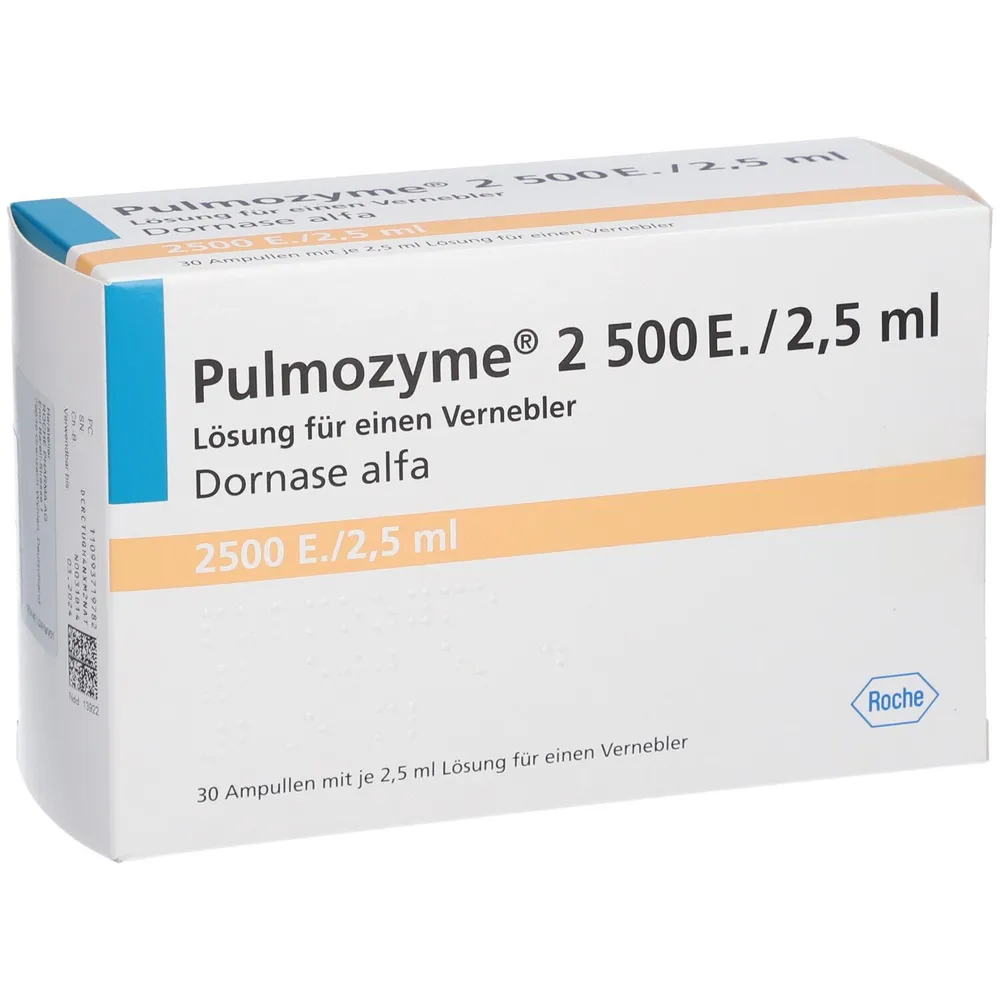
Table of Contents
PACKAGE LEAFLET: INFORMATION FOR THE USER
Pulmozyme 2500 U/2.5 ml
Solution for nebuliser
Dornase alfa
Please read this leaflet carefully before using this medicine because it contains important information for you.
Always take this medicine exactly as described in this leaflet or as your doctor or pharmacist has instructed.
- Keep this leaflet. You may need to read it again.
- If you have any questions, consult your doctor or pharmacist.
- This medicine has been prescribed for you personally. Do not give it to others, even if their symptoms are the same as yours, as it could be harmful.
- If any of the side effects worsens, or if you notice any side effects not listed in this leaflet, inform your doctor or pharmacist. See section 4.
Contents of this leaflet:
- What Pulmozyme is and what it is used for
- What you need to know before using Pulmozyme
- How to use Pulmozyme
- Possible side effects
- How to store Pulmozyme
- Contents of the pack and other information
1. WHAT PULMOZYME IS AND WHAT IT IS USED FOR
Pulmozyme contains a substance called dornase alfa, the human-made version of a protein naturally present in the human body known as 'DNase'.
Pulmozyme is used to treat people with cystic fibrosis. By helping to break down the thick mucus present in the airways, Pulmozyme helps the lungs of people with cystic fibrosis to function better.
Pulmozyme must be inhaled using a device called a 'nebulizer' (see section 3: How to use Pulmozyme). During treatment with Pulmozyme, you should continue taking your other prescribed medications for cystic fibrosis as usual (see 'Other medicines and Pulmozyme' in section 2).
2. WHAT YOU SHOULD KNOW BEFORE USING PULMOZYME
Do not use Pulmozyme
- if you are allergic (hypersensitive) to dornase alfa or to any of the excipients of Pulmozyme (listed in section 6).
Warnings and precautions
Consult your doctor or pharmacist before using Pulmozyme.
Children
The use of Pulmozyme is not recommended in children under 5 years of age. Consult your doctor or
pharmacist before using Pulmozyme if the medicine has been prescribed for a child under 5
years of age.
Other medicines and Pulmozyme
Inform your doctor or pharmacist if you are taking or have recently taken any other
medicines, including those without a prescription and herbal preparations. This is because
Pulmozyme may affect the action mechanism of certain medicines, and some medicines may
affect the action mechanism of Pulmozyme.
During treatment with Pulmozyme, you may continue the therapies you usually take for
cystic fibrosis (including antibiotics, pancreatic enzymes, bronchodilators, and analgesics). If you have any doubts,
consult your doctor or pharmacist before using Pulmozyme.
Pregnancy and breastfeeding
Do not use Pulmozyme if you are pregnant, planning a pregnancy, or breastfeeding, unless
your doctor has instructed you to do so.
Driving and using machines
It is unlikely that Pulmozyme will affect your ability to drive or use tools or
machinery.
3. HOW TO USE PULMOZYME
Always use Pulmozyme exactly as directed by your doctor. Pulmozyme must be
inhaled using a nebulizer (see 'Which nebulizer to use'). If you have any doubts,
consult your doctor.
During treatment with Pulmozyme, continue to undergo the standard respiratory physiotherapy
prescribed for you.
Children aged 5 years and older
- Pulmozyme should be used every day.
- The recommended dose is one vial per day, inhaled using an appropriate nebulizer.
- If you are over 21 years old, your doctor may prescribe the use of one vial twice daily.
Children under 5 years of age
- Pulmozyme is not recommended for children under 5 years of age.
Which nebulizer to use:
Use a nebulizer such as:
- Hudson T Up-draft II/Pulmo-Aide, Airlife Misty/Pulmo-Aide, Respirgard adapted/Pulmo-Aide or AcornII/Pulmo-Aide.
- Pulmozyme can also be used with a reusable nebulizer system, such as Pari LL/Inhalierboy, Pari LC/Inhalierboy or Master, Aiolos/2Aiolos, Side Stream/CR50 or MobilAire or Porta-Neb.
- The Pari eFlow Rapid nebulizer, an electronic nebulizer using vibrating membrane technology, may be used. The Pari eFlow Rapid nebulizer must be cleaned according to the manufacturer's instructions. Additionally, use of the Pari EasyCare cleaning device is recommended after every seven uses.
- Ultrasonic nebulizers must not be used, as this type of device may prevent Pulmozyme from working properly.
Read and carefully follow the manufacturer's instructions for the use of each nebulizer.
Consult your doctor to find out which nebulizers can be used with Pulmozyme.
How to use Pulmozyme with the nebulizer
Each time you prepare the nebulizer for use with Pulmozyme, remember these important points:
- Do not mix Pulmozyme with other liquids or medicines in the nebulizer.
- Never use any leftover Pulmozyme; it must always be discarded.
- If you use a "reusable" nebulizer, remember to clean it after use. The nebulizer manufacturer will provide all necessary instructions for cleaning the device components after Pulmozyme use.
- If someone else accidentally uses Pulmozyme, inform your doctor immediately.
To use the nebulizer
- Make sure the nebulizer is clean.
- Snap off the neck of a Pulmozyme vial.
- Pour the contents into the nebulizer chamber.
- Follow the nebulizer's instructions for use and inhale Pulmozyme immediately.
If you use more Pulmozyme than you should
If you use more Pulmozyme than prescribed, inform your doctor immediately.
If you forget to use Pulmozyme
- If you miss a dose, take the missed dose as soon as you remember.
- If it is almost time for your next scheduled dose, skip the missed dose.
- Do not use a double dose to make up for a forgotten dose.
If you stop using Pulmozyme
If you stop treatment with Pulmozyme, your respiratory symptoms may worsen. Inform your
doctor if you intend to stop using Pulmozyme.
If you have any questions about how to use Pulmozyme, consult your doctor or pharmacist.
4. POSSIBLE ADVERSE REACTIONS
Like all medicines, Pulmozyme can cause adverse reactions, although not everyone experiences them.
Adverse reactions associated with Pulmozyme treatment are rare and occur in fewer than 1 in 1000 people.
Adverse reactions include:
- Chest pain.
- Fever.
- Stomach discomfort (indigestion).
- Voice changes, including hoarseness or loss of voice.
- Sore throat.
- Breathing difficulties.
- Runny or stuffy nose and sneezing (rhinitis).
- Eye irritation (conjunctivitis). Signs include eye redness, itching, and increased eye secretions.
- Skin rash, which may present as hives and itching (urticaria).
- At the beginning of treatment, lung function may decrease and mucus production may increase beyond normal. However, these symptoms usually improve over time.
If any of the adverse reactions worsen, or if you notice any adverse reaction not listed in this leaflet, inform your doctor or pharmacist.
Reporting of adverse reactions
If you experience any adverse reaction, including those not listed in this leaflet, consult your doctor or pharmacist. You may also report adverse reactions directly via the national reporting system at http://www.aifa.gov.it/content/come-segnalare-una-sospetta-reazione-avversa . By reporting adverse reactions, you can help provide further information on the safety of this medicine.
5. HOW TO STORE PULMOZYME
- Pulmozyme vials must be stored in the refrigerator (2°C - 8°C) in the original packaging to protect them from light.
- If a vial is kept outside the refrigerator for a short period at temperatures higher than those indicated (only on one occasion and for no longer than 24 hours at temperatures up to 30°C), it may still be used.
- Keep this medicine out of the sight and reach of children.
- Do not use Pulmozyme after the expiry date (Exp.) stated on the carton. The expiry date refers to the last day of the month.
- Do not dispose of any unused vials via wastewater or household waste. Instead, return them to the pharmacist for proper disposal. This will help protect the environment. Only keep unused vials if your doctor instructs you to do so.
6. Package contents and other information
What Pulmozyme contains
- The active substance in Pulmozyme 2500 U/2.5 ml solution for nebuliser is dornase alfa, also known as recombinant human deoxyribonuclease 1 or rhDNase. Each 2.5 ml (millilitres) of liquid medicine contains 2500 units (or 2.5 milligrams) of dornase alfa.
- The excipients are sodium chloride, calcium chloride dihydrate, and water for injections.
Description of the appearance of Pulmozyme and package contents
Pulmozyme solution for nebuliser is supplied in clear plastic vials. The vials contain 2.5 ml of liquid medicine. The medicine is a clear, colourless to slightly yellowish solution.
Pulmozyme is available in packs of 6 vials.
Marketing Authorisation Holder
Roche S.p.A.
Viale G.B. Stucchi 110,
20900 Monza (MB), Italy
Responsible producer for batch release
Roche Pharma AG,
Emil-Barel Str. 1 D
79639 Grenzach-Wyhlen (Germany)
This patient information leaflet was last approved on