Prontogest
Italy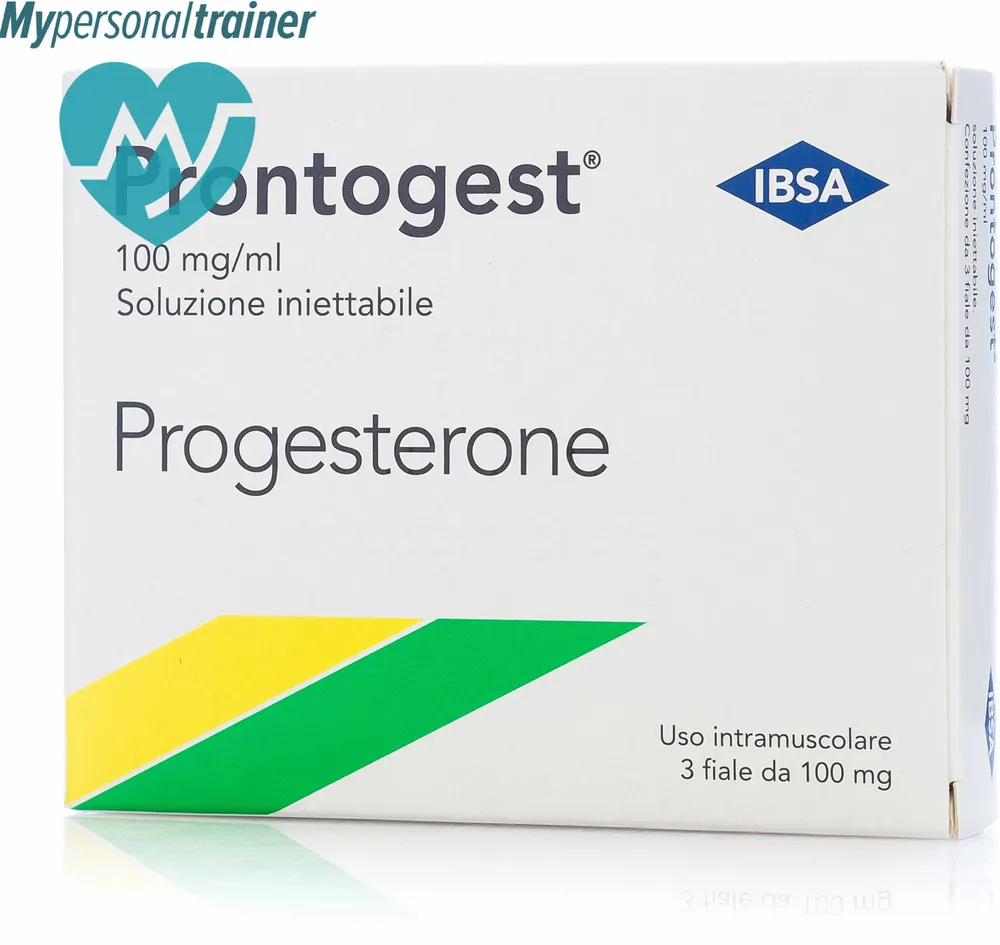
Table of Contents
- Patient Information Leaflet
- PRONTOGEST 50 mg/ml injectable solution, 100 mg/ml injectable solution
- 1. What PRONTOGEST is and what it is used for
- 2. What you need to know before taking PRONTOGEST
- 3. How to take PRONTOGEST
- 4. Possible side effects
- 5. How to store PRONTOGEST
- 6. Package contents and other information
Patient Information Leaflet
PRONTOGEST 50 mg/ml injectable solution, 100 mg/ml injectable solution
Progesterone
Please read this leaflet carefully before using this medicine as it contains important information for you.
- Keep this leaflet. You may need to read it again.
- If you have any questions, ask your doctor or pharmacist.
- This medicine has been prescribed for you only. Do not give it to other people, even if their symptoms are the same as yours, as it may be harmful.
- If you experience any side effect, including those not listed in this leaflet, contact your doctor or pharmacist. See section 4.
Contents of this leaflet:
- What PRONTOGEST is and what it is used for
- What you need to know before using PRONTOGEST
- How to use PRONTOGEST
- Possible side effects
- How to store PRONTOGEST
- Contents of the pack and other information
1. What PRONTOGEST is and what it is used for
PRONTOGEST contains an active substance called progesterone. Progesterone is a natural female sex hormone. This medicine acts on the lining of the uterus, supporting its normal functions; it also helps the onset and maintenance of pregnancy.
PRONTOGEST is used in women:
- with the following menstrual cycle disorders: excessive menstrual bleeding (hypermenorrhea), reduced menstrual bleeding (hypomenorrhea), frequent menstrual cycles (polymenorrhea), infrequent menstrual cycles (oligomenorrhea), absence of menstruation (amenorrhea);
- with vaginal bleeding (metrorrhagia);
- with threatened miscarriage or history of recurrent miscarriages;
- with threatened preterm labour;
- to prevent postpartum depression;
- who require progesterone supplementation because their body does not produce enough (in cases of hypofertility or primary or secondary ovarian insufficiency);
- who are pregnant and require surgical intervention;
- who suffer from premenstrual syndrome, a condition characterized by breast tenderness, headache, abdominal or leg swelling, and mood instability.
2. What you need to know before taking PRONTOGEST
Do not take PRONTOGEST if:
- you are allergic to progesterone or to any of the other ingredients of this medicine (listed in section 6);
- you have vaginal bleeding (not due to menstruation) that has not been evaluated by your doctor;
- you have had a miscarriage and your doctor suspects that some tissue remains inside the uterus (retained or incomplete miscarriage);
- you have or have had blood clots in blood vessels (thrombi or emboli), for example in the legs (thrombophlebitis), lungs, eyes, or any other part of the body;
- you have had a rupture of a blood vessel in the brain (cerebral hemorrhage);
- you have severe liver problems.
Warnings and precautions
Exercise special caution with PRONTOGEST
If, during treatment with PRONTOGEST, you experience any of the following conditions—even several days after taking the dose—contact your doctor immediately, as it may be necessary to discontinue treatment or change your therapy:
- blood clots in the lungs. This condition presents with difficulty breathing, chest pain, and cough;
- blood clots in the brain leading to stroke. This condition presents with severe headache or vomiting, dizziness, fainting, or changes in vision or speech, weakness or numbness in one arm or leg;
- blood clots in the limbs (peripheral vessels), especially in the legs. This condition presents with pain, swelling, redness, and increased temperature in the affected area;
- blood clots in the eyes. This condition presents with visual disturbances such as total or partial loss of vision, double vision, or decreased vision;
- changes in hormone levels or liver function tests.
If you are scheduled for a histological examination of the uterus, remember to inform your doctor that you are undergoing treatment with PRONTOGEST.
Before starting treatment with PRONTOGEST
Consult your doctor before taking PRONTOGEST if you have or have had:
- epilepsy;
- headaches (migraine);
- asthma;
- heart or kidney problems;
- diabetes;
- depression. In such cases, your doctor will closely monitor your clinical condition during treatment.
Also consult your doctor before taking PRONTOGEST if you are currently in pre-menopause.
Other medicines and PRONTOGEST
Inform your doctor or pharmacist if you are taking, have recently taken, or might take any other medicines, including those not requiring a prescription.
Pregnancy, breastfeeding and fertility
If you are pregnant, suspect you may be pregnant, or are planning to become pregnant, consult your doctor before taking any medicine.
- PRONTOGEST may be used during pregnancy under the conditions listed in section 1.
- PRONTOGEST should not be used if you are breastfeeding.
Driving and using machines
PRONTOGEST may cause dizziness or drowsiness. Do not drive or operate machinery if you experience either of these side effects.
PRONTOGEST contains benzyl alcohol
This medicine contains 200 mg of benzyl alcohol per 1 ml vial, equivalent to 200 mg/ml.
Benzyl alcohol may cause allergic reactions.
Ask your doctor or pharmacist for advice if you are pregnant or breastfeeding. This is because large amounts of benzyl alcohol may accumulate in the body and cause adverse effects (such as metabolic acidosis).
Ask your doctor or pharmacist for advice if you have liver or kidney disease. This is because large amounts of benzyl alcohol may accumulate in the body and cause adverse effects (such as metabolic acidosis).
3. How to take PRONTOGEST
Take this medicine exactly as directed by your doctor, who will determine the correct dose and duration of treatment according to your condition. If you have any doubts, consult your doctor or pharmacist.
Dose and duration of treatment with PRONTOGEST
The dose to be taken depends on the reason for which you are taking PRONTOGEST:
- threatened miscarriage: the usual dose is 100–200 mg daily for at least 7 days, administered during the first three months of pregnancy. Subsequently, 50 mg on alternate days for a further 20 days. From the fourth to the sixth month, the usual dose is 100–200 mg daily for at least 7 days, followed by 100 mg on alternate days for a further 20 days;
- history of recurrent miscarriages: the usual dose is 50–100 mg two or three times weekly, administered from the very early stages of pregnancy;
- hypermenorrhea - polymenorrhea - metrorrhagia: the dose should be higher than 50 mg daily, administered a few days before the onset of menstruation. Your doctor may consider the possibility of performing a curettage before starting PRONTOGEST therapy;
- amenorrhea - hypomenorrhea - oligomenorrhea: the usual dose is 25 mg daily for 5 days per month. Your doctor may consider combining another medicine (for example, estrogens) with PRONTOGEST therapy;
- during surgical intervention performed in pregnancy: the usual dose is 100–200 mg daily;
- premenstrual syndrome: the usual dose is 50 mg daily, administered starting from the 14th day until the onset of menstrual flow, or 100 mg daily administered 2–4 days before menstruation;
- prevention of postpartum depression: the usual dose is 200 mg daily for 7 days, administered immediately after delivery. Subsequently, 100 mg daily until the onset of the first menstruation. After the first menstruation, the usual dose is 50–100 mg daily, administered from the 14th day of the menstrual cycle until the onset of menstrual flow. Treatment will continue until complete disappearance of symptoms, gradually reducing the dose;
- progesterone supplementation: the usual dose is 50–100 mg daily. In case of confirmed pregnancy, treatment must be continued until the 8th–12th week of gestation.
Method of administration
Administer PRONTOGEST by intramuscular injection (into a muscle), following the instructions for use reported at the end of this leaflet.
If you take more PRONTOGEST than you should
Contact your doctor.
If you forget to take PRONTOGEST
Take the missed dose as soon as you remember, then continue your treatment regularly. Do not use a double dose to make up for the forgotten dose. However, inform your doctor about the missed dose.
If you stop treatment with PRONTOGEST
Do not stop treatment with PRONTOGEST without first consulting your doctor or pharmacist.
If you have any doubts about the use of this medicine, consult your doctor or pharmacist.
4. Possible side effects
Like all medicines, this medicine can cause side effects, although not everybody gets them.
The following side effects have been reported during treatment with medicines containing progesterone, such as PRONTOGEST:
- blood clots in the eyes, limbs, lungs, or brain leading to stroke ( see section 2 - “Take special care with PRONTOGEST” );
- changes in liver function tests (alkaline phosphatase, transaminases) ( see section 2 - “Take special care with PRONTOGEST” );
- increased blood pressure or changes in blood clotting parameters;
- premenstrual syndrome, characterized by breast tenderness, headache, abdominal or leg swelling, and mood swings. These symptoms occur before each menstrual period;
- changes in sexual desire;
- bleeding between periods;
- changes or absence of menstrual flow, alterations in uterine secretions, breast pain (mastodynia);
- weight gain or weight loss;
- headache, dizziness, difficulty sleeping (insomnia), drowsiness, nervousness, depression;
- skin reactions such as brownish patches on the skin resembling suntan marks (chloasma), hives with or without itching;
- abnormal hair growth (hirsutism), patchy hair loss (alopecia);
- yellowing of the eyes and skin, signs of cholestatic jaundice.
Reporting of side effects
If you experience any side effects, including those not listed in this leaflet, talk to your doctor or pharmacist. You can also report side effects directly via the national reporting system at the website
“https://www.aifa.gov.it/content/segnalazioni-reazioni-avverse”.
By reporting side effects, you can help provide more information on the safety of this medicine.
5. How to store PRONTOGEST
Keep this medicine out of the sight and reach of children.
Do not store PRONTOGEST at temperatures above 25 °C.
Do not use this medicine after the expiry date stated on the packaging. The expiry date refers to the last day of that month.
Do not dispose of medicines via wastewater or household waste. Ask your pharmacist how to dispose of medicines you no longer use. This will help protect the environment.
6. Package contents and other information
What PRONTOGEST contains
The active substance is: progesterone.
Each vial of PRONTOGEST 50 mg/ml injectable solution contains 50 mg of progesterone.
Each vial of PRONTOGEST 100 mg/ml injectable solution contains 100 mg of progesterone.
The other components are: benzyl alcohol, ethyl oleate.
Description of the appearance of PRONTOGEST and contents of the pack
PRONTOGEST 50 mg/ml injectable solution is available in packs of 3 vials of 1 ml.
PRONTOGEST 100 mg/ml injectable solution is available in packs of 3 or 7 vials of 1 ml.
Marketing Authorization Holder
IBSA Farmaceutici Italia S.r.l., Via Martiri di Cefalonia, 2, 26900 Lodi.
Manufacturer
Biologici Italia Laboratories S.r.l., Via Filippo Serpero, 2, 20060 Masate (Milan)
IBSA Farmaceutici Italia S.r.l., Via Martiri di Cefalonia, 2, 26900 Lodi
INSTRUCTIONS FOR USE OF PRONTOGEST
To use PRONTOGEST, follow the steps below:
A Preparation of the injection
B Check of administration materials
C Preparation of the vial
D Filling the syringe
E Removal of air bubbles
F Intramuscular injection
G Disposal of used components
Below is a detailed description of each step.
A. Preparation of the injection
It is important to ensure maximum cleanliness. Begin by thoroughly washing your hands and drying them with a clean towel. Choose a clean area where you can prepare the injection, having available:
- one vial of PRONTOGEST.
You must also have the following components available, which are not supplied with the medicine:
- a syringe with needle
- an alcohol-impregnated swab
- a sharps disposal container (for the safe disposal of needles, vials, etc.)
B. Check of administration materials
- The syringe and needle are provided with a protective cap.
- Check that the cap is securely in place. If it is not, or if it is damaged, do not use the syringe and needle.
- Ensure that the expiry date printed on the PRONTOGEST vial has not passed. Do not use the medicine if it has expired.
C. Preparation of the vial
- On the neck of the vial, there is a colored line.
- Gently tap the top of the vial to dislodge any liquid residue that may be present at the tip.
- Press firmly on the apex of the vial to break it at the colored line.
D. Filling the syringe
- Ensure that the plunger is at the bottom of the syringe.
- Insert the needle into the vial and gently tilt the vial together with the syringe.
- Ensure that the tip of the needle is below the liquid level and gently pull back the syringe plunger to draw all the solution from the vial into the syringe.
E. Removal of air bubbles
- Hold the syringe vertically with the needle pointing upwards. Slightly pull back the plunger and tap the syringe gently to allow any air bubbles to rise to the top.
- Slowly press the plunger until all air is expelled from the syringe and a drop of solution appears at the tip of the needle.
F. Intramuscular injection
- Take the alcohol-impregnated swab and thoroughly clean the area of skin where the injection will be administered, then allow it to dry.
- Hold the syringe in one hand.
- With a quick, vertical motion, insert the needle into the muscle.
- Do not inject directly into a vein.
- Inject the solution by applying gentle, steady pressure on the plunger until the entire prescribed amount of solution has been administered.
- Remove the needle while keeping it in a vertical position.
- Clean the injection site with the alcohol swab using a circular motion.
G. Disposal of used components
After completing the injection, place the used needle, empty vial, and syringe into the sharps disposal container. Any unused solution must be discarded.