Prolizip
Italy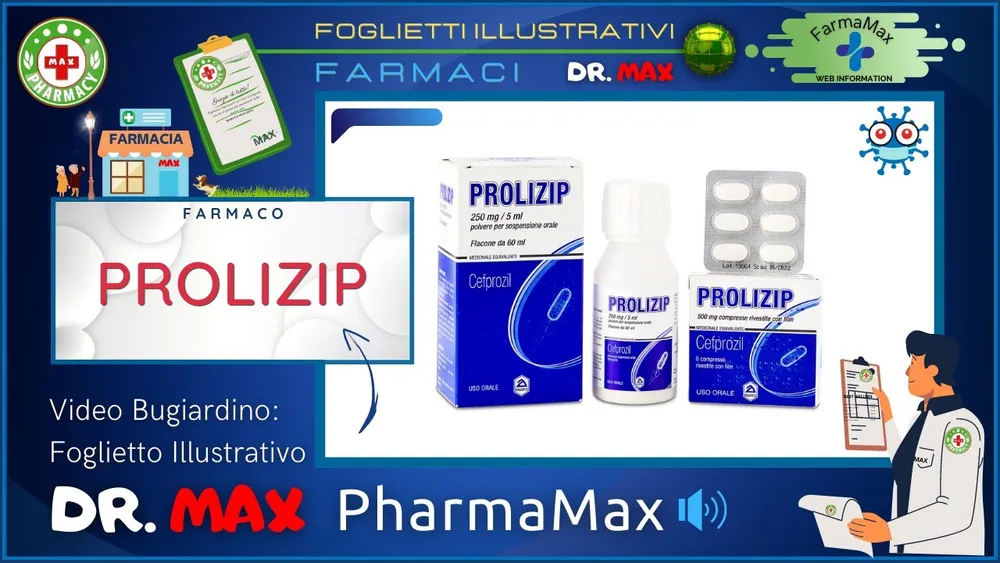
Table of Contents
PACKAGE LEAFLET
PROLIZIP 500 mg film-coated tablets, 250 mg/5 ml powder for oral suspension
Cefprozil
Generic medicine
THERAPEUTIC PHARMACOLOGICAL CATEGORY
Systemic antibacterial belonging to the cephalosporin class.
THERAPEUTIC INDICATIONS
PROLIZIP is indicated for the treatment of the following infections caused by susceptible bacteria:
- Upper respiratory tract infections including pharyngitis, tonsillitis, sinusitis and otitis media;
- Lower respiratory tract infections including bronchitis and pneumonia;
- Skin and soft tissue infections;
- Uncomplicated urinary tract infections, including acute cystitis.
Culture and sensitivity tests should be performed to assess the susceptibility of the infecting organism to PROLIZIP.
CONTRAINDICATIONS
PROLIZIP is contraindicated in patients with hypersensitivity to the active substance or to any of the excipients. The medicinal product is also contraindicated in patients with hypersensitivity to cephalosporins or to substances closely related chemically.
Due to the presence of aspartame, the oral suspension is contraindicated in patients with phenylketonuria.
PRECAUTIONS FOR USE
Renal function should be assessed before and during therapy, especially in seriously ill patients. Patients with known or suspected renal impairment (see: Dosage, method and duration of administration) must be carefully monitored clinically and by laboratory tests before and during treatment. The total daily dose of PROLIZIP should be reduced in patients with severe renal dysfunction (creatinine clearance ≤ 30 ml/min) due to higher and/or prolonged plasma antibiotic concentrations.
Cephalosporins, including PROLIZIP, should be administered with caution to patients receiving concomitant treatment with potent diuretics, as they may potentially worsen renal function.
Prolonged use of PROLIZIP may lead to the development of resistant bacterial strains. Careful patient monitoring is essential. If superinfection occurs during therapy, appropriate measures must be taken. PROLIZIP should be prescribed with caution in patients with a history of gastrointestinal disorders, particularly colitis.
INTERACTIONS
Inform your doctor or pharmacist if you have recently taken any other medicines, including those without a prescription.
Cephalosporin antibiotics may cause a falsely positive urinary glucose test with copper-based tests (Benedict's or Fehling's solutions or Clinitest tablets), but not with enzymatic tests (glucose oxidase) for glycosuria. A falsely negative result may occur in the ferricyanide test for blood glucose. The presence of cefprozil in blood does not interfere with the determination of plasma or urinary creatinine by the alkaline picrate method.
Positive direct Coombs test results have been reported during treatment with cephalosporins. Concomitant use of cephalosporins and aminoglycosides has resulted in nephrotoxicity.
SPECIAL WARNINGS
Before initiating therapy with PROLIZIP, it is essential to carefully evaluate whether the patient has previously shown hypersensitivity to cephalosporins, penicillins or other drugs.
Caution should be exercised when administering the drug to patients sensitive to penicillins, as cross-sensitivity between beta-lactam antibiotics has been clearly demonstrated and may occur in up to 10% of patients with a history of penicillin allergy. In case of an allergic reaction to PROLIZIP, therapy must be discontinued. Severe acute hypersensitivity reactions may require emergency measures.
Antibacterial treatment alters the normal bacterial flora of the colon and may allow excessive growth of clostridia. Clinical studies indicate that a toxin produced by Clostridium difficile is the main cause of "antibiotic-associated colitis". Pseudomembranous colitis, ranging from mild to very severe, has been observed with almost all antibiotics.
In case of colitis diagnosis, appropriate treatment measures must be adopted.
Pregnancy and breastfeeding
Consult your doctor or pharmacist before taking any medicine.
Reproduction studies in mice, rats and rabbits with doses exceeding 0.8 times, 8.5 times, and 18.5 times, respectively, the maximum daily human dose (1000 mg), normalized to body surface area (mg/m²), did not show evidence that PROLIZIP is harmful to the fetus. However, since specific and controlled studies in pregnant women have not been conducted and animal reproduction studies are not always predictive of human response, PROLIZIP should be used during pregnancy only if clearly needed.
Less than 0.3% of the administered dose is excreted in human milk. Caution is recommended when administering PROLIZIP to nursing mothers.
Effects on ability to drive and use machines
No studies have been conducted on the ability to drive vehicles or use machinery.
However, due to the possibility of headache, dizziness and somnolence, caution should be exercised when driving vehicles or operating machinery.
Important information on some excipients of PROLIZIP
The oral suspension contains sucrose. If your doctor has diagnosed you with an intolerance to certain sugars, contact him before taking this medicine.
The oral suspension contains aspartame, a source of phenylalanine. Do not administer to patients with phenylketonuria.
The oral suspension contains the colouring agent FD&C Yellow No. 6 (E110) which may cause allergic reactions.
DOSAGE, METHOD AND DURATION OF ADMINISTRATION
PROLIZIP may be administered regardless of food intake, as food does not affect its absorption.
Adults and children over 12 years
PROLIZIP is administered orally for the treatment of infections caused by susceptible bacteria at the following doses:
- Upper respiratory tract infections: 500 mg every 24 hours
- Sinusitis: 250 mg every 12 hours
- Lower respiratory tract infections: 500 mg every 12 hours
- Uncomplicated urinary tract infections: 500 mg every 24 hours
- Skin and soft tissue infections:
- mild/moderate: 500 mg every 24 hours in one or two doses
- severe: 500 mg every 12 hours
Children aged between 6 months and 12 years
- Upper respiratory tract infections:
- pharyngitis and tonsillitis: 20 mg/kg every 24 hours or 7.5 mg/kg every 12 hours
- otitis media: 15 mg/kg every 12 hours
The maximum daily dose for children should not exceed the maximum daily dose recommended for adults.
For the treatment of infections caused by beta-haemolytic streptococcus, it is recommended to administer PROLIZIP at therapeutic doses for at least 10 days.
Children under 6 months of age
The efficacy and safety of PROLIZIP have not been established in children under 6 months of age. Accumulation of other cephalosporins has been reported in neonates (due to prolonged half-life of these drugs in this age group).
It is important that the patient strictly follows the medical prescription (dosage and duration of treatment).
The dosing syringe supplied with the package allows accurate measurement of the amount of drug to be administered to the patient, according to the dosage prescribed by the physician.
Reduced renal function
PROLIZIP may be administered to patients with impaired renal function. No dosage adjustments are necessary in patients with creatinine clearance values above 30 ml/min. For patients with creatinine clearance values less than or equal to 30 ml/min, the recommended dose is half the normal dose administered at the usual intervals.
PROLIZIP is partially removed by hemodialysis; therefore, it should be administered at the end of hemodialysis.
Reduced hepatic function
No dosage adjustments are necessary for patients with impaired hepatic function.
Duration of treatment
Follow the medical prescription strictly.
Instructions for use
The bottles containing powder for oral suspension should be reconstituted as follows:
- add water up to the level indicated on the bottle
- shake the bottle well to suspend the powder
- wait a few minutes and, if necessary, add more water up to the level indicated on the bottle. The reconstituted suspension is ready for use; it should be stored in the refrigerator and used within 14 days. It is recommended to shake the bottle containing the suspension vigorously before use. To use the dosing syringe, draw from the bottle containing the reconstituted solution the amount required according to the physician's prescription.
OVERDOSE
Single doses up to 5000 mg/kg administered in animal toxicity studies did not result in serious or fatal consequences.
PROLIZIP is mainly eliminated via the renal route. In case of severe overdose, especially in patients with impaired renal function, hemodialysis may help remove the absorbed drug.
In case of accidental ingestion/overdose of an excessive amount of PROLIZIP, contact your doctor immediately or go to the nearest hospital.
If you have any doubts about the use of PROLIZIP, consult your doctor or pharmacist.
UNDESIRABLE EFFECTS
Like all medicines, PROLIZIP can cause adverse effects, although not everybody experiences them.
The most commonly reported adverse reactions are the following:
Gastrointestinal: diarrhoea, nausea, vomiting and abdominal pain
Central nervous system: dizziness, hyperactivity, headache, irritability, insomnia, confusion and somnolence. All these reactions were reversible after discontinuation of therapy.
Hypersensitivity: erythema and urticaria. These reactions have been reported more frequently in children than in adults. Signs and symptoms may appear a few days after starting therapy and resolve a few days after its completion.
Other: diaper rash and superinfection, genital pruritus and vaginitis.
Laboratory test parameter alterations:
Hepatobiliary: increased levels of SGOT, SGPT, alkaline phosphatase and bilirubin. As with some penicillins and other cephalosporins, cholestatic jaundice has rarely been observed.
Haematopoietic: transient leukopenia and eosinophilia. Rarely, an increase in prothrombin time has been observed.
Renal: slight increase in blood urea nitrogen and serum creatinine levels.
Rarely and regardless of causal relationship to PROLIZIP, the following events have been observed: anaphylaxis, angioedema, fever, serum sickness, erythema multiforme, Stevens-Johnson syndrome, thrombocytopenia, colitis (including pseudomembranous colitis).
Following the instructions provided in this leaflet reduces the risk of adverse effects.
If any of the adverse effects worsens or if you notice any adverse effect not listed in this leaflet, inform your doctor or pharmacist.
EXPIRY DATE AND STORAGE
Expiry date: see the date printed on the packaging. The expiry date refers to the product in unopened packaging, correctly stored.
Warning: do not use the medicine after the expiry date stated on the packaging.
This medicine, prior to reconstitution, does not require any special storage conditions.
The suspension, once reconstituted, is ready for use. It should be stored in the refrigerator (2 °C – 8 °C) and used within 14 days.
Medicines must not be disposed of via wastewater or household waste. Ask your pharmacist how to dispose of medicines no longer required. This will help protect the environment.
Keep out of the reach and sight of children.
COMPOSITION
PROLIZIP 500 mg tablets
Each film-coated tablet contains:
Active substance: cefprozil monohydrate 526.32 mg equivalent to cefprozil 500 mg
Excipients:
Core: microcrystalline cellulose, sodium starch glycolate, magnesium stearate. Coating: hypromellose, titanium dioxide, macrogol 400, polysorbate 80.
PROLIZIP 250 mg/5 ml powder for oral suspension
5 ml of extemporaneous suspension contain:
Active substance: cefprozil monohydrate 263.16 mg equivalent to cefprozil 250 mg
Excipients: powder for oral suspension: sucrose, sodium chloride, citric acid monohydrate, simethicone emulsion (30%), polysorbate 80, aspartame (E951), glycine, sodium benzoate, carmellose sodium, dispersible cellulose, anhydrous colloidal silica, bubble gum flavour, colouring agent FD&C Yellow No. 6 (E110).
PHARMACEUTICAL FORM AND CONTENT
Film-coated tablets. Pack of 6 tablets of 500 mg cefprozil.
Powder for oral suspension. 1 bottle of 60 ml extemporaneous suspension of 250 mg/5 ml cefprozil.
MARKETING AUTHORISATION HOLDER
FARTO S.R.L. - Viale Alessandro Guidoni, 97 - 50127 - Florence, Italy.
MANUFACTURER AND FINAL CONTROLLER
APL Swift Services (Malta) Limited
HF26, Hal Far Industrial Estate, Hal Far, Birzebbugia, BBG 3000, Malta