Plasbumin
Italy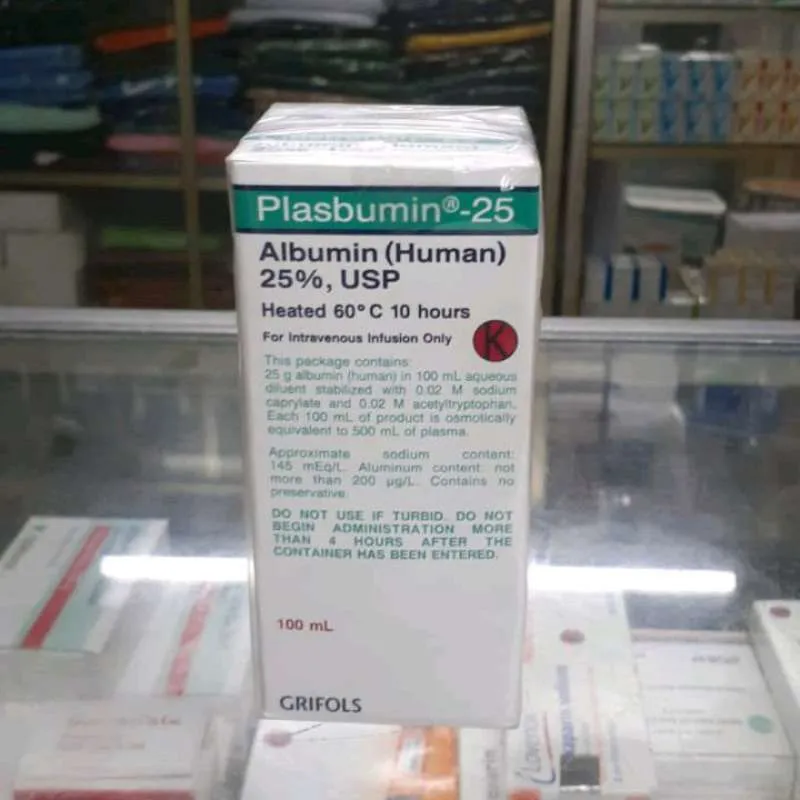
Table of Contents
Package leaflet: Information for the patient
Plasbumin 200 g/l solution for infusion
Human albumin from human plasma
Please read all of this leaflet carefully before using this medicine because it contains important information for you.
- Keep this leaflet. You may need to read it again.
- If you have any questions, ask your doctor, pharmacist, or nurse.
- This medicine has been prescribed for you only. Do not give it to other people, even if their symptoms are the same as yours, as it may be harmful.
- If you experience any side effects, including those not listed in this leaflet, tell your doctor, pharmacist, or nurse. See section 4.
Contents of this leaflet:
- What Plasbumin is and what it is used for
- What you need to know before using Plasbumin
- How to use Plasbumin
- Possible side effects
- How to store Plasbumin
- Contents of the pack and other information
1. What Plasbumin is and what it is used for
Plasbumin 200 g/l contains:
active substance: 200 g/l of plasma proteins consisting of at least 95% human albumin
Human albumin is used for the restoration and maintenance of circulating blood volume when hypovolaemia has been demonstrated and when the use of a colloid is appropriate.
The choice of albumin rather than artificial colloids will depend on the clinical condition of the individual patient, according to official recommendations.
2. What you should know before using Plasbumin
Do not use Plasbumin
If you are allergic (hypersensitive) to human albumin or to any of the ingredients of this medicine
(listed in section 6).
Warnings and precautions
Talk to your doctor before using Plasbumin.
If you have previously experienced an allergic reaction to albumin, inform your doctor or nurse immediately.
If allergic or anaphylactic reactions occur during infusion, the infusion must be stopped immediately and appropriate treatment initiated. In case of shock, treatment should follow current guidelines for shock management.
Albumin should be used with caution in conditions where an increase in blood volume (hypervolemia) and its consequences, or hemodilution, may pose a particular risk to the patient.
Examples of such conditions include:
- Decompensated heart failure (reduced cardiac performance)
- Arterial hypertension (increased blood pressure)
- Esophageal varices (dilated esophageal veins)
- Pulmonary edema (fluid accumulation in the lungs)
- Hemorrhagic diathesis (predisposition to bleeding)
- Severe anemia (marked reduction in red blood cells and/or oxygen-carrying protein)
- Renal and post-renal anuria (absence of urine production)
The solution of human albumin for infusion is more concentrated than the plasma normally present in the body. Therefore, when administering concentrated human albumin, particular attention should be paid to ensure adequate hydration of the patient. Patients receiving albumin must be carefully monitored by healthcare personnel to avoid fluid overload and circulatory overload.
Albumin solutions at 20% are relatively low in electrolytes compared to 5% solutions. Therefore, when administering albumin, the patient's electrolyte status must be monitored (see section "Dosage, method and duration of administration") and measures must be taken to restore or maintain normal electrolyte balance.
Albumin solutions must not be diluted with water for injections, as this may cause hemolysis (destruction of red blood cells) in the patient.
If relatively large volumes need to be replaced, coagulation parameters and hematocrit (the cellular component of blood) should be monitored. Adequate replacement of other blood components (clotting factors, electrolytes, platelets, erythrocytes) must be ensured.
If dosage and infusion rate are not adjusted according to the patient's circulatory condition, an increase in blood volume (hypervolemia) may occur. At the first clinical signs of cardiovascular overload—such as headache (cephalalgia), breathing difficulties (dyspnea), jugular vein distension, increased blood pressure, increased central venous pressure, or pulmonary edema—the infusion must be immediately stopped.
Albumin may increase the risk of death in patients with brain injuries or burns. In patients with severe brain injuries or burns, treatment with albumin must be carefully evaluated considering the risk/benefit profile.
Caution is required when administering this product to diabetic patients due to its glucose content.
Viral safety
When medicines are manufactured from human blood or plasma, specific measures are implemented to prevent transmission of infections to patients. These measures include:
- Careful selection of blood and plasma donors to ensure potentially infected donors are excluded.
- Testing of each donation and plasma pool for the presence of viruses/infections.
- Inclusion of manufacturing steps capable of inactivating or removing viruses.
Despite these measures, the possibility of transmitting infectious agents cannot be completely ruled out when administering medicinal products derived from human blood or plasma. This also applies to emerging or unknown viruses or other infectious agents.
There have been no reports of viral transmission associated with albumin manufactured according to well-established processes and conforming to European Pharmacopoeia standards.
It is strongly recommended that each time you receive a dose of PLASBUMIN, both the product name and batch number are recorded, in order to maintain traceability of the batch used.
For individuals engaged in sports: using this medicine without therapeutic need constitutes doping and may lead to a positive result in anti-doping tests.
Other medicines and Plasbumin
No pharmacological interactions with other medicinal products are known. However, inform your doctor or pharmacist if you are taking, have recently taken, or might take any other medicines.
Plasbumin 200 g/l must not be mixed with other medicines, whole blood, or concentrated red blood cells. It must not be mixed with protein hydrolysates, amino acid solutions, or solutions containing alcohol.
It may be mixed with standard intravenous carbohydrate and electrolyte solutions.
Concentrated albumin solutions must not be diluted with water for injections, as this may cause destruction of red blood cells (hemolysis) in the patient.
Pregnancy, breastfeeding and fertility
If you are pregnant, suspect you may be pregnant, planning to become pregnant, or are breastfeeding, consult your doctor or pharmacist before taking this medicine.
The safety of Plasbumin during pregnancy has not been established in controlled clinical studies. However, clinical experience with albumin suggests no harmful effects on pregnancy, the fetus, or the newborn.
Animal studies are insufficient to demonstrate safety regarding reproduction, embryofetal development, course of pregnancy, and peri- and postnatal development.
However, albumin is a normal constituent of human blood.
Driving and using machines
No effects have been observed that could impair the ability to drive vehicles or operate machinery.
3. How to use Plasbumin
For instructions on correct use and dosage, refer to the section "The following information
is intended exclusively for healthcare professionals"
Use this medicine exactly as described in this leaflet or as directed by your doctor, pharmacist, or nurse.
If you have any doubts, consult your doctor or pharmacist.
The required dose of albumin preparations and the rate of infusion must be determined according to the individual patient's needs, the severity of trauma or illness, and fluid and protein loss.
If you use more Plasbumin than you should
If the dose or rate of infusion is too high, an increase in blood volume (hypervolemia) may occur. In such cases, symptoms related to cardiovascular overload may appear, such as headache (cephalalgia), difficulty breathing (dyspnea), swelling of the neck veins (jugular vein distension), increased blood pressure (hypertension), increased central venous pressure, and fluid accumulation in the lungs (pulmonary edema). As soon as any of these conditions occur, the patient must inform the healthcare provider, and the infusion must be immediately stopped. The patient's hemodynamic parameters should be closely monitored.
4. Possible adverse reactions
Like all medicines, this medicine may cause adverse reactions, although not everybody gets them.
If any of the following adverse reactions occur, contact your doctor immediately or go to the nearest hospital.
Severe adverse reactions such as shock are rare; in such cases, the infusion must be stopped immediately and appropriate treatment initiated as indicated.
Other mild adverse reactions include: flushing, urticaria, fever, and nausea. These mild reactions occur rarely and usually resolve by slowing down or stopping the infusion.
For information on viral safety, see section 2, "What you need to know before using Plasbumin".
Reporting of adverse reactions
If you experience any adverse reaction, including those not listed in this leaflet, inform your doctor or nurse. You may also report adverse reactions directly via the national reporting system at http://www.agenziafarmaco.gov.it/it/responsabili. Reporting adverse reactions can help provide more information on the safety of this medicine.
5. How to store Plasbumin
KEEP OUT OF SIGHT AND REACH OF CHILDREN
Do not use this medicinal product after the expiry date stated on the label and carton.
The expiry date refers to the last day of that month.
Do not use this medicinal product from vials that have been previously opened or damaged, or if the contents appear cloudy, as microbial contamination may have occurred.
Do not store at temperatures above 30°C.
Do not freeze.
Store the vial in its original packaging and protect from light.
Once the container has been opened, the contents should be used immediately. Unused solutions must be discarded due to the risk of bacterial contamination.
Cracked vials, or those previously opened or damaged, must not be used, as microbial contamination may have occurred.
6. Package contents and other information
What Plasbumin 200 g/l contains
Active substance: 200 g/l of plasma proteins consisting of at least 95% human albumin.
Other components and excipients:
Water for injections
Total sodium 130 - 160 mmol/l (equivalent to 0.58 mmol/g of protein).
Aluminum < 200 μg/l
Stabilizing agents:
Sodium caprylate 16 mmol/l
Acetyltryptophanate 16 mmol/l
Description of the appearance of Plasbumin and package contents
Plasbumin is an infusion solution, slightly viscous, clear and almost colorless, yellow, amber or green in appearance.
50 ml vial of 20% albumin solution
100 ml vial of 20% albumin solution
Do not use if the solution is cloudy or if deposits have formed. This may indicate that the protein is unstable or that the solution has been contaminated.
Marketing Authorization Holder
Instituto Grifols S.A. - c/Can Guasc, 2 – Parets del Vallès, 08150 Barcelona - Spain
Manufacturer responsible for batch release:
Instituto Grifols S.A. - c/Can Guasc, 2 – Parets del Vallès, 08150 Barcelona – Spain
The following information is intended exclusively for physicians or healthcare personnel:
- Plasbumin must be administered intravenously, either directly or diluted with an isotonic solution (e.g., 5% glucose or 0.9% sodium chloride). Mixing with electrolyte solutions should be performed under aseptic conditions.
- Do not dilute albumin solutions with water for injections, as this may cause hemolysis in the patient.
- The solution must be clear or slightly opalescent. Do not use cloudy solutions or those containing deposits. These may indicate that the proteins are unstable or that the solution has been contaminated. Once the vial has been opened, the contents must be infused immediately.
- Remove the plastic tamper-evident band. Remove the seal to expose the stopper. Always disinfect the top of the stopper with an appropriate antiseptic immediately before piercing the vial.
- Infusion must be performed intravenously using a sterile, pyrogen-free, single-use infusion set. Before inserting the infusion set into the vial stopper, disinfect the stopper using an antiseptic solution. Once the vial has been opened, the contents must be infused immediately.
- The infusion rate must be adjusted according to individual cases and indications. During plasmapheresis, the infusion rate should be adjusted according to the removal rate. Hypervolemia may occur if dosage and infusion rate are not adapted to the patient's circulatory status. At the first signs of cardiovascular overload (headache, dyspnea, jugular vein distension), increased arterial or venous blood pressure, or pulmonary edema, stop the infusion immediately.
- If large volumes are to be administered, the product should be warmed to room or body temperature before use.
- When administering concentrated albumin, ensure adequate hydration of the patient. Patients must be closely monitored to avoid circulatory overload and overhydration.
- When administering albumin, the patient's electrolyte status must be monitored and electrolyte balance must be restored or maintained.
- Adequate replacement of other blood components (coagulation factors, electrolytes, platelets, and red blood cells) must be ensured.
Unused solutions must be disposed of in accordance with local regulations.