Pevisone
Italy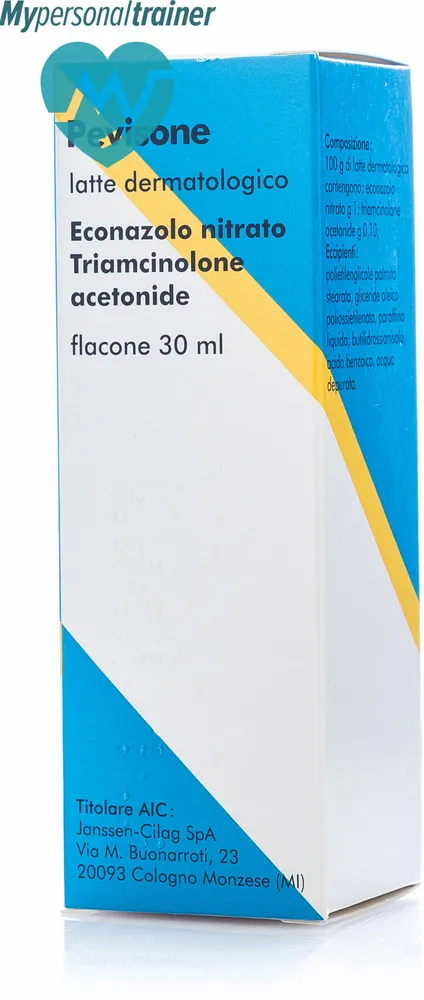
Table of Contents
Package leaflet: Information for the patient
Pevisone 1%+0,1% cutaneous emulsion
econazole nitrate and triamcinolone acetonide
Please read this leaflet carefully before using this medicine because it contains important information for you.
- Keep this leaflet. You may need to read it again.
- If you have any questions, ask your doctor or pharmacist.
- This medicine has been prescribed for you only. Do not give it to other people, even if their symptoms are the same as yours, as it may be harmful.
- If you experience any side effects, including those not listed in this leaflet, contact your doctor or pharmacist. See section 4.
Contents of this leaflet:
- What Pevisone is and what it is used for
- What you need to know before using Pevisone
- How to use Pevisone
- Possible side effects
- How to store Pevisone
- Contents of the pack and other information
1. What Pevisone is and what it is used for
Pevisone contains two active substances called econazole nitrate and triamcinolone acetonide.
Econazole nitrate belongs to a group of medicines called "antifungals" used to treat fungal infections.
Triamcinolone acetonide belongs to a group of medicines called "corticosteroids" used to treat inflammation.
Pevisone is a dermatological medicine indicated for the treatment of fungal skin infections (mycoses) characterized by a significant inflammatory component or allergic manifestations, such as fungal eczema, Hebra's eczema, herpes circinatus, intertrigo, trichophytic folliculitis, fungal infections of the beard, and dermatitis, which may present with redness, blisters, crusts, itching, and desquamation, among others.
Consult your doctor if you do not feel better or if you feel worse.
2. What you need to know before using Pevisone
Do NOT use Pevisone
- if you are allergic to econazole nitrate, triamcinolone acetonide, corticosteroids, or any of the other ingredients of this medicine (listed in section 6).
- like all medicinal products containing corticosteroids for topical use, do not use Pevisone if you have any of the following specific skin diseases such as:
- tuberculosis
- chickenpox
- herpes simplex (a viral disease characterized by painful blisters on the skin)
- or other infections caused by skin viruses.
Do not apply Pevisone to areas of skin where vaccination has recently been performed.
Warnings and precautions
Talk to your doctor or pharmacist before using Pevisone.
Stop treatment and contact your doctor if allergic reactions or irritation occur.
Pevisone is intended for external use only.
Pevisone is not intended for ophthalmic or oral use.
Please note that corticosteroids (anti-inflammatory medicines) applied to the skin may:
- be absorbed in sufficient amounts to produce systemic effects (throughout the body), including impairment of adrenal gland function (adrenal suppression).
- also cause:
- thinning of the skin
- striae (stretch marks)
- rosacea (a skin condition causing redness)
- perioral dermatitis (red rashes around the mouth)
- acne
- dilation of superficial blood vessels (telangiectasia)
- purpura (a skin rash characterized by bright red hemorrhagic spots)
- hypertrichosis (increased hair growth)
- delayed wound healing
- increased risk of dermatological superinfections (new infections developing in patients with an ongoing infection not yet healed), opportunistic infections (infections affecting individuals with already compromised immune systems)
Systemic absorption (throughout the body) may be increased by several factors such as:
- application over a large area of skin surface
- application on damaged skin
- application under occlusive dressing (covering the skin with a non-porous material, e.g., non-flexible plastic film)
- prolonged therapy.
Repeated and/or prolonged application of corticosteroids in the periorbital area may induce cataract (clouding of the eye's lens), ocular hypertension, or increase the risk of glaucoma (increased pressure inside the eye).
Contact your doctor if blurred vision or other visual disturbances occur.
If used too frequently, over large areas, or incorrectly for prolonged periods, you may experience withdrawal symptoms after stopping treatment.
If your symptoms reappear shortly after stopping treatment, do not restart using the cutaneous emulsion without first consulting your doctor, unless previously advised by them to do so. If your condition has resolved and at the time of recurrence the redness spreads beyond the initial treatment area and you feel a burning sensation, consult your doctor before restarting treatment.
Children and adolescents
Following the use of corticosteroids on children's skin, suppression of adrenal gland activity (glands located near the kidneys that produce hormones) and the development of Cushing's syndrome (a condition in which the body produces too much cortisol, a type of steroid) are more likely than in adults.
Therefore, Pevisone should be used with caution in children, and treatment should be discontinued if signs of adrenal suppression or Cushing's syndrome appear.
Other medicines and Pevisone
Inform your doctor or pharmacist if you are currently using, have recently used, or might use any other medicines.
Tell your doctor or pharmacist if you are taking:
- oral anticoagulants (medicines that inhibit blood clotting) such as warfarin and acenocoumarol: Pevisone may alter their effect. Use Pevisone with caution if you are being treated with anticoagulants. Your doctor will monitor the anticoagulant effect more frequently. Your doctor will assess whether an adjustment of the oral anticoagulant dosage is needed during and after treatment with Pevisone.
Pregnancy and breastfeeding
If you are pregnant, suspect you may be pregnant, planning pregnancy, or breastfeeding, consult your doctor or pharmacist before using this or any other medicine.
Pregnancy
Do not use Pevisone during the first trimester of pregnancy unless your doctor considers it necessary for your health, due to possible systemic absorption.
Pevisone may be used during the second and third trimesters of pregnancy if the potential benefit to the mother outweighs the possible risks to the fetus (unborn child).
Medicines of this class should not be used in large quantities, over large areas of skin surface, or for prolonged periods in pregnant patients.
Breastfeeding
Use Pevisone with caution during breastfeeding, as there are insufficient data to determine whether Pevisone passes into breast milk.
Driving and using machines
No special precautions required.
Pevisone contains butylated hydroxyanisole
Butylated hydroxyanisole may cause local skin reactions (e.g., contact dermatitis) or irritation of the eyes and mucous membranes.
Pevisone contains benzoic acid
This medicine contains 60 mg of benzoic acid in each 30 g tube of cutaneous emulsion, equivalent to 2 mg/g of emulsion.
Benzoic acid may cause local irritation.
Benzoic acid may increase jaundice (yellowing of the skin and eyes) in neonates (up to 4 weeks of age).
3. How to use Pevisone
Use this medicine exactly as instructed by your doctor or pharmacist. If you have
any doubts, consult your doctor or pharmacist.
Apply Pevisone no more than twice a day, preferably once in the morning and once in the
evening, to the affected skin area with gentle massage.
Pevisone must not be applied under an occlusive skin bandage or over a large
area of skin surface.
The duration of treatment with Pevisone should not exceed eight days; thereafter, treatment
should be continued, at the doctor's discretion, until complete healing is achieved using an antifungal medicine alone.
If you use Pevisone too frequently, over large areas, or incorrectly for prolonged periods,
you may experience a withdrawal reaction, particularly if treatment is stopped
suddenly (see sections 2 and 4). Consult your doctor who prescribed the treatment.
Use in children and adolescents
No data are available.
If you use more Pevisone than you should
Pevisone is for topical use only.
In case of contact with the eyes, rinse thoroughly with clean water or saline solution and consult a doctor if
symptoms persist.
In case of accidental ingestion/ingestion of Pevisone, contact your doctor immediately or go
to the nearest hospital.
If you have any doubts about the use of Pevisone, consult your doctor or pharmacist.
4. Possible side effects
Like all medicines, this medicine can cause side effects, although not everyone experiences them.
Below is a list of side effects that have occurred with Pevisone.
Common side effects (may affect up to 1 in 10 people) include:
- skin burning sensation
- skin irritation
- erythema
Side effects with unknown frequency (frequency cannot be estimated from the available data) include:
- hypersensitivity
- angioedema
- contact dermatitis
- skin atrophy
- pruritus
- skin exfoliation
- striae (stretch marks) of the skin
- telangiectasia (dilation of superficial blood vessels)
- application site pain
- application site swelling
- blurred vision
- steroid withdrawal reaction: If used too frequently, over large areas or incorrectly for prolonged periods, a withdrawal reaction may occur after stopping treatment, with one or all of the following characteristics: skin redness that may extend beyond the initially treated area, burning or stinging sensation, intense itching, skin peeling, open and weeping sores.
Locally, on the treated skin, dryness, local inflammation, acne-like eruptions, light-colored spots, or increased hair growth may occasionally also occur.
However, the occurrence of side effects may be favored when large skin areas are treated with high doses for prolonged periods, or when treated areas are covered with a dressing.
The use, especially prolonged, of topical products may lead to sensitization phenomena, manifesting as redness and intense itching. In such cases, discontinue treatment and consult your doctor.
Reporting of side effects
If you experience any side effect, including those not listed in this leaflet, consult your doctor or pharmacist. You may also report side effects directly via the national reporting system at the website https://www.aifa.gov.it/content/segnalazioni-reazioni-avverse. By reporting side effects, you can help provide more information on the safety of this medicine.
5. How to store Pevisone
Do not store above 25°C.
Keep this medicine out of the sight and reach of children.
Do not use this medicine after the expiry date which is stated on the packaging after the word
Exp.. The expiry date refers to the last day of that month.
Do not dispose of any medicine via wastewater or household waste. Ask your pharmacist how to
dispose of medicines you no longer use. This will help protect the environment.
6. Package contents and other information
What Pevisone contains
100 g of cutaneous emulsion contain:
- The active substances are: econazole nitrate and triamcinolone. 100 g of cutaneous emulsion contain econazole nitrate 1 g; triamcinolone acetonide 0.10 g.
- The other components are: polyethylene glycol palmitostearate, polyoxyethylene glyceride oleate, liquid paraffin, butylated hydroxyanisole, benzoic acid, purified water.
Description of the appearance of Pevisone and contents of the pack
Cutaneous emulsion for topical use: 30 ml bottle
Marketing Authorization Holder
Karo Pharma AB
Box 16184
SE-103 24 Stockholm
Sweden
Manufacturer
JANSSEN PHARMACEUTICA N.V.
Turnhoutseweg, 30
B-2340 Beerse (Belgium)