Pedippi
ItalyTable of Contents
- Package leaflet: Information for the patient
- PEDIPPI 2 mg/ml, powder for oral suspension
- 1. What PEDIPPI oral suspension is and what it is used for
- 2. What you need to know before taking PEDIPPI oral suspension
- 3. How to take PEDIPPI oral suspension
- 4. Possible side effects
- 5. How to store PEDIPPI oral suspension
- 6. Package contents and other information
- Instructions for use of the syringe
Package leaflet: Information for the patient
PEDIPPI 2 mg/ml, powder for oral suspension
Omeprazole
Please read all of this leaflet carefully before taking this medicine because it contains important information for you.
- Keep this leaflet. You may need to read it again.
- If you have any questions, ask your doctor or pharmacist.
- This medicine has been prescribed for you only. Do not give it to other people, even if they have the same symptoms as you, because it could be harmful.
- If you experience any side effects, including those not listed in this leaflet, tell your doctor or pharmacist. See section 4.
Contents of this leaflet:
- What PEDIPPI oral suspension is and what it is used for
- What you need to know before taking PEDIPPI oral suspension
- How to take PEDIPPI oral suspension
- Possible side effects
- How to store PEDIPPI oral suspension
- Contents of the pack and other information
1. What PEDIPPI oral suspension is and what it is used for
The name of the medicine is PEDIPPI 2 mg/ml, powder for oral suspension (referred to as PEDIPPI oral suspension in this leaflet).
PEDIPPI oral suspension contains the active substance omeprazole. It belongs to a group of medicines called "proton pump inhibitors", which work by reducing the amount of acid produced by the stomach.
Omeprazole is commonly used to treat the following conditions:
In adults:
- "Gastro-oesophageal reflux disease" (GORD). This condition occurs when acid from the stomach leaks back into the oesophagus (the tube connecting the throat to the stomach), causing pain, inflammation, and heartburn.
- Ulcers in the upper part of the intestine (duodenal ulcer)
In children:
Children aged over 1 month:
- "Gastro-oesophageal reflux disease" (GORD). This condition occurs when acid from the stomach leaks back into the oesophagus (the tube connecting the throat to the stomach), causing pain, inflammation, and heartburn. In children, symptoms of this condition may include regurgitation of stomach contents into the mouth, discomfort (vomiting), and poor weight gain.
Your doctor will tell you why this medicine has been prescribed for you.
2. What you need to know before taking PEDIPPI oral suspension
Do not take PEDIPPI oral suspension
- If you are allergic to omeprazole or to any of the other ingredients of this medicine (listed in section 6).
- If you are allergic to medicines containing other proton pump inhibitors (e.g. pantoprazole, lansoprazole, rabeprazole, esomeprazole).
- If you are taking a medicine containing nelfinavir (used for HIV infection).
Do not take this medicine if any of the conditions described above apply to you. If in doubt, consult your doctor or pharmacist before taking PEDIPPI oral suspension.
Warnings and precautions
Talk to your doctor or pharmacist before taking omeprazole.
Serious skin reactions, including Stevens-Johnson syndrome, toxic epidermal necrolysis, drug reaction with eosinophilia and systemic symptoms (DRESS), and acute generalized exanthematous pustulosis (AGEP) have been reported in association with omeprazole treatment. Stop using PEDIPPI oral suspension and contact your doctor immediately if you notice any of the symptoms related to these serious skin reactions described in section 4.
Omeprazole may mask symptoms of other diseases. Therefore, if you experience any of the following events before or during treatment with PEDIPPI oral suspension, contact your doctor immediately:
- Significant and unexplained weight loss and difficulty swallowing.
- Stomach pain or indigestion.
- Vomiting food or blood.
- Black stools (stools containing blood).
- Severe or persistent diarrhoea, as omeprazole has been associated with a small increased risk of infectious diarrhoea.
- Severe liver problems.
- If you have ever had a skin reaction after treatment with a medicine similar to omeprazole that reduces stomach acid.
- If you are scheduled to undergo a specific blood test (chromogranin A).
If you have been taking omeprazole for a long time (for more than 1 year), your doctor will likely monitor you regularly. Each time you visit your doctor, report any new or unusual symptoms or circumstances.
Taking a proton pump inhibitor such as omeprazole, especially for more than one year, may slightly increase the risk of fractures of the hip, wrist, or spine.
Inform your doctor if you have osteoporosis or if you are taking corticosteroids (which may increase the risk of osteoporosis).
If you develop a skin rash, particularly in sun-exposed areas, inform your doctor as soon as possible, as it may be necessary to stop treatment with omeprazole. Remember to also mention any other adverse effects such as joint pain.
During treatment with omeprazole, inflammation of the kidneys may occur. Signs and symptoms may include reduced urine volume or blood in the urine and/or hypersensitivity reactions such as fever, skin rash, and joint stiffness. Report these signs to your doctor.
Children
Some children with chronic conditions may require long-term treatment, although this is not recommended. Do not administer this medicine to children under 1 month of age.
Other medicines and PEDIPPI oral suspension
Inform your doctor or pharmacist if you are taking, have recently taken, or might take any other medicines. This includes medicines you purchase without a prescription. This is because omeprazole can affect how some medicines work, and conversely, some medicines can affect omeprazole.
Do not take omeprazole if you are taking a medicine containing nelfinavir (used to treat HIV infection).
Inform your doctor or pharmacist if you are taking any of the following medicines:
- ketoconazole, itraconazole, posaconazole, or voriconazole (used to treat fungal infections)
- digoxin (used to treat heart problems)
- diazepam (used to treat anxiety, to relax muscles, or for epilepsy)
- phenytoin (used for epilepsy). If you are taking phenytoin, your doctor will need to monitor you when starting or stopping omeprazole
- medicines used to thin the blood, such as warfarin or other vitamin K antagonists. Your doctor may need to monitor you when starting or stopping omeprazole
- rifampicin (used to treat tuberculosis)
- atazanavir (used to treat HIV infection)
- tacrolimus (used in organ transplantation)
- St John’s wort (Hypericum perforatum) (used to treat mild depression)
- cilostazol (used to treat intermittent claudication)
- saquinavir (used to treat HIV infection)
- clopidogrel (used to prevent blood clots [thrombi])
- erlotinib (used to treat cancer)
- methotrexate (a chemotherapeutic agent used at high doses to treat cancer); if you are taking a high dose of methotrexate, your doctor may temporarily discontinue omeprazole treatment.
If your doctor has prescribed you the antibiotics amoxicillin and clarithromycin along with omeprazole for the treatment of ulcers caused by Helicobacter pylori infection, it is very important that you inform your doctor about any other medicines you are taking.
PEDIPPI oral suspension with food and drinks
You must take PEDIPPI oral suspension without food, on an empty stomach.
Pregnancy, breastfeeding, and fertility
If you are pregnant, think you may be pregnant, are planning to become pregnant, or are breastfeeding, consult your doctor or pharmacist before taking this medicine. Omeprazole may be used during pregnancy.
Omeprazole is excreted in breast milk, but it is unlikely to affect the breastfed infant when taken at therapeutic doses. If you are breastfeeding, your doctor will decide whether you can take omeprazole.
Driving and using machines
It is unlikely that omeprazole will affect your ability to drive or use tools or machines.
Adverse drug reactions such as dizziness and visual disturbances may occur (see section 4). If you experience these, do not drive or use machinery.
PEDIPPI oral suspension contains maltitol, potassium, sodium, sodium methyl parahydroxybenzoate, and
sodium benzoate.
- Maltitol: if you have been diagnosed with an intolerance to certain sugars, consult your doctor before taking this medicine.
- Sodium: this medicine contains 17.2 mg of sodium (a main component of table salt) per ml, or 86 mg of sodium per 5 ml dose. This 5 ml dose corresponds to 4.3% of the maximum recommended daily dietary intake of sodium for an adult.
- Potassium: this medicine contains 1.39 mmol (or 54.3 mg) of potassium per ml, or 6.95 mmol (or 271.5 mg) of potassium per 5 ml dose. This should be taken into consideration by patients with impaired renal function or those on a low-potassium diet.
- Sodium methyl parahydroxybenzoate: may cause allergic reactions (including delayed reactions).
- Sodium benzoate: this medicine contains 25 mg of sodium benzoate in each 5 ml dose.
3. How to take PEDIPPI oral suspension
Take this medicine exactly as directed by your doctor or pharmacist. If you are unsure, consult your doctor or pharmacist.
Your doctor will tell you how much medicine to take and for how long. This will depend on your condition and age.
The maximum recommended dose of omeprazole 2 mg/ml oral suspension is 15 mg per day. Other dosage strengths of omeprazole oral suspension and other pharmaceutical forms of omeprazole are available for higher dose administration. For doses ≤ 15 mg, the 2 mg/ml concentration is recommended.
The recommended doses are listed below.
Use in adults
For the treatment of symptoms of GERD such as heartburn and acid regurgitation:
If your doctor has told you that your oesophagus (the tube connecting the throat to the stomach) is slightly damaged, the recommended dose is 20 mg once daily for 4–8 weeks. Your doctor may instruct you to take a dose of 40 mg for an additional 8 weeks if the oesophagus has not yet healed.
Once the oesophagus has healed, the recommended dose is 10 mg once daily.
If the oesophagus is not damaged, the usual dose is 10 mg once daily.
For preventing recurrence of duodenal ulcers:
The recommended dose ranges from 10 mg to 20 mg once daily. Your doctor may increase the dose up to 40 mg once daily.
Use in children and adolescents
For treating symptoms of GERD such as heartburn and acid regurgitation:
Children older than 1 month may take omeprazole. The dose is based on the child's body weight, and your doctor will determine the correct dose according to the following:
| Age | Weight | Dosage |
| 1 month | > 5 to ≤ 10 kg | 1 mg/kg once daily, up to a maximum of 10 mg once daily. Doses higher than 1.5 mg/kg/day have not been studied. |
| 1 year of age** | 10–20 kg | 10 mg once daily. If necessary, the dose may be increased up to 20 mg once daily. |
* Individual dose measurements of ≤ 2 ml are not recommended.
** Omeprazole oral suspension 2 mg/ml may be used in patients to administer up to 15 mg of omeprazole per day to provide adequate buffering and absorption capacity. For higher omeprazole doses, other pharmaceutical forms of omeprazole must be used.
Taking this medicine
-
This medicine contains 10 mg (PEDIPPI 2 mg/ml oral suspension) in each 5 millilitres (5 ml) of suspension.
-
Take this medicine by mouth.
-
It is recommended to take the dose in the morning.
-
This medicine should be taken on an empty stomach, at least 30 minutes before a meal.
-
Use the dosing device provided to measure the correct dose (see Dosage instructions).
-
After taking the dose, you may drink a glass of water.
-
This medicine may also be administered via nasogastric (NG) tubes or percutaneous endoscopic gastrostomy (PEG) tubes.
-
Instructions for administration via NG or PEG tubes:
o Before administration, ensure that the enteral feeding tube is free from blockages.
o Flush the enteral tube with 5 ml of water.
o Administer the required dose of omeprazole oral suspension using an appropriate measuring device.
o Flush the enteral tube again with 5 ml of water.
This product can be used with nasogastric (NG) and percutaneous endoscopic gastrostomy (PEG) tubes made of polyurethane and PVC, with sizes ranging from 6 Fr to 16 Fr. For tubes with smaller diameters (6 Fr), a 2 ml flush volume may be used in very small children.
To facilitate administration in infants, the medicine may be given mixed with a small amount of milk (no more than 10–15 ml). You may discuss this with your doctor, who can provide further advice.
Preparing and taking the suspension
The container is a two-compartment system containing powder both in the cap and in the bottle. The two powders must first be combined and then reconstituted with water. A red mixing disc will fall into the medicine to help mix the powders and to aid in mixing the suspension after water is added. The disc must remain in the bottle. After reconstitution, the red cap is replaced with a grey cap. It is recommended that a pharmacist or other healthcare professional prepare the PEDIPPI oral suspension before dispensing it to the patient (see section 6).
If you take more PEDIPPI oral suspension than you should
If you take more medicine than prescribed by your doctor, contact your doctor or pharmacist immediately.
If you forget to take PEDIPPI oral suspension
If you forget to take a dose, take it as soon as you remember. However, if it is almost time for your next dose, skip the missed dose. Do not take a double dose to make up for the forgotten dose.
If you stop taking PEDIPPI oral suspension
Do not stop treatment with omeprazole without first talking to your doctor or pharmacist.
If you have any questions about the use of this medicine, consult your doctor or pharmacist.
4. Possible side effects
Like all medicines, this medicine can cause side effects, although not everybody gets them.
If you experience any of the following rare but serious side effects, stop taking
PEDIPPI oral suspension and contact a doctor immediately:
- Sudden wheezing, swelling of the lips, tongue, throat or body, skin rash, fainting or difficulty swallowing (severe allergic reaction).
- Skin redness with blistering or peeling. There may also be severe blistering with bleeding of the lips, eyes, mouth, nose and genitals. This could be “Stevens-Johnson syndrome” or “toxic epidermal necrolysis”.
- Widespread rash, high body temperature and swollen lymph nodes (DRESS syndrome or drug hypersensitivity syndrome).
- Widespread red, scaly rash with bumps under the skin and blisters accompanied by fever. Symptoms usually occur early in treatment (acute generalized exanthematous pustulosis).
- Yellowing of the skin, dark urine and fatigue, which may be signs of liver problems.
Other side effects include:
Common side effects (may affect up to 1 in 10 people)
- Headache.
- Stomach or intestinal problems: diarrhoea, stomach pain, constipation, flatulence.
- Feeling unwell (nausea) or being unwell (vomiting).
- Benign polyps in the stomach.
Uncommon side effects (may affect up to 1 in 100 people)
- Swelling of the feet and ankles.
- Sleep disturbance (insomnia).
- Dizziness, tingling sensations such as “pins and needles”, drowsiness.
- Feeling of unsteadiness (vertigo).
- Changes in blood tests assessing liver function.
- Skin rash, nodular skin eruptions (urticaria) and itchy skin.
- General feeling of being unwell and lack of energy.
Rare side effects (may affect up to 1 in 1,000 people)
- Changes in blood composition, such as reduced number of white blood cells or platelets. This may cause weakness, bruising or increase the likelihood of infections.
- Allergic reactions, sometimes very severe, including swelling of lips, tongue and throat, fever, wheezing.
- Low levels of sodium in the blood. This may cause weakness, feeling unwell (vomiting) and cramps.
- Feeling restless, confused or depressed.
- Changes in taste.
- Vision problems such as blurred vision.
- Sudden sensation of wheezing or breathlessness (bronchospasm).
- Dry mouth.
- Inflammation inside the mouth.
- A fungal infection called “thrush” that may affect the intestine.
- Liver problems, including jaundice, which may cause yellowing of the skin, dark urine and fatigue.
- Hair loss (alopecia).
- Skin rash upon exposure to sunlight.
- Joint pain (arthralgia) or muscle pain (myalgia).
- Severe kidney problems (interstitial nephritis).
- Increased sweating.
Very rare side effects (may affect up to 1 in 10,000 people)
- Changes in blood cell counts, including agranulocytosis (lack of white blood cells).
- Aggressiveness.
- Seeing, perceiving or hearing things that are not there (hallucinations).
- Severe liver problems leading to liver failure and brain inflammation.
- Sudden onset of severe skin rash or blistering or peeling skin. This may be associated with high fever and joint pain (erythema multiforme, Stevens-Johnson syndrome, toxic epidermal necrolysis).
- Muscle weakness.
- Breast enlargement in men.
Not known (frequency cannot be estimated from the available data)
- Inflammation of the intestine (causing diarrhoea).
- If you take omeprazole for more than three months, your blood magnesium levels may decrease. Low magnesium levels may present as fatigue, involuntary muscle contractions, disorientation, seizures, dizziness or increased heart rate. If you experience any of these symptoms, contact your doctor immediately. Low magnesium levels may also lead to reduced potassium or calcium levels in the blood. Your doctor may decide to perform regular blood tests to monitor your magnesium levels.
- Skin rash, which may be accompanied by joint pain.
Omeprazole oral suspension may, in very rare cases, affect white blood cells, leading to
immunodeficiency. If you develop an infection with symptoms such as fever with a severe deterioration in your
general health, or fever with signs of a local infection such as neck, throat or mouth pain or difficulty urinating, you
should consult a doctor as soon as possible to rule out a lack of white blood cells (agranulocytosis) by means of a
blood test. In such cases, it is important to inform the doctor about the medicine you are taking.
Reporting of side effects
If you experience any side effect, including those not listed in this leaflet, talk to your
doctor or pharmacist. You can also report side effects directly via:
Website:
https://www.aifa.gov.it/content/segnalazioni-reazioni-avverse
By reporting side effects, you can help provide more information on the safety of this
medicine.
5. How to store PEDIPPI oral suspension
- Keep this medicine out of the sight and reach of children.
- Do not use this medicine after the expiry date stated on the packaging after "Exp." The expiry date refers to the last day of that month.
- Dry powders: do not store above 25°C. Store in the original aluminium sachet to protect the medicine from light and moisture.
- After reconstitution: store in the refrigerator (2°C–8°C). Store in the original container to protect the medicine from light. Keep the bottle tightly closed. The reconstituted suspension is stable for 28 days. After this time, any remaining suspension must be discarded. The suspension may be stored at temperatures below 25°C for a maximum of 2 days.
- Do not use PEDIPPI oral suspension if you notice anything unusual about its appearance (see section 6). Inform your pharmacist. Do not dispose of medicines via wastewater or household waste. Ask your pharmacist how to dispose of medicines no longer required. This will help protect the environment.
6. Package contents and other information
Information for pharmacy/healthcare professionals
Instructions for initial reconstitution
Mixing the powder in the cap with that in the vial
- Shake the vial for 10 seconds to loosen the powder.
- Turn the red cap counterclockwise (see arrow on the cap) until the seal breaks, releasing the powder from the red cap into the vial.
- Rotate the red cap back to its original position, securing it firmly onto the vial.
Reconstitution of the powder
- Shake the vial vigorously for ten seconds to mix the powders.
- Gently tap the bottom of the vial three times on a firm horizontal surface to ensure all powder has fallen into the vial and none remains in the cap.
- Remove the red cap from the vial.
- Add 64 ml of water using the provided measuring cup, up to the line indicated on the label.
- Securely replace the red cap on the vial and shake vigorously for 30 seconds.
Attaching the syringe adapter
- Remove and discard the red cap and the red ring.
- Insert the transparent, colorless vial adapter and replace the red cap with the grey plastic screw cap.
- Leave the vial for fifteen minutes to allow the product to reach its final consistency.
Dose measurement
Instructions for use of the syringe
- Shake the vial for 20 seconds immediately before each use.
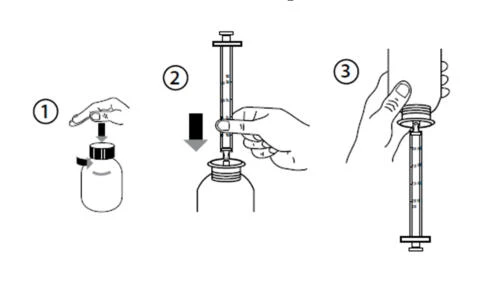
- To open the vial, press down on the grey cap and turn it counterclockwise (Figure 1). Do not remove the white part of the cap.
- Take the syringe and insert it into the opening of the adapter (Figure 2).
- Invert the vial (Figure 3).
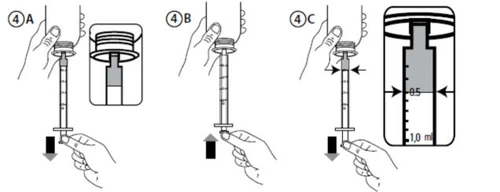
- Fill the syringe with a small amount of suspension by pulling the plunger downward (Figure 4A). Then push the plunger upward to remove any air bubbles (Figure 4B). Finally, pull the plunger downward until the flat upper edge of the piston aligns with the graduation mark corresponding to the amount in millilitres (ml) prescribed by the doctor (Figure 4C).
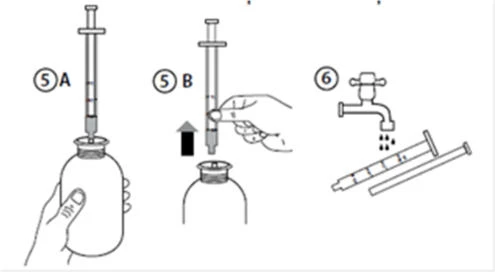
- Turn the vial back to the upright position (Figure 5A).
- Remove the syringe from the adapter (Figure 5B).
- Insert the tip of the syringe into the patient's mouth and slowly push the plunger to administer the medication. The suspension will be released slowly, while the last portion will be dispensed more quickly due to reduced resistance at the tip of the syringe.
- Wash the syringe with water and allow it to dry before reusing (Figure 6).
- Close the vial with the grey plastic screw cap, leaving the adapter in place inside the vial. Note: It is normal for the red plastic disc to remain in the suspension during use; do not attempt to remove it.
What PEDIPPI oral suspension contains
- The active substance is omeprazole. Each ml of oral suspension contains 2 mg of omeprazole.
- The other components are sodium bicarbonate (E500), potassium bicarbonate (E501), sodium alginate (E401), maltitol (E965), mannitol (E421), sucralose (E955), xanthan gum (E415), natural vanilla flavour containing maltodextrin (maize), natural mint flavour containing gum arabic/acacia gum (E414), titanium dioxide (E171), sodium benzoate (E211), sodium methyl parahydroxybenzoate (E219).
Description of the appearance of PEDIPPI oral suspension and contents of the pack
Before reconstitution: white/whitish/yellowish powder contained in a cap attached to a vial containing white/whitish/yellowish powder, which may contain dark specks due to the sweetener.
After reconstitution: white/whitish/brownish oral suspension. It may contain dark specks due to the sweetener.
Pack:
Amber plastic bottle (PET) containing powder, fitted with a red closure cap made of polypropylene (PP) and a red mixing disc made of polypropylene (PP) containing powder, all enclosed in an aluminium pouch.
Each bottle contains 47 g of powder for oral suspension. Once reconstituted, the bottle contains 90 ml of oral suspension, of which at least 75 ml are intended for dosing and administration.
Each pack also contains an oral dosing syringe made of opaque polypropylene (PP) (5 ml capacity, graduated every 1 ml with intermediate marks every 0.1 ml), a white HDPE plunger, a transparent LDPE colourless press-in adapter, and a grey replacement cap made of PP.
Pack sizes: 1 or 2 vials.
Not all pack sizes may be marketed.
Marketing Authorisation Holder and Manufacturer
Xeolas Pharmaceuticals Limited,
Hamilton Building,
DCU, Glasnevin,
Dublin 9,
IRELAND.
This medicinal product is authorised in the European Economic Area Member States under the following names:
Italy Pedippi
United Kingdom Omeprazole 2mg/ml Powder for oral suspension
Netherlands Pedippi 2mg/ml poeder voor orale suspensie omeprazol
Ireland Pedippi 2mg/ml Powder for oral suspension
France NEXOCET 2 mg/ml poudre pour suspension buvable
Portugal NOAXO 2 mg/ml Pó para Suspensão Oral
Germany OPPI 2 mg/ml Pulver zur Herstellung einer Suspension zum Einnehmen
Belgium Nexocet Powder for Oral Suspension
Iceland Pedippi 2 mg/ml mixtúruduft, dreifa
Denmark Pedippi 2 mg/ml, pulver til oral suspension
Norway Pedippi 2 mg/ml, pulver til mikstur, suspensjon
Sweden Pedippi 2 mg/ml, pulver till oral suspension
Finland Pedippi 2 mg/ml jauhe oraalisuspensiota varten