Paxneury
Italy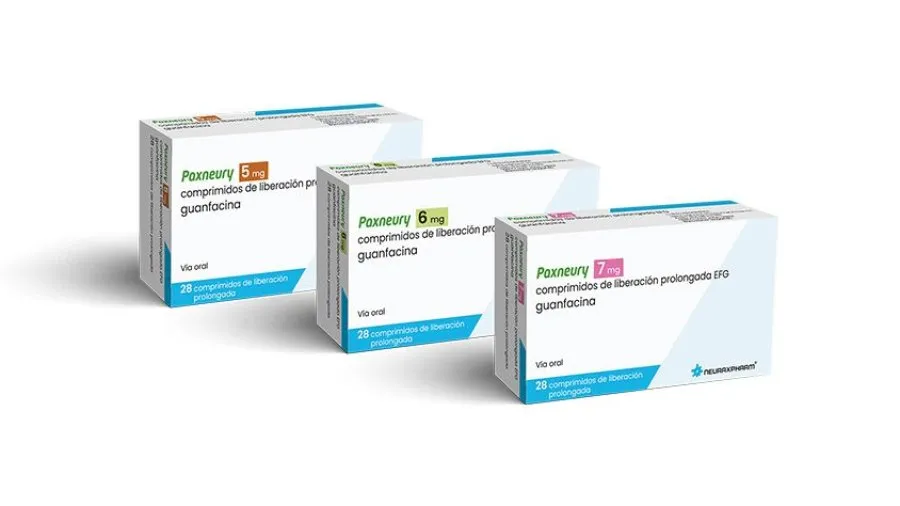
Table of Contents
- Patient Information Leaflet
- Paxneury 1 mg prolonged-release tablets, 2 mg prolonged-release tablets, 3 mg prolonged-release tablets, 4 mg prolonged-release tablets, 5 mg prolonged-release tablets, 6 mg prolonged-release tablets, 7 mg prolonged-release tablets
- 1. What Paxneury is and what it is used for What Paxneury is
- 2. What you need to know before taking Paxneury Do not take Paxneury
- 3. How to take Paxneury
- 4. Possible side effects
- 5. How to store Paxneury
- 6. Package contents and other information What Paxneury contains
Patient Information Leaflet
Paxneury 1 mg prolonged-release tablets, 2 mg prolonged-release tablets, 3 mg prolonged-release tablets, 4 mg prolonged-release tablets, 5 mg prolonged-release tablets, 6 mg prolonged-release tablets, 7 mg prolonged-release tablets
guanfacine
Please read all of this leaflet carefully before taking this medicine because it contains
important information for you.
- Keep this leaflet. You may need to read it again.
- If you have any questions, ask your doctor, pharmacist, or nurse.
- This medicine has been prescribed for you only. Do not pass it on to others, even if their symptoms are the same as yours, as it may be harmful.
- If you experience any side effects, including those not listed in this leaflet, tell your doctor or pharmacist. See section 4.
- This patient information leaflet is written as if addressed to the person taking the medicine. If the medicine is being given to your child, replace "you" with "your child".
Contents of this leaflet:
- What Paxneury is and what it is used for
- What you need to know before taking Paxneury
- How to take Paxneury
- Possible side effects
- How to store Paxneury
- Contents of the pack and other information
1. What Paxneury is and what it is used for What Paxneury is
Paxneury contains the active substance guanfacine. This medicine belongs to a group of
medicines that affect brain activity. This medicine can improve attention,
concentration, and reduce impulsiveness and hyperactivity.
What Paxneury is used for
This medicine is used for the treatment of "attention deficit/hyperactivity disorder"
(ADHD) in children and adolescents aged 6–17 years for whom the currently used stimulant medicine is not suitable and/or the currently used medicine does not adequately control ADHD symptoms.
The medicine is prescribed as part of a treatment programme, which usually includes:
- psychological therapy
- educational therapy
- social therapy
Information about ADHD
People with ADHD have difficulties with:
- staying still
- concentrating
ADHD can cause problems in daily life. Children and adolescents with ADHD
may have difficulties in learning and doing schoolwork. They may find it hard to behave appropriately at
home, at school, or in other settings.
2. What you need to know before taking Paxneury Do not take Paxneury
- if you are allergic to guanfacine or to any of the other ingredients of this medicine (listed in section 6).
Warnings and precautions
Talk to your doctor or pharmacist before taking this medicine if:
- you have low or high blood pressure, heart problems, or a family history of heart problems
- you have recently fainted
- you have thoughts or feelings about suicide
- you suffer from other psychiatric disorders
Talk to your doctor or pharmacist if you are taking this medicine and:
- experience aggressive feelings or behaviors, or
- have suicidal thoughts or feelings
If taken for long periods, Paxneury may affect weight and height; therefore, your doctor will monitor growth.
Do not stop taking Paxneury without consulting your doctor. Abruptly stopping treatment with Paxneury may cause withdrawal symptoms such as increased heart rate and blood pressure (see section 4).
If you fall into any of the above categories (or are unsure), consult your doctor or pharmacist before taking this medicine, as it may worsen these conditions. Your doctor will monitor you regularly to assess the medicine's effects.
Children (under 6 years of age) and adults (18 years and over)
This medicine must not be used in children under 6 years of age or in adults aged 18 years and over, because it is not known whether it is effective or safe.
Medical checks during treatment with Paxneury
Before starting this medicine, your doctor will perform checks to ensure that this medicine is safe and beneficial for you. During treatment with this medicine, your doctor will repeat these checks once a week during the initial period, after any dose adjustments, at least every 3 months during the first year, and then at least twice a year. These checks may include:
- blood pressure and heart rate, and other heart checks if appropriate
- response to treatment, particularly whether the medicine causes drowsiness or makes you feel sleepy
- height and weight
Contact your doctor if you do not feel better or if you feel worse, very drowsy, or experience drowsiness after taking this medicine for about 6 weeks. Your doctor may wish to review your treatment.
Other medicines and Paxneury
Inform your doctor or pharmacist if you are taking, have recently taken, or might take any other medicines. This is because Paxneury may affect the action of other medicines and vice versa.
In particular, inform your doctor or pharmacist if you are taking any of the following types of medicines:
- medicines that lower blood pressure (antihypertensives)
- medicines for epilepsy, such as valproic acid
- medicines that cause drowsiness (sedatives)
- medicines for mental health conditions (benzodiazepines, barbiturates, and antipsychotics)
- medicines that may affect how Paxneury is eliminated by the liver (see the table below)
| Medicines | Used to treat |
| Aprepitant | Nausea and dizziness |
| Atazanavir, efavirenz, etravirine, fosamprenavir, indinavir, nevirapine, ritonavir, saquinavir | HIV infection |
| Ciprofloxacin, chloramphenicol, clarithromycin, erythromycin, rifabutin, rifampicin, telithromycin | Bacterial infections |
| Fluconazole, itraconazole, posaconazole, ketoconazole | Fungal infections |
| Crizotinib, imatinib | Cancer |
| Diltiazem, verapamil | Cardiovascular disorders |
| Boceprevir, telaprevir | Viral hepatitis |
| Suboxone | Substance dependence |
| Bosentan | Cardiovascular disorders (e.g. narrowing of blood vessels in the lungs) |
| Carbamazepine, oxcarbazepine, phenobarbital, phenytoin, primidone | Used to control epilepsy |
| Modafinil | Medicine that promotes wakefulness and is used to treat sleep disorders |
| St. John's wort (Hypericum perforatum) | Herbal preparation used to treat depression |
If you fall into any of the situations mentioned above, or if you are unsure, consult your doctor or pharmacist before
taking this medicine.
Paxneury with food, drinks and alcohol
- Do not take this medicine with fatty foods (e.g. a high-fat meal), as they may affect the way the medicine works.
- Do not drink grapefruit juice with this medicine, as it may affect the way the medicine works.
- Do not drink alcohol when taking this medicine, as it may cause drowsiness or make you feel sleepy.
Pregnancy and breastfeeding
If you are pregnant, think you might be pregnant, planning a pregnancy, or are breastfeeding, ask your doctor or pharmacist for advice before taking this medicine.
- Do not take this medicine if you are pregnant or if you are not using effective contraception. It is not known whether Paxneury may have effects on the unborn child.
- Do not breastfeed during treatment with Paxneury unless otherwise instructed by your doctor.
Driving and using machines
You may experience dizziness and drowsiness when taking this medicine, especially at the beginning of treatment, and these symptoms may last for 2–3 weeks or longer. If this occurs, do not drive vehicles or ride bicycles, do not operate tools or machinery, and avoid any activity that could lead to accidents until you have determined how this medicine affects you. Fainting has also been reported, although this is not a common effect.
Paxneury contains lactose
Lactose is a type of sugar. If your doctor has diagnosed you with an intolerance to certain sugars, contact him/her before taking this medicine.
Paxneury contains sodium
This medicine contains less than 1 mmol (23 mg) of sodium per tablet, i.e. essentially ‘sodium-free’.
3. How to take Paxneury
Treatment will be initiated under the supervision of a qualified specialist in childhood and/or adolescent behavioural disorders.
Take this medicine exactly as directed by your doctor or pharmacist. If you have any doubts, consult your doctor or pharmacist.
During treatment, your doctor will closely monitor the effects of Paxneury on you, especially during the initial period and/or after any dose adjustments.
Dosage
- Your doctor will prescribe an initial dose of 1 mg daily. The dose may be increased by your doctor according to body weight and response to Paxneury, but not by more than 1 mg per week. Depending on your response to treatment, your doctor may increase the dose more slowly. The recommended maintenance dose ranges from 0.05 to 0.12 mg per kg of body weight per day.
- You may not notice an immediate effect at the beginning of treatment; some patients may observe improvement after the first week, but this may take longer.
- The daily dose will range between 1 and 7 mg, depending on age and response to Paxneury treatment, but must not exceed 7 mg.
How to take Paxneury
- This medicine should be taken once daily, in the morning or evening.
- It may be taken with or without food, but must not be taken with fatty foods (e.g. a high-fat breakfast).
- Swallow the tablet whole with a glass of water or another liquid (but not with grapefruit juice).
- Do not break, crush, or chew the tablet, as this affects the medicine's release mechanism. Inform your doctor if you are unable to swallow the tablet whole.
Duration of treatment
If you need to take Paxneury for more than one year, your doctor will review your response to treatment and may advise you to temporarily stop taking the medicine, for example during school holidays. This will help determine whether the medicine is still necessary for you.
If you take more Paxneury than you should
If you take more Paxneury than prescribed, contact your doctor or go to hospital immediately.
Take the medicine pack with you and inform the doctor of the amount taken.
The following effects may occur: low or high blood pressure, slowed heart rate, slowed breathing, feeling tired or weak.
If you forget to take Paxneury
If you miss a dose, wait until the next day and take your usual dose.
- If you have missed two or more doses, consult your doctor, as you may need to restart Paxneury at a lower dose.
- Do not take a double dose to make up for a missed dose.
If you stop taking Paxneury
Do not stop taking this medicine without first consulting your doctor.
- If you stop treatment with this medicine, your blood pressure and heart rate may increase (see section 4 below).
- To discontinue treatment, your doctor will gradually reduce the dose of Paxneury to minimize the risk of adverse effects.
If you have any doubts about how to use this medicine, consult your doctor or pharmacist.
4. Possible side effects
Like all medicines, this medicine can cause side effects, although not everyone gets them. If you have any doubts, consult your doctor.
If you experience any discomfort during treatment with this medicine, inform an adult immediately.
Serious side effects
The following serious side effects have been reported: drowsiness (sedation), dizziness (hypotension), slowed heart rate (bradycardia), feeling faint or loss of consciousness (syncope), and a serious withdrawal reaction characterized by increased blood pressure following abrupt discontinuation of Paxneury treatment; symptoms may include headache, confusion, nervousness, agitation, and tremors (hypertensive encephalopathy).
Some of these side effects are more likely to occur at the beginning of treatment and may resolve with continued therapy. If any of these effects occur, contact your doctor immediately.
Other side effects
The following side effects have been reported.
Very common (may affect more than 1 in 10 people)
- drowsiness (feeling sleepy)
- tiredness (fatigue)
- headache
- stomach or abdominal pain (abdominal pain).
Common (may affect up to 1 in 10 people)
- low heart rate
- reduced blood pressure
- feeling restless or irritable
- difficulty sleeping (insomnia), interrupted sleep (middle insomnia), or nightmares
- feeling depressed, anxious, or mood swings (affective lability)
- lack of energy (lethargy)
- weight gain
- loss of appetite
- dry mouth
- bedwetting (enuresis)
- nausea or vomiting
- diarrhoea, abdominal discomfort, or constipation
- low blood pressure upon standing (orthostatic hypotension)
- skin rash.
Uncommon (may affect up to 1 in 100 people)
- allergic reaction (hypersensitivity)
- chest pain
- indigestion (dyspepsia)
- breathing difficulties (asthma)
- feeling weak (asthenia)
- pale skin (pallor)
- epileptic seizures or convulsions
- frequent need to urinate (pollakiuria)
- feeling agitated
- aggression
- changes in liver function test results (increased alanine aminotransferase)
- increased blood pressure
- unusual heart rhythm (sinus arrhythmia and first-degree atrioventricular block)
- rapid heartbeat (tachycardia)
- reduced heart rate
- dizziness upon standing (postural dizziness)
- itching
- seeing or hearing things that are not real (hallucinations).
Rare (may affect up to 1 in 1,000 people)
- sleeping more than usual (hypersomnia)
- high blood pressure (hypertension)
- feeling unwell (malaise).
Very rare (may affect up to 1 in 10,000 people)
- a serious withdrawal reaction characterized by increased blood pressure following abrupt discontinuation of Paxneury treatment; symptoms may include headache, confusion, nervousness, agitation, and tremors (hypertensive encephalopathy).
Not known (frequency cannot be estimated from the available data)
- difficulty achieving or maintaining an erection (erectile dysfunction).
Reporting of side effects
If you experience any side effect, including those not listed in this leaflet, talk to your doctor or pharmacist. You can also report side effects directly via the national reporting system listed in Annex V. Reporting side effects can help provide more information on the safety of this medicine.
5. How to store Paxneury
Keep this medicine out of the sight and reach of children.
Do not use this medicine after the expiry date which is stated on the carton and blister after
"Exp". The expiry date refers to the last day of that month.
This medicine does not require any special storage conditions. Do not use this
medicine if the tablets or the blister appear damaged.
Do not dispose of any medicine via wastewater or household waste. Ask your pharmacist how to dispose of medicines you no longer use. This will help protect the environment.
6. Package contents and other information What Paxneury contains
- Each 1 mg tablet contains guanfacine hydrochloride, equivalent to 1 mg of guanfacine
- Each 2 mg tablet contains guanfacine hydrochloride, equivalent to 2 mg of guanfacine
- Each 3 mg tablet contains guanfacine hydrochloride, equivalent to 3 mg of guanfacine
- Each 4 mg tablet contains guanfacine hydrochloride, equivalent to 4 mg of guanfacine
- Each 5 mg tablet contains guanfacine hydrochloride, equivalent to 5 mg of guanfacine
- Each 6 mg tablet contains guanfacine hydrochloride, equivalent to 6 mg of guanfacine
- Each 7 mg tablet contains guanfacine hydrochloride, equivalent to 7 mg of guanfacine
The other components are hypromellose 2208, methacrylic acid-ethyl acrylate copolymer (type A),
lactose monohydrate, povidone K-30, crospovidone (type A), microcrystalline cellulose, colloidal anhydrous silica,
sodium lauryl sulfate, polysorbate 80, fumaric acid, glyceryl dibehenate
Description of the appearance of Paxneury and contents of the pack
Paxneury is a prolonged-release tablet: this means that its active ingredient is released from the tablet over a certain period of time. The tablets are supplied in packs of 28.
- The 1 mg guanfacine prolonged-release tablets are white, round, 8 mm in diameter, biconvex, with the inscription “I” on one side.
- The 2 mg guanfacine prolonged-release tablets are white, elongated in shape (14 x 6 mm), biconvex, with the inscription “II” on one side.
- The 3 mg guanfacine prolonged-release tablets are white, round, 6 mm in diameter, biconvex, with the inscription “3” on one side.
- The 4 mg guanfacine prolonged-release tablets are white, round, 7 mm in diameter, biconvex, with the inscription “IV” on one side.
- The 5 mg guanfacine prolonged-release tablets are white, round, 8 mm in diameter, biconvex, with the inscription “V” on one side.
- The 6 mg guanfacine prolonged-release tablets are white, round, 9 mm in diameter, biconvex, with the inscription “VI” on one side.
- The 7 mg guanfacine prolonged-release tablets are white, elongated in shape (12.5 x 6.5 mm), biconvex, with the inscription “7” on one side.
Marketing Authorisation Holder and Manufacturer
Marketing Authorisation Holder
Neuraxpharm Pharmaceuticals, S.L
Avda. Barcelona 69
08970 Sant Joan Despí
Barcelona, Spain
Manufacturer
Neuraxpharm Pharmaceuticals, S.L.
Avda. Barcelona 69
08970 Sant Joan Despí
Barcelona, Spain
or
Neuraxpharm Arzneimittel GmbH
Elisabeth-Selbert-Strasse 23, Richrath
Langenfeld (Rheinland)
40764, Germany
For further information on this medicinal product, please contact the local representative of the Marketing Authorisation Holder:
België/Belgique/Belgien Lietuva
Neuraxpharm Belgium Neuraxpharm Pharmaceuticals, S.L.
Tél/Tel: +32 (0)2 732 56 95 Tel.: +34 93 475 96 00
България Luxembourg/Luxemburg
Neuraxpharm Pharmaceuticals, S.L. Neuraxpharm Belgium
Tel.: +34 93 475 96 00 Tél/Tel: +32 (0)2 732 56 95
Česká republika Magyarország
Neuraxpharm Bohemia s.r.o. Neuraxpharm Hungary Kft.
Tel: +420 739 232 258 Tel.: +3630 464 6834
Malta
Danmark Neuraxpharm Pharmaceuticals, S.L.
Neuraxpharm Sweden AB Tel.: +34 93 475 96 00
Tlf: +46 (0)8 30 91 41
(Sverige)
Deutschland Nederland
neuraxpharm Arzneimittel GmbH Neuraxpharm Netherlands B.V.
Tel: +49 2173 1060 0 Tel.: +31 70 208 5211
Eesti Norge
Neuraxpharm Pharmaceuticals, S.L. Neuraxpharm Sweden AB
Tel.: +34 93 475 96 00 Tlf: +46 (0)8 30 91 41
(Sverige)
Ελλάδα Österreich
Brain Therapeutics PC Neuraxpharm Austria GmbH
Tel: +302109931458 Tel.: +43 (0)2236 320038
España Polska
Neuraxpharm Spain, S.L.U. Neuraxpharm Polska Sp. z.o.o.
Tel: +34 93 475 96 00 Tel.: +48 783 423 453
France Portugal
Neuraxpharm France Neuraxpharm Portugal, Unipessoal Lda
Tél: +33 1.53.62.42.90 Tel: +351 910 259 536
Hrvatska România
Neuraxpharm Pharmaceuticals, S.L. Neuraxpharm Pharmaceuticals, S.L.
Tel.: +34 93 602 24 21 Tel.: +34 93 602 24 21
Ireland Slovenija
Neuraxpharm Ireland Ltd Neuraxpharm Pharmaceuticals, S.L.
Tel: +353 (0)1 428 7777 Tel.: +34 93 602 24 21
Ísland Slovenská republika
Neuraxpharm Sweden AB Neuraxpharm Slovakia a.s.
Sími: +46 (0)8 30 91 41 Tel: +421 255 425 562
(Svíþjóð)
Italia Suomi/Finland
Neuraxpharm Italy S.p.A. Neuraxpharm Sweden AB
Tel: +39 0736 980619 Puh/Tel: +46 (0)8 30 91 41
(Ruotsi/Sverige)
Κύπρος Sverige
Brain Therapeutics PC Neuraxpharm Sweden AB
Tel: +302109931458 Tel: +46 (0)8 30 91 41
Latvija United Kingdom (Northern Ireland)
Neuraxpharm Pharmaceuticals, S.L. Neuraxpharm Ireland Ltd
Tel.: +34 93 475 96 00 Tel: +353 (0)1 428 7777
Other sources of information
More detailed information on this medicinal product is available on the website of the European Medicines Agency: http://www.ema.europa.eu