Paxabel
Italy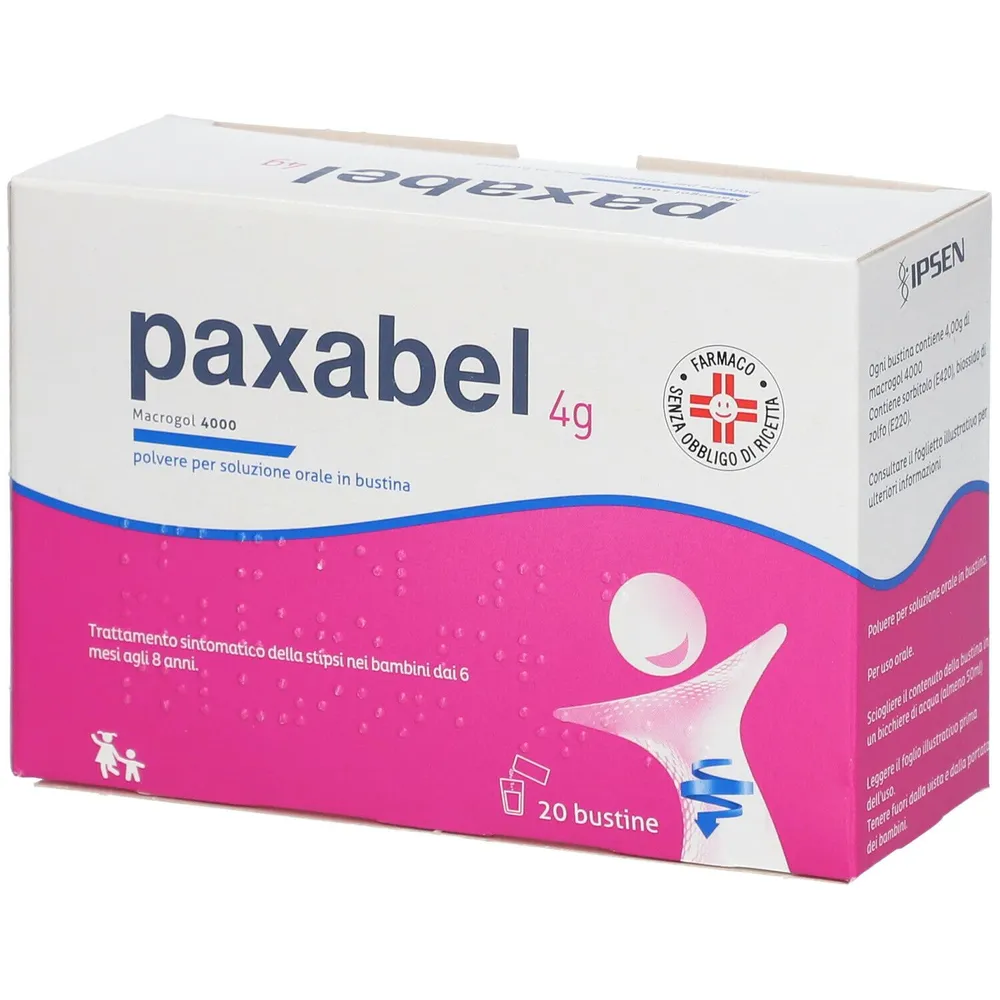
Table of Contents
- Package leaflet: Information for the patient
- Paxabel 10 g, oral solution powder in sachet
- 1. What Paxabel is and what it is used for
- 2. What you need to know before using Paxabel
- 3. How to take Paxabel
- 4. Possible side effects
- 5. How to store Paxabel
- 6. Package contents and other information
- Patient information leaflet
- Paxabel 4 g, powder for oral solution in sachet
- 1. What Paxabel is and what it is used for
- 2. What you need to know before using Paxabel
- 3. How to take Paxabel
- 4. Possible side effects
- 5. How to store Paxabel
- 6. Package contents and other information
Package leaflet: Information for the patient
Paxabel 10 g, oral solution powder in sachet
Macrogol 4000
Please read this leaflet carefully before using this medicine because it contains important information for you.
- Keep this leaflet. You may need to read it again.
- If you have any questions, ask your doctor or pharmacist.
- This medicine has been prescribed for you only. Do not give it to other people, even if their symptoms are the same as yours, as it may be harmful.
- Contact your doctor if you do not notice any improvement or if your symptoms worsen.
- If you experience any side effects, including those not listed in this leaflet, contact your doctor or pharmacist.
Contents of this leaflet:
- What Paxabel is and what it is used for
- What you need to know before taking Paxabel
- How to use Paxabel
- Possible side effects
- How to store Paxabel
- Contents of the pack and other information
1. What Paxabel is and what it is used for
Paxabel contains the active substance Macrogol 4000, which belongs to a class of medicines called osmotic laxatives. It works by drawing water into the stools, helping to relieve problems caused by very slow intestinal movement. Paxabel is not absorbed into the bloodstream or metabolized in the body. Paxabel is used for the symptomatic treatment of constipation in adults and children aged 8 years and older.
This medicine is a powder to be dissolved in a glass of water (at least 50 ml) and then drunk. It usually works within 24–48 hours after administration.
The treatment of constipation with any medicinal product should be considered an adjunct to an appropriate lifestyle and a healthy diet.
2. What you need to know before using Paxabel
Do not use Paxabel:
- if you are allergic (hypersensitive) to macrogol (polyethylene glycol) or to any of the other ingredients of this medicine (listed in section 6).
- if you have an existing illness, such as a serious intestinal disease: or inflammatory bowel disease (for example, ulcerative colitis, Crohn's disease, abnormal dilation of the intestine), or intestinal perforation or risk of intestinal perforation, or ileus, or suspected intestinal obstruction, or abdominal pain of undetermined cause.
Do not use this medicine if you suffer from any of the conditions listed above. If you are unsure, consult your
pharmacist or doctor before taking this medicine.
Warnings and precautions
Allergic reactions such as skin rash and swelling of the face or throat (angioedema) have been reported in adults after taking products containing macrogol (polyethylene glycol). Isolated cases of severe allergic reactions characterized by weakness, collapse, breathing difficulties, and general malaise have also been reported.
If you experience any of these symptoms, stop taking Paxabel immediately and consult a doctor without delay.
This medicine may sometimes cause diarrhoea. Check with your doctor or pharmacist before taking the medicine if:
- you have impaired liver or kidney function,
- you are taking diuretics (water tablets) or are elderly, as there is a risk of reduced sodium (salt) or potassium levels in the blood.
Before taking PAXABEL, consult your doctor or pharmacist if you know you have a swallowing disorder.
If you have difficulty swallowing, avoid mixing Paxabel with starch-based food thickeners. This may result in a watery liquid that could enter the lungs and cause pneumonia if you are unable to swallow properly.
Other medicines and Paxabel
There is a possibility that the absorption of other medicines may be temporarily reduced when used concomitantly with PAXABEL, particularly medicines with a narrow therapeutic index or short half-life such as digoxin, antiepileptics, coumarins, and immunosuppressive agents, potentially leading to reduced effectiveness.
Inform your doctor or pharmacist if you are taking, or have recently taken, any other medicines, including those not requiring a prescription.
If it is necessary to thicken liquids for safe ingestion, Paxabel may counteract the effect of the thickener.
Pregnancy and breastfeeding
Paxabel may be used during pregnancy and breastfeeding.
If you are pregnant, suspect you may be pregnant, are planning a pregnancy, or are breastfeeding, consult your doctor or pharmacist before taking this medicine.
Driving and using machines
No studies have been conducted on the effects on the ability to drive vehicles and/or operate machinery.
Important information about some of the ingredients of Paxabel
The presence of sulphur dioxide may rarely cause severe hypersensitivity reactions and breathing difficulties.
This medicine contains 1.7 mg of sorbitol per sachet.
Paxabel may still be used if you are diabetic or on a galactose-free diet.
This medicine contains less than 1 mmol of sodium (23 mg) per sachet, i.e. essentially "sodium-free".
3. How to take Paxabel
Take this medicine exactly as described in this leaflet or as directed by your doctor or pharmacist. If you are unsure, consult your doctor or pharmacist.
Use in adults and children aged over 8 years
The recommended dose is 1 or 2 sachets per day, preferably taken as a single dose in the morning.
The daily dose should be adjusted according to the clinical effect achieved and may vary from 1 sachet every other day (especially in children) up to a maximum of 2 sachets per day.
Dissolve the contents of the sachet in a glass of water (at least 50 ml) immediately before use and drink the solution.
It is important to note that:
- Paxabel takes 24–48 hours to take effect.
- In children, treatment with Paxabel should not last longer than 3 months.
- The improvement in the frequency of bowel movements achieved with Paxabel can be maintained through a healthy lifestyle and proper diet.
- Consult your doctor or pharmacist if your symptoms worsen or do not improve.
If you take more Paxabel than you should
Taking too much Paxabel may cause diarrhoea, stomach ache, and vomiting. Diarrhoea usually resolves when treatment is stopped or the dose is reduced.
If severe diarrhoea or vomiting occurs, contact your doctor as soon as possible, as treatment may be required to prevent loss of salts (electrolytes) in the fluids lost.
If you forget to take Paxabel
Take the next dose as soon as you remember. Do not take a double dose to make up for the missed dose.
4. Possible side effects
Like all medicines, Paxabel may cause side effects, although not everyone experiences them.
Side effects are generally mild and temporary and include:
In children:
Common (may affect up to 1 in 10 people)
- Abdominal pain (stomach ache)
- Diarrhoea which may cause rectal cramps (anus)
Uncommon (may affect up to 1 in 100 people)
- Nausea or vomiting
- Abdominal distension (bloating)
Not known (frequency cannot be estimated from the available data)
- Allergic reactions (hypersensitivity) (rash, urticaria, swelling of the face and throat, difficulty breathing, weakness or collapse)
In adults:
Common (may affect up to 1 in 10 people)
- Abdominal pain (stomach ache)
- Abdominal distension (bloating)
- Nausea or vomiting
- Diarrhoea
Uncommon (may affect up to 1 in 100 people)
- Vomiting
- Urgency to defecate
- Faecal incontinence
Not known (frequency cannot be estimated from the available data)
- Low blood potassium levels which may cause weakness, tremors, and irregular heartbeat
- Low sodium levels which may cause tiredness and confusion, muscle spasms, seizures, and coma
- Dehydration caused by severe diarrhoea, especially in the elderly
- Symptoms of an allergic reaction, such as skin redness, rash, urticaria, swelling of the face and throat, difficulty breathing, weakness, and collapse.
Reporting of side effects
If you experience any side effect, including those not listed in this leaflet, talk to your doctor or pharmacist.
You can also report side effects directly via the national reporting system at https://www.aifa.gov.it/content/segnalazioni-reazioni-avverse.
By reporting side effects, you can help provide more information on the safety of this medicine.
5. How to store Paxabel
Keep this medicine out of the sight and reach of children.
Do not use Paxabel after the expiry date stated on the carton. The expiry date refers to the last day of that month.
Paxabel requires no special storage conditions.
Do not dispose of any medicine via wastewater or household waste. Ask your pharmacist how to dispose of medicines you no longer use. This will help protect the environment.
6. Package contents and other information
What Paxabel contains
- The active substance is 10 g of macrogol 4000 per sachet.
- The other components are:
Sodium saccharin (E954), orange-grapefruit flavour containing essential oils of orange and grapefruit,
concentrated orange juice, citral, acetaldehyde, linalool, ethyl butyrate, alpha-terpineol, octanal, beta and
gamma hexenol, maltodextrin, arabic gum, sorbitol (E420), BHA (E320) and sulfur dioxide (E220).
Description of the appearance of Paxabel and package contents
Paxabel is a whitish powder with an orange-grapefruit odour and taste, to be mixed in a liquid.
Paxabel is available in single-dose sachets contained in packs of 10, 20, 50 and 100 sachets. Not all pack sizes may be marketed.
Marketing Authorisation Holder and Manufacturer
Marketing Authorisation Holder
IPSEN CONSUMER HEALTHCARE S.R.L.
Via Giorgio Stephenson, 43/A
20157 Milano, Italy
Manufacturer
Beaufour-Ipsen Industrie S.A.
Rue Ethe Virton
28100 Dreux (France)
This medicinal product is authorised in the European Economic Area member states under the following names:
Forlax 10g in Austria, Belgium, the Czech Republic, Estonia, France, Germany, Latvia, Lithuania, Luxembourg, Poland, Portugal, the Slovak Republic and the Netherlands.
Tanilas 10g in Greece, Idrolax in Ireland, and Dulcobalance in the United Kingdom.
Patient information leaflet
Paxabel 4 g, powder for oral solution in sachet
Macrogol 4000
Please read this leaflet carefully before administering this medicine, as it contains
important information for you.
- Keep this leaflet. You may need to read it again.
- If you have any questions, consult your doctor or pharmacist.
- This medicine has been prescribed for your child only. Do not give it to other people, even if their symptoms are the same, as it may be harmful.
- Contact your doctor if you do not notice any improvement or if symptoms worsen.
- If any adverse reaction occurs, including those not listed in this leaflet, consult your doctor or pharmacist.
Contents of this leaflet:
- What Paxabel is and what it is used for
- What you need to know before taking Paxabel
- How to use Paxabel
- Possible side effects
- How to store Paxabel
- Package contents and other information
1. What Paxabel is and what it is used for
Paxabel contains the active substance Macrogol 4000, which belongs to a class of medicines called osmotic laxatives. It works by drawing water into the stools, helping to relieve problems caused by very slow intestinal movement. Paxabel is not absorbed into the bloodstream or metabolized by the body.
Paxabel is used for the symptomatic treatment of constipation in children aged between 6 months and 8 years. This medicine is a powder that must be dissolved in a glass of water and then drunk.
The effect of PAXABEL occurs within 24–48 hours after administration.
Treatment of constipation with any medicinal product should be considered an adjunct to an appropriate lifestyle and a healthy diet.
2. What you need to know before using Paxabel
Do not use Paxabel:
- if your child is allergic (hypersensitive) to macrogol (polyethylene glycol) or to any of the other ingredients of this medicine (listed in section 6).
- if your child has an existing medical condition such as a serious intestinal disease: or inflammatory bowel disease (for example, ulcerative colitis, Crohn's disease, abnormal dilation of the intestine), or intestinal perforation or risk of intestinal perforation, or ileus, or suspected intestinal obstruction, or abdominal pain of undetermined cause.
Do not give this medicine to your child if they suffer from any of the conditions listed above. If you are unsure,
consult your pharmacist or doctor before administering the medicine.
Warnings and precautions
Allergic reactions such as skin rash and swelling of the face or throat (angioedema) have been reported in adults after taking products containing macrogol (polyethylene glycol). Isolated cases of severe allergic reactions characterized by weakness, collapse, breathing difficulties, and general malaise have also been reported.
If your child shows any of these symptoms, seek medical advice immediately.
An organic disorder must be ruled out before starting treatment. Consult your pharmacist or doctor before administering this medicine.
This medicine may sometimes cause diarrhoea. Consult your doctor or pharmacist before administering the medicine if your child:
- has impaired liver or kidney function
- is taking diuretics (water tablets), as there is a risk of reduced sodium (salt) or potassium levels in the blood.
Before taking PAXABEL, consult your doctor or pharmacist if you know you have a swallowing disorder.
If you have difficulty swallowing, avoid mixing Paxabel with starch-based food thickeners. This may result in a watery liquid that could enter the lungs and cause pneumonia if swallowing is not properly coordinated.
Other medicines and Paxabel
There is a possibility that the absorption of other medicines may be temporarily reduced when used with PAXABEL, particularly medicines with a narrow therapeutic index or short half-life such as digoxin, antiepileptics, coumarins, and immunosuppressive agents, potentially leading to reduced effectiveness.
Inform your doctor or pharmacist if your child is taking or has recently taken any other medicines, including those without a prescription.
If it is necessary to thicken liquids for safe ingestion, Paxabel may counteract the effect of the thickener.
Pregnancy and breastfeeding
Paxabel can be used during pregnancy and breastfeeding.
If you are pregnant, suspect you may be pregnant, planning to become pregnant, or are breastfeeding, ask your doctor or pharmacist for advice before taking this medicine.
Driving and using machines
No studies have been conducted on the effects on the ability to drive vehicles and/or use machinery.
Important information about some ingredients of Paxabel
The presence of sulfur dioxide may rarely cause severe hypersensitivity reactions and breathing difficulties.
This medicine contains 0.66 mg of sorbitol per sachet.
Paxabel can still be used in diabetic children or in children on a galactose-free diet.
This medicine contains less than 1 mmol of sodium (23 mg) per sachet, i.e. essentially "sodium-free".
3. How to take Paxabel
Take this medicine exactly as described in this leaflet or as directed by your doctor or pharmacist. If you have any doubts, consult your doctor or pharmacist.
The recommended dose varies depending on the child's age:
- From 6 months to 1 year: 1 sachet per day.
- From 1 to 4 years: 1 - 2 sachets per day.
- From 4 to 8 years: 2 - 4 sachets per day.
Dissolve the contents of the sachet in a glass of water (at least 50 ml) shortly before use and give it to your child to drink. If the dose is one sachet per day, administer it in the morning. If the dose is more than one sachet per day, administer the medicine in the morning and in the evening.
The daily dose in children older than 1 year may be adjusted according to the clinical response obtained.
It is important to know that:
- Paxabel takes 24 - 48 hours to take effect.
- In children, treatment duration should not exceed 3 months.
- The improvement in bowel movement frequency achieved with Paxabel can be maintained through a healthy lifestyle and proper diet.
- Consult your doctor or pharmacist if symptoms worsen or do not improve.
If you take more Paxabel than you should
Taking too much Paxabel may cause diarrhoea, stomach ache, and vomiting. Diarrhoea usually resolves when treatment is stopped or the dose is reduced.
If your child develops severe diarrhoea or vomiting, contact your doctor as soon as possible, as treatment may be needed to prevent loss of salts (electrolytes) in the fluids lost.
If you forget to take Paxabel
Give the next dose as soon as you remember. Do not give a double dose to make up for the missed dose.
4. Possible side effects
Like all medicines, Paxabel may cause side effects, although not everybody gets them.
Side effects are generally mild and temporary and include:
In children:
Common (may affect up to 1 in 10 people)
- Abdominal pain (stomach ache)
- Diarrhoea which may cause rectal spasms (anus)
Uncommon (may affect up to 1 in 100 people)
- Nausea or vomiting
- Abdominal distension (bloating)
Not known (frequency cannot be estimated from the available data)
- Allergic reactions (hypersensitivity) (skin rash, urticaria, swelling of the face and throat, difficulty breathing, weakness or collapse)
In adults, additional side effects have been observed:
Uncommon (may affect up to 1 in 100 people)
- Urgency to go to the toilet
- Faecal incontinence
Not known (frequency cannot be estimated from the available data)
- Low blood potassium levels which may lead to muscle weakness, tremors, and irregular heartbeat
- Low sodium levels which may lead to tiredness and confusion, muscle spasms, seizures and coma
- Dehydration caused by severe diarrhoea, especially in the elderly
- Skin redness
Reporting of side effects
If you experience any side effect, including those not listed in this leaflet, talk to your doctor or pharmacist.
You can also report side effects directly via the national reporting system at https://www.aifa.gov.it/content/segnalazioni-reazioni-avverse.
By reporting side effects, you can help provide more information on the safety of this medicine.
5. How to store Paxabel
Keep this medicine out of the sight and reach of children.
Do not use Paxabel after the expiry date stated on the packaging. The expiry date refers to the last day of that month.
Paxabel does not require any special storage conditions.
Do not dispose of medicines via wastewater or household waste. Ask your pharmacist how to dispose of medicines you no longer use. This will help protect the environment.
6. Package contents and other information
What Paxabel contains
The active substance is 4.00 g of macrogol 4000 per sachet.
The other components are:
sodium saccharin (E954), orange-grapefruit flavour containing essential oils of orange and grapefruit,
concentrated orange juice, citral, acetaldehyde, linalool, ethyl butyrate, alpha-terpineol, octanal, beta and gamma
hexenol, maltodextrin, arabic gum, sorbitol (E420), BHA (E320) and sulfur dioxide (E220).
Description of the appearance of Paxabel and contents of the pack
Paxabel is a whitish powder with an orange-grapefruit odour and taste, to be mixed in a liquid.
Paxabel is available in unit-dose sachets contained in packs of 10, 20, 30 and 50 sachets. It is possible
that not all pack sizes are marketed.
Marketing Authorisation Holder and Manufacturer
Marketing Authorisation Holder
IPSEN CONSUMER HEALTHCARE S.R.L.
Via Giorgio Stephenson, 43/A
20157 Milan, Italy
Manufacturer
Beaufour-Ipsen Industrie S.A.
Rue Ethe Virton
28100 Dreux (France)
This medicinal product is authorised in the Member States of the European Economic Area under the following names:
Forlax 4g in Austria, Belgium, Czech Republic, Estonia, France, Germany, Latvia, Lithuania, Luxembourg and Slovakia
Forlax Junior 4g in the Netherlands, Sweden and Portugal
Tanilas 4g in Greece