Pascorbin
Italy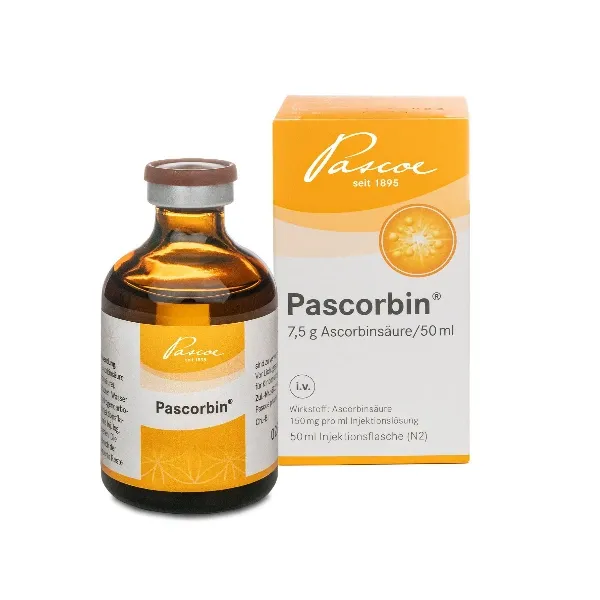
Instructions for Use
Package leaflet: Information for the user
Pascorbin 50 mg/mL injection solution or infusion solution
ascorbic acid
Please read all of this leaflet carefully before you start using this medicine because it contains important information for you.
Keep this leaflet. You may need to read it again.
If you have any questions, ask your doctor or pharmacist.
This medicine has been prescribed for you only. Do not give it to other people, even if their symptoms are the same as yours, because it may be harmful.
If you experience any adverse reactions, including those not listed in this leaflet, consult your doctor or pharmacist. See section 4.
Contents of this leaflet
- What Pascorbin is and what it is used for
- What you need to know before using Pascorbin
- How to use Pascorbin
- Possible side effects
- How to store Pascorbin
- Contents of the pack and other information
1. What Pascorbin is and what it is used for
Pascorbin is intended for the treatment of clinical conditions of vitamin C deficiency not amenable to dietary intake or oral vitamin C preparations, in particular:
- endothelial dysfunction, e.g. cardiovascular diseases
- after surgical intervention or trauma
- in critically ill patients
- sepsis
Pascorbin contains ascorbic acid (vitamina C) as the essential active ingredient, which cannot be produced internally by the human body.
Although food contains all the vitamins the body needs, vitamin C deficiency may occur in elderly individuals (over 65 years of age), heavy alcohol drinkers, smokers, pregnant women, breastfeeding mothers, and people with unbalanced dietary habits.
Extremely low levels of vitamin C in white blood cells are observed in patients with acute infections, severely impaired liver function, severe injuries (trauma, burns, major surgical procedures), and patients undergoing hemodialysis.
2. What you need to know before using Pascorbin
Do not use Pascorbin:
- if you are allergic to vitamin C or to any of the other ingredients of this medicine (listed in section 6)
- if you suffer from oxalate urolithiasis (a type of kidney or bladder stones) or hyperoxaluria (a condition in which excessive amounts of oxalate are present in the urine)
- if you have an iron overload/iron accumulation disorder (e.g. thalassemia, haemochromatosis, sideroblastic anaemia, red blood cell concentrate transfusions)
- if you have severe renal insufficiency (impaired kidney function)
- if you have glucose-6-phosphate dehydrogenase deficiency (an inherited disorder of red blood cell metabolism)
- at high doses, if you are under 12 years of age.
Warnings and precautions
Talk to your doctor before using Pascorbin.
Exercise particular caution with Pascorbin:
- if you need to undergo certain laboratory tests (including tests for glucose, uric acid, creatinine, inorganic phosphate): ascorbic acid may interfere with test results and thus lead to false readings. In such cases, your doctor will inform you whether you should avoid taking vitamin C one day prior to these tests.
During treatment with Pascorbin, it is important that you pay attention to your daily water intake (approximately 1.5–2 L per day).
To reduce the risk of kidney or urinary tract stone formation, it is recommended to avoid consuming additional foods rich in oxalate (e.g. rhubarb, spinach, beetroot, etc.) during treatment with Pascorbin.
If you have previously suffered from recurrent kidney stones, the maximum daily dose of 100–200 mg of vitamin C should not be exceeded, as there is an increased risk of calcium oxalate stone formation.
Note for diabetic patients:
Parenterally administered ascorbic acid may interfere with blood glucose measurements.
Children and adolescents
Children under 12 years of age should not receive more than 5–7 mg of ascorbic acid/kg body weight per day. High doses of Pascorbin are contraindicated in children under 12 years of age.
Other medicines and Pascorbin
The following drugs reduce vitamin C levels in the body and may therefore reduce the effectiveness of Pascorbin:
- acetylsalicylic acid (anti-inflammatory drug), such as aspirin
- nicotine from cigarettes
- alcohol
- appetite suppressants (e.g. fenfluramine)
- iron (taken as a dietary supplement)
- medicines used to treat epilepsy (e.g. phenytoin)
- oral contraceptives containing oestrogens (e.g. "the pill")
- antibiotics (e.g. tetracycline)
- flufenazine (for mental disorders): blood concentrations may decrease due to vitamin C therapy
Concomitant administration of vitamin C with deferoxamine mesylate/Desferal (used in iron overload) may cause cardiac dysfunction.
High doses of vitamin C may reduce the effect of oral anticoagulants.
Note for patients with renal insufficiency
Antacids containing aluminium in combination with vitamin C may lead to increased aluminium levels in the blood.
Due to the lack of complete clinical data, higher doses of vitamin C should be administered with a certain time interval from chemotherapy or radiotherapy. If vitamin C is infused before chemotherapy/radiotherapy, a time interval of 24 hours is recommended. If vitamin C is administered after chemotherapy/radiotherapy, an interval of at least 24 hours must be maintained. For chemotherapeutic agents with a half-life longer than 6 hours, an interval of 3–4 half-lives should be maintained.
Pascorbin with food and drinks
No interactions are expected.
Pregnancy and breastfeeding
If you are pregnant, think you may be pregnant, are planning to become pregnant, or are breastfeeding, consult your doctor or pharmacist before taking this medicine.
Ascorbic acid is excreted into the fetal circulation and breast milk. Daily doses of 100 to 500 mg of ascorbic acid should not be exceeded in pregnant women and breastfeeding mothers.
Due to its high vitamin C content, do not use Pascorbin if you are pregnant or breastfeeding.
Driving and using machines
If you experience side effects such as dizziness, nausea, or visual disturbances (see section 4. "Possible side effects"), your ability to drive or operate machinery may be impaired.
Pascorbin contains sodium
This medicine contains 324 mg of sodium (the main component of table salt) per vial. This corresponds to 16% of the maximum daily recommended dietary intake for an adult.
This should be taken into consideration for patients on a low-sodium diet.
3. How to use Pascorbin
Use this medicine exactly as your doctor has told you. If you have any doubts, consult your doctor or pharmacist.
The recommended dose is:
Adults:
The usual dose is 0.5–1.0 g of ascorbic acid (corresponding to 10–20 mL of solution). Depending on the clinical condition, up to 2.5 g of ascorbic acid per day may be used for infusion. Severe trauma or surgical procedures may require daily doses of at least 3 g of ascorbic acid to restore normal plasma levels.
More than one vial may be administered as a single dose. For instructions on handling the vial after first opening, see section 5.
Paediatric population:
Children under 12 years of age should not receive a dose exceeding 5–7 mg of ascorbic acid/kg body weight per day. High doses of Pascorbin are contraindicated in children under 12 years of age.
Method of administration:
For intravenous injection or infusion.
Pascorbin will be administered by your doctor.
The duration of treatment depends on the course of the disease and laboratory test results.
If you use more Pascorbin than you should
Due to the risk of kidney stone formation, see section 2. "Warnings and precautions".
If you forget to use Pascorbin
Consult your doctor to determine the next dose.
If you stop using Pascorbin
Discontinuing use of this medicine may compromise the success of treatment! If you experience unpleasant side effects, discuss further treatment with your doctor.
If you have any questions about the use of this medicine, consult your doctor or pharmacist.
4. Possible side effects
Like all medicines, this medicine can cause side effects, although not everybody gets them.
If you experience any of the following side effects, contact your doctor immediately, who will usually
promptly stop the injection/infusion.
Very rare: may affect up to 1 in 10,000 people
- respiratory hypersensitivity reactions, e.g. shortness of breath.
- skin hypersensitivity reactions, e.g. rash, urticaria, itching.
- transient circulatory problems (e.g. dizziness, nausea, headache, vision problems).
- reactions such as chills and elevated temperature have been observed in patients with acute infections.
- gastrointestinal disorders, e.g. nausea, vomiting, diarrhoea.
- renal oxalate stones.
- increased frequency of urination.
Reporting of side effects
If you experience any side effect, including those not listed in this leaflet,
please consult your doctor or pharmacist. You can also report side effects directly via the
national reporting system at https://www.aifa.gov.it/content/segnalazioni-reazioni-
avverse . Reporting side effects can help provide more information on the safety of this medicine.
5. How to store Pascorbin
Keep the vial in the outer packaging to protect the medicine from light.
Keep this medicine out of the sight and reach of children.
The preservative-free injectable or infusion solution is for single use only. It must be used
immediately after opening. Any unused solution must be discarded.
From a microbiological standpoint, the product should be used immediately. If not used immediately,
the storage times and conditions prior to use are the responsibility of the user and should normally not
exceed 24 hours at temperatures between 2 °C and 8 °C, unless the vial was opened under controlled
and validated aseptic conditions.
Do not use this medicine after the expiry date stated on the carton and label. The expiry date refers to
the last day of that month.
6. Package contents and other information
What Pascorbin contains
- The active substance is: ascorbic acid
- 1 vial containing 50 ml of injectable/infusion solution contains 2.5 g of ascorbic acid
- The other components are: sodium hydrogen carbonate and water for injections
Description of the appearance of Pascorbin and package contents
Pascorbin is a clear, yellowish injectable solution for intravenous injection or infusion.
Each package contains 1, 20, or 60 vials with 50 mL of injectable or infusion solution.
Not all pack sizes may be marketed.
Pascorbin is supplied in a 50 mL glass injection vial (brown glass, hydrolytic class II, Ph. Eur.) closed with a bromobutyl rubber stopper and an aluminium crimp cap.
Marketing Authorization Holder and Manufacturer
Marketing Authorization Holder
Pascoe pharmazeutische Präparate GmbH
Schiffenberger Weg 55
D-35394 Gießen
Germany
Manufacturer
Pascoe pharmazeutische Präparate GmbH
Europastrasse 2
D-35394 Gießen
Germany
This medicinal product is authorized in the European Economic Area countries under the following names:
Malta: Pascorbin 50 mg/ml solution for injection/infusion
Denmark: Pascoe C
Luxembourg: Pascorbin 50 mg/ml Injektions- oder Infusionslösung
Italy: Pascorbin
Norway: Vitamin C Pascoe
Sweden: Askorbinsyra Pascoe
For healthcare professionals only
Adults:
The usual dose is 0.5–1.0 g of ascorbic acid (corresponding to 10–20 mL of solution).
Depending on the clinical condition, up to 3 g of ascorbic acid per day may be administered by infusion.
In clinical studies involving patients with the approved indications, the following dosages have proven effective:
- Endothelial dysfunction: 1–3 g (20–60 mL)
- After surgery, trauma, and in critically ill patients: 2–3 g (40–60 mL)
- Sepsis: at least 1.5 g (30 mL)
Single doses exceeding one vial are possible (see section 5).
Paediatric population:
Children under 12 years of age must not receive more than 5–7 mg of ascorbic acid/kg body weight per day. High doses of Pascorbin are contraindicated in children under 12 years of age (see section 3).
Method of administration
For intravenous injection or infusion.
Injectable/infusion therapy must be administered by a physician.
Instructions for use and handling:
The preservative-free injectable/infusion solution in the vial is for single use only.
It must be used immediately after opening. Any unused solution must be discarded.
This page has been machine-translated and may contain inaccuracies. The original data is available in the manufacturing country's language.
Last data check: May 11, 2026 · Data source: Agenzia Italiana del Farmaco (AIFA)