Paracetamol Pensavital
Italy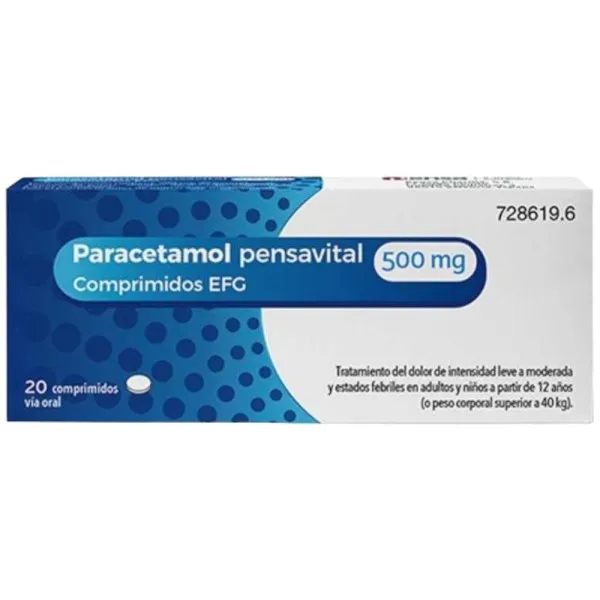
Table of Contents
- Package leaflet: Information for the user
- Paracetamolo Pensavital 500 mg tablets
- 1. What Paracetamolo Pensavital is and what it is used for
- 2. What you need to know before taking Paracetamol Pensavital
- 3. How to take Paracetamolo Pensavital
- 4. Possible side effects
- 5. How to store Paracetamol Pensavital
- 6. Package contents and other information
Package leaflet: Information for the user
Paracetamolo Pensavital 500 mg tablets
paracetamol
Equivalent medicine
Please read all of this leaflet carefully before taking this medicine because it contains important information for you.
Always take this medicine exactly as described in this leaflet or as your doctor or pharmacist has advised you.
- Keep this leaflet. You may need to read it again.
- If you need more information or advice, consult your pharmacist.
- If you experience any side effect, including those not listed in this leaflet, consult your doctor or pharmacist. See section 4.
- Consult your doctor if you do not notice any improvement or if you notice a worsening of symptoms after 3 days.
Contents of this leaflet:
- What Paracetamolo Pensavital is and what it is used for
- What you need to know before taking Paracetamolo Pensavital
- How to take Paracetamolo Pensavital
- Possible side effects
- How to store Paracetamolo Pensavital
- Contents of the pack and other information
1. What Paracetamolo Pensavital is and what it is used for
Paracetamol is a medicine that works by relieving pain and reducing fever (analgesic and antipyretic).
Paracetamolo Pensavital is used to reduce mild to moderate pain and/or fever in adults and children aged 10 years and older ( or weighing more than 33 kg ).
2. What you need to know before taking Paracetamol Pensavital
Do not take Paracetamol Pensavital
- if you are allergic to paracetamol or to any of the other ingredients of this medicine (listed in section 6).
Warnings and precautions
Talk to your doctor or pharmacist before taking Paracetamol Pensavital:
if you have kidney problems
if you have heart or lung diseases
if you have liver disease or are taking medicines that affect liver function
if you have anaemia (a reduction in red blood cells that may cause pale yellowish skin and lead to weakness or shortness of breath)
if you regularly consume large amounts of alcohol. Chronic alcoholics should be careful not to take more than 2 g of paracetamol every 24 hours.
if you are taking other medicines containing paracetamol, as they may seriously damage the liver
if you are asthmatic and sensitive to acetylsalicylic acid (aspirin).
You should not take paracetamol frequently for prolonged periods, as long-term or frequent use may cause liver problems. Speak with your doctor or pharmacist if you intend to take paracetamol for a longer period.
Do not use Paracetamol Pensavital without consulting a doctor if you have alcohol-related problems or if you have liver damage. Do not take Paracetamol Pensavital with alcohol. The effect of alcohol is not increased by taking Paracetamol Pensavital.
Never take more paracetamol than indicated in section 3 of this leaflet. A higher dose does not increase pain relief, but may cause severe liver damage. Symptoms of liver damage usually appear after a couple of days. Therefore, it is very important that you contact your doctor as soon as possible if you have taken a higher dose than recommended.
If you have high fever or signs of infection after more than 3 days of treatment, or if pain persists after more than 5 days of treatment, you should contact your doctor.
Children
Do not use in children under 10 years of age. For children under 10 years of age, consult your doctor or pharmacist, as other formulations with doses more suitable for this patient group are available.
Other medicines and Paracetamol Pensavital
Inform your doctor or pharmacist if you are taking, have recently taken, or might take any other medicines.
Do not take any other medicine containing paracetamol.
Paracetamol Pensavital may affect or be affected by other medicines. Inform your doctor or pharmacist if you are taking:
metoclopramide or domperidone (used to treat nausea (feeling unwell) or vomiting (feeling sick));
- colestyramine (used to reduce cholesterol levels in the blood). This medicine should be taken at least one hour before or after paracetamol.
- warfarin and other medicines used to thin the blood, in case daily pain relief is needed over a long period
- medicines used to increase urine elimination (loop diuretics such as those belonging to the furosemide group)
- probenecid (used for the treatment of gout)
- substances that induce liver enzymes e.g. rifampicin (used to treat infections) and medicines used to treat epilepsy such as barbiturates, phenytoin, carbamazepine, primidone
- lamotrigine (for the treatment of epilepsy), as paracetamol may reduce its effects
- propranolol (used to treat high blood pressure and heart rhythm disorders)
- flucloxacillin (an antibiotic), due to a serious risk of blood and fluid disturbances (metabolic acidosis with high anion gap) requiring urgent treatment, which may occur particularly in cases of severe renal impairment, sepsis (when bacteria and their toxins circulate in the blood causing organ damage), malnutrition, chronic alcoholism, and when taking the maximum daily dose of paracetamol.
Paracetamol Pensavital may interfere with certain laboratory tests, such as the measurement of uric acid and blood glucose levels.
Paracetamol Pensavital with food and alcohol
Taking paracetamol in patients who regularly consume alcohol (3 or more alcoholic drinks per day – beer, wine, spirits… daily) may cause liver damage.
Taking this medicine with food does not alter its effectiveness.
Pregnancy and breastfeeding
If you are pregnant, think you may be pregnant, are planning a pregnancy, or are breastfeeding, ask your doctor or pharmacist for advice before taking this medicine.
If necessary, paracetamol may be used during pregnancy. It is advisable to use the lowest possible dose that relieves pain and/or fever and to take it for the shortest possible time. Contact your doctor if pain and/or fever do not decrease or if you need to take the medicine more frequently.
Although paracetamol is excreted in breast milk in small amounts, no adverse effects in infants have been reported. Paracetamol at the recommended doses may be used briefly during breastfeeding.
Driving and using machines
Paracetamol does not affect or affects negligibly the ability to drive or use machines.
Paracetamol Pensavital contains sodium
This medicine contains less than 1 mmol (23 mg) of sodium per tablet, i.e. essentially “sodium-free”.
3. How to take Paracetamolo Pensavital
Take this medicine exactly as stated in this leaflet or as instructed by your doctor or pharmacist. If you have any doubts, consult your doctor or pharmacist.
Treatment should be initiated with the lowest effective dose.
The recommended dose is:
Adults and adolescents aged 15 years and older:
Take one or two tablets every 4-6 hours (3-4 times daily), but do not exceed the maximum daily dose of 6 tablets (3000 mg).
Children aged 12 years and older (or weighing more than 40 kg):
Take one 500 mg tablet up to 6 times daily.
The maximum daily dose must not exceed 6 tablets (3000 mg).
Children aged between 10 and 12 years (or weighing between 33 kg and 40 kg):
Take one 500 mg tablet up to 4 times daily.
The maximum daily dose must not exceed 4 tablets (2000 mg).
For oral use. The tablets should be taken with a glass of liquid, preferably water.
This medicine is not recommended for use in children under 10 years of age.
At least 4 hours should elapse between doses.
Do not use in combination with other products containing paracetamol.
Do not exceed the recommended dosage.
Patients with impaired renal or hepatic function
In patients with impaired renal or hepatic function, the dose should be reduced or the dosing interval increased. In patients with severely impaired renal function, the dosing interval for Paracetamolo Pensavital should be at least 8 hours. Consult your doctor or pharmacist.
Follow the instructions provided here unless your doctor has given you different advice.
Consult your doctor or pharmacist if you think this medicine is too strong or too weak.
If you take more Paracetamolo Pensavital than you should
If you take too much paracetamol, contact your doctor or pharmacist immediately. Even if you feel well, you may still risk liver damage.
To prevent liver damage, it is important that treatment is started as soon as possible (preferably within 10-12 hours after overdose).
Symptoms of overdose may include: nausea (feeling unwell), vomiting (sickness), anorexia (loss of appetite), yellowing of the skin and eyes (jaundice), abdominal pain, and risk of kidney or liver damage. In such cases, the patient must go to hospital immediately.
Patients undergoing treatment with barbiturates or chronic alcoholics may be more susceptible to the toxic effects of a paracetamol overdose.
If you forget to take Paracetamolo Pensavital
Do not take a double dose to make up for a missed dose.
If you have any further questions about the use of this medicine, consult your doctor or pharmacist.
4. Possible side effects
Like all medicines, this medicine can cause side effects, although not everyone will experience them.
This medicine may cause the following side effects:
Rare (may affect up to 1 in 1,000 people): discomfort, low blood pressure (hypotension), and increased blood transaminase levels.
Very rare (may affect up to 1 in 10,000 people): kidney disorders, cloudy urine, allergic dermatitis (skin rash), jaundice (yellowing of the skin), blood disorders (agranulocytosis, leucopenia, neutropenia, haemolytic anaemia), and hypoglycaemia (low blood sugar). There have been very rare cases of severe skin reactions.
Paracetamol may cause liver damage if taken in high doses or for prolonged periods.
Reporting of side effects
If you experience any side effect, including those not listed in this leaflet, talk to your doctor or pharmacist. You can also report side effects directly via the national reporting system at https://www.aifa.gov.it/content/segnalazioni-reazioni-avverse
By reporting side effects, you can help provide more information on the safety of this medicine.
5. How to store Paracetamol Pensavital
Keep this medicine out of the sight and reach of children.
Do not use this medicine after the expiry date stated on the packaging after Exp. The expiry date refers to the last day of that month.
This medicine does not require any special storage conditions.
Do not dispose of any medicine via wastewater or household waste. Ask your pharmacist how to dispose of medicines you no longer use. This will help protect the environment.
6. Package contents and other information
What Paracetamolo Pensavital contains
The active substance is paracetamol.
The other components are sodium carboxymethyl starch (Type A), purified water, pregelatinized starch,
povidone K30 (E1201), stearic acid (E570), crospovidone (E1202).
Description of the appearance of Paracetamolo Pensavital and pack sizes
Paracetamolo Pensavital tablets are white, biconvex, round tablets, marked with "PA" on one side, with a diameter of 11.0 ± 0.5 mm.
Paracetamolo Pensavital is available in blisters containing 20 tablets.
Not all pack sizes may be marketed.
Marketing Authorisation Holder and Manufacturer
Marketing Authorisation Holder
Towa Pharmaceutical S.p.A.
Via Enrico Tazzoli, 6
20154 Milan
Italy
Manufacturer
Galenicum Health, S.L.
Avda. Cornellà 144, 7º -1ª, Edificio Lekla
Esplugues de Llobregat
08950 Barcelona
Spain
or
SAG Manufacturing S.L.U
Crta. N-I, Km 36,
San Agustín de Guadalix,
28750 Madrid
Spain
This medicinal product is authorised in the European Economic Area countries under the following
names:
- Portugal: Paracetamol Amperlem 500 mg Comprimidos
- Italy: Paracetamolo Pensavital
Detailed and updated information on this product is available by scanning the QR Code on the outer packaging using a smartphone. The same information is also available at the following URL:
https://www.pensapharma.it/paracetamolo-pensavital-500mgcompresse/