Paracetamol Noridem
Italy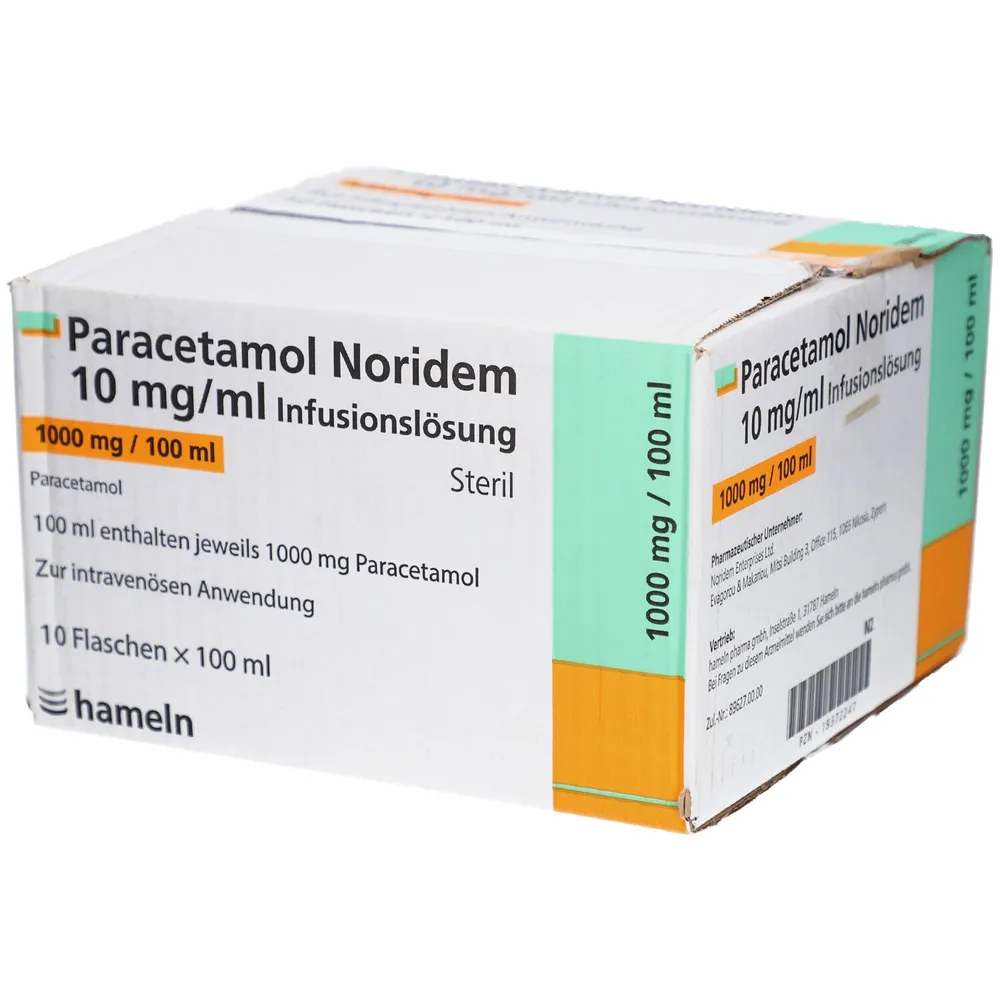
Table of Contents
- Package leaflet: Information for the user
- Paracetamol Noridem 10 mg/mL solution for infusion
- 1. What Paracetamol Noridem is and what it is used for
- 2. What you need to know before using Paracetamol Noridem
- 3. How to use Paracetamol Noridem
- 4. Possible side effects
- 5. How to store Paracetamol Noridem
- 6. Package contents and other information
Package leaflet: Information for the user
Paracetamol Noridem 10 mg/mL solution for infusion
paracetamol
Generic medicine
Please read all of this leaflet carefully before you start using this medicine, as it contains important information for you.
- Keep this leaflet. You may need to read it again.
- If you have any questions, ask your doctor, pharmacist, or nurse.
- This medicine has been prescribed for you only. Do not give it to other people, even if they have the same symptoms as yours, because it may be harmful.
- If you experience any adverse reaction, including those not listed in this leaflet, tell your doctor, pharmacist, or nurse. See section 4.
Contents of this leaflet
- What Paracetamol Noridem is and what it is used for
- What you need to know before using Paracetamol Noridem
- How to use Paracetamol Noridem
- Possible side effects
- How to store Paracetamol Noridem
- Contents of the pack and other information
1. What Paracetamol Noridem is and what it is used for
This medicinal product is an analgesic (relieves pain) and an antipyretic (reduces fever).
The 100 mL bottle is intended for adults, adolescents, and children weighing more than 33 kg.
The 50 mL bottle is suitable for full-term newborns, infants, young children, and children weighing less than 33 kg.
It is indicated for the short-term treatment of moderate pain, especially following surgical procedures, and for the short-term treatment of fever.
2. What you need to know before using Paracetamol Noridem
Do not use Paracetamol Noridem
- if you are allergic to paracetamol or to any of the other ingredients of this medicine (listed in section 6).
- if you are allergic to propacetamol (another injectable analgesic and paracetamol precursor).
- if you have severe liver disease.
Warnings and precautions
Long-term or frequent use of this medicine is not recommended. This medicine should be used only until you are able to take oral painkillers again.
Your doctor will ensure that you do not receive doses higher than those recommended, as this may lead to severe liver damage.
Talk to your doctor, pharmacist, or nurse before using Paracetamol Noridem:
- if you have liver or kidney disease or alcohol abuse;
- if you are taking other medicines containing paracetamol;
- if you have nutritional problems (malnutrition) or dehydration;
- if you have glucose-6-phosphate dehydrogenase (G6PD) deficiency, an enzyme disorder of red blood cells that may lead to their destruction (haemolysis);
- if you have ever developed a severe skin rash or skin peeling, blisters and/or mouth ulcers after taking paracetamol. Serious skin reactions, including Stevens-Johnson syndrome, toxic epidermal necrolysis, and acute generalized exanthematous pustulosis, have been reported with paracetamol treatment. Stop using paracetamol and contact your doctor immediately if you notice any of the symptoms described in section 4. Inform your doctor before treatment if any of the conditions listed above apply to you.
During treatment with Paracetamol Noridem, inform your doctor immediately if:
- you have serious conditions such as severe kidney impairment or sepsis (when bacteria and their toxins circulate in the blood causing organ damage), or if you have malnutrition, chronic alcoholism, or are also taking flucloxacillin (an antibiotic). In patients with these conditions, a serious condition called metabolic acidosis (an imbalance in blood and body fluids) has been reported when paracetamol is used at regular doses for prolonged periods or when paracetamol is taken together with flucloxacillin. Symptoms of metabolic acidosis may include: severe breathing difficulties with rapid and deep breathing, drowsiness, nausea, and vomiting.
Other medicines and Paracetamol Noridem
Tell your doctor or pharmacist if you are taking, have recently taken, or might take any other medicine.
In particular, inform your doctor if you are taking:
- medicines containing paracetamol or propacetamol. Inform your doctor if you are taking other medicines containing paracetamol or propacetamol. Your doctor will take this into account to avoid exceeding the recommended daily dose (indicated in section 3);
- probenecid (for gout). Your doctor may reduce the dose of Paracetamol Noridem if you are taking both medicines at the same time;
- salicylamide (an anti-inflammatory medicine);
- medicines that induce liver enzymes;
- medicines used to thin the blood ( anticoagulants ), taken orally, such as warfarin. Your doctor may closely monitor the effect of anticoagulants;
- flucloxacillin (an antibiotic), due to a serious risk of a blood and fluid imbalance (called metabolic acidosis) that requires urgent treatment (see section 2).
Tell your doctor or pharmacist if you are taking or have recently taken any other medicines, including those not requiring a prescription.
Pregnancy and breastfeeding
If you are pregnant, think you may be pregnant, planning to become pregnant, or breastfeeding, consult your doctor or pharmacist before taking this medicine.
Pregnancy
Paracetamol Noridem may be used during pregnancy if necessary. However, in such cases, your doctor must assess whether the treatment is advisable.
Consult your doctor or pharmacist before taking any medicine.
Breastfeeding
Paracetamol Noridem may be used during breastfeeding.
Consult your doctor or pharmacist before taking any medicine.
Driving and using machines
Paracetamol Noridem has no effect or a negligible effect on the ability to drive and use machines.
Paracetamol Noridem contains sodium
This medicine contains less than 1 mmol (23 mg) of sodium per 100 mL, i.e., essentially “sodium-free”.
3. How to use Paracetamol Noridem
Intravenous use
Paracetamol Noridem will be administered to you by a healthcare professional through infusion into one of your veins.
The dose will be adjusted by the doctor according to your body weight and general condition.
The doctor will ensure that you do not receive doses exceeding the recommended amount.
The 100 mL vial is intended for adults, adolescents, and children weighing more than 33 kg.
The 50 mL vial is suitable for term neonates, infants, young children, and children weighing less than 33 kg.
Dosage
Dosage based on patient's weight (refer to the following dosage table)
| Patient weight | Dose per administration | Volume per administration | Maximum volume of Paracetamol Noridem (10 mg/mL) per administration based on the upper weight limit of the group (mL)** | Maximum daily dose*** |
| ≤10 kg* | 7.5 mg/kg | 0.75 mL/kg | 7.5 mL | 30 mg/kg |
| from >10 kg to ≤33 kg | 15 mg/kg | 1.5 mL/kg | 49.5 mL | 60 mg/kg, not exceeding 2 g |
| from >33 kg to ≤50 kg | 15 mg/kg | 1.5 mL/kg | 75 mL | 60 mg/kg, not exceeding 3 g |
| >50 kg with additional risk factors for hepatotoxicity | 1 g | 100 mL | 100 mL | 3 g |
| >50 kg without additional risk factors for hepatotoxicity | 1 g | 100 mL | 100 mL | 4 g |
* Preterm neonates: safety and efficacy data are not available for preterm neonates.
** Patients of lower body weight will require smaller volumes.
The minimum interval between each administration must be at least 4 hours.
The minimum interval between each administration in patients with severe renal impairment must
be at least 6 hours.
No more than 4 doses should be administered within 24 hours.
***Maximum daily dose: the maximum daily dose reported in the table above applies to
patients who are not taking other products containing paracetamol and should be adjusted accordingly, taking into account such products.
Paracetamol in solution is administered as a 15-minute intravenous infusion.
Inform your doctor or pharmacist if you feel that the effect of Paracetamolo Noridem is too strong or too weak.
If you use more Paracetamolo Noridem than you should
Contact your doctor immediately if you or your child have taken an excessive dose of this
medicinal product, even if you or your child appear to be well. This is because an overdose of
paracetamol may cause delayed but severe liver damage.
In case of overdose, symptoms generally appear within the first 24 hours and may include:
nausea, vomiting, anorexia, pallor, abdominal pain, and risk of liver damage.
If you have any doubts about the use of this medicinal product, consult your doctor or pharmacist.
4. Possible side effects
Like all medicines, this medicine can cause side effects, although not everybody gets them.
Possible side effects include:
Very rare (may affect up to 1 in 10,000 people):
Very rare cases of severe skin reactions have been reported.
- Allergic reaction. Signs of an allergic reaction include:
- skin rash,
- sudden wheezing,
- difficulty breathing,
- swelling of the eyelids, face, lips or throat.
In isolated cases, changes in laboratory test results have been observed, requiring regular blood tests:
- abnormal decrease in levels of certain types of blood cells (platelets, white blood cells), possibly leading to bleeding from the nose or gums. If this occurs, inform your doctor.
If you experience any of the symptoms listed above, stop treatment immediately and
inform your doctor.
Rare (may affect up to 1 in 1,000 people):
- general feeling of being unwell,
- drop in blood pressure,
- changes in laboratory test results: abnormal increase in liver enzyme levels detected in blood tests. If any of the above situations occur, inform your doctor, as regular blood tests may subsequently be required.
Stop taking paracetamol and contact your doctor immediately if you notice any of the
following symptoms:
- flat, red spots, target-shaped or circular rashes on the trunk, often with central blisters, skin peeling, mouth ulcers, or sores in the throat, nose, genitals and eyes. These serious skin rashes may be preceded by fever and flu-like symptoms (Stevens-Johnson syndrome and toxic epidermal necrolysis).
- A widespread red, scaly rash, with skin swelling and blisters accompanied by fever at the beginning of treatment (acute generalized exanthematous pustulosis).
Cases of skin redness, flushing, itching and abnormally rapid heartbeat have been reported.
Cases of pain and burning sensation at the site of administration have also been reported.
Frequency not known (frequency cannot be estimated from the available data):
A serious condition causing the blood to become more acidic (called metabolic acidosis), in patients with severe illness who are using paracetamol (see section 2).
Reporting of side effects
If you experience any side effects, including those not listed in this leaflet, talk to your doctor, pharmacist or nurse. You can also report side effects directly via the national reporting system at https://www.aifa.gov.it/content/segnalazioni-reazioni-avverse . Reporting side effects can help provide more information on the safety of this medicine.
5. How to store Paracetamol Noridem
Keep this medicine out of the sight and reach of children.
Do not use this medicine after the expiry date stated on the packaging after "Exp".
The expiry date refers to the last day of that month.
Do not store above 30°C. Do not refrigerate or freeze.
Keep the vial in the metallized plastic bag and cardboard box to protect the medicine from light.
For the 50 mL vial, after dilution in a sodium chloride 9 mg/mL (0.9%) solution or glucose 50 mg/mL (5%) solution: do not store for longer than 1 hour (including infusion time).
Before administration, the solution should be visually inspected. Do not use this medicine if particles or discoloration are observed.
For single use only. The medicine must be used immediately after opening. Any unused solution remaining must be discarded. Do not dispose of medicines via wastewater or household waste. Ask your pharmacist how to dispose of medicines no longer required. This will help protect the environment.
6. Package contents and other information
What Paracetamol Noridem contains
- The active substance is paracetamol. Each 100 mL vial contains 1 g of paracetamol. Each 50 mL vial contains 500 mg of paracetamol. 1 mL contains 10 mg of paracetamol.
- The other components are: mannitol, disodium phosphate anhydrous, hydrochloric acid (for pH adjustment), sodium hydroxide (for pH adjustment) and water for injections.
Description of the appearance of Paracetamol Noridem and contents of the pack
Paracetamol Noridem 10 mg/mL infusion solution is a clear, slightly yellowish infusion solution.
Paracetamol Noridem is packed in cardboard boxes containing polypropylene vials of 50 mL. Each vial is enclosed in a metallised plastic bag.
Paracetamol Noridem is packed in cardboard boxes containing polypropylene vials of 100 mL. Each vial is enclosed in a metallised plastic bag.
The 50 mL and 100 mL vials are available in packs of 1, 5, 10 and 12 vials.
Not all pack sizes may be marketed.
Marketing Authorisation Holder and Manufacturer
Marketing Authorisation Holder:
Noridem Enterprises Limited
Evagorou And Makariou
Mitsi Building 3, Office 115
1065 Nicosia, Cyprus
Manufacturer:
DEMO S.A. PHARMACEUTICAL INDUSTRY
National Road Athens Lamia 21 Km,
14568 Kryoneri, Attikis, Greece
T: +30 210 8161802
This medicinal product is authorised in the European Economic Area Member States under the following names:
Portugal: Paracetamol Noridem
Netherlands: Paracetamol Noridem 10 mg/ml oplossing voor infusie
France: Paracetamol Noridem 10 mg/ml, solution pour perfusion
Belgium: Paracetamol Noridem 10 mg/ml, solution pour perfusion /
Paracetamol Noridem 10 mg/ml oplossing voor infusie /
Paracetamol Noridem 10 mg/ml, Infusionslösung
Luxembourg: Paracetamol Noridem 10 mg/ml, solution pour perfusion
Austria: Paracetamol Noridem 10 mg/ml, Infusionslösung
Germany: Paracetamol Noridem 10 mg/ml Infusionslösung
Czech Republic: Paracetamol Noridem
Slovak Republic: Paracetamol Noridem 10 mg/ml infúzny roztok
Spain: Paracetamol Noridem 10 mg/ml solución para perfusión EFG
Denmark: Paracetamol Noridem
Finland: Paracetamol Noridem
Norway: Paracetamol Noridem
Sweden: Paracetamol Noridem
Hungary: Paracetamol Noridem 10 mg/ml oldatos infúzió
Ireland: Paracetamol Noridem 10 mg/ml solution for infusion
Italy: Paracetamolo Noridem
Poland: Paracetamol Noridem
Romania: Paracetamol Noridem 10 mg/ml Soluţie perfuzabilă
The following information is intended exclusively for physicians or healthcare professionals:
Below is a summary of information regarding dosage, dilution, administration and storage of Paracetamol Noridem. Refer to the Summary of Product Characteristics for complete prescribing information.
Intravenous use
The 100 mL vial is intended for adults, adolescents and children weighing more than 33 kg.
The 50 mL vial is intended for full-term neonates, infants, young children and children weighing less than 33 kg.
Dosage
The dosage is based on the patient's body weight (refer to the dosing table below).
| Patient weight | Dose per administration | Volume per administration | Maximum volume of Paracetamol Noridem (10 mg/mL) per administration based on the upper weight limit of the group (mL)** | Maximum daily dose*** |
| ≤10 kg* | 7.5 mg/kg | 0.75 mL/kg | 7.5 mL | 30 mg/kg |
| from >10 kg to ≤33 kg | 15 mg/kg | 1.5 mL/kg | 49.5 mL | 60 mg/kg without exceeding 2 g |
| from >33 kg to ≤50 kg | 15 mg/kg | 1.5 mL/kg | 75 mL | 60 mg/kg without exceeding 3 g |
| >50 kg with additional risk factors for hepatotoxicity | 1 g | 100 mL | 100 mL | 3 g |
| >50 kg without additional risk factors for hepatotoxicity | 1 g | 100 mL | 100 mL | 4 g |
* Preterm neonates: Safety and efficacy data in preterm neonates are not available
** Patients of lower body weight will require smaller volumes.
The minimum interval between each administration must be at least 4 hours.
The minimum interval between each administration in patients with severe renal impairment
must be at least 6 hours.
No more than 4 doses should be administered within 24 hours.
***Maximum daily dose: The maximum daily dose reported in the table above refers to
patients who are not taking other products containing paracetamol and should be adjusted accordingly,
taking such products into account.
Method of administration
RISK OF THERAPEUTIC ERRORS
Caution must be exercised to avoid dosing errors due to confusion between
milligrams (mg) and millilitres (mL), which may lead to accidental overdose and
Paracetamol solution is administered as a 15-minute intravenous infusion.
Patients with body weight ≤10 kg:
- The Paracetamol Noridem vial must not be hung as in the case of an infusion due to the small volume of medicinal product to be administered in this population.
- The volume to be administered must be withdrawn from the vial and may be given undiluted or diluted up to one-tenth (one volume of Paracetamol Noridem in nine volumes of diluent) in a sodium chloride 9 mg/mL (0.9%) solution or in a glucose 50 mg/mL (5%) solution and administered over 15 minutes.
- A 5 mL or 10 mL syringe must be used to measure the appropriate dose according to the child's weight and desired volume. However, the volume must never exceed 7.5 mL per dose.
- The user must consult the product information for dosing instructions.
- For 50 mL and 100 mL vials, a 0.8 mm (21 gauge) needle must be used and the stopper must be punctured vertically at the specifically indicated point.
- It may also be diluted in a sodium chloride 9 mg/mL (0.9%) solution or glucose 50 mg/mL (5%) solution up to one-tenth (one volume of Paracetamol Noridem in nine volumes of diluent).
- The diluted solution must be inspected visually and must not be used if opalescence, visible particles or precipitate are present.