Palforzia
Italy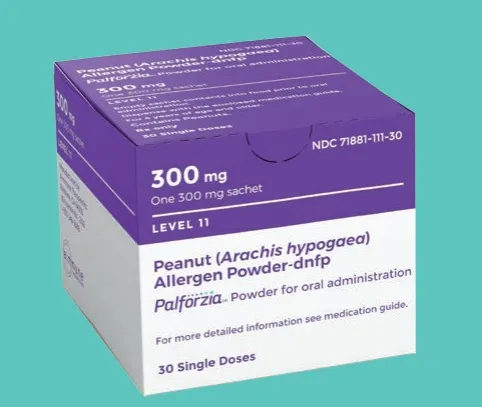
Table of Contents
- Package leaflet: Information for the patient
- PALFORZIA 0.5 mg oral powder in open capsules, 1 mg oral powder in open capsules, 10 mg oral powder in open capsules, 20 mg oral powder in open capsules, 100 mg oral powder in open capsules, 300 mg oral powder in sachets
- 1. What PALFORZIA is and what it is used for
- 2. What you need to know before taking PALFORZIA
- 3. How to take PALFORZIA
- 4. Possible side effects
- 5. How to store PALFORZIA
- 6. Package contents and other information
Package leaflet: Information for the patient
PALFORZIA 0.5 mg oral powder in open capsules, 1 mg oral powder in open capsules, 10 mg oral powder in open capsules, 20 mg oral powder in open capsules, 100 mg oral powder in open capsules, 300 mg oral powder in sachets
Defatted powder of seeds of Arachis hypogaea L. (peanuts)
Please read all of this leaflet carefully before taking this medicine because it contains important information for you.
- Keep this leaflet. You may need to read it again.
- If you have any questions, ask your doctor.
- This medicine has been prescribed for you only. Do not give it to other people, even if their symptoms are the same as yours, because it could be harmful.
- If you experience any adverse reaction, including those not listed in this leaflet, consult your doctor. See section 4.
Contents of this leaflet
- What PALFORZIA is and what it is used for
- What you need to know before taking PALFORZIA
- How to take PALFORZIA
- Possible side effects
- How to store PALFORZIA
- Contents of the pack and other information
1. What PALFORZIA is and what it is used for
PALFORZIA contains peanut protein derived from defatted peanut seed powder. It belongs to a category of medicines called food allergens. It is a treatment for people who are allergic to peanuts (Arachis hypogaea L.).
PALFORZIA is intended for children and adolescents aged 1 to 17 years, as well as those who reach adulthood during treatment.
PALFORZIA works in individuals with peanut allergy by gradually increasing the body's ability to tolerate small amounts of peanuts (desensitisation). PALFORZIA may help reduce the severity of allergic reactions that occur after exposure to peanuts.
PALFORZIA is not effective against other nut allergies or other food allergies.
While receiving PALFORZIA treatment, you must continue to strictly avoid consuming peanuts.
2. What you need to know before taking PALFORZIA
Do not take PALFORZIA
- if you are allergic to any of the other ingredients of this medicine (listed in section 6)
- if you have severe asthma or if your asthma is not under control (according to your doctor's assessment)
- if you have had a condition called "food protein-induced enterocolitis syndrome" (FPIES) in the past 12 months (applicable to children aged 1 to 3 years)
- if you have ever had growth or developmental problems, i.e. "failure to thrive" (applicable to children aged 1 to 3 years)
- if you have or have ever had swallowing difficulties or chronic gastrointestinal disorders
- if you have or have ever had a severe mast cell disorder (according to your doctor's assessment)
- if you have experienced severe or potentially life-threatening anaphylaxis within the previous 60 days before starting treatment.
Warnings and precautions
Talk to your doctor before taking PALFORZIA and inform them of any medical conditions you may have.
While taking PALFORZIA, you must not consume any type of peanut or foods containing peanuts through your diet.
It is important to record the batch number of PALFORZIA. Each time you receive a new pack of PALFORZIA, note down the date and the batch number (found on the packaging after "Lot") and keep this information in a safe place.
PALFORZIA does not treat symptoms of peanut allergy and must not be taken during an allergic reaction.
Your doctor will advise you on the best time to start treatment, depending on any medical conditions you may have.
PALFORZIA contains the substance to which patients allergic to peanuts react. Allergic reactions to PALFORZIA may occur during treatment. These reactions usually occur within the first two hours after taking a dose of PALFORZIA and are generally mild or moderate, but may sometimes be severe. Patients aged 12 years or older and/or those with high sensitivity to peanuts may be at greater risk of experiencing allergic symptoms during treatment.
Stop taking PALFORZIA and seek immediate medical help if you experience any of the following symptoms:
- difficulty breathing
- throat tightness or a sensation of throat fullness
- difficulty swallowing
- voice changes
- dizziness or fainting or a sense of impending doom
- severe stomach cramps or pain, vomiting or diarrhoea
- severe skin redness or itching
- worsening of asthma or any other respiratory problems
- heartburn, difficulty swallowing, pain when swallowing, stomach pain or chest pain that does not go away or worsens
Certain conditions or factors may increase the likelihood of an allergic reaction. These include:
- worsening of asthma
- presence of an open sore or other damage to the lining tissue of the mouth or the passage from the mouth to the stomach (oesophagus)
- physical exercise
- taking a very hot bath or shower
- extreme fatigue or having had little sleep
- for women, the menstrual period
- taking certain painkillers such as aspirin or ibuprofen
- consuming alcohol
- stress
- taking PALFORZIA on an empty stomach
- having an illness such as a cold or flu or other viral infections
To avoid some of these factors affecting you, there are certain actions you should take. These factors include: physical exercise, hot bath or shower, alcohol consumption, or taking this medicine on an empty stomach. See the sections “PALFORZIA with food, drink and alcohol” and “Instructions for administration” for advice on how to proceed.
For all other conditions or factors listed above, consult your doctor if you experience allergic reactions during such activities.
Your doctor will prescribe an auto-injectable adrenaline, which you must always carry with you in case of a severe allergic reaction. Your doctor will explain how to recognize an allergic reaction and will teach you when and how to use the adrenaline. If you have any questions about its use, consult your doctor and read the adrenaline patient information leaflet.
If you use adrenaline, do not take any further doses of PALFORZIA and seek immediate medical help right away.
Peanut desensitization with PALFORZIA takes time. The ability to tolerate gradually increasing small amounts of peanut has been demonstrated after completing all stages of the up-dosing regimen of PALFORZIA and after at least 3 months of maintenance therapy, and this ability continues to improve over time.
You must take PALFORZIA every day to maintain the desensitization provided by the medicine. Missing doses may increase the risk of allergic reactions.
Treatment with PALFORZIA may not work in all patients.
Children and adolescents
PALFORZIA is intended for children and adolescents aged 1 to 17 years, including those who turn 18 during treatment.
Do not give this medicine to children under 1 year of age, as it is not known whether PALFORZIA is safe and effective in this age group.
Other medicines and PALFORZIA
Inform your doctor if you are taking, have recently taken, or might take any other medicines.
PALFORZIA with food, drink and alcohol
PALFORZIA must not be mixed with liquids (such as water, milk, juice, soup, smoothie).
Do not consume alcohol or medicines containing alcohol within 2 hours before and 2 hours after taking PALFORZIA, as this may increase the likelihood of an allergic reaction.
Pregnancy, breastfeeding and fertility
Do not start treatment with PALFORZIA if you are pregnant or planning to become pregnant.
If you are pregnant, suspect you may be pregnant, are planning a pregnancy, or are breastfeeding with breast milk, consult your doctor before taking this medicine.
Driving and using machines
PALFORZIA may slightly affect the ability to drive, ride a bicycle, or use machinery. Exercise caution for 2 hours after taking a dose of PALFORZIA if you experience an allergic reaction that affects your ability to drive, ride a bicycle, or use machinery. Wait until all symptoms of an allergic reaction have completely resolved before driving, riding a bicycle, going to the playground, or using machinery.
3. How to take PALFORZIA
Take this medicine exactly as directed by your doctor. If you have any doubts, consult your doctor.
PALFORZIA must be prescribed by physicians experienced in the diagnosis and treatment of allergies and allergic reactions, including anaphylaxis.
How is PALFORZIA taken?
Administration
Treatment with PALFORZIA consists of three phases: initial dose escalation, up-dosing, and maintenance. You must complete these treatment phases in the order prescribed by your doctor. During the initial dose escalation and up-dosing phases, the dose of PALFORZIA is increased in a specific manner. During the maintenance phase, you take the same daily dose of PALFORZIA every day.
To maintain the level of desensitization to peanuts, you must take PALFORZIA every day.
If you feel unwell or believe your asthma is less well controlled, inform your doctor on the day of your clinic visit.
Initial dose escalation
You will receive the first doses (initial dose escalation) of PALFORZIA over approximately 4–5 hours at your doctor's clinic. On the first day, you will receive 0.5 mg, 1 mg, 1.5 mg, 3 mg, and 6 mg of PALFORZIA.
Patients aged 1 to 3 years:
On the first day, you will receive 0.5 mg, 1 mg, 1.5 mg, and 3 mg of PALFORZIA.
Patients aged 4 to 17 years:
On the first day, you will receive 0.5 mg, 1 mg, 1.5 mg, 3 mg, and 6 mg of PALFORZIA.
Up-dosing
If you tolerate the initial dose escalation phase, you will be asked to return to the clinic on another day (usually the next day) to begin the up-dosing phase. The first dose at each up-dosing level is administered by your doctor in the clinic. If the patient tolerates the first dose at a new dosage level, the doctor will instruct the patient to continue taking that dose daily at home for approximately 2 weeks. The patient must remain under medical observation for at least 60 minutes after administration of the first dose at each new dosage level, until discharge is permitted.
Patients aged 1 to 3 years:
There are 12 different up-dosing levels, starting from PALFORZIA 1 mg (level 0) up to PALFORZIA 300 mg (level 11).
The up-dosing levels are shown in the following table:
| Daily dose | Dose level | Dose presentation |
| 1 mg | level 0 | 1 capsule of 1 mg (red) |
| 3 mg | level 1 | 3 capsules of 1 mg (red) |
| 6 mg | level 2 | 6 capsules of 1 mg (red) |
| 12 mg | level 3 | 2 capsules of 1 mg (red) and 1 capsule of 10 mg (blue) |
| 20 mg | level 4 | 1 capsule of 20 mg (white) |
| 40 mg | level 5 | 2 capsules of 20 mg (white) |
| 80 mg | level 6 | 4 capsules of 20 mg (white) |
| 120 mg | level 7 | 1 capsule of 20 mg (white) and 1 capsule of 100 mg (red) |
| 160 mg | level 8 | 3 capsules of 20 mg (white) and 1 capsule of 100 mg (red) |
| 200 mg | level 9 | 2 capsules of 100 mg (red) |
| 240 mg | level 10 | 2 capsules of 20 mg (white) and 2 capsules of 100 mg (red) |
| 300 mg | level 11 | 1 sachet of 300 mg |
Before starting maintenance treatment, all 12 up-dosing levels must have been completed. At least 24 weeks are required to complete all up-dosing levels.
Patients aged 4 to 17 years:
In this phase, 11 different up-dosing levels are planned, starting with PALFORZIA 3 mg (level 1) and increasing up to PALFORZIA 300 mg (level 11).
The up-dosing levels are shown in the following table:
| Daily dose | Dose level | Dose presentation |
| 3 mg | level 1 | 3 capsules of 1 mg (red) |
| 6 mg | level 2 | 6 capsules of 1 mg (red) |
| 12 mg | level 3 | 2 capsules of 1 mg (red) and 1 capsule of 10 mg (blue) |
| 20 mg | level 4 | 1 capsule of 20 mg (white) |
| 40 mg | level 5 | 2 capsules of 20 mg (white) |
| 80 mg | level 6 | 4 capsules of 20 mg (white) |
| 120 mg | level 7 | 1 capsule of 20 mg (white) and 1 capsule of 100 mg (red) |
| 160 mg | level 8 | 3 capsules of 20 mg (white) and 1 capsule of 100 mg (red) |
| 200 mg | level 9 | 2 capsules of 100 mg (red) |
| 240 mg | level 10 | 2 capsules of 20 mg (white) and 2 capsules of 100 mg (red) |
| 300 mg | level 11 | 1 sachet of 300 mg |
It is necessary to complete all 11 levels of the up-dosing phase before starting maintenance treatment. At least 22 weeks are required to complete all levels of the up-dosing phase.
During the up-dosing phase, your doctor will visit you approximately every 2 weeks to evaluate you and determine the next up-dosing level.
Maintenance therapy
If you tolerate level 11 (300 mg) of the up-dosing phase, your doctor will ask you to continue taking PALFORZIA at a daily dose of 300 mg as maintenance therapy.
Preparation for use
PALFORZIA is available in capsules or sachets. Empty the powder from the PALFORZIA capsules or sachets.
Do not swallow PALFORZIA capsules.
Open your daily dose of PALFORZIA.
- To open a capsule, gently separate the two ends over a bowl containing soft food and empty the powder into the bowl by rolling each half of the capsule between your index finger and thumb. Tap each half of the capsule to ensure all powder is emptied.
- To open a sachet, carefully cut or tear along the indicated top line. Turn the sachet upside down over a bowl containing soft food and tap it to ensure all powder is emptied.
Empty the entire dose of PALFORZIA oral powder onto a small amount of soft food to which you are not allergic, such as fruit puree, yogurt, or rice pudding. Make sure you are not allergic to the food used for mixing.
The food used for mixing must be cold and not warmer than room temperature.
Mix thoroughly.
Use just enough food to mix with PALFORZIA, so that you can eat it all and take the full dose in a few spoonfuls.
Take PALFORZIA immediately after mixing. However, if necessary, PALFORZIA may be mixed with food and stored in the refrigerator for up to 8 hours before administration. If not consumed within 8 hours, it must be discarded and a new dose prepared.
Handling instructions
Do not inhale PALFORZIA powder, as it may cause breathing problems (worsening of asthma) or trigger an allergic reaction.
Wash your hands immediately after handling PALFORZIA capsules or sachets.
When your doctor tells you that an up-dosing level has been completed, you must discard all remaining capsules or sachets in the package (see section 5) before starting a new level, including any additional doses included in each package if not used.
Administration instructions
Take PALFORZIA at approximately the same time each day with food, preferably during the evening meal. Do not take this medicine on an empty stomach.
Do not take PALFORZIA at home on days when you are scheduled to see your doctor for evaluations, as PALFORZIA will be administered by your doctor on those occasions.
Children must receive each dose of PALFORZIA from an adult and must be observed for about one hour after administration to monitor for any symptoms of an allergic reaction.
Do not take PALFORZIA within 2 hours before going to bed.
Do not take a hot bath or shower immediately before taking PALFORZIA or within 3 hours after taking PALFORZIA.
Do not engage in physical exercise immediately before taking PALFORZIA or within 3 hours after taking PALFORZIA.
If you have engaged in physical activity or taken a hot bath or shower and feel warm, or if you are sweating and your heart rate is elevated, do not take PALFORZIA until you have cooled down and your heart rate (pulse) has returned to normal.
Do not take more than your prescribed individual daily dose as determined by your current PALFORZIA dose level in a single day.
If you take more PALFORZIA than you should
Taking PALFORZIA at doses higher than recommended increases the risk of allergic reactions.
In case of severe reactions, such as difficulty swallowing, difficulty breathing, voice changes, or throat tightness, treat the reaction with your adrenaline auto-injector according to your doctor's instructions and then contact your doctor immediately.
If you forget to take PALFORZIA
Do not take a double dose to make up for a missed dose.
Missing doses of PALFORZIA may cause you to lose the peanut tolerance you have built up and increase the risk of allergic reactions.
If you miss your PALFORZIA dose for 1-2 consecutive days, take the next dose the following day at your usual scheduled time.
If you miss your PALFORZIA dose for 3 consecutive days, stop taking PALFORZIA and contact your doctor for instructions on how to restart treatment.
If you stop taking PALFORZIA
Stopping PALFORZIA may cause you to lose the peanut tolerance you have built up and increase the risk of allergic reactions.
If you have any further questions about the use of this medicine, consult your doctor.
4. Possible side effects
Like all medicines, this medicine can cause side effects, although not everyone will experience them.
Important side effects
PALFORZIA may cause severe allergic reactions, which can be life-threatening. If you develop any of the following symptoms, stop taking PALFORZIA, treat the reaction according to any instructions previously provided by your doctor, and contact your doctor immediately.
- Difficulty breathing
- Throat tightness or fullness
- Difficulty swallowing or speaking
- Voice changes
- Dizziness or fainting, or a feeling of impending doom
- Severe stomach cramps or pain, vomiting, or diarrhoea
- Severe skin redness or itching
PALFORZIA may cause stomach and digestive system problems, including eosinophilic esophagitis. This is a condition affecting the tube connecting the mouth to the stomach and may occur in up to 1 in 1,000 people. Symptoms of eosinophilic esophagitis may include:
- Difficulty swallowing
- Food getting stuck in the throat
- Burning in the chest, mouth, or throat
- Regurgitation
- Difficulty eating
- Poor weight gain
- Loss of appetite
If you experience these symptoms persistently, consult your doctor.
Other side effects
Very common (may affect up to 1 in 10 people)
- Severe allergic reaction
- Cough
- Sore throat
- Throat tightness
- Pain in the throat and mouth
- Allergic rhinitis (runny nose, sneezing, nasal itching, nasal discomfort)
- Sneezing
- Nasal congestion
- Vomiting
- Stomach pain
- Feeling of sickness (nausea)
- Mouth itching
- Tingling or numbness in the mouth
- Itching
- Rash
- Hives
Common (may affect up to 1 in 100 people)
- Shortness of breath
- Wheezing
- Hoarse voice
- Throat clearing
- Tingling or numbness in the throat
- Indigestion
- Difficulty swallowing
- Increased salivation
- Inflammation of the lips
- Diarrhoea
- Mouth swelling
- Mouth ulcers
- Chest discomfort
- Redness
- Tiredness
- Facial swelling
- Sensation of something stuck in the throat
- Headache
- Anxiety
- Swelling under the skin
- Eczema
- Itchy eyes
- Swollen eyes
- Increased tear production
- Allergic conjunctivitis (itchy eyes, tearing)
- Eye redness
- Itchy ears
- Symptoms of eosinophilic esophagitis (difficulty swallowing, food sticking in the throat, burning in the chest, mouth or throat, regurgitation, difficulty eating, poor weight gain, loss of appetite)*
Frequency not known
- Hypersensitivity
Reporting of side effects
If you experience any side effect, including those not listed in this leaflet, talk to your doctor, pharmacist, or nurse. You can also report side effects directly via the national reporting system listed in Annex V. By reporting side effects, you can help provide more information on the safety of this medicine.
5. How to store PALFORZIA
Keep this medicine out of the sight and reach of children.
Do not use this medicine after the expiry date which is stated on the carton and on the blister or sachet
after “EXP”. The expiry date refers to the last day of that month.
Store below 25 °C.
Do not use this medicine if you notice the presence of hard lumps of powder that do not easily crumble or
if the powder has changed colour.
Do not dispose of medicines via household waste. Ask your pharmacist how to dispose of medicines you
no longer use. This will help protect the environment.
6. Package contents and other information
What PALFORZIA contains
The active substance is a peanut protein derived from defatted peanut seed powder (Arachis hypogaea L.).
The other components are:
PALFORZIA 0.5 mg, 1 mg, 10 mg, 20 mg oral powder in open capsules
Partially pregelatinized maize starch, microcrystalline cellulose, anhydrous colloidal silicon dioxide,
magnesium stearate
PALFORZIA 100 mg oral powder in open capsules
Microcrystalline cellulose, anhydrous colloidal silicon dioxide, magnesium stearate
PALFORZIA 300 mg oral powder in sachets
Microcrystalline cellulose, anhydrous colloidal silicon dioxide, magnesium stearate
Description of the appearance of PALFORZIA and contents of the pack
Oral powder ranging in colour from white to beige in open capsules or sachets.
Initial dose escalation (see section 3)
Each box contains 13 capsules in 5 unit-dose blisters:
- 0.5 mg (1 capsule of 0.5 mg)
- 1 mg (1 capsule of 1 mg)
- 1.5 mg (1 capsule of 0.5 mg and 1 capsule of 1 mg)
- 3 mg (3 capsules of 1 mg)
- 6 mg (6 capsules of 1 mg)
Up-dosing phase (see section 3)
| Name/dosage of capsule or sachet | Package contents per dose level (daily dose) |
| PALFORZIA 1 mg oral powder in capsules to be opened | Level 0 (1 mg daily) – ages 1 to 3 years: 16 capsules in blister, 16 doses (each blister cavity contains 1 capsule of 1 mg) Level 1 (3 mg daily): 48 capsules in blister, 16 doses (each blister cavity contains 3 capsules of 1 mg) Level 2 (6 mg daily): 96 capsules in blister, 16 doses (each blister cavity contains 6 capsules of 1 mg) |
| PALFORZIA 10 mg PALFORZIA 1 mg oral powder in capsules to be opened | Level 3 (12 mg daily): 48 capsules in blister, 16 doses (each blister cavity contains 1 capsule of 10 mg + 2 capsules of 1 mg) |
| PALFORZIA 20 mg oral powder in capsules to be opened | Level 4 (20 mg daily): 16 capsules in blister, 16 doses (each blister cavity contains 1 capsule of 20 mg) Level 5 (40 mg daily): 32 capsules in blister, 16 doses (each blister cavity contains 2 capsules of 20 mg) Level 6 (80 mg daily): 64 capsules in blister, 16 doses (each blister cavity contains 4 capsules of 20 mg) |
| PALFORZIA 100 mg oral powder in capsules to be opened | Level 9 (200 mg daily): 32 capsules in blister, 16 doses (each blister cavity contains 2 capsules of 100 mg) |
| PALFORZIA 100 mg PALFORZIA 20 mg oral powder in capsules to be opened | Level 7 (120 mg daily): 32 capsules in blister, 16 doses (each blister cavity contains 1 capsule of 100 mg + 1 capsule of 20 mg) Level 8 (160 mg daily): 64 capsules in blister, 16 doses (each blister cavity contains 1 capsule of 100 mg + 3 capsules of 20 mg) Level 10 (240 mg daily): 64 capsules in blister, 16 doses (each blister contains 2 capsules of 100 mg + 2 capsules of 20 mg) |
| PALFORZIA 300 mg oral powder in sachet | Level 11 (300 mg daily): 15 sachets (300 mg sachet) |
Maintenance dose regimen (see section 3)
Each box contains 30 sachets of 300 mg.
Marketing Authorization Holder
STALLERGENES
6 rue Alexis de Tocqueville
92160 Antony
France
Manufacturer
Millmount Healthcare Limited
Block 7, City North Business Campus
Stamullen
Co Meath
Ireland
STALLERGENES
6 rue Alexis de Tocqueville
92160 Antony
France
For further information about this medicinal product, please contact the local representative of the marketing authorization holder:
België/Belgique/Belgien Lietuva
STALLERGENES STALLERGENES
Tel: 080042059 Tel: +353 (0)1 5827964
България Luxembourg/Luxemburg
STALLERGENES STALLERGENES
Teл.: +353 (0)1 5827964 Tél/Tel: 80085610
Česká republika Magyarország
STALLERGENES STALLERGENES
Tel: +353 (0)1 5827964 Tel.: +353 (0)1 5827964
Danmark Malta
STALLERGENES STALLERGENES
Tlf: +353 (0)1 5827964 Tel: +353 (0)1 5827964
Deutschland Nederland
STALLERGENES STALLERGENES
Tel: +49 (0)800 00 09 897 Tel: 08002255607
Eesti Norge
STALLERGENES STALLERGENES
Tel: +353 (0)1 5827964 Tlf: +353 (0)1 5827964
Ελλάδα Österreich
STALLERGENES STALLERGENES
Τηλ: +353 (0)1 5827964 Tel: +43 (0)800 017821
España Polska
Stallergenes Ibérica S.A. STALLERGENES
Tel: 900752204 Tel.: +353 (0)1 5827964
France Portugal
STALLERGENES STALLERGENES
Tel: +33 (0)805 542 377 Tel: +353 (0)1 5827964
Hrvatska România
STALLERGENES STALLERGENES
Tel: +353 (0)1 5827964 Tel: +353 (0)1 5827964
Ireland Slovenija
STALLERGENES STALLERGENES
Tel: (+353) 0151 34005 Tel: +353 (0)1 5827964
Ísland Slovenská republika
STALLERGENES STALLERGENES
Sími: +353 (0)1 5827964 Tel: +353 (0)1 5827964
Italia Suomi/Finland
Stallergenes Italia S.r.l. STALLERGENES
Tel: 800931497 Puh/Tel: +353 (0)1 5827964
Κύπρος Sverige
STALLERGENES STALLERGENES
Τηλ: +353 (0)1 5827964 Tel: +353 (0)1 5827964
Latvija
STALLERGENES
Tel: +353 (0)1 5827964
Additional sources of information
More detailed information on this medicinal product is available on the website of the European Medicines Agency: https://www.ema.europa.eu