Oxervate
Italy
Table of Contents
Package leaflet: Information for the patient
OXERVATE 20 micrograms/mL eye drops, solution
cenegermin
Please read this leaflet carefully before using this medicine because it contains important information for you.
- Keep this leaflet. You may need to read it again.
- If you have any questions, ask your doctor or pharmacist.
- This medicine has been prescribed for you only. Do not give it to other people, even if they have the same symptoms as you, because it could be harmful.
- If you experience any side effect, including those not listed in this leaflet, contact your doctor or pharmacist. See section 4.
Contents of this leaflet
- What OXERVATE is and what it is used for
- What you need to know before using OXERVATE
- How to use OXERVATE
- Possible side effects
- How to store OXERVATE
- Contents of the pack and other information
1. What OXERVATE is and what it is used for
OXERVATE contains the active substance cenegermin. Cenegermin is a type of nerve growth factor (a human protein) that occurs naturally on the surface of the eye.
OXERVATE is used to treat adult patients with moderate or severe neurotrophic keratitis. This is a disease affecting the cornea (the transparent layer at the front of the eye) causing damage to the outer surface of the cornea that does not heal naturally, or corneal ulcers. OXERVATE helps promote healing of the cornea.
2. What you need to know before using OXERVATE
Do not use OXERVATE:
- if you are allergic to cenegermin or to any of the other ingredients of this medicine (listed in section 6).
Warnings and precautions
Use this medicine only in the affected eye.
Talk to your doctor before using this medicine:
- if you have an eye infection, as this must be treated first. If you develop an eye infection while using OXERVATE, you must stop treatment and seek immediate medical advice.
- if you have eye cancer, as this medicine may worsen the cancer.
- if you are using eye drops containing corticosteroids (e.g. to treat ocular inflammation) or preservatives (e.g. benzalkonium chloride, poliquaternium-1, benzododecinium bromide, cetrimide). Eye drops containing these substances may slow down or interfere with eye healing and should therefore be avoided during treatment with this medicine.
Treatment with OXERVATE may cause mild to moderate eye discomfort, such as pain. If you experience a severe eye reaction, seek medical attention.
Contact lenses may interfere with the proper use of this medicine. If you wear contact lenses, remove them before using this medicine and wait 15 minutes after using this medicine before reinserting them.
Children and adolescents
This medicine must not be used in children and adolescents under 18 years of age, as there is insufficient information on the use of this medicine in this age group.
Other medicines and OXERVATE
Tell your doctor or pharmacist if you are using, have recently used, or might use any other medicines.
If you need to use any other eye drops, you must use them at least 15 minutes before or 15 minutes after using OXERVATE. This will help prevent one eye drop from diluting the other. If you also use an ointment, gel, or another eye drop with a thicker consistency, you should use OXERVATE first, then wait at least 15 minutes before administering the other medicines.
Pregnancy and breastfeeding
If you are pregnant, think you might be pregnant, planning to become pregnant, or breastfeeding, consult your doctor or pharmacist before using this medicine.
Use of this medicine should be avoided during pregnancy. Inform your doctor if you are pregnant or suspect you may be pregnant.
It is not known whether this medicine passes into breast milk. Inform your doctor before breastfeeding, as a decision must be made whether to discontinue breastfeeding or to avoid or discontinue treatment with OXERVATE.
Driving and using machines
Your vision may be temporarily blurred immediately after using this medicine. If this occurs, wait until your vision returns to normal before driving or operating machinery.
3. How to use OXERVATE
Use this medicine exactly as your doctor or pharmacist has told you. If you are unsure, consult your doctor or pharmacist.
Recommended dose
The recommended dose is 1 drop into the affected eye 6 times daily at 2-hour intervals, starting in the morning (i.e., 6 drops per day within a 12-hour period). You must continue treatment for 8 weeks.
Instructions for use
Follow these instructions carefully and ask your doctor or pharmacist if there is anything you do not understand.
For ocular use.
You will receive a thermal pack containing a weekly supply of OXERVATE and a separate delivery system (comprising medical devices for drawing up and administering the medicine).
The weekly pack contains 7 vials of OXERVATE (1 vial for each day of the week). Remove the weekly pack of OXERVATE from the thermal container as soon as possible and store it in the refrigerator without delay (and in any case no later than 5 hours after receiving the medicine from the pharmacist). Since the pharmacist has stored this medicine in the freezer, if treatment is started immediately after receiving the weekly pack, allow the first vial to thaw (this may take up to 30 minutes).
Each morning (always at the same time each morning), take a single vial of this medicine from the refrigerator and prepare it as follows:
- Wash your hands.
- If you wear contact lenses, remove them before using the drops and wait 15 minutes after using the medicine before reinserting your lenses.
- Remove the snap-off closure cap from the vial (Figure 1).
- Peel off the back of the blister containing the vial adapter (Figure 2).
- Without removing the vial adapter from the blister, connect it to the vial by pressing firmly downwards until it clicks into place on the vial neck. The tip of the adapter must fully pierce the rubber stopper of the vial. Once correctly connected, the vial adapter must not be removed from the vial (Figure 3).
- Remove and discard the vial adapter packaging.
2
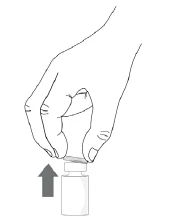
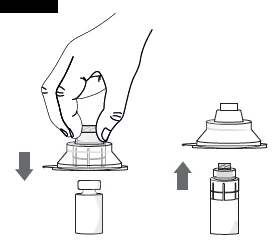
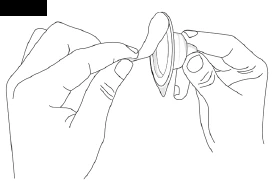
The multidose vial of OXERVATE is now ready for use (1 drop into the affected eye every 2 hours, six times daily). The vial may be stored in the refrigerator or at a temperature below 25°C during the day, but must not be frozen.
To draw up and administer each dose of this medicine, follow these steps:
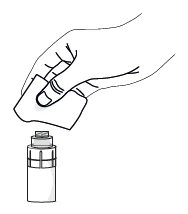
- Take a single disinfecting wipe and gently clean the surface of the valve on the vial adapter connector (Figure 4). After cleaning the valve, allow it to dry for approximately 1 minute.
- Take a pipette (dropper) and remove it from its protective packaging.
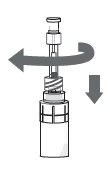
- Screw the pipette (clockwise) onto the vial adapter connector (Figure 5).
- Ensure the pipette plunger is fully pushed down.
- To draw the solution into the pipette, turn the vial upside down (with the pipette attached) and gently pull the plunger until it stops. Make sure the plunger has reached the stop point (Figure 6).
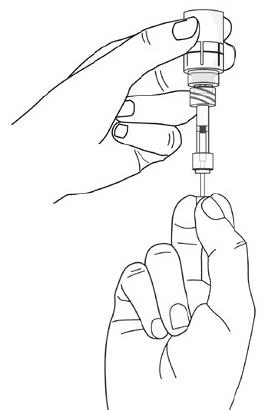
- Check the pipette to ensure it contains the eye drop solution. Air bubbles may cause a blockage and prevent the pipette from filling properly (especially on first use). If the pipette is empty, keep the vial upside down with the pipette attached, push the plunger fully down, and pull it out again.
- Once properly filled, unscrew the pipette from the vial adapter connector.
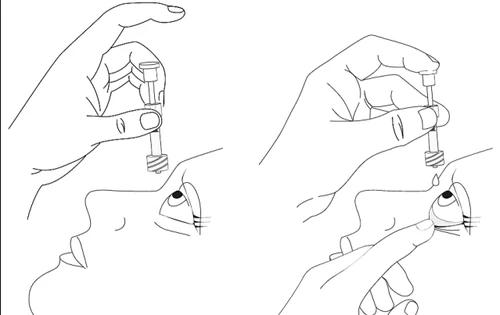
- Holding the pipette pointing downwards between your thumb and middle finger, tilt your head backwards and position the pipette over the affected eye. Pull down the lower eyelid with a finger to create a small pocket. Gently press the plunger until a single drop falls into the conjunctival sac (Figure 7). Be sure not to touch the eye with the tip of the pipette.
- With your head tilted backwards, blink several times to allow the medicine to spread over and remain on the eye surface.
- Immediately after use, discard the used pipette, even if there is still residual liquid.
- If a drop does not fall into the eye, try again using a new pipette and a new disinfecting wipe.
- After each use during the day, wash your hands and return the vial to the refrigerator (or store it at a temperature below 25°C) for the remainder of the day, with the vial adapter still attached.
Repeat the process described above (from Figure 4 onwards) every 2 hours, 6 times daily. Use a new disinfecting wipe and a new pipette each time.
If you are using drops in both eyes, repeat the above instructions for the other eye, using a new pipette (in this case, you will need to use 2 vials per day).
Discard the used vial at the end of each day (even if there is still residual liquid), and in any case no later than 12 hours after connecting the vial adapter.
You will receive a new supply of OXERVATE every week for the duration of the treatment period.
To ensure accurate administration every 2 hours, you may wish to set an alarm as a reminder.
To ensure that six doses are taken by the end of each day of treatment, use the weekly dosing record card provided with the delivery system. On this card, write the date of first use of the weekly supply, the time when the vial was opened (i.e., when the adapter was connected to the vial), and record each time you use an eye drop of this medicine during the week.
If you use more OXERVATE than you should
If you accidentally use more medicine than prescribed, rinse the affected eye with lukewarm water. Do not instill further drops until the next scheduled dose. Using more OXERVATE than recommended is unlikely to be harmful. Continue with the next dose as planned.
If you forget to use OXERVATE
Continue with the next dose as planned. Do not take a double dose to make up for a missed dose. You may take the missed dose 2 hours after the last scheduled dose of the day, provided it is still within 12 hours of opening the daily vial. Do not use more than 6 drops per day in the affected eye(s).
If you stop using OXERVATE
The eye lesion or ulcer will worsen, which may lead to infections or vision impairment. Consult your doctor before stopping treatment with OXERVATE.
If you have any doubts about how to use this medicine, consult your doctor or pharmacist.
4. Possible side effects
Like all medicines, this medicine can cause side effects, although not everybody will experience them.
Most side effects generally occur in or around the eye.
The following side effects have been reported:
Very common (may affect more than 1 in 10 people)
- eye pain.
Common (may affect up to 1 in 10 people)
- eye inflammation;
- eyelid pain;
- abnormal sensation and discomfort in the eye, including the feeling of having something in the eye;
- increased tearing (this may include symptoms such as eye discharge);
- eyelid inflammation with itching and redness;
- redness of the conjunctiva (the mucous membrane covering the front part of the eye and lining the inside of the eyelids);
- sensitivity to light;
- eye irritation or around the eye;
- formation of deposits in the eye;
- headache.
Uncommon (may affect up to 1 in 100 people)
- excessive growth of blood vessels within the cornea;
- corneal infection with pus and swelling.
Reporting of side effects
If you experience any side effect, including those not listed in this leaflet, talk to your doctor or pharmacist.
You can also report side effects directly via the national reporting system listed in Annex V.
By reporting side effects, you can help provide more information on the safety of this medicine.
5. How to store OXERVATE
Keep this medicine out of the sight and reach of children.
Do not use this medicine after the expiry date stated on the carton and on the label of the vial after "Exp". The expiry date refers to the last day of that month.
Store the weekly pack containing 7 OXERVATE vials in a refrigerator (2-8 °C).
After attaching the adapter to the vial, the vial may be stored either in the refrigerator or at a temperature below 25 °C.
Discard the used vial at the end of the day (even if there is still some liquid remaining), and in any case no later than 12 hours after attaching the adapter to it.
The pipettes included in the delivery system are for single use only. Each pipette must be discarded immediately after use, even if there is still some liquid remaining.
Do not dispose of any medicine via wastewater or household waste. Ask your pharmacist how to dispose of medicines no longer required. This will help protect the environment.
6. Package contents and other information
What OXERVATE contains
- The active substance is cenegermin. 1 mL of OXERVATE contains 20 micrograms of cenegermin.
- The other components are trehalose dihydrate, mannitol, anhydrous disodium phosphate dibasic, sodium dihydrogen phosphate dihydrate, hypromellose, polyethylene glycol 6000, L-methionine, water for injections, hydrochloric acid, sodium hydroxide and nitrogen.
Description of the appearance of OXERVATE and contents of the pack
OXERVATE is an eye drop solution that is a clear, colourless liquid.
It is supplied in multidose glass bottles.
Each bottle contains 1 mL of eye drops.
The bottles are contained in a weekly cardboard box containing 7 bottles.
7 bottle adapters, 42 droppers, 42 disinfectant wipes and a dose administration record card
will be supplied separately from the bottles. As spare supplies, one additional adapter (1),
three droppers (3) and three wipes (3) will be included.
Pack size: 7 multidose bottles.
Marketing Authorisation Holder
Dompé farmaceutici S.p.A.
Via San Martino, 12
20122 Milano
Italy
Manufacturer
Dompé farmaceutici S.p.A.
Via Campo di Pile
67100 L’Aquila
Italy
More detailed information on this medicinal product is available on the European Medicines Agency website: http://www.ema.europa.eu.