Oxaliplatin Sandoz
Italy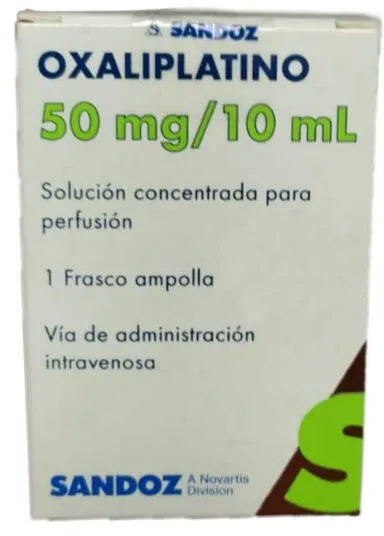
Table of Contents
- Package leaflet: Information for the user
- Oxaliplatin Sandoz 5 mg/ml concentrate for solution for infusion
- 1. What Oxaliplatino Sandoz is and what it is used for
- 2. What you need to know before you are given Oxaliplatino Sandoz
- 3. How Oxaliplatino Sandoz is used
- 4. Possible side effects
- 5. How to store Oxaliplatin Sandoz
- 6. Package Contents and Other Information
Package leaflet: Information for the user
Oxaliplatin Sandoz 5 mg/ml concentrate for solution for infusion
Equivalent medicine
Please read this leaflet carefully before you are given this medicine because it
contains important information for you
- Keep this leaflet. You may need to read it again.
- If you have any questions, ask your doctor or nurse.
- If you get any side effects, including those not listed in this leaflet, tell your doctor or nurse. See section 4.
Contents of this leaflet
1 What Oxaliplatin Sandoz is and what it is used for
2 What you need to know before you are given Oxaliplatin Sandoz
3 How Oxaliplatin Sandoz is used
4 Possible side effects
5 How to store Oxaliplatin Sandoz
6 Contents of the pack and other information
1. What Oxaliplatino Sandoz is and what it is used for
Oxaliplatino Sandoz is an anticancer medicine that contains the active substance oxaliplatino.
Oxaliplatino Sandoz is used to treat intestinal cancer after its surgical removal or when it has already spread.
Oxaliplatino Sandoz is used in combination with other anticancer medicines called 5-fluorouracil (5-FU) and folinic acid (FA).
2. What you need to know before you are given Oxaliplatino Sandoz
You must not be given Oxaliplatino Sandoz
- if you are allergic to oxaliplatin
- if you are breastfeeding
- if you already have a low number of blood cells
- if you already have tingling and numbness in the fingers of your hands and/or feet and have difficulty performing tasks requiring precision, such as buttoning clothes
- if you have severe kidney problems
Warnings and precautions:
Inform your doctor before you are given Oxaliplatino Sandoz
- if you have previously had an allergic reaction to medicines containing platinum, such as carboplatin or cisplatin. Allergic reactions may occur during oxaliplatin infusion
- if you have mild or moderate kidney problems
- if you have liver problems, or if abnormalities appear in liver function tests during treatment
- if you have or have previously had heart disorders, such as an abnormal electrical signal known as QT interval prolongation, irregular heartbeat, or a family history of heart problems
- if you have recently received or plan to receive vaccines. During treatment with oxaliplatin, you must not receive vaccinations with "live" or "attenuated" vaccines, such as the yellow fever vaccine.
Other medicines and Oxaliplatino Sandoz
Inform your doctor if you are taking, have recently taken, or might take any other medicines.
Pregnancy, breastfeeding and fertility
Pregnancy
- Pregnancy is not recommended during oxaliplatin therapy; therefore, you must use an effective method of contraception. Female patients must use appropriate contraceptive measures during therapy and for 9 months after its discontinuation.
- Male patients are advised not to father a child during treatment and for up to 6 months after treatment, and to use adequate contraception during this period.
- If you are pregnant or planning a pregnancy, it is very important to discuss this with your doctor before starting any treatment.
- If you become pregnant during treatment, you must inform your doctor immediately.
Breastfeeding
- You must not breastfeed during treatment with oxaliplatin.
Fertility
- Oxaliplatin may have an anti-fertility effect, which may be irreversible. Male patients may wish to inquire about sperm preservation before starting therapy.
- After treatment with oxaliplatin, female patients who intend to become pregnant are advised to seek genetic counselling.
Ask your doctor or pharmacist for advice before taking any medicine.
Driving and using machines
Treatment with Oxaliplatino Sandoz may increase the risk of dizziness, nausea, vomiting, and other neurological symptoms affecting walking and balance. If this occurs, you must not drive or operate machinery. If you experience vision disturbances while taking Oxaliplatino Sandoz, do not drive, operate heavy machinery, or engage in hazardous activities.
3. How Oxaliplatino Sandoz is used
This medicine will be administered to you by medical personnel; do not take it yourself.
Oxaliplatino Sandoz is to be administered only to adults.
Dosage
The dose of Oxaliplatino Sandoz depends on your body surface area, which is calculated based on your weight and height.
The usual dose for adults, including elderly patients, is 85 mg/m² of body surface area. The dose may also be adjusted based on the results of your blood tests and any side effects you may have previously experienced with Oxaliplatino Sandoz.
Method and route of administration
- Oxaliplatino Sandoz will be prescribed by a specialist in anticancer treatments.
- It will be administered by a healthcare professional who will have prepared the required dose of Oxaliplatino Sandoz.
- Oxaliplatino Sandoz is given as a slow intravenous injection (intravenous infusion) over a period of 2–6 hours. If you experience discomfort or pain at the injection site, inform medical personnel immediately.
- Oxaliplatino Sandoz will be administered together with folinic acid and before the infusion of 5-fluorouracil.
Frequency of administration
You will usually receive the infusion once every two weeks.
Duration of treatment
The duration of treatment will be determined by your doctor.
The treatment lasts up to a maximum of 6 months when administered after complete resection of the tumour.
If you are given more Oxaliplatino Sandoz than you should
Since this medicinal product will be administered by a healthcare professional, it is highly unlikely that you will receive too much or too little.
In case of overdose, you may experience a worsening of side effects; in such a case, your doctor may prescribe appropriate treatment for these side effects.
If a dose of Oxaliplatino Sandoz is missed
Your doctor will decide when you should receive the medicine. If you think a dose has been missed, inform your doctor as soon as possible.
If you have any doubts about your treatment, consult your doctor or pharmacist.
4. Possible side effects
Like all medicines, this medicine can cause side effects, although not everyone experiences them.
If you experience any side effect, it is important that you inform your doctor before the next
administration.
Contact your doctor immediately if you notice any of the following symptoms:
- Signs of an allergic or anaphylactic reaction such as sudden rash, itching, skin hives, difficulty swallowing, swelling of the face, lips, tongue or other parts of the body, shortness of breath, wheezing or breathing difficulties, severe fatigue (feeling faint). In most cases, these symptoms occurred during or immediately after the infusion, but delayed allergic reactions have also been observed hours or even days after infusion (very common)
- Unusual bruising, bleeding or signs of infection such as sore throat or high temperature (very common)
- Persistent or severe diarrhoea or vomiting (very common)
- Unexplained respiratory symptoms such as dry or wet cough, difficulty breathing or crackling sounds (very common), shortness of breath and wheezing, as these may indicate a serious lung disease that could be fatal
- Stomatitis/mucositis (irritation of the lips or mouth ulcers) (very common)
- Blood or dark brown coffee-ground-like particles in vomit (common)
- A group of symptoms such as headache, altered mental function, seizures and vision changes ranging from blurred vision to loss of vision (symptoms of reversible posterior leukoencephalopathy syndrome, a rare neurological disorder) (rare)
- Symptoms of stroke (including sudden severe headache, confusion, visual difficulties in one or both eyes, numbness or weakness of the face, arm or leg usually on one side, drooping face, difficulty walking, dizziness, loss of balance and speech difficulties)
- Severe fatigue with a decrease in red blood cell count and shortness of breath (haemolytic anaemia) (rare), alone or in combination with low platelet count, unusual bruising (thrombocytopenia) (rare), and kidney disease with reduced or no urine output (all symptoms of haemolytic-uraemic syndrome) (frequency not known)
Other known side effects of Oxaliplatin Sandoz are:
Very common (may affect more than 1 in 10 people):
- Oxaliplatin Sandoz may affect the nervous system (peripheral neuropathy). You may experience tingling and/or numbness in the fingers, toes, around the mouth or in the throat; these disturbances may sometimes occur together with muscle cramps. These effects are often triggered by exposure to cold, for example opening a refrigerator or holding a cold drink. You may also have difficulty performing precise tasks, such as buttoning clothes. Although in most cases these symptoms resolve completely on their own, persistent symptoms related to peripheral sensory neuropathy may occur after treatment has ended. Some individuals have reported a tingling sensation similar to an electric shock when the neck is flexed and touched along the arms or trunk.
- Oxaliplatin Sandoz may sometimes cause an unpleasant sensation in the throat, particularly when swallowing, and may give the feeling of difficulty breathing. This sensation, when it occurs, appears during or within a few hours after the infusion and may be triggered by exposure to cold. Although unpleasant, it is usually short-lived and resolves without requiring treatment. As a result, your doctor may decide to adjust your treatment.
- Oxaliplatin Sandoz may cause diarrhoea, mild nausea (feeling unwell) and vomiting (feeling sick). However, to prevent nausea, your doctor will usually give you a medicine before treatment, which may be continued after treatment. Oxaliplatin Sandoz causes a temporary reduction in blood cell counts. A reduction in red blood cells may lead to anaemia (a decrease in red blood cells), abnormal bleeding or bruising (due to reduced platelets). A reduction in white blood cells may increase susceptibility to infections. Your doctor will take blood samples to monitor your blood cell counts before starting treatment and before each subsequent cycle.
- Discomfort, pain or irritation at or near the injection site during infusion
- Fever, chills (shivering), mild to moderate fatigue, body aches
- Changes in body weight, loss of appetite or appetite changes, taste disturbances, constipation
- Headache, back pain
- Swelling of nerves connected to muscles, neck stiffness, unusual sensations in the tongue with possible speech difficulties
- Stomach pain
- Abnormal bleeding, including nosebleeds
- Cough, difficulty breathing
- Allergic reactions, skin rashes which may include red, itchy skin, mild hair loss (alopecia)
- Abnormal blood test results, including those indicating abnormal liver function
Common (may affect up to 1 in 10 people):
- Infection due to reduced white blood cells
- Severe blood infection in addition to reduced white blood cells (neutropenic sepsis), which may be fatal
- Reduction in white blood cells accompanied by fever > 38.3°C or prolonged fever > 38°C for more than one hour (febrile neutropenia)
- Indigestion and heartburn, hot flushes, hiccups, dizziness
- Increased sweating and nail changes, skin peeling
- Chest pain
- Runny nose and upper respiratory tract infections
- Joint and bone pain
- Pain during urination and altered kidney function, changes in urinary frequency, dehydration
- Blood in urine/stool
- High blood pressure
- Depression and difficulty sleeping
- Conjunctivitis and vision problems
- Blood clot, usually in a leg, causing pain, swelling or redness
- Blood clot in the lungs causing chest pain or breathlessness
- Weight loss
- Skin rash
- Low levels of calcium in the blood
- Falls
Uncommon (may affect up to 1 in 100 people):
- Severe blood infection (sepsis), which may be fatal
- Blockage or swelling of the intestine
- Nervousness
Rare (may affect up to 1 in 1,000 people):
- Hearing loss
- Scarring and thickening of the lungs causing breathing difficulties, sometimes fatal (interstitial lung disease)
- Temporary and reversible loss of vision
- Unexpected bleeding or bruising due to widespread blood clots in small blood vessels throughout the body (disseminated intravascular coagulation), which may be fatal
Very rare (may affect up to 1 in 10,000 people):
- Kidney disease with reduced or no urine output (symptoms of acute kidney failure)
- Vascular liver disorders
Not known (frequency cannot be estimated from available data):
- Allergic vasculitis (inflammation of blood vessels)
- Autoimmune reaction leading to reduction in all blood cell lines (autoimmune pancytopenia), pancytopenia
- Severe blood infection and low blood pressure (septic shock), which may be fatal
- Seizures (uncontrolled body movements)
- Throat spasm causing breathing difficulties
- Extreme fatigue with reduced red blood cell count and shortness of breath (haemolytic anaemia), alone or combined with low platelet count and kidney disease with reduced or no urine output (symptoms of haemolytic-uraemic syndrome), which may be fatal
- Abnormal heart rhythm (QT prolongation), detectable by electrocardiogram (ECG), which may be fatal
- Myocardial infarction (heart attack), angina pectoris (chest pain or discomfort)
- Muscle pain and swelling, together with weakness, fever, or brownish-red urine (symptoms of muscle damage called rhabdomyolysis), which may be fatal
- Oesophagitis (inflammation of the lining of the oesophagus – the tube connecting the mouth to the stomach – causing pain and difficulty swallowing)
- Abdominal pain, nausea, vomiting blood or vomit resembling "coffee grounds" or dark/tarry stools (symptoms of gastrointestinal ulcer, with potential bleeding or perforation), which may be fatal
- Reduced blood flow to the intestine (intestinal ischaemia), which may be fatal
- Risk of new tumours. Leukaemia, a form of blood cancer, has been reported in patients after taking Oxaliplatin Sandoz in combination with other medicines. Talk to your doctor about the potential increased risk of this type of cancer while taking Oxaliplatin Sandoz and other medicines
- Abnormal non-cancerous liver nodules (focal nodular hyperplasia)
Reporting of side effects
If you experience any side effect, including those not listed in this leaflet, talk to your doctor or pharmacist. You can also report side effects directly via the national reporting system at https://www.aifa.gov.it/content/segnalazioni-reazioni-avverse
Reporting side effects can help provide more information on the safety of this medicine.
5. How to store Oxaliplatin Sandoz
Keep this medicine out of the sight and reach of children.
Oxaliplatin Sandoz must not come into contact with the eyes or skin. In case of accidental
spillage, inform the doctor or nurse immediately.
Before mixing, this medicine should be stored in the outer packaging to protect it from light, and must not be frozen.
Do not store above 25°C.
Do not use this medicine after the expiry date, which is stated on the packaging and label after Exp. The expiry date refers to the last day of that month.
After the infusion is completed, the doctor or nurse will dispose of Oxaliplatin Sandoz safely, handling it with care.
6. Package Contents and Other Information
What Oxaliplatin Sandoz Contains
- The active substance is oxaliplatin.
- The excipient is water for injections.
Description of the Appearance of Oxaliplatin Sandoz and Contents of the Pack
Clear, colourless solution, free from suspended particles.
1 ml of solution contains 5 mg of oxaliplatin as the active substance.
This medicinal product is a concentrate for infusion solution.
10 ml of concentrate for infusion solution contains 50 mg of oxaliplatin.
20 ml of concentrate for infusion solution contains 100 mg of oxaliplatin.
30 ml of concentrate for infusion solution contains 150 mg of oxaliplatin.
40 ml of concentrate for infusion solution contains 200 mg of oxaliplatin.
50 ml of concentrate for infusion solution contains 250 mg of oxaliplatin.
Pack Sizes
50 mg/10 ml: 1 vial, 5 vials, 10 vials
100 mg/20 ml: 1 vial
150 mg/30 ml: 1 vial
200 mg/40 ml: 1 vial
250 mg/50 ml: 1 vial
With or without plastic protection (Onco-Safe or Sleeving).
"Onco-Safe" and Sleeving do not come into contact with the medicinal product and provide additional protective packaging during transport, enhancing safety for medical and pharmacy personnel.
Not all pack sizes may be marketed.
Marketing Authorisation Holder
Sandoz S.p.A.
Viale Luigi Sturzo 43
20154 Milan
Italy
Manufacturer
Ebewe Pharma Ges.m.b.H Nfg. KG
Mondseestrasse 11, A-4866 Unterach
Austria
Fareva Unterach GmbH
Mondseestraße 11
4866 Unterach, Austria
Salutas Pharma GmbH
Otto-von-Guericke-Allee 1, D-39179 Barleben
Germany
This medicinal product is authorised in the Member States of the European Economic Area and in the United Kingdom (Northern Ireland) under the following names:
Austria: Oxaliplatin Ebewe 5mg/ml Konzentrat zur Herstellung einer Infusionslösung
Belgium: Oxaliplatin Sandoz 5 mg/ml concentraat voor oplossing voor infusie
Bulgaria: Oxaliplatin Ebewe 5mg/ml concentrate for solution infusion
Cyprus: Oxaliplatin Ebewe 5mg/ml concentrate for solution for infusion
Czech Republic: Oxaliquid 5 mg/ml
Denmark: Oxaliplatin "Sandoz"
Greece: Oksaliplatiin „Ebewe“ 5 mg/ml
France: OXALIPLATINE SANDOZ 5 MG/ML, SOLUTION A DILUER POUR PERFUSION
United Kingdom (Northern Ireland): Oxaliplatin 5mg/ml Concentrate for Solution for Infusion
Greece: Plaxitin 5mg/ml πυκνό διάλυμα για παρασκευή διαλύματος πρός έγχυση
Italy: Oxaliplatino Sandoz 5mg/ml concentrato per soluzione per infusione
Latvia: Oksaliplatina EBEWE 5mg/ml koncentrats infūzijas šķīdumam
Lithuania: Oxalipatin Sandoz 5 mg/ml solution à diluer pour perfusion
Malta: Oxaliplatin Ebewe 5mg/ml concentrate for solution for infusion
Netherlands: Oxaliplatine Sandoz concentraat 5 mg/ml, concentraat voor oplossing voor infusie
Norway: Oxaliplatin Sandoz 5 mg/ml konsentrat til infusjonsvæske, oppløsning
Poland: Oxaliplatin-Ebewe
Portugal: Oxaliplatina Tubernax
Romania: Oxaliplatin Ebewe 5 mg/ml, concentrat pentru soluţie perfuzabilă
Sweden: Oxaliplatin Sandoz 5 mg/ml koncentrat till infusionsvätska, lösning
Slovenia: Oxaliplatin Ebewe 5mg/ml koncentrat za raztopino za infundiranje
Slovakia: Oxaliplatin Sandoz 5 mg/ml infúzny koncentrát
The following information is intended exclusively for healthcare professionals:
Special Precautions for Disposal and Handling
As with any potentially toxic agent, solutions containing oxaliplatin must be prepared and handled with care.
Instructions for Handling
Handling of this cytotoxic agent by healthcare personnel requires all precautions necessary to ensure the protection of the operator and the working environment.
Preparation of injectable solutions of cytotoxic agents must be carried out only by trained and qualified personnel familiar with the drugs used, operating under conditions that guarantee product integrity and environmental protection, particularly the safety of personnel involved in handling, according to hospital standards. This requires a dedicated preparation area where eating, drinking, and smoking are prohibited.
Personnel must have access to appropriate equipment, including long-sleeved gowns, protective masks, head covers, safety goggles, sterile disposable gloves, protective work surface pads, and designated containers and waste bags for disposal.
Faeces and vomit must be handled with caution.
Pregnant women should be advised to avoid handling cytotoxic agents.
All broken containers must be handled with the same precautions and considered as contaminated waste. Contaminated waste must be incinerated in rigid, properly labelled containers designated for this purpose. See the subsection "Disposal" below.
In case of accidental skin contact with concentrated oxaliplatin or infusion solution, wash immediately and thoroughly with water.
In case of accidental contact with mucous membranes, wash immediately and thoroughly with water.
Special Precautions for Administration
- DO NOT use injection materials containing aluminium.
- DO NOT administer the product undiluted.
- Glucose 5% solution for infusion must always be used as diluent; DO NOT dilute with sodium chloride or chloride-containing solutions.
- DO NOT mix with any other medicinal product in the same infusion bag, and DO NOT administer simultaneously with other drugs through the same infusion line.
- DO NOT mix with alkaline solutions or other alkaline medicinal products (in particular 5-fluorouracil, folinic acid-based medicinal products containing trometamol as excipient, and trometamol salts of other medicinal products). Alkaline solutions or alkaline medicinal products compromise the stability of oxaliplatin.
Instructions for Use with Folinic Acid (e.g., Calcium Folinic or Disodium Folinic Acid)
Oxaliplatin 85 mg/m² administered intravenously via infusion in 250–500 ml of 5% glucose solution is given simultaneously with an intravenous infusion of folinic acid, equally diluted in 5% glucose solution, over 2–6 hours, using a Y-site connector placed immediately before the infusion site. These two medicinal products must not be combined in the same infusion bag. Folinic acid must not contain trometamol as excipient and must be diluted using isotonic 5% glucose solutions, but not alkaline solutions or those containing sodium chloride or chloride.
Instructions for Use with 5-Fluorouracil
Oxaliplatin must always be administered before fluoropyrimidines (e.g., 5-fluorouracil).
After oxaliplatin administration, flush the infusion line and then administer 5-fluorouracil.
For further information on medicinal products used in combination with oxaliplatin, refer to their respective Summary of Product Characteristics.
Concentrate for Infusion Solution
Inspect visually before use. Only clear, particle-free solutions should be used.
This medicinal product is for single use only. Any unused solutions must be discarded.
Dilution for Intravenous Infusion
Withdraw the required amount of concentrate from the vial(s) and dilute in 250–500 ml of 5% glucose solution to achieve an oxaliplatin concentration of not less than 0.2 mg/ml.
Administer by intravenous infusion.
From a microbiological standpoint, the infusion preparation should be used immediately.
If not used immediately, the in-use storage times and conditions prior to use are the responsibility of the user and normally should not exceed 24 hours at 2–8°C, unless dilution has been performed under controlled and validated aseptic conditions.
Chemical and physical in-use stability has been demonstrated for 48 hours at 2–8°C when diluted to concentrations of 0.2 mg/ml and 2.0 mg/ml with 5% glucose, and for 6 hours at 20–25°C when diluted to concentrations of 0.2 mg/ml and 2.0 mg/ml with 5% glucose.
Inspect visually before use. Only clear, particle-free solutions should be used.
This medicinal product is for single use only. Any unused solutions must be discarded.
See the subsection "Disposal" below.
NEVER use sodium chloride solutions either for reconstitution or dilution.
Infusion
Pre-hydration is not required prior to oxaliplatin administration.
Oxaliplatin should be diluted in 250–500 ml of 5% glucose solution to achieve a concentration of not less than 0.2 mg/ml and administered via peripheral or central intravenous infusion over 2 to 6 hours. When oxaliplatin is administered with 5-fluorouracil, the oxaliplatin infusion must precede the 5-fluorouracil infusion.
Disposal
Any unused medicinal product and all materials used for reconstitution, dilution, and administration must be disposed of in accordance with standard hospital procedures for cytotoxic waste and in compliance with current regulations regarding hazardous waste disposal.
Administration
FOR ADULTS ONLY
The recommended dose of oxaliplatin in adjuvant therapy is 85 mg/m² administered intravenously, repeated every 2 weeks for 12 cycles (6 months).
The recommended dose of oxaliplatin in the treatment of metastatic colorectal cancer is 85 mg/m² administered intravenously, repeated every 2 weeks until disease progression or unacceptable toxicity occurs.
The dose should be adjusted according to tolerability (see section 4.4, "Special Warnings and Precautions for Use", in the respective SmPC).
Oxaliplatin administration must always precede that of fluoropyrimidines, e.g., 5-fluorouracil.
Oxaliplatin should be administered as an intravenous infusion lasting 2–6 hours in 250–500 ml of 5% glucose solution (50 mg/ml), to achieve a concentration between 0.2 and 0.70 mg/ml; in clinical practice, 0.7 mg/ml is the maximum concentration for an oxaliplatin dose of 85 mg/m².
Shelf Life
Packaged for sale: 24 months.
In-use stability after dilution
From both microbiological and chemical viewpoints, the reconstituted solution should be used immediately.
Otherwise, the in-use storage times and conditions prior to use are the responsibility of the user and normally should not exceed 24 hours at 2–8°C, unless dilution was performed under controlled and validated aseptic conditions.
Chemical and physical in-use stability has been demonstrated for 48 hours at 2–8°C when diluted to concentrations of 0.2 mg/ml and 2.0 mg/ml with 5% glucose, and for 6 hours at 20–25°C when diluted to concentrations of 0.2 mg/ml and 2.0 mg/ml with 5% glucose.
Special Precautions for Storage
Store the vial in its outer packaging to protect from light.
Do not freeze.
Do not store above 25°C.