Oxaliplatin Accord
Italy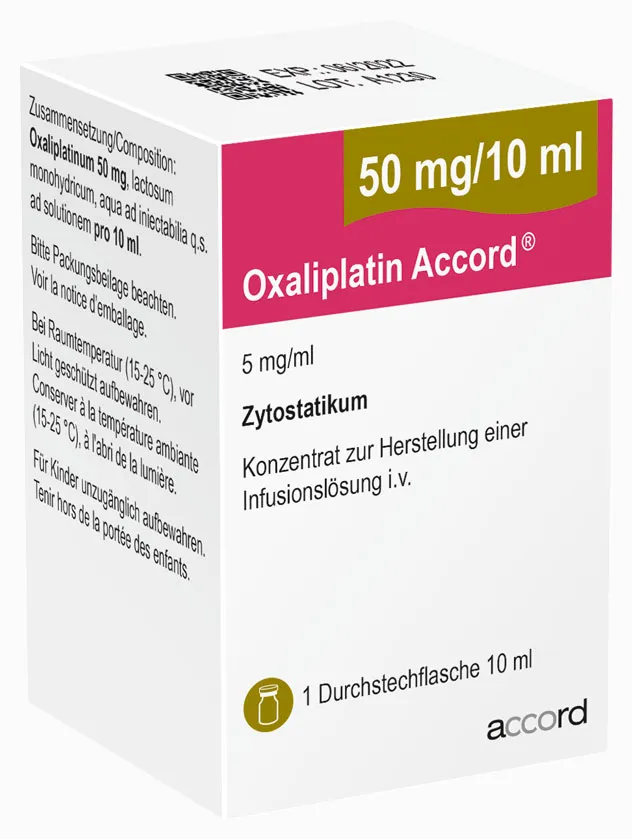
Table of Contents
- Package Leaflet: Information for the User
- Oxaliplatin Accord 5 mg/ml concentrate for solution for infusion
- 1. What Oxaliplatin Accord concentrate for solution for infusion is and what it is used for
- 3. How to use Oxaliplatin Accord concentrate for solution for infusion
- 4. Possible side effects
- 5. How to store Oxaliplatin Accord concentrate for solution for infusion
- 6. Contents of the pack and other information
- The following information is intended exclusively for doctors or healthcare professionals
- 1. COMPOSITION
- 2. PRESENTATION
- 3. SAFE HANDLING INSTRUCTIONS
- 4. PREPARATION FOR INTRAVENOUS ADMINISTRATION
Package Leaflet: Information for the User
Oxaliplatin Accord 5 mg/ml concentrate for solution for infusion
Generic medicine
Read this leaflet carefully before using this medicine
- Keep this leaflet. You may need to read it again.
- If you have any questions, ask your doctor, pharmacist or nurse.
- If you get any side effects, including those not listed in this leaflet, tell your doctor, pharmacist or nurse. See section 4.
Contents of this leaflet
- What Oxaliplatin Accord concentrate for solution for infusion is and what it is used for
- What you need to know before using Oxaliplatin Accord concentrate for solution for infusion
- How to use Oxaliplatin Accord concentrate for solution for infusion
- Possible side effects
- How to store Oxaliplatin Accord concentrate for solution for infusion
- Contents of the pack and other information
1. What Oxaliplatin Accord concentrate for solution for infusion is and what it is used for
The name of the medicine is 'Oxaliplatin Accord 5 mg/ml', but in the remainder of this leaflet it will be referred to as 'Oxaliplatin concentrate for solution for infusion'.
The active substance of Oxaliplatin concentrate for solution for infusion is oxaliplatin.
Oxaliplatin concentrate for solution for infusion is used for the treatment of colorectal cancer (treatment of stage III colon carcinoma after complete resection of the primary tumour, metastatic colon and rectal cancer). Oxaliplatin concentrate for solution for infusion is used in combination with other anticancer medicines called 5-fluorouracil and folinic acid.
Oxaliplatin concentrate for solution for infusion must be dissolved and prepared into a solution before it can be injected into a vein. Oxaliplatin concentrate for solution for infusion is a platinum-containing antineoplastic or anticancer drug.
- What you need to know before using Oxaliplatin Accord concentrate for solution for infusion
Do NOT take Oxaliplatin Accord concentrate for solution for infusion if:
- You are allergic to oxaliplatin or to any of the excipients of Oxaliplatin concentrate for solution for infusion
- You are breastfeeding
- Your blood cell count is already low
- You already experience tingling and numbness in the fingers of your hands and/or feet and have difficulty performing fine tasks, e.g. buttoning clothes
- You have severe kidney problems.
Warnings and precautions
Talk to your doctor or pharmacist before taking Oxaliplatin Accord concentrate for solution for infusion
- If you have had an allergic reaction to medicines containing platinum, such as carboplatin or cisplatin. Allergic reactions may occur during oxaliplatin infusion.
- If you have moderate or mild kidney problems
- If you have any type of liver problem or show abnormal kidney function test results during treatment.
- If you have or have had heart conditions such as abnormal electrical signals known as QT interval prolongation, an irregular heartbeat, or a family history of heart problems.
- If you have recently received or plan to receive any vaccine. During treatment with oxaliplatin, you must not be vaccinated with 'live' or 'attenuated' vaccines, such as the yellow fever vaccine. 1/10
Inform your doctor immediately if you experience any of the symptoms listed below. Your doctor may need to treat you for these events. Your doctor may reduce your dose of Oxaliplatin Accord 5 mg/ml, or delay or stop treatment with Oxaliplatin Accord 5 mg/ml.
- If, during treatment, you experience an uncomfortable sensation in your throat, especially when swallowing, and have a feeling of breathlessness.
- If you have nerve problems in your hands or feet, such as numbness or tingling, or decreased sensitivity in your hands or feet.
- If you have headache, altered mental function, seizures, or vision abnormalities ranging from blurred vision to loss of vision.
- If you feel unwell or are unwell (nausea or vomiting).
- If you have severe diarrhoea.
- If you have pain in your lips or mouth ulcers (mucositis/stomatitis).
- If you have diarrhoea, or a decrease in white blood cells or platelets. Your doctor may reduce your dose of Oxaliplatin Accord 5 mg/ml or delay your treatment with Oxaliplatin Accord 5 mg/ml.
- If you experience unexplained respiratory symptoms such as cough or difficulty breathing. Your doctor may stop treatment with Oxaliplatin Accord 5 mg/ml.
- If you experience extreme tiredness, shortness of breath, or develop a kidney disease in which you urinate little or not at all (symptoms of acute kidney failure).
- If you have fever (temperature greater than or equal to 38°C) or chills, which may be signs of infection. You may be at risk of developing blood infection.
- If you have a fever above 38°C. Your doctor will determine whether you have a reduced white blood cell count.
- If unexpected bleeding or bruising occurs (disseminated intravascular coagulation), as these may be signs of blood clots in small blood vessels in the body.
- If you faint (lose consciousness) or have an irregular heartbeat while taking Oxaliplatin Accord 5 mg/ml, as this may be a sign of a serious heart condition.
- If you experience muscle pain and swelling associated with weakness, fever, or brown-red urine. These may be signs of muscle damage (rhabdomyolysis) and could lead to kidney problems or other complications.
- If you have abdominal pain, nausea, vomiting with blood or vomit resembling 'coffee grounds', or dark/tarry stools, as these may be signs of intestinal ulcer (gastrointestinal ulcer with potential bleeding or perforation).
- If you have abdominal pain (in the stomach), diarrhoea with blood, and nausea and/or vomiting, which may be caused by reduced blood flow to the abdominal wall (intestinal ischaemia).
Children and adolescents
Oxaliplatin must not be used in children and adolescents under 18 years of age.
Other medicines and Oxaliplatin Accord concentrate for solution for infusion
Inform your doctor or pharmacist if you are taking, have recently taken, or might take any other medicine.
- 5-fluorouracil (an anticancer medicine)
- Erythromycin (an antibiotic)
- Salicylates (painkillers)
- Granisetron (an antiemetic medicine)
- Paclitaxel (an anticancer medicine)
- Sodium valproate (an antiepileptic medicine)
Pregnancy, breastfeeding and fertility
Pregnancy
- During treatment with oxaliplatin, becoming pregnant is not recommended and you must use reliable contraceptive measures. Women must use reliable contraception during and for 15 months after therapy.
- Men must not father a child during treatment and for 12 months afterwards and must use reliable contraception during this period. 2/10
- If you are pregnant, suspect you may be pregnant, or are planning a pregnancy, consult your doctor before receiving any treatment.
- If you become pregnant during treatment, you must inform your doctor immediately.
Breastfeeding
You must not breastfeed during treatment with oxaliplatin.
Fertility
- Oxaliplatin may cause infertility, which may be irreversible. Male patients should be counselled about sperm preservation before treatment.
- If you are planning a pregnancy after treatment with oxaliplatin, genetic counselling is recommended.
Ask your doctor or pharmacist for advice before taking any medicine.
Driving and using machines:
Treatment with oxaliplatin may increase the risk of dizziness, nausea and vomiting, and other neurological symptoms affecting gait and balance. In this case, you must not drive or operate machinery. If you have vision problems while taking Oxaliplatin concentrate for solution for infusion, do not drive, operate heavy machinery, or perform hazardous activities.
3. How to use Oxaliplatin Accord concentrate for solution for infusion
Oxaliplatin concentrate for solution for infusion is indicated for adults only.
For single use only.
Dosage
The dose of Oxaliplatin concentrate for solution for infusion is based on body surface area. This is calculated according to height and weight.
The usual dose for adults, including elderly patients, is 85 mg/m² of body surface area. The dose you will receive may also depend on the results of blood tests and whether you have previously experienced adverse reactions with Oxaliplatin concentrate for solution for infusion.
Method and route of administration
Oxaliplatin concentrate for solution for infusion will be prescribed by a specialist experienced in oncological therapy.
You will receive the treatment from a healthcare professional who will have prepared the required dose of Oxaliplatin concentrate for solution for infusion.
Oxaliplatin concentrate for solution for infusion is administered by slow intravenous infusion over a period of 2–6 hours.
Oxaliplatin concentrate for solution for infusion will be administered to you concurrently with folinic acid and prior to the infusion of 5-fluorouracil.
Frequency of administration
You will generally receive the infusion once every 2 weeks.
3/10
Duration of treatment
The duration of treatment will be determined by your doctor.
When used following complete resection of the tumour, treatment should not exceed 6 months.
If you use more Oxaliplatin concentrate for solution for infusion than you should
Since this medicine is administered to you by a healthcare professional, it is highly unlikely that you will receive too much or too little.
In case of overdose, you may experience increased adverse effects. Your doctor can provide appropriate treatment for these adverse effects.
If you have any doubts about your treatment, consult your doctor, nurse, or pharmacist.
4. Possible side effects
Like all medicines, this medicine can cause side effects, although not everyone gets them.
If you experience any side effect, it is important that you inform your doctor before your next treatment.
Listed below are the side effects that may occur.
Contact your doctor immediately if you notice any of the following side effects:
- Allergic or anaphylactic reaction with sudden signs such as rash, itching or hives on the skin, difficulty swallowing, swelling of the face, lips, tongue or other body parts, shortness of breath or wheezing, breathing difficulties, extreme tiredness (you may feel you are about to faint).
- Unusual bruising, bleeding or signs of infection such as sore throat and high fever.
- Severe or persistent diarrhoea or vomiting (feeling unwell).
- Presence of blood or dark brown coffee-ground-like particles in vomit.
- Mucositis/stomatitis (sores on the lips or mouth ulcers).
- Respiratory symptoms such as dry or productive cough, difficulty breathing, crackling sounds, dyspnoea and wheezing.
- A group of symptoms including headache, altered mental function, seizures and vision changes, ranging from blurred vision to loss of vision (symptoms of reversible posterior leukoencephalopathy syndrome, a rare neurological disorder).
- Symptoms of stroke (including sudden severe headache, confusion, difficulty seeing in one or both eyes, numbness or weakness of the face, arm or leg, usually on one side, facial drooping, difficulty walking, dizziness, loss of balance and difficulty speaking).
- Severe fatigue with a reduction in red blood cell count (haemolytic anaemia), alone or in combination with low platelet count, unusual bruising (thrombocytopenia), and kidney disease causing little or no urine output (all symptoms of haemolytic-uremic syndrome).
Other known side effects of Oxaliplatin Accord are:
Very common (may affect more than 1 in 10 people):
- Tingling and/or numbness in fingers and toes, around the mouth or in the throat, which may sometimes occur with muscle cramps (peripheral neuropathy).
- Discomfort near or at the injection site during infusion.
- Fever, stiffness (tremors), mild or severe fatigue, body pain.
- Weight changes, loss of appetite or appetite changes, altered taste, constipation.
- Stomach pain.
- Abnormal bleeding, including nosebleeds.
- Mild hair loss (alopecia).
Common (may affect up to 1 in 10 people):
- Infection due to a reduction in white blood cells.
4/10
- Severe blood infection associated with a reduction in white blood cells (neutropenic sepsis), which may be fatal.
- Reduction in white blood cells with fever > 38.3°C or prolonged fever > 38°C for more than 1 hour (febrile neutropenia).
- Indigestion and heartburn, hiccups, hot flushes, dizziness.
- Increased sweating and nail abnormalities, skin peeling.
- Chest pain.
- Lung disorders and runny nose.
- Joint pain and bone pain.
- Pain on urination and changes in kidney function, changes in frequency of urination, dehydration.
- Blood in urine/stool, swelling of veins, blood clots in the lungs.
- High blood pressure.
- Depression and insomnia.
- Conjunctivitis and vision problems.
- Decreased levels of calcium in the blood.
- Falls.
Uncommon (may affect up to 1 in 100 people):
- Severe blood infection (septicaemia), which may be fatal.
- Bowel blockage or swelling of the intestine.
- Nervousness.
Rare (may affect up to 1 in 1,000 people):
- Deafness.
- Scarring and thickening of the lungs causing breathing difficulties, sometimes fatal (interstitial lung disease).
- Temporary and reversible loss of vision.
- Unexpected bleeding or bruising due to widespread blood clots in small blood vessels throughout the body (disseminated intravascular coagulation), which may be fatal.
Very rare (may affect up to 1 in 10,000 people):
- Vascular disorders of the liver (symptoms include abdominal pain and swelling, weight gain, and swelling of tissues in the feet, ankles or other body parts).
Not known (frequency cannot be estimated from available data):
- Allergic vasculitis (inflammation of blood vessels).
- Autoimmune reaction leading to reduced blood cell lines (autoimmune pancytopenia).
- Seizures (uncontrolled body movements).
- Throat spasms causing breathing difficulties.
- Abnormal heart rhythm (QT prolongation), detectable by electrocardiogram (ECG), which may be fatal.
- Muscle pain and swelling associated with weakness, fever or brown-red urine (symptoms of muscle damage known as rhabdomyolysis), which may be fatal.
- Dark, tarry stools (symptoms of gastrointestinal ulcer with potential bleeding or perforation), which may be fatal.
- Reduced blood flow to the intestine (intestinal ischaemia), which may be fatal.
- Myocardial infarction (heart attack), angina pectoris (chest pain or discomfort).
- Inflammation of the oesophagus (inflammation of the oesophageal lining – the tube connecting the mouth to the stomach), resulting in pain and difficulty swallowing.
- Risk of new tumours such as leukaemia, when administered in combination with certain other medicines.
- Abnormal non-cancerous liver nodules (focal nodular hyperplasia).
Reporting of side effects
If you experience any side effect, including those not listed in this leaflet, talk to your doctor, pharmacist or nurse.
You can also report side effects directly via
Website: https://www.aifa.gov.it/content/segnalazioni-reazioni-avverse .
5/10
Reporting side effects can help provide more information on the safety of this medicine.
5. How to store Oxaliplatin Accord concentrate for solution for infusion
Keep this medicine out of the sight and reach of children.
Before mixing, this medicine must be stored in the outer packaging to protect it from light,
and must not be frozen.
Do not use this medicine after the expiry date stated on the packaging and label after "Exp". The expiry date refers to the last day of that month.
Chemical and physical in-use stability has been demonstrated for 48 hours at a temperature of +2°C to +8°C and for 24 hours at +25°C. From a microbiological standpoint, the infusion solution should be used immediately. If not used immediately, the in-use storage times and conditions prior to use are the responsibility of the user and normally should not exceed 24 hours at 2°C–8°C, unless dilution has been carried out under controlled and validated aseptic conditions.
Do not use Oxaliplatin concentrate for solution for infusion if you notice that the solution is not clear and free from particles.
Medicines must not be disposed of via wastewater or household waste. Ask your pharmacist how to dispose of medicines no longer required. This will help protect the environment.
Oxaliplatin concentrate for solution for infusion must not come into contact with the eyes or skin. In case of accidental spillage, inform the doctor or nurse immediately.
At the end of the infusion, the doctor or nurse must carefully dispose of any remaining Oxaliplatin concentrate for solution for infusion.
6. Contents of the pack and other information
What Oxaliplatin Accord contains:
Oxaliplatin Accord contains the active substance oxaliplatin.
The other ingredient is water for injections.
Description of the appearance of Oxaliplatin concentrate for solution for infusion and contents of the pack:
1 ml of concentrate for solution for infusion contains 5 mg of oxaliplatin.
Oxaliplatin concentrate for solution for infusion is a clear, colourless solution free from visible particles.
Each glass vial is individually packaged in a cardboard carton.
10 ml of concentrate for solution for infusion contains 50 mg of oxaliplatin.
20 ml of concentrate for solution for infusion contains 100 mg of oxaliplatin.
40 ml of concentrate for solution for infusion contains 200 mg of oxaliplatin.
Not all pack sizes may be marketed.
Marketing Authorization Holder
Accord Healthcare S.L.U.
World Trade Center,
Moll de Barcelona,
s/n, Edifici Est 6ª planta,
08039 Barcelona,
Spain
Manufacturer
Accord Healthcare Polska Sp.z o.o.,
ul. Lutomierska 50, 95-200 Pabianice,
Poland
Accord Healthcare Single Member S.A.,
64th Km National Road Athens,
Lamia, Schimatari,
32009, Greece
This medicinal product is authorised in the European Economic Area Member States under the following names:
| Member State | Name of the medicinal product | |------------------|-----------------------------------| | United Kingdom | Oxaliplatin 5 mg/ml Concentrate for Solution for Infusion | | Austria | Oxaliplatin Accord 5 mg/ml Konzentrat zur Herstellung einer Infusionslösung | | Belgium | Oxaliplatin Accord Healthcare 5 mg/ml concentré pour solution de perfusion / concentraat voor oplossing voor infusie / Konzentrat zur Herstellung einer Infusionslösung | | Bulgaria | Оксалиплатин Акорд 5 mg/ml концентрат за инфузионен разтвор | | Czech Republic | Oxaliplatin Accord 5 mg/ml Koncentrát pro Přípravu Infuzního Roztoku | | Germany | Oxaliplatin Accord 5 mg/ml Konzentrat zur Herstellung einer Infusionslösung | | Denmark | Oxaliplatin Accord 5 mg/ml koncentrat til infusionsvæske, opløsning | | Estonia | Oxaliplatin Accord 5 mg/ml infusioonilahuse kontsentraat | | Spain | Oxaliplatino Accord 5 mg/ml Concentrado para Solución para Perfusión EFG | | Finland | Oxaliplatin Accord 5 mg/ml Infuusiokonsentraatti, Liuosta Varten / koncentrat till infusionsvätska, lösning | | France | Oxaliplatin Accord Healthcare 5 mg/ml concentré pour solution de perfusion | | Hungary | Oxaliplatin Accord 5 mg/ml koncentrátum oldatos infúzióhoz | | Ireland | Oxaliplatin 5 mg/ml Concentrate for Solution for Infusion | | Italy | Oxaliplatino Accord 5 mg/ml concentrato per soluzione per infusione | | Latvia | Oxaliplatin Accord 5 mg/ml koncentrāts infūziju šķīduma pagatavošanai | | Lithuania | Oxaliplatin Accord 5 mg/ml koncentratas infuziniam tirpalui | | Malta | Oxaliplatin 5 mg/ml Concentrate for Solution for Infusion | | Netherlands | Oxaliplatine Accord 5 mg/ml concentraat voor oplossing voor infusie | | Poland | Oxaliplatinum Accord, 5 mg/ml, koncentrat do sporządzania roztworu do infuzji | | Portugal | Oxaliplatina Accord | | Romania | Oxaliplatin Accord 5 mg/ml concentrat pentru solutie perfuzabilă | | Sweden | Oxaliplatin Accord 5 mg/ml koncentrat till infusionsvätska, lösning |
The following information is intended exclusively for doctors or healthcare professionals
PREPARATION GUIDE FOR USE WITH OXALIPLATIN INFUSION CONCENTRATE
FOR INFUSION SOLUTION
It is important to read all the contents of this procedure before preparing OXALIPLATIN
INFUSION CONCENTRATE FOR INFUSION SOLUTION
1. COMPOSITION
Oxaliplatin concentrate for solution for infusion is a clear, colorless solution containing 5 mg/ml of
oxaliplatin.
2. PRESENTATION
Oxaliplatin concentrate for infusion solution is supplied in single-use vials. 1 vial per carton.
For 10 ml
The concentrate for infusion solution is contained in a 15 ml clear type I (borosilicate) tubular glass vial, closed with a V9048 FM259/0 OMNIFLEX PLUS 2500/RF 20 mm rubber stopper and a 20 mm lavender-coloured aluminium seal with a ‘flip-off’ cap.
For 20 ml
The concentrate for infusion solution is contained in a 20 ml clear type I (borosilicate) tubular glass vial, closed with a V9048 FM259/0 OMNIFLEX PLUS 2500/RF 20 mm rubber stopper and a 20 mm lavender-coloured aluminium seal with a ‘flip-off’ cap.
For 40 ml
The concentrate for infusion solution is contained in a 50 ml clear type I (borosilicate) tubular glass vial, closed with a V9048 FM259/0 OMNIFLEX PLUS 2500/RF 20 mm rubber stopper and a 20 mm lavender-coloured aluminium seal with a ‘flip-off’ cap.
Shelf life and storage:
2 years.
After dilution of the solution in 5% glucose solution, chemical and physical stability in use has been demonstrated for up to 48 hours at +2°C to +8°C and for 24 hours at +25°C.
From a microbiological standpoint, the infusion preparation should be used immediately.
If not used immediately, the storage times and conditions prior to use are the responsibility of the user and should normally not exceed 24 hours at 2–8°C, unless dilution has been carried out under controlled and validated aseptic conditions.
Keep the vial in the outer packaging to protect the medicinal product from light. Do not freeze.
Inspect visually before use. Use only clear solutions without particles.
The medicinal product is for single use only. Any unused solution should be discarded.
3. SAFE HANDLING INSTRUCTIONS
As with other potentially toxic compounds, caution should be exercised during handling and preparation
of oxaliplatin solutions.
Handling instructions
Handling of this cytotoxic agent by healthcare personnel requires all necessary precautions to ensure
protection of the personnel involved and of the surrounding environment.
Preparation of injectable solutions of cytotoxic agents must be carried out by trained, specialized personnel
familiar with the drugs used, under conditions ensuring drug integrity, environmental protection and, in
8/10
particular, protection of personnel handling the drugs, in accordance with hospital guidelines. Preparation must be performed in a specific area designated for this purpose, where eating, drinking and smoking are prohibited.
Personnel must be equipped with appropriate materials for handling, in particular long-sleeved gowns,
protective masks, head covers, protective eyewear, sterile disposable gloves, protective coverings for the work area,
containers and collection bags for waste.
Faeces and vomit must be handled with care.
Pregnant women should be advised to avoid handling cytotoxic agents.
All broken containers must be handled with the same precautions and considered contaminated waste. Contaminated waste must be incinerated in appropriately labelled rigid containers. See the section
“Disposal” below.
If concentrated oxaliplatin for infusion solution comes into contact with the skin, wash the skin immediately and thoroughly with water.
If concentrated oxaliplatin for infusion solution comes into contact with mucous membranes, rinse immediately and thoroughly with water.
4. PREPARATION FOR INTRAVENOUS ADMINISTRATION
Special precautions for administration
- DO NOT use injection materials containing aluminum.
- DO NOT administer the product undiluted.
- Use only 5% glucose solution for infusion as diluent. DO NOT dilute for infusion with solutions containing sodium chloride or chloride.
- DO NOT mix with other medicinal products in the same infusion bag, nor administer simultaneously via the same infusion line.
- DO NOT mix with alkaline solutions or medicinal products, particularly 5-fluorouracil, folinic acid preparations containing tromethamine as excipient, and tromethamine salts of other active substances. Alkaline solutions and medicinal products negatively affect the stability of oxaliplatin.
Instructions for use with folinic acid (as calcium folinate or disodium folinate)
The intravenous infusion of 85 mg/m² of oxaliplatin in 250–500 ml of 5% glucose solution should be administered
simultaneously with the intravenous infusion of folinic acid in 5% glucose solution, over 2–6 hours,
using a 'Y'-site connector placed immediately before the infusion site.
These two medicinal products must not be combined in the same infusion bag. Folinic acid must not contain
tromethamine as excipient and must be diluted only with 5% isotonic glucose solution, never with
alkaline solutions or solutions containing sodium chloride or chloride.
Instructions for use with 5-fluorouracil
Oxaliplatin must always be administered before fluoropyrimidines – for example, 5-fluorouracil.
After administration of oxaliplatin, flush the line and then administer 5-fluorouracil.
For further information on medicinal products associated with oxaliplatin, refer to the respective Summary of
Product Characteristics provided by the manufacturer.
o USE ONLY the recommended solvents (see below).
o Only clear, particle-free solutions should be used.
4.1 Preparation of the infusion solution
Withdraw the required amount of concentrate solution from the vial(s) and dilute it with 250–500 ml of 5% glucose
solution to achieve an oxaliplatin concentration between not less than 0.2 mg/ml and 0.7
mg/ml. The concentration range within which the physico-chemical stability of oxaliplatin has been demonstrated is 0.2
mg/ml up to 2.0 mg/ml.
Administer by intravenous infusion.
After dilution in 5% glucose solution, chemical and physical stability during use has been demonstrated for 48
hours at +2°C to +8°C and for 24 hours at +25°C.
From a microbiological standpoint, this infusion solution should be used immediately. If not used immediately, storage
times and conditions prior to use are the responsibility of the user and normally should not exceed 24 hours at 2°C–8°C,
unless dilution has been carried out under controlled, aseptic, and validated conditions.
Inspect visually before use. Use only clear, particle-free solutions.
The medicinal product is for single use only. Any unused infusion solution must be discarded (see section “Disposal” below).
NEVER use sodium chloride solution or solutions containing chloride for dilution.
The compatibility of the oxaliplatin infusion solution has been tested with representative PVC-based administration sets.
4.2 Infusion of the solution
Pre-hydration is not required prior to oxaliplatin administration.
Diluted oxaliplatin in 250–500 ml of 5% glucose solution, to achieve a concentration of at least 0.2 mg/ml, must be infused either via a peripheral vein or a central venous line over 2–6 hours. When oxaliplatin is administered with 5-fluorouracil, the oxaliplatin infusion must precede the administration of 5-fluorouracile.
4.3 Disposal
Any residual medicinal product and all materials used for dilution and administration
must be destroyed in accordance with standard hospital procedures applicable to cytotoxic agents,
in compliance with local requirements for disposal of hazardous waste.