Otezla
Italy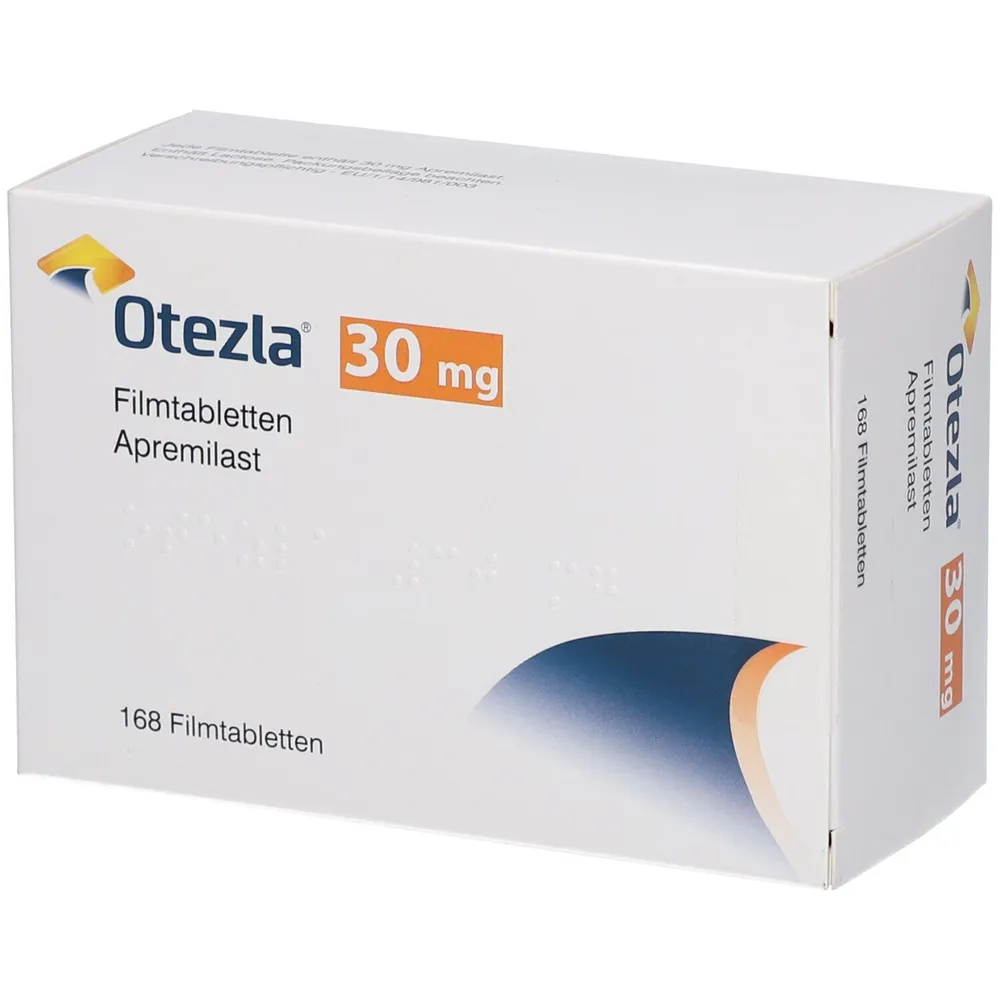
Table of Contents
- Package leaflet: Information for the patient
- Otezla 10 mg film-coated tablets, 20 mg film-coated tablets, 30 mg film-coated tablets
- 1. What Otezla is and what it is used for
- 2. What you should know before taking Otezla
- 3. How to take Otezla
- 4. Possible side effects
- 5. How to store Otezla
- 6. Package contents and other information
Package leaflet: Information for the patient
Otezla 10 mg film-coated tablets, 20 mg film-coated tablets, 30 mg film-coated tablets
apremilast
Please read all of this leaflet carefully before you start taking this medicine as it contains
important information for you.
- Keep this leaflet. You may need to read it again.
- If you have any questions, ask your doctor, pharmacist, or nurse.
- This medicine has been prescribed for you only. Do not give it to other people, even if they have the same symptoms as yours, as it may be harmful.
- If you experience any side effects, including any not listed in this leaflet, tell your doctor, pharmacist, or nurse. See section 4.
Contents of this leaflet:
- What Otezla is and what it is used for
- What you need to know before taking Otezla
- How to take Otezla
- Possible side effects
- How to store Otezla
- Contents of the pack and other information
1. What Otezla is and what it is used for
What Otezla is
Otezla contains the active substance “apremilast”. This active substance belongs to a group of medicines called “phosphodiesterase 4 inhibitors”, which help reduce inflammation.
What Otezla is used for
Otezla is used to treat adults with the following conditions:
- Active psoriatic arthritis – if it is not possible to use another type of medicine called “disease-modifying antirheumatic drugs” (DMARDs), or if treatment with one of these medicines has been tried but was not effective.
- Moderate to severe chronic plaque psoriasis – if one of the following treatments cannot be used, or if one of these treatments has been tried but was not effective:
- phototherapy – a treatment in which certain areas of the skin are exposed to ultraviolet light
- systemic therapy – a treatment that affects the whole body rather than just one area, such as “cyclosporine”, “methotrexate” or “psoralen”.
- Behçet’s disease (BD) – for the treatment of mouth ulcers, which are a common problem for people with this disease.
Otezla is used to treat children and adolescents aged 6 years and older and weighing at least 20 kg, with the following condition:
- Moderate to severe plaque psoriasis – if your doctor determines that systemic therapy such as Otezla is appropriate for you.
What psoriatic arthritis is
Psoriatic arthritis is an inflammatory joint disease, usually accompanied by psoriasis, a skin inflammatory condition.
What plaque psoriasis is
Psoriasis is an inflammatory skin disease that can cause red, scaly, thick patches on the skin, which may be itchy and painful, and may also affect the scalp and nails.
What Behçet’s disease is
Behçet’s disease is a rare type of inflammatory disease that affects many parts of the body. The most common problem is mouth ulcers.
How Otezla works
Psoriatic arthritis, psoriasis and Behçet’s disease are usually lifelong conditions for which there is currently no cure. Otezla works by reducing the activity of an enzyme in the body called “phosphodiesterase 4”, which is involved in the inflammatory process. By reducing the activity of this enzyme, Otezla can help control the inflammation associated with psoriatic arthritis, psoriasis and Behçet’s disease, thereby alleviating the signs and symptoms of these conditions.
In adults with psoriatic arthritis, treatment with Otezla leads to improvement in joint swelling and pain and may improve overall physical function.
In adults and in children and adolescents aged 6 years and older and weighing at least 20 kg with psoriasis, treatment with Otezla leads to a reduction in psoriatic plaques on the skin and in other signs and symptoms of the disease.
In adults with Behçet’s disease, treatment with Otezla reduces the number of mouth ulcers and may stop them completely. It may also reduce associated pain.
Otezla has also been shown to improve quality of life in adult and pediatric patients with psoriasis, in adult patients with psoriatic arthritis, and in adult patients with Behçet’s disease. This means that the impact of the disease on daily activities, relationships and other factors would be less than before.
2. What you should know before taking Otezla
Do not take Otezla:
- if you are allergic to apremilast or to any of the other ingredients of this medicine (listed in section 6).
- if you are or think you may be pregnant.
Warnings and precautions
Talk to your doctor or pharmacist before taking Otezla.
Depression and suicidal thoughts
Inform your doctor before starting Otezla if you have depression that is worsening, including suicidal thoughts.
You or the person caring for you must also immediately inform your doctor of any changes in behavior or mood, feelings of depression, or suicidal thoughts that you may experience after taking Otezla.
Severe kidney problems
If you have severe kidney problems, your dose will be different – see section 3.
If you are underweight
Talk to your doctor if you lose weight unintentionally while taking Otezla.
Gastrointestinal problems
If you develop severe diarrhea, nausea, or vomiting, you must talk to your doctor.
Children and adolescents
Otezla is not recommended for use in children under 6 years of age or weighing less than 20 kg with moderate to severe plaque psoriasis, as it has not been studied in this age group or body weight category.
Otezla is not recommended for use in children and adolescents under 18 years of age for other indications, as safety and efficacy have not been established in this age group.
Other medicines and Otezla
Tell your doctor or pharmacist if you are taking, have recently taken, or might take any other medicines, including over-the-counter medicines and herbal supplements. This is because Otezla may affect the action of other medicines, and other medicines may affect the action of Otezla.
In particular, inform your doctor or pharmacist before taking Otezla if you are taking any of the following medicines:
- rifampicin – an antibiotic used for tuberculosis
- phenytoin, phenobarbital, and carbamazepine – medicines used to treat seizures or epilepsy
- St. John’s wort – a herbal remedy used for mild anxiety and depression.
Pregnancy and breastfeeding
Do not take Otezla if you are or think you may be pregnant.
If you are pregnant, suspect you may be pregnant, plan to become pregnant, or are breastfeeding, consult your doctor or pharmacist before taking this medicine.
There is limited information available on the effects of Otezla during pregnancy. You must not become pregnant while taking this medicine and should use an effective method of contraception during treatment with Otezla.
It is not known whether this medicine passes into breast milk. You must not use Otezla while breastfeeding.
Driving and using machines
Otezla does not impair the ability to drive or operate machinery.
Otezla contains lactose
Otezla contains lactose (a type of sugar). If your doctor has diagnosed you with an intolerance to certain sugars, contact him or her before taking this medicine.
3. How to take Otezla
Take this medicine exactly as directed by your doctor. If you have any doubts, consult your doctor or pharmacist.
Dosage
- When you start taking Otezla, you will receive a "starter pack" containing enough tablets for a total of two weeks of treatment.
- The "starter pack" is clearly labeled to ensure you take the correct tablet at the right time.
- Treatment will begin with a lower dose, which will be gradually increased during the first week of treatment (titration phase).
- The "starter pack" will also contain enough tablets for an additional week of treatment at the recommended dose.
- Once the recommended dose is reached, you will take only single tablets from the prescribed packs.
- You will need to follow this dose titration schedule only once, even if you restart treatment after an interruption.
Adults
- The recommended dose of Otezla for adult patients is 30 mg twice daily, after completion of the dose titration phase, as shown in the following table: one 30 mg dose in the morning and one 30 mg dose in the evening, approximately 12 hours apart, with or without food. This corresponds to a total daily dose of 60 mg.
Dose
Day Morning dose Evening dose Total daily dose
Day 1 10 mg (pink) No dose 10 mg
Day 2 10 mg (pink) 10 mg (pink) 20 mg
Day 3 10 mg (pink) 20 mg (brown) 30 mg
Day 4 20 mg (brown) 20 mg (brown) 40 mg
Day 5 20 mg (brown) 30 mg (beige) 50 mg
From Day 6 onwards 30 mg (beige) 30 mg (beige) 60 mg
Children and adolescents aged 6 years and older
- The dose of Otezla will be based on body weight.
For patients weighing 20 kg to less than 50 kg: The recommended dose of Otezla is 20 mg twice daily, after completion of the dose titration phase, as shown in the following table: one 20 mg dose in the morning and one 20 mg dose in the evening, approximately 12 hours apart, with or without food. This corresponds to a total daily dose of 40 mg.
For patients weighing 50 kg or more: The recommended dose of Otezla is 30 mg twice daily, after completion of the dose titration phase (same as adults), as shown in the following table: one 30 mg dose in the morning and one 30 mg dose in the evening, approximately 12 hours apart, with or without food. This corresponds to a total daily dose of 60 mg.
Patients with severe renal impairment
-
If you are an adult with severe kidney problems, the recommended dose of Otezla is 30 mg once daily (morning dose).
-
In children and adolescents aged 6 years and older with severe renal impairment:
- For patients weighing 50 kg or more, the recommended dose of Otezla is 30 mg once daily (morning dose).
- For children weighing between 20 kg and less than 50 kg, the recommended dose is 20 mg once daily (morning dose).
Your doctor will explain how to increase the dose when starting treatment with Otezla. Your doctor may advise you to take only the morning dose shown in the table above, appropriate for you (either adult or pediatric/adolescent), and to skip the evening dose.
How and when to take Otezla
- Otezla is for oral use.
- Swallow the tablets whole, preferably with water.
- You may take the tablets with or without food.
- Take Otezla at approximately the same time each day: one tablet in the morning and one tablet in the evening.
If your condition has not improved after six months of treatment, you should consult your doctor.
If you take more Otezla than you should
If you take more Otezla than prescribed, consult your doctor or go to a hospital immediately. Bring the medicine pack and this leaflet with you.
If you forget to take Otezla
- If you forget to take a dose of Otezla, take it as soon as you remember. If it is almost time for your next dose, skip the missed dose and take the next dose at the scheduled time.
- Do not take a double dose to make up for a forgotten dose.
If you stop taking Otezla
- Continue taking Otezla until your doctor tells you to stop.
- Do not stop treatment with Otezla without first consulting your doctor.
If you have any questions about the use of this medicine, ask your doctor or pharmacist.
4. Possible side effects
Like all medicines, this medicine can cause side effects, although not everybody gets them.
Serious side effects – depression and suicidal thoughts
Inform your doctor immediately of any changes in behaviour or mood, feelings of depression, suicidal thoughts or suicidal behaviour (this is not common).
Very common side effects (may affect more than 1 in 10 people)
- diarrhoea
- nausea
- headache
- upper respiratory tract infections such as cold, runny nose, sinus infection
Common side effects (may affect up to 1 in 10 people)
- cough
- back pain
- vomiting
- feeling tired
- stomach pain
- loss of appetite
- frequent bowel movements
- difficulty sleeping (insomnia)
- indigestion or heartburn
- inflammation and swelling of the airways in the lungs (bronchitis)
- common cold (nasopharyngitis)
- depression
- migraine
- tension headache
Uncommon side effects (may affect up to 1 in 100 people)
- rash
- hives
- weight loss
- allergic reaction
- bleeding in the stomach or intestines
- suicidal ideation or behaviour
- anxiety
- mood changes
Side effects with unknown frequency (frequency cannot be estimated from the available data):
- severe allergic reaction (may include swelling of the face, lips, mouth, tongue or throat, which may cause difficulty breathing or swallowing)
If you are 65 years of age or older, you may be at higher risk of complications due to severe diarrhoea, nausea and vomiting. If your intestinal problems become severe, you must consult your doctor.
Reporting of side effects
If you experience any side effects, including those not listed in this leaflet, talk to your doctor, pharmacist or nurse. You can also report side effects directly via the national reporting system listed in Annex V. By reporting side effects, you can help provide more information on the safety of this medicine.
5. How to store Otezla
- Keep this medicine out of the sight and reach of children.
- Do not use this medicine after the expiry date stated on the blister, carton, or box following "Exp". The expiry date refers to the last day of that month.
- Do not store above 30°C.
- Do not use this medicine if you notice any damage or signs of tampering with the packaging.
Do not dispose of medicines via wastewater or household waste. Ask your pharmacist how to dispose of medicines no longer in use. This will help protect the environment.
6. Package contents and other information
What Otezla contains
The active substance is apremilast.
- Otezla 10 mg film-coated tablets: each film-coated tablet contains 10 mg of apremilast.
- Otezla 20 mg film-coated tablets: each film-coated tablet contains 20 mg of apremilast.
- Otezla 30 mg film-coated tablets: each film-coated tablet contains 30 mg of apremilast.
The other components in the tablet core are microcrystalline cellulose, lactose monohydrate, sodium croscarmellose and magnesium stearate.
- The film coating contains polyvinyl alcohol, titanium dioxide (E171), macrogol (3350), talc and red iron oxide (E172).
- The 20 mg film-coated tablets also contain yellow iron oxide (E172).
- The 30 mg film-coated tablets also contain yellow iron oxide (E172) and black iron oxide (E172).
Description of the appearance of Otezla and contents of the pack
The Otezla 10 mg film-coated tablet is a diamond-shaped, pink, film-coated tablet with “APR” imprinted on one side and “10” on the opposite side.
The Otezla 20 mg film-coated tablet is a diamond-shaped, brown, film-coated tablet with “APR” imprinted on one side and “20” on the opposite side.
The Otezla 30 mg film-coated tablet is a diamond-shaped, beige, film-coated tablet with “APR” imprinted on one side and “30” on the opposite side.
Packs for initiation of treatment
For initiation of treatment, the folding cartons contain:
- 27 film-coated tablets: 4 tablets of 10 mg and 23 tablets of 20 mg
- 27 film-coated tablets: 4 tablets of 10 mg, 4 tablets of 20 mg and 19 tablets of 30 mg.
Packs containing Otezla 20 mg tablets
- The standard pack for one month contains 56 film-coated tablets of 20 mg.
Packs containing Otezla 30 mg tablets
- The standard pack for one month contains 56 film-coated tablets of 30 mg.
- The standard pack for three months contains 168 film-coated tablets of 30 mg.
Marketing Authorisation Holder and Manufacturer
Amgen Europe B.V.
Minervum 7061
4817 ZK Breda
The Netherlands
Marketing Authorisation Holder
Amgen Europe B.V.
Minervum 7061
4817 ZK Breda
The Netherlands
Manufacturer
Amgen NV
Telecomlaan 5-7
1831 Diegem
Belgium
For further information about this medicinal product, please contact the local representative of the Marketing Authorisation Holder:
België/Belgique/Belgien Lietuva
s.a. Amgen n.v. Amgen Switzerland AG Vilniaus filialas
Tél/Tel: +32 (0)2 7752711 Tel: +370 5 219 7474
България Luxembourg/Luxemburg
Амджен България ЕООД s.a. Amgen
Тел.: +359 (0)2 424 7440 Belgique/Belgien
Tél/Tel: +32 (0)2 7752711
Česká republika Magyarország
Amgen s.r.o. Amgen Kft.
Tel: +420 221 773 500 Tel.: +36 1 35 44 700
Danmark Malta
Amgen, filial af Amgen AB, Sverige Amgen S.r.l
Tlf: +45 39617500 Italy
Tel: +39 02 6241121
Deutschland Nederland
Amgen GmbH Amgen B.V.
Tel.: +49 89 1490960 Tel: +31 (0)76 5732500
Eesti Norge
Amgen Switzerland AG Vilniaus filialas Amgen AB
Tel: +372 586 09553 Tlf: +47 23308000
Ελλάδα Österreich
Amgen Ελλάς Φαρμακευτικά Ε.Π.Ε. Amgen GmbH
Τηλ: +30 210 3447000 Tel: +43 (0)1 50 217
España Polska
Amgen S.A. Amgen Biotechnologia Sp. z o.o.
Tel: +34 93 600 18 60 Tel.: +48 22 581 3000
France Portugal
Amgen S.A.S. Amgen Biofarmacêutica, Lda.
Tél: +33 (0)9 69 363 363 Tel: +351 21 4220606
Hrvatska România
Amgen d.o.o. Amgen România SRL
Tel: +385 (0)1 562 57 20 Tel: +4021 527 3000
Ireland Slovenija
Amgen Ireland Limited AMGEN zdravila d.o.o.
Tel: +353 1 8527400 Tel: +386 (0)1 585 1767
Ísland Slovenská republika
Vistor hf. Amgen Slovakia s.r.o.
Sími: +354 535 7000 Tel: +421 2 321 114 49
Italia Suomi/Finland
Amgen S.r.l. Amgen AB, sivuliike Suomessa/Amgen AB, filial
Tel: +39 02 6241121 i Finland
Puh/Tel: +358 (0)9 54900500
Kύπρος Sverige
C.A. Papaellinas Ltd Amgen AB
Τηλ: +357 22741 741 Tel: +46 (0)8 6951100
Latvija United Kingdom (Northern Ireland)
Amgen Switzerland AG Rīgas filiāle Amgen Limited
Tel: +371 257 25888 Tel: +44 (0)1223 420305
Other sources of information
For detailed and up-to-date information on this medicinal product, scan the QR code on the secondary packaging with a smartphone. The same information is also available at the following website: www.otezla-eu-pil.com.
More detailed information on this medicinal product is available on the website of the European Medicines Agency: http://www.ema.europa.eu.
ANNEX IV
SCIENTIFIC CONCLUSIONS AND REASONS FOR THE VARIATION OF THE TERMS
OF THE MARKETING AUTHORISATION(S)
Scientific conclusions
Taking into account the assessment by the Pharmacovigilance Risk Assessment Committee (PRAC) of the Periodic Safety Update Report(s) (PSUR) for apremilast, the PRAC's scientific conclusions are as follows:
Scientific conclusions and reasons for the variation of the terms of the marketing authorisations
In light of the available data on anxiety and mood alteration from spontaneous reports, including in some cases a close temporal relationship and a positive de-challenge, and considering the potential class effect, the PRAC considers that a causal relationship between apremilast and these adverse reactions is at least a reasonable possibility. The PRAC concluded that the product information for medicinal products containing apremilast should be modified accordingly.
Update of section 4.4 of the Summary of Product Characteristics (SmPC) to revise the current warning regarding psychiatric disorders, and update of section 4.8 of the SmPC to add the adverse reactions “anxiety” and “mood alteration” with a frequency of “not common”. The patient information leaflet is updated accordingly.
The following changes to the product information for medicinal products containing apremilast are recommended (new text underlined and in bold, deleted text struck through):
Summary of Product Characteristics
- Section 4.4
The warning should be modified as follows:
Psychiatric disorders
Apremilast is associated with an increased risk of psychiatric disorders such as insomnia, anxiety, mood alteration and depression. Cases of suicidal ideation and behaviour, including suicide, have been observed in patients with or without prior history of depression (see section 4.8). The risks and benefits of initiating or continuing treatment with apremilast should be carefully evaluated if patients report past or current psychiatric symptoms, or if concomitant treatment with other medicinal products that may cause psychiatric events is anticipated. Patients and caregivers should be instructed to notify the prescribing physician of any changes in behaviour or mood and of any suicidal thoughts. If patients develop new or worsening psychiatric symptoms, suicidal ideation or a suicide attempt is observed, discontinuation of treatment with apremilast is recommended.
- Section 4.8
The following adverse reactions should be added to the System Organ Class “Psychiatric disorders” with a frequency of “Not common”: anxiety and mood alteration.
Patient Leaflet
- Section 4 Possible side effects
Uncommon side effects (may affect up to 1 in 100 people)
- anxiety
- mood alteration
Having reviewed the PRAC recommendation, the Committee for Human Medicinal Products (CHMP) agrees with the overall conclusions and the rationale of the recommendation.
Reasons for the variation of the terms of the marketing authorisation(s)
Based on the scientific conclusions on apremilast, the CHMP considers that the benefit-risk balance of the medicinal product(s) containing apremilast remains unchanged, subject to the proposed changes to the product information.
The CHMP recommends the variation of the terms of the marketing authorisation(s).