Oraqix
Italy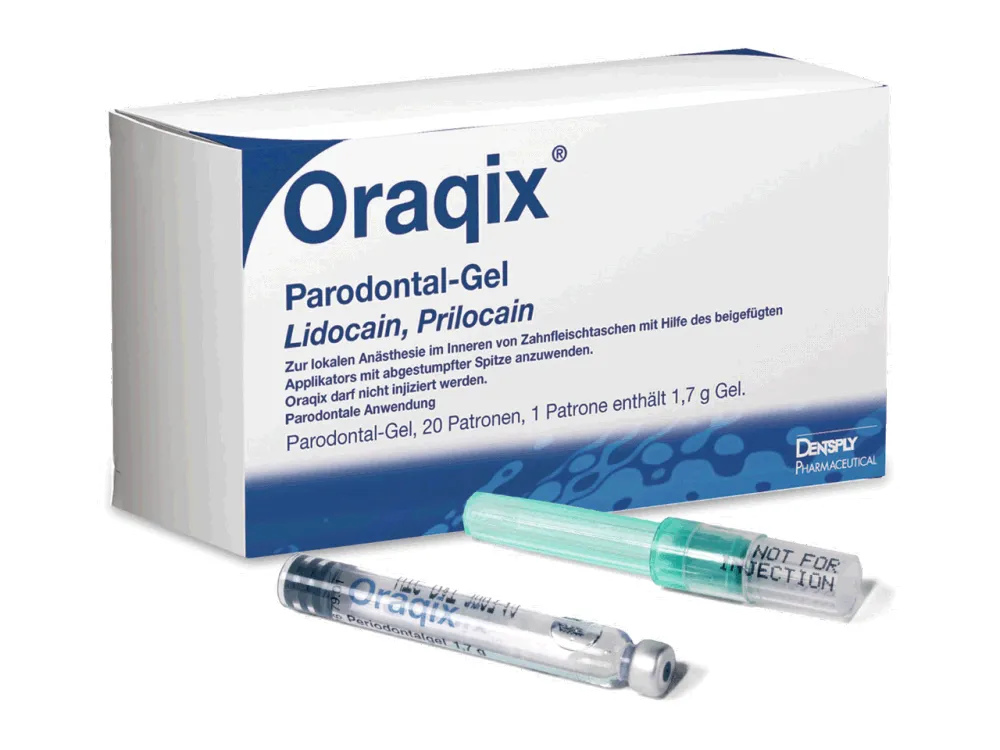
Table of Contents
PACKAGE LEAFLET: INFORMATION FOR THE USER
Oraqix 25/25 mg/g Periodontal Gel
lidocaine and prilocaine
Please read this leaflet carefully before using this medicine.
- Keep this leaflet. You may need to read it again.
- If you have any questions, ask your dentist or dental hygienist.
- This medicine has been prescribed for you. Do not give it to others, even if their symptoms are the same as yours, as it may be harmful.
- If any of the side effects worsen, or if you notice any side effects not listed in this leaflet, inform your dentist, dental hygienist or doctor.
Contents of this leaflet:
- What Oraqix is and what it is used for
- Before you use Oraqix
- How to use Oraqix
- Possible side effects
- How to store Oraqix
- Further information
1. What Oraqix is and what it is used for
Oraqix is a gel used to prevent gum pain. Oraqix is used in adults for the management of pain associated with certain types of dental procedures, such as scaling and/or root planing (cleaning those portions of the teeth that a toothbrush cannot reach) and probing (examination of teeth and gums).
2. Before using Oraqix
Do not use Oraqix
- if you are allergic (hypersensitive) to lidocaine, prilocaine, or other similar local anaesthetics;
- if you are allergic (hypersensitive) to any of the other ingredients of the gel (see section 6, Other information);
- if your doctor has told you that you have congenital or idiopathic methaemoglobinaemia (a condition in which an excessive amount of haemoglobin is converted into methaemoglobin in the blood. If too much methaemoglobin is produced, the blood has difficulty delivering oxygen to tissues);
- if your doctor has told you that you suffer from recurrent episodes of porphyria or if you may have inherited porphyria (porphyrias are a group of disorders that affect the process of blood formation).
Tell your dentist/dental hygienist if any of the following apply to you:
- if you have kidney or liver disease;
- if you have irregular heart activity or cardiac conduction disorders;
- if you have ulcers or infections in the mouth;
- if your doctor has told you that you have glucose-6-phosphate deficiency (an inherited condition occurring when the body lacks the important enzyme glucose-6-phosphate dehydrogenase).
Take special care with Oraqix
- The use of Oraqix in children and adolescents has not been evaluated; therefore, its use is not recommended in individuals under 18 years of age.
- Avoid contact of Oraqix with the eyes. If the gel comes into accidental contact with the eyes, rinse them immediately with water or saline solution and protect them until sensitivity is restored.
- Oraqix may sometimes completely block sensitivity in the treated areas. Be careful not to accidentally bite parts of your mouth. Also avoid consuming hot drinks and food until sensation has fully returned.
- Oraqix may interfere with doping tests for detection of illicit substances in athletes of both sexes, as it may produce a false positive result for such substances.
Using Oraqix with other medicines
Tell your dentist if you are taking:
- any other amide-type local anaesthetic or medicines used to treat heart arrhythmias (antiarrhythmics, e.g. mexiletine), since these drugs in combination with Oraqix may increase the risk of adverse effects described in the section "If you use more Oraqix than you should";
- other medicines that may cause methaemoglobinaemia, such as certain types of antibiotics known as sulfonamides.
Tell your dentist/dental hygienist if you are taking or have recently taken any other
medicines, including those without a prescription.
Pregnancy and breastfeeding
If you are pregnant, planning to become pregnant, or breastfeeding, inform your dentist or
dental hygienist before starting treatment with Oraqix.
- Oraqix must not be used during pregnancy unless specifically advised by your dentist.
- Breastfeeding may be continued after treatment with Oraqix.
Driving and using machines
Oraqix has no known effects on the ability to drive or operate machinery.
3. How to use Oraqix
Oraqix must be administered by a dentist or dental hygienist. The dose will be determined by the dentist or dental hygienist and will depend on the number of teeth to be treated.
- Oraqix Periodontal Gel is intended for use in adult patients.
- Oraqix must not be injected.
- Oraqix gel is applied to the gum using a dental syringe or via the Oraqix Dispenser with a blunt-tipped applicator.
- The maximum dose per single treatment is 5 cartridges.
- Full effect is achieved approximately 30 seconds after application, after which the dentist or dental hygienist can begin the procedure. The effect usually lasts about 20 minutes.
- If you feel that the effect of Oraqix is too strong or too weak, inform your dentist or dental hygienist.
- Administration of other local anaesthetics during the same treatment session is possible.
- Frequent use of high amounts of Oraqix is not recommended.
If you use more Oraqix than you should
If you have been given an excessive amount of local anaesthetic (e.g. Oraqix in combination with another anaesthetic), the following adverse effects may occur: numbness of the lips and area around the mouth, nervousness, feeling of dizziness, vertigo, motor incoordination, or occasionally blurred vision, drowsiness, and loss of consciousness. Other rare effects reported include convulsions, shortness of breath, and low blood pressure.
An overdose of prilocaine (Oraqix in combination with another prilocaine-containing anaesthetic) may also cause methaemoglobinaemia (see section 2). This is characterized by slate-grey cyanosis (a greyish-blue discolouration of the lips and skin).
If any of the symptoms described above occur, contact your dentist, dental hygienist, or doctor; go to the nearest emergency room for risk assessment and medical advice. You may need to remain under observation for several hours.
4. Possible side effects
Like all medicines, Oraqix can cause side effects, although not everybody experiences them.
Common side effects (affect up to 10% of treated patients):
- headache
- taste disturbances
- reactions in the oral cavity (pain, burning, numbness of other parts of the mouth or lips, ulcers, irritation and redness).
Uncommon side effects (affect less than 1% of treated patients):
- allergic reactions which may include: skin redness, throat swelling, breathing difficulties and fever
- dizziness
- nausea
- breathing difficulties and cyanosis (bluish-grey skin and lip discolouration)
- burning sensation
- swelling at the application site
An overdose of Oraqix could cause central nervous system excitation or depression, and cardiac conduction and cardiac function depression. If any of these side effects become concerning, go immediately to hospital.
If any of the side effects worsen, for example if you experience breathing difficulties or throat swelling, or if you suspect an anaphylactic reaction to the anaesthetic, inform your dentist or doctor immediately or go directly to hospital. If any side effects not listed in this leaflet occur, contact your dentist or dental hygienist while you are still at the clinic, or your doctor if you are already at home when they occur.
5. How to store Oraqix
- Keep out of the sight and reach of children.
- Do not freeze.
- Do not use Oraqix after the expiry date stated on the packaging. The expiry date refers to the last day of the month indicated.
Medicines should not be disposed of via wastewater or household waste. Ask your pharmacist
how to dispose of medicines you no longer use. This will help protect the environment.
6. Other information
What Oraqix contains
The active substances are prilocaine (base) and lidocaine (base).
The excipients are: purified poloxamer 188, purified poloxamer 407, purified water, and
diluted hydrochloric acid, used to adjust pH.
Description of the appearance of Oraqix and contents of the pack
Oraqix is a periodontal gel. It is a clear, colourless gel in a single-use glass cartridge.
One gram of Oraqix Periodontal Gel contains 25 mg of lidocaine and 25 mg of prilocaine.
One cartridge contains 1.7 g of gel (42.5 mg of lidocaine and 42.5 mg of prilocaine).
Each pack contains 20 cartridges.
Marketing Authorisation Holder
DENTSPLY ITALIA S.r.l., Via A. Curtatone 3 - 00185 Roma, Italy
Tel: +39 06 72640360
Fax: +39 06 72640321
Email: [email protected]
Manufacturer
Recipharm Karlskoga AB, Björkbornsvägen 5, SE-691 33 Karlskoga, Sweden
This medicinal product is authorised in EEA Member States under the following
names:
| MEMBER STATE | MEDICINAL PRODUCT NAME |
|--------------|------------------------|
| Austria | Oraqix Parodontal-Gel
Lidocain und Prilocain |
| Denmark | Oraqix periodontalgel
lidocain og prilocain |
| Finland | Oraqix geeli ientaskuun
lidokaiini ja prilokaiini |
| Germany | Oraqix Parodontal-Gel
Lidocain und Prilocain |
| Iceland | Oraqix tannholdshlaup
lidókain og prilókain |
| Netherlands | Oraqix periodontale gel
lidocaïne en prilocaïne |
| Norway | Oraqix periodontalgel
lidokain og prilokain |
| Sweden | Oraqix periodontalgel
lidokain och prilokain |
| Belgium | Oraqix 25/25 mg Gel periodontal
Lidocaïne et Prilocaïne |
| Luxembourg | Oraqix 25/25 mg Gel periodontal
Lidocaïne et Prilocaïne |
| Ireland | Oraqix 25/25 mg per g Periodontal Gel
Lidocaine and Prilocaine |
| United Kingdom | Oraqix 25/25 mg per g Periodontal Gel
Lidocaine and Prilocaine |
| France | Oraqix gel périodontal
Lidocaïne et Prilocaïne |
| Portugal | Oraqix Gel Periodontal
Lidocaína e Prilocaína |
| Spain | Oraqix Gel Periodontal
Lidocaína y Prilocaína |
| Italy | Oraqix 25/25 mg/g Gel Periodontale
Lidocaina e Prilocaina |
Leaflet approved on: 7 June 2011
To be detached
…………………………………………………………………………………………………………
The following information is intended for healthcare professionals only:
For further information on the use of Oraqix, please refer to the Summary of Product Characteristics (SmPC).
Instructions for use
- Oraqix must not be injected.
- On average, one cartridge (1.7 g) or less of Oraqix is sufficient for the treatment of one dental quadrant. The maximum recommended dose of Oraqix per single treatment session is 5 cartridges, equivalent to 8.5 g of gel containing 212.5 mg of lidocaine base and 212.5 mg of prilocaine base.
- At administration, Oraqix should appear in liquid form. If it has formed a gel, store it in the refrigerator until it becomes liquid again. The air bubble visible in the cartridge will move when the cartridge is tilted.
- The gel becomes opaque at temperatures below 5 °C. It will return to its original appearance when warmed to room temperature. At the end of administration, Oraqix appears in gel form.
- The cartridge and applicator are single-use. They are compatible with the Oraqix Dispenser.
- Apply Oraqix gel into the periodontal pockets using a dental syringe or the Oraqix Dispenser with the blunt-tipped applicator provided in the pack, until the gel becomes visible at the gingival margin. Wait 30 seconds before starting the procedure (a longer waiting time does not enhance anaesthesia). The duration of anaesthesia, as assessed by deep probing of the pockets, is approximately 20 minutes. If the anaesthetic effect begins to wear off, reapply Oraqix as needed.
- If additional local anaesthesia is required in combination with Oraqix, please refer to the SmPC of each additional anaesthetic. Since systemic toxic effects are additive (see Sections 4.5 and 4.9 of the Oraqix SmPC), it is not recommended to administer further local anaesthetics during the same treatment session if the administered amount of Oraqix corresponds to the maximum recommended dose of 5 cartridges.
- Avoid contact with Oraqix to prevent the development of possible allergies.