Ondexxya
Italy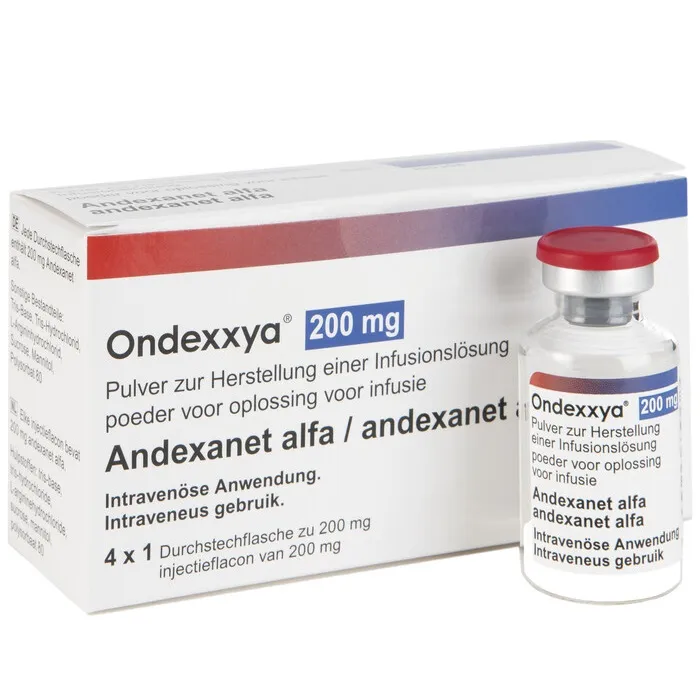
Table of Contents
- Package leaflet: Information for the patient and user
- Ondexxya 200 mg powder for solution for infusion
- 1. What Ondexxya is and what it is used for
- 2. What you need to know before you are given Ondexxya
- 3. How to use Ondexxya
- 4. Possible side effects
- 5. How to store Ondexxya
- 6. Package contents and other information
- The following information is intended for healthcare professionals only:
Package leaflet: Information for the patient and user
Ondexxya 200 mg powder for solution for infusion
andexanet alfa
This medicinal product is subject to additional monitoring. This will allow rapid identification of new safety information. You can help by reporting any side effects you experience while taking this medicine. See the end of section 4 for information on how to report side effects.
Please read this leaflet carefully as it contains important information for you. Please note that
this medicine is mainly used in emergency situations and that the doctor will have already determined that it is necessary.
- Keep this leaflet. You may need to read it again.
- If you have any questions, consult your doctor or nurse.
- If you experience any side effects, including those not listed in this leaflet, consult your doctor or nurse. See section 4.
Contents of this leaflet
- What Ondexxya is and what it is used for
- What you need to know before being given Ondexxya
- How Ondexxya is used
- Possible side effects
- How to store Ondexxya
- Contents of the pack and other information
1. What Ondexxya is and what it is used for
Ondexxya contains the active substance andexanet alfa, which reverses the effects of certain anticoagulants called factor Xa inhibitors (apixaban or rivaroxaban). Factor Xa inhibitors are given to prevent blood clots from forming in blood vessels. Your doctor may decide to administer Ondexxya to rapidly reverse the effects of the anticoagulant in the event of potentially life-threatening or uncontrolled bleeding.
2. What you need to know before you are given Ondexxya
Do not use Ondexxya
- if you are allergic to andexanet alfa or to any of the other ingredients of this medicine (listed in section 6).
- if you are allergic to hamster proteins.
- if you are receiving heparin.
Warnings and precautions
Reversal of the effect of a factor Xa inhibitor with Ondexxya may increase the risk of blood clots. After treatment with Ondexxya, your doctor will decide when to restart anticoagulant therapy.
An independent pro-coagulant effect of andexanet alfa may pose an additional risk for the development of thrombosis.
If you experience adverse reactions during Ondexxya infusion, your doctor may slow down or stop the treatment. To counteract adverse reactions, your doctor may administer an antihistamine (see section 4).
If you are scheduled for surgery requiring anticoagulation with heparin, the use of Ondexxya should be avoided.
Children and adolescents
There is no information available on the use of Ondexxya in children and adolescents.
Other medicines and Ondexxya
Inform your doctor if you are taking, have recently taken, or might take any other medicines.
This medicine is intended only to reverse the effects of factor Xa inhibitors. It is unlikely that Ondexxya will alter the effects of other medicines or that other medicines will alter the effect of Ondexxya.
Treatment with Ondexxya should be avoided if heparin anticoagulation may be required. Ondexxya causes resistance to heparin.
Pregnancy and breastfeeding
Inform your doctor if you are pregnant, suspect you may be pregnant, are planning a pregnancy, or are breastfeeding.
Ondexxya is not recommended during pregnancy or in women of childbearing potential who are not using contraception.
You must not breastfeed during treatment with this medicine. It is not known whether andexanet alfa is excreted in breast milk.
Driving and using machines
It is unlikely that this medicine will affect your ability to drive or use machinery.
Ondexxya contains polysorbate 80
This medicine contains 2 mg of polysorbate 80 per vial, equivalent to 0.1 mg/mL. Polysorbates may cause allergic reactions. Inform your doctor if you have known allergies.
3. How to use Ondexxya
This medicinal product is for hospital use only.
Your doctor or nurse will administer the medicine to you by injection or infusion into a vein.
Your doctor or nurse will determine the dose of medicine suitable for you. The dose depends on
the specific anticoagulant you are taking, as well as the dose and the time elapsed since the last
dose of the anticoagulant.
After administration of Ondexxya, your doctor will decide when to restart anticoagulant therapy.
Detailed instructions for the doctor or nurse on the administration of Ondexxya are provided at the
end of this leaflet (see “Instructions for use”).
If you have any doubts about the use of this medicine, consult your doctor.
4. Possible side effects
Like all medicines, this medicine can cause side effects, although not everybody gets them.
List of side effects observed in people with bleeding
Common (may affect up to 1 in 10 people)
- Stroke
- Heart attack
- Blood clot in the leg, arm, lung, or brain
- Fever
Uncommon (may affect up to 1 in 100 people)
- Mini-stroke
- Cardiac arrest
- Signs/symptoms of infusion-related reactions such as chills, high blood pressure, shortness of breath, confusion, or agitation.
Reporting of side effects
If you experience any side effect, including those not listed in this leaflet, talk to your doctor or nurse.
You can also report side effects directly via the national reporting system listed in Annex V. By reporting side effects, you can help provide more information on the safety of this medicine.
5. How to store Ondexxya
This medicine will be stored in a hospital setting and these instructions are intended solely for
hospital staff.
Keep this medicine out of the sight and reach of children.
Do not use this medicine after the expiry date stated on the vial and carton after “Exp”.
The expiry date refers to the last day of that month.
Store in a refrigerator (2 °C – 8 °C).
Do not freeze.
After reconstitution, Ondexxya should be used immediately.
6. Package contents and other information
What Ondexxya contains
- The active substance is andexanet alfa.
- The other components are Tris base, Tris hydrochloride, L-arginine hydrochloride, sucrose, mannitol, polysorbate 80.
Description of the appearance of Ondexxya and contents of the pack
Ondexxya is supplied in glass vials as a white to off-white powder for solution for infusion, which must be reconstituted (dissolved) before use. The reconstituted solution is a clear, colourless or pale yellow solution.
Each pack contains four or five vials.
Not all pack sizes may be marketed.
Marketing Authorisation Holder
AstraZeneca AB
SE-151 85 Södertälje
Sweden
Manufacturer
Alexion Pharma International Operations Limited
Alexion Dublin Manufacturing Facility
College Business and Technology Park
Blanchardstown Rd North
Dublin D15 R925
Ireland
For further information about this medicinal product, please contact the local representative of the Marketing Authorisation Holder:
België/Belgique/Belgien Lietuva
AstraZeneca S.A./N.V. UAB AstraZeneca Lietuva
Tel: +32 2 370 48 11 Tel: +370 5 2660550
България Luxembourg/Luxemburg
АстраЗенека България ЕООД AstraZeneca S.A./N.V.
Тел.: +359 24455000 Tél/Tel: +32 2 370 48 11
Česká republika Magyarország
AstraZeneca Czech Republic s.r.o. AstraZeneca Kft.
Tel: +420 222 807 111 Tel.: +36 1 883 6500
Danmark Malta
AstraZeneca A/S Associated Drug Co. Ltd
Tlf.: +45 43 66 64 62 Tel: +356 2277 8000
Deutschland Nederland
AstraZeneca GmbH AstraZeneca BV
Tel: +49 40 809034100 Tel: +31 85 808 9900
Eesti Norge
AstraZeneca AstraZeneca AS
Tel: +372 6549 600 Tlf: +47 21 00 64 00
Ελλάδα Österreich
AstraZeneca A.E. AstraZeneca Österreich GmbH
Τηλ: +30 210 6871500 Tel: +43 1 711 31 0
España Polska
AstraZeneca Farmacéutica Spain, S.A. AstraZeneca Pharma Poland Sp. z o.o.
Tel: +34 91 301 91 00 Tel.: +48 22 245 73 00
France Portugal
AstraZeneca AstraZeneca Produtos Farmacêuticos, Lda.
Tél: +33 1 41 29 40 00 Tel: +351 21 434 61 00
Hrvatska România
AstraZeneca d.o.o. AstraZeneca Pharma SRL
Tel: +385 1 4628 000 Tel: +40 21 317 60 41
Ireland Slovenija
AstraZeneca Pharmaceuticals (Ireland) DAC AstraZeneca UK Limited
Tel: +353 1609 7100 Tel: +386 1 51 35 600
Ísland Slovenská republika
Vistor AstraZeneca AB, o.z.
Sími: +354 535 7000 Tel: +421 2 5737 7777
Italia Suomi/Finland
AstraZeneca S.p.A. AstraZeneca Oy
Tel: +39 02 00704500 Puh/Tel: +358 10 23 010
Κύπρος Sverige
Αλέκτωρ Φαρµακευτική Λτδ AstraZeneca AB
Τηλ: +357 22490305 Tel: +46 8 553 26 000
Latvija
SIA AstraZeneca Latvija
Tel: +371 67377100
This medicinal product has been granted a marketing authorisation “under conditional approval”. This means that additional data on this medicinal product are required.
The European Medicines Agency will review new information on this medicinal product at least annually, and this package leaflet will be updated as necessary.
Further sources of information
More detailed information on this medicinal product is available on the website of the European Medicines Agency: https://www.ema.europa.eu/ .
The following information is intended for healthcare professionals only:
Andexanet alfa has not been shown to be effective and is not indicated for the treatment of bleeding associated with
any factor Xa inhibitor other than rivaroxaban or apixaban. Additionally, it does not reverse the effects of
non-FXa inhibitors.
Dosage and administration
Andexanet alfa is administered as an intravenous (IV) bolus at a target rate of
approximately 30 mg/min over 15 minutes (low dose) or 30 minutes (high dose), immediately followed by
a continuous infusion of 4 mg/min (low dose) or 8 mg/min (high dose) for 120 minutes (see
Table 1).
Table 1: Dosing regimens
| Initial intravenous bolus | Continuous intravenous infusion | Total number of 200 mg vials required | |
| Low dose | 400 mg at a target rate of 30 mg/min | 4 mg/min for 120 minutes (480 mg) | 5 |
| High dose | 800 mg at a target rate of 30 mg/min | 8 mg/min for 120 minutes (960 mg) | 9 |
The recommended dosing regimens have been established based on the effects of andexanet alfa in healthy volunteers who received a direct FXa inhibitor and on the ability to reverse anti-FXa activity levels. The dosing regimen has been used in clinical studies conducted in patients with acute major bleeding.
Reversal of apixaban
The recommended dosing regimen of andexanet alfa is based on the dose of apixaban administered to the patient at the time of anticoagulant reversal and on the time elapsed since the last apixaban dose (see Table 2). If the dose of the last anticoagulant administration or the interval between the last dose and the bleeding episode is unknown, no dose recommendation is available. The clinical decision to initiate treatment should be supported by measurement of baseline anti-FXa activity levels (if such levels are available within an acceptable timeframe).
Table 2: Summary of doses for reversal of apixaban
| Factor Xa inhibitor | Last dose of the factor Xa inhibitor | Time from last dose of factor Xa inhibitor before starting andexanet alfa | |
| < 8 hours | ≥ 8 hours | ||
| Apixaban | ≤ 5 mg | Low dose | Low dose |
| > 5 mg | High dose | ||
Reversal of rivaroxaban
The recommended dosing regimen of andexanet alfa is based on the dose of rivaroxaban administered to the patient at the time of reversal of anticoagulant therapy and on the time elapsed since the last dose of rivaroxaban (see Table 3). If the dose of the last anticoagulant administration or the interval between the last dose and the bleeding episode is unknown, no dose recommendation is available. The clinical decision to initiate treatment should be supported by measurement of baseline anti-FXa activity (if such measurement is available within an acceptable timeframe).
Table 3: Summary of doses for reversal of rivaroxaban
| Factor Xa inhibitor | Last dose of the factor Xa inhibitor | Time from last dose of the factor Xa inhibitor before starting andexanet alfa | |
| < 8 hours | ≥ 8 hours | ||
| Rivaroxaban | ≤ 10 mg | Low dose | Low dose |
| > 10 mg | High dose | ||
Patients receiving treatment with a Factor Xa (FXa) inhibitor suffer from underlying conditions that predispose them to thromboembolic events. Reversal of therapy with an FXa inhibitor exposes patients to the thrombotic risk associated with the underlying condition. To reduce this risk, resumption of anticoagulant therapy should be considered as soon as medically appropriate.
Instructions for Use
Reconstitute andexanet alfa and then transfer the 10 mg/mL solution without further dilution into large-capacity sterile syringes if using a syringe pump, or into suitable empty polyolefin (PO) or polyvinyl chloride (PVC) intravenous (IV) bags. Prior to intravenous infusion administration, use an in-line filter made of polyethersulfone (PES) with a pore size of 0.2 or 0.22 micron, or an equivalent low-protein-binding filter.
For reconstituted solutions, chemical and physical in-use stability has been demonstrated for at least eight hours at 25°C. From a microbiological standpoint, the product should be used immediately after opening. If not used immediately, the duration and conditions of in-use storage prior to use are the responsibility of the user.
Reconstitution
Before beginning reconstitution, gather the following materials:
- The calculated number of vials indicated in Table 1.
- An equal number of 20 mL (or larger) solvent syringes equipped with a 20-gauge needle (or smaller diameter, e.g., 21-gauge).
- Alcohol-impregnated swabs.
- Large sterile syringe (50 mL or larger). When administering via syringe pump, multiple syringes may be required to accommodate the final volume of reconstituted product.
- Polyolefin (PO) or polyvinyl chloride (PVC) intravenous bags (150 mL or larger) to hold the final volume of reconstituted product (when administering via IV bags).
- Water for injections.
- In-line filter made of polyethersulfone (PES) with a pore size of 0.2 or 0.22 micron, or an equivalent low-protein-binding filter.
Andexanet alfa does not need to be brought to room temperature before reconstitution or before administration to the patient. Maintain aseptic technique during the reconstitution procedure.
Reconstitute each vial according to the following steps:
- Remove the flip-off cap from each vial.
- Clean the rubber stopper of each vial with an alcohol-impregnated swab.
- Using a 20 mL (or larger) syringe and a 20-gauge needle (or smaller diameter, e.g., 21-gauge), withdraw 20 mL of water for injections.
- Insert the needle into the center of the rubber stopper.
- Slowly depress the plunger and inject the 20 mL of water for injections into the vial, directing the stream against the inner wall of the vial to minimize foaming.
- Gently rotate each vial until the powder is completely dissolved. DO NOT SHAKE the vials to avoid foaming. Dissolution time is approximately three to five minutes per vial.
- Before administration, visually inspect the reconstituted solution for the presence of particulate matter and/or discoloration. Do not use if opalescent particles or discoloration are observed.
- To ensure effective reconstitution of the required dose and to minimize errors, inject 20 mL of water for injections into each vial before proceeding to the next step.
- If stored at room temperature, use andexanet alfa within eight hours after reconstitution.
Administration via Syringe Pump
- After reconstituting all required vials, withdraw the reconstituted solution from each vial using a large syringe (50 mL or larger) equipped with a 20-gauge needle (or smaller diameter, e.g., 21-gauge).
- Prepare the bolus and infusion doses in separate large-volume syringes.
- Due to the larger volume, high-dose bolus and infusion must be divided into additional syringes (two syringes each for bolus and infusion).
- To prevent accidental air transfer, keep the syringe needle pointing upward and do not lay the syringe down between draws.
- Before administration, connect necessary accessories (e.g., extension tubing, in-line filter made of polyethersulfone (PES) with a pore size of 0.2 or 0.22 micron or equivalent low-protein-binding filter, syringe pump).
- Administer the reconstituted solution at the appropriate rate.
- Dispose of all used syringes, needles, vials, and unused portions of the reconstituted solution according to local regulations.
Administration via Intravenous Bags
- After reconstituting all required vials, withdraw the reconstituted solution from each vial using a large syringe (50 mL or larger) equipped with a 20-gauge needle (or smaller diameter, e.g., 21-gauge).
- Transfer the reconstituted solution from the syringe into appropriate IV bags.
- Repeat steps 1 and 2 to transfer the entire volume of bolus and infusion into PO or PVC IV bags.
- To ensure proper administration rate, it is recommended to divide the bolus and infusion into two separate bags. Alternatively, a single PO or PVC IV bag may be used for both bolus and infusion, but the correct infusion rate must be ensured when transitioning from bolus to infusion.
- Before administration, connect necessary accessories (e.g., extension tubing, in-line filter made of polyethersulfone (PES) with a pore size of 0.2 or 0.22 micron or equivalent low-protein-binding filter, IV pump).
- Administer the reconstituted solution at the appropriate rate.
Disposal
All used syringes, needles, vials, and unused portions of the reconstituted solution must be disposed of in accordance with applicable local regulations.