Ondansetron Teva
Italy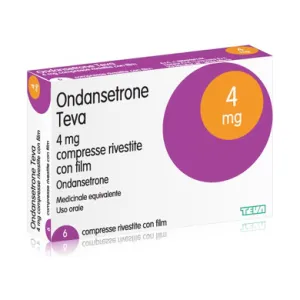
Table of Contents
- Package leaflet: Information for the user
- Ondansetron Teva 4 mg Film-coated tablets, 8 mg Film-coated tablets
- 1. What Ondansetrone Teva is and what it is used for
- 2. What you need to know before taking Ondansetron Teva
- 3. How to take Ondansetrone Teva
- 4. Possible side effects
- 5. How to store Ondansetron Teva
- 6. Contents of the pack and other information
Package leaflet: Information for the user
Ondansetron Teva 4 mg Film-coated tablets, 8 mg Film-coated tablets
Generic medicine
Please read all of this leaflet carefully before you start taking this medicine because it contains important information for you.
- Keep this leaflet. You may need to read it again.
- If you have any questions, ask your doctor or pharmacist.
- This medicine has been prescribed for you only. Do not give it to other people, even if they have the same symptoms as yours, because it may be harmful.
- If you experience any side effect, including those not listed in this leaflet, tell your doctor or pharmacist. See section 4.
Contents of this leaflet
- What Ondansetron Teva is and what it is used for
- What you need to know before taking Ondansetron Teva
- How to take Ondansetron Teva
- Possible side effects
- How to store Ondansetron Teva
- Contents of the pack and other information
1. What Ondansetrone Teva is and what it is used for
Ondansetrone Teva belongs to a group of medicines called antiemetics, which are used to
prevent nausea and vomiting.
Ondansetrone Teva is used for:
- treating nausea and vomiting caused by chemotherapy or radiotherapy in adults, children and adolescents aged between 6 months and 17 years
- preventing nausea and vomiting following surgical procedures in adults.
2. What you need to know before taking Ondansetron Teva
Do not take Ondansetron Teva:
- If you are allergic (hypersensitive) to ondansetron or to any of the other ingredients of this medicine (listed in section 6).
- If you are being administered apomorphine (a medicine used to treat Parkinson's disease).
Must not be used in children with a body surface area less than 0.6 m² or with a body weight up to 10 kg. For this group of patients, more suitable dosage forms with a lower content of active substance are available.
Warnings and precautions
Talk to your doctor or pharmacist before taking Ondansetron Teva if you:
- are allergic to medicines similar to ondansetron (5-HT₃ antagonists);
- have heart problems, including irregular heartbeat (arrhythmia);
- have liver problems;
- have a blockage of the intestinal tract or have suffered from severe constipation;
- have undergone intestinal surgery;
- have undergone adenoid or tonsil surgery;
- have problems with electrolyte levels in your blood, such as potassium, sodium, and magnesium.
Other medicines and Ondansetron Teva
Tell your doctor or pharmacist if you are taking, have recently taken, or might take any other medicines.
Ondansetron Teva alters the effects and/or side effects of certain medicines, including:
- Apomorphine (a medicine used to treat Parkinson's disease). Severe drops in blood pressure and loss of consciousness have been reported when ondansetron was taken together with apomorphine.
- Carbamazepine, phenytoin (used to treat epilepsy).
- Rifampicin (used to treat tuberculosis).
- Tramadol (used to relieve moderate to moderately severe pain).
- Medicines acting on the heart, such as certain anticancer drugs (anthracyclines or trastuzumab), or drugs that prolong the QT interval (which may cause changes in the ECG with risk of abnormal or irregular heartbeat, potentially life-threatening).
- Selective serotonin reuptake inhibitors (SSRIs) used to treat depression and/or anxiety, such as fluoxetine, paroxetine, sertraline, fluvoxamine, citalopram, escitalopram.
- Selective serotonin-noradrenaline reuptake inhibitors (SNRIs) used to treat depression and/or anxiety, such as venlafaxine or duloxetine.
Pregnancy and breastfeeding
Ondansetron Teva must not be used during the first trimester of pregnancy, because Ondansetron Teva may slightly increase the risk of the baby being born with cleft lip and/or cleft palate (fissures or splits in the upper lip and/or palate). If you are already pregnant, think you may be pregnant, or are planning a pregnancy, consult your doctor or pharmacist before taking Ondansetron Teva. If you are a woman of childbearing age, you may be advised to use effective contraception.
Do not breastfeed while taking Ondansetron Teva.
This is because a small amount passes into breast milk. Consult your doctor.
Driving and using machines
- Ondansetron Teva does not affect or affects negligibly your ability to drive vehicles or operate machinery.
Ondansetron Teva contains lactose
If your doctor has diagnosed you with an intolerance to certain sugars, contact him before taking this medicine.
Ondansetron Teva contains sodium
This medicine contains less than 1 mmol (23 mg) of sodium per coated tablet, i.e. essentially "sodium-free".
3. How to take Ondansetrone Teva
Take this medicine exactly as directed by your doctor or pharmacist. If you
have any doubts, consult your doctor or pharmacist.
The recommended dose is:
For the treatment of nausea and vomiting caused by chemotherapy or radiotherapy:
- Adults (including elderly patients): A dose of 8 mg taken 1 or 2 hours before chemotherapy or radiotherapy, followed by another 8 mg dose 12 hours after treatment. Afterwards, you may take 8 mg twice daily for up to 5 days, starting 24 hours after chemotherapy or radiotherapy.
- Use in children (over 6 months of age) and adolescents: Initial administration of Ondansetrone Teva may be given as a single intravenous injection at least 15 minutes before chemotherapy. Afterwards, the medicine may be administered in tablet form two to three times daily for up to 5 days after chemotherapy. The tablet dose will depend on your child's body weight and will be determined by the doctor.
For the prevention of nausea and vomiting after surgery:
- Adults (including elderly patients): A 16 mg dose may be taken one hour before anesthesia. Alternatively, you may take an 8 mg dose one hour before anesthesia, followed by two additional 8 mg doses given at eight-hour intervals.
- Use in children (over 1 month of age) and adolescents: Intravenous administration of Ondansetrone Teva is recommended.
Patients with liver problems
The total daily dose must not exceed 8 mg.
The effect of Ondansetrone Teva should begin within one or two hours after taking the dose.
If you vomit within one hour after taking the dose, take another dose. Otherwise, continue taking
the tablets as indicated on the label, but do not take more than prescribed by your doctor. If nausea persists, inform your doctor.
Method of administration
Swallow the tablets whole, preferably with a glass of water.
Ondansetrone Teva 8 mg film-coated tablets: The score line is only to help you break the tablet if you have difficulty swallowing it whole.
If you take more Ondansetrone Teva than you should
If you or your child takes more Ondansetrone Teva than prescribed, contact your doctor immediately or go to hospital. Take the medicine packaging with you.
An overdose may cause temporary vision problems, severe constipation, dizziness, or fainting.
If you forget to take Ondansetrone Teva
Do not take a double dose to make up for the forgotten dose.
If you experience nausea or vomiting after missing a tablet, take a tablet as soon as you remember, and continue taking the tablets as before. If you forget to take a tablet but do not have nausea, wait until the next scheduled dose as indicated on the label. Take the remaining doses at the correct times.
If you stop taking Ondansetrone Teva
Do not stop treatment without consulting your doctor, even if you feel better.
If you have any doubts about how to use this medicine, consult your doctor or pharmacist.
4. Possible side effects
Like all medicines, this medicine can cause side effects, although not everybody gets them.
If you experience any of the following conditions, stop treatment immediately and contact your doctor
or go to the nearest emergency room:
Uncommon: may affect up to 1 in 100 people
- seizures
Rare: may affect up to 1 in 1,000 people
- an allergic reaction causing (swelling of the face, lips, tongue or throat, difficulty swallowing or breathing, rash)
- collapse
- disturbances in heart rhythm (sometimes leading to sudden loss of consciousness)
Very rare: may affect up to 1 in 10,000 people
- widespread rash with blisters and peeling of the skin over a large area of the body (toxic epidermal necrolysis).
Other side effects include:
Very common: may affect more than 1 in 10 people
- headache
Common: may affect up to 1 in 10 people
- feeling of warmth or flushing
- constipation
- changes in liver function test results (if you take Ondansetrone Teva with a medicine called cisplatin; otherwise this effect is not common)
Uncommon: may affect up to 1 in 100 people
- reduced vision or temporary loss of vision, usually recovering within 20 minutes
- unusual body movements or tremors
- hiccups
- low blood pressure, which may cause fainting or dizziness
- irregular heartbeat or chest pain
- slowing of the heartbeat
Rare: may affect up to 1 in 1,000 people
- dizziness or feeling lightheaded
- blurred vision
Very rare: may affect up to 1 in 10,000 people
- reduced vision or temporary loss of vision, mainly after intravenous administration.
Not known: (frequency cannot be estimated from the available data)
- myocardial ischemia (signs include: sudden chest pain or chest tightness).
Children and adolescents
The adverse event profiles in children and adolescents were comparable to those observed in adults.
Reporting of side effects
If you experience any side effects, including those not listed in this leaflet, talk to your doctor or pharmacist. You can also report side effects directly via the national reporting system available at www.aifa.gov.it/content/segnalazioni-reazioni-avverse. By reporting side effects, you can help provide more information on the safety of this medicine.
5. How to store Ondansetron Teva
Keep this medicine out of the sight and reach of children.
Do not use this medicine after the expiry date (EXP.) stated on the blister and carton.
The expiry date (EXP.) refers to the last day of that month.
This medicine does not require any special storage conditions.
Do not dispose of medicines via wastewater. Ask your pharmacist how to dispose of medicines you no longer use.
This will help protect the environment.
6. Contents of the pack and other information
What Ondansetrone Teva contains
- The active substance is ondansetron. Each film-coated tablet contains 4 mg of ondansetron (as ondansetron dihydrochloride dihydrate).
| The active substance is ondansetron. | ||
| Each film-coated tablet contains 8 mg of ondansetron (as ondansetron hydrochloride | ||
| dihydrate) | . | |
- The other ingredients are:
- tablet core: lactose monohydrate, sodium starch glycolate, microcrystalline cellulose, pregelatinized maize starch, magnesium stearate,
- coating: hypromellose, titanium dioxide (E171), macrogol (400 and 6000), iron oxide yellow (E172).
Description of the appearance of Ondansetrone Teva and contents of the pack
- Ondansetrone Teva 4 mg tablets are yellow, film-coated, oblong tablets, marked with the number “4” on one side and smooth on the other.
- Ondansetrone Teva 8 mg tablets are yellow, film-coated, oblong tablets, marked with the number “8” on one side and a score line on the other.
- Ondansetrone Teva 4 mg film-coated tablets are available in packs of 2, 4, 5, 6, 10, 15, 30, 50, 100 and 500; hospital packs of 10x1 and 50x1 film-coated tablets.
- Ondansetrone Teva 8 mg film-coated tablets are available in packs of 2, 4, 5, 6, 9, 10, 15, 18, 50, 100 and 500; hospital packs of 10x1 and 50x1 film-coated tablets.
Not all pack sizes may be marketed.
Marketing Authorisation Holder and Manufacturer
Marketing Authorisation Holder
Teva Italia S.r.l. – Piazzale Luigi Cadorna, 4 – 20123 Milano
Manufacturer
Pharmachemie B.V. – Swensweg, 5 – 2031 GA Haarlem (The Netherlands)
Teva Pharmaceutical Works Ltd – Pallagi st 13 – 4042 Debrecen (Hungary)
Merckle GmbH Ludwig-Merckle-Strasse 3 89143 Blaubeuren (Germany)