Ondansetron Hikma
Italy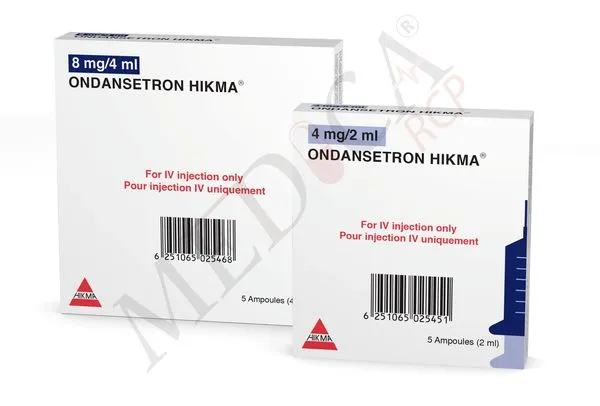
Table of Contents
- Package leaflet: Information for the user
- Ondansetrone Hikma 4 mg/2 ml injectable solution, 8 mg/4 ml injectable solution
- 1. What Ondansetrone Hikma is and what it is used for
- 2. What you need to know before using Ondansetrone Hikma
- 3. How to use Ondansetrone Hikma
- 4. Possible side effects
- 5. How to store Ondansetrone Hikma
- 6. Package Contents and Other Information
Package leaflet: Information for the user
Ondansetrone Hikma 4 mg/2 ml injectable solution, 8 mg/4 ml injectable solution
Ondansetrone
Please read all of this leaflet carefully before you start using this medicine because it contains important information for you.
- Keep this leaflet. You may need to read it again.
- If you have any questions, ask your doctor, nurse or pharmacist.
- This medicine has been prescribed for you only. Do not give it to other people, even if they have the same symptoms as yours, because it may be harmful.
- If you experience any side effects, including any not listed in this leaflet, tell your doctor, nurse or pharmacist. See section 4.
Contents of this leaflet:
- What Ondansetrone Hikma is and what it is used for
- What you need to know before using Ondansetrone Hikma
- How to use Ondansetrone Hikma
- Possible side effects
- How to store Ondansetrone Hikma
- Contents of the pack and other information
1. What Ondansetrone Hikma is and what it is used for
Ondansetrone Hikma contains a substance belonging to a group of medicines called
antiemetics.
Ondansetrone Hikma is used for:
- preventing nausea and vomiting caused by chemotherapy (in adults and children) and by radiotherapy (adults only);
- preventing nausea and vomiting after surgery.
Ask your doctor, nurse or pharmacist if you require further explanation regarding these uses.
2. What you need to know before using Ondansetrone Hikma
- If you are allergic to ondansetron or to any of the other ingredients of this medicine (listed in section 6).
- If you are taking apomorphine (used to treat Parkinson's disease).
If you are unsure, talk to your doctor, nurse, or pharmacist before taking
Ondansetrone Hikma.
Before taking Ondansetrone Hikma, tell your doctor, pharmacist, or nurse if:
- you have ever had heart problems (for example, congestive heart failure causing shortness of breath and swollen ankles)
- you have irregular heartbeat (arrhythmias)
- you are allergic to medicines similar to ondansetron, such as granisetron or palonosetron
- you have liver problems
- you have intestinal obstruction
- you have problems with levels of certain salts in your blood, such as potassium, sodium, and magnesium. If you are not sure whether any of the above conditions apply to you, talk to your doctor, nurse, or pharmacist before receiving Ondansetrone Hikma.
Other medicines and Ondansetrone Hikma
Tell your doctor or pharmacist if you are taking, have recently taken, or might take any other medicines. This includes medicines you buy without a prescription and herbal medicines. This is because Ondansetrone Hikma can affect how some medicines work. Also, some other medicines can affect how Ondansetrone Hikma works. In particular, tell your doctor, nurse, or pharmacist if you are taking any of the following medicines:
- carbamazepine or phenytoin, used to treat epilepsy
- rifampicin, used to treat infections such as tuberculosis (TB)
- antibiotics such as erythromycin or ketoconazole
- antiarrhythmic medicines used to treat irregular heartbeat
- beta-blockers used to treat certain heart or eye conditions, anxiety, or to prevent migraines
- tramadol, a painkiller
- medicines affecting the heart (haloperidol or methadone)
- medicines used to treat cancer (particularly anthracyclines and trastuzumab)
- SSRIs (selective serotonin reuptake inhibitors) used to treat depression and/or anxiety, including fluoxetine, paroxetine, sertraline, fluvoxamine, citalopram, escitalopram
- SNRIs (serotonin and noradrenaline reuptake inhibitors) used to treat depression and/or anxiety, including venlafaxine, duloxetine
If you are not sure whether any of the above conditions apply to you, talk to your doctor, nurse, or pharmacist before receiving Ondansetrone Hikma.
Ondansetrone Hikma must not be administered in the same syringe or infusion solution as any other medicine.
Pregnancy and breastfeeding
It is not known whether Ondansetrone Hikma is safe during pregnancy.
If you are pregnant, breastfeeding, think you may be pregnant, or are planning to become pregnant, ask
your doctor or pharmacist for advice before taking this medicine.
Do not breastfeed while taking Ondansetrone Hikma. This is because small amounts pass into breast
milk. Ask your doctor or midwife for advice.
Ondansetrone Hikma contains a small amount of sodium citrate and sodium chloride.
This medicine contains 6.4 mmol (or 148 mg) of sodium per maximum daily dose of 23 mg.
This should be taken into consideration by patients on a controlled sodium diet.
3. How to use Ondansetrone Hikma
Ondansetrone Hikma is normally administered by a nurse or doctor. The dose prescribed to you depends on the treatment you are undergoing.
To prevent nausea and vomiting following chemotherapy or radiotherapy in adults
On the day of chemotherapy or radiotherapy
- The recommended dose for adults is 8 mg given by intravenous injection just before treatment, followed by another 8 mg 12 hours later. After chemotherapy, your medication will generally be continued orally as an 8 mg tablet or 10 ml (8 mg) of ondansetrone syrup.
In the following days
- The recommended dose for adults is one 8 mg tablet or 10 ml (8 mg) of syrup taken twice daily.
- This treatment may continue for up to 5 days.
- If your chemotherapy or radiotherapy causes severe nausea and vomiting, a higher dose of ondansetrone may be given. Your doctor will decide on this.
Management of nausea and vomiting following chemotherapy in adolescents and children over 6 months of age
Your doctor will determine the dose based on the child's size (body surface area) or weight.
On the day of chemotherapy
- The first dose is administered by intravenous injection just before your child's treatment. After chemotherapy, the medication is generally given orally 12 hours later as ondansetrone syrup or ondansetrone tablets.
In the following days
- 2.5 ml (2 mg) of syrup twice daily for young children weighing 10 kg or less.
- One 4 mg tablet or 5 ml (4 mg) of syrup twice daily for larger children weighing more than 10 kg.
- Two 4 mg tablets or 10 ml (8 mg) of syrup twice daily for adolescents (or those with a larger body surface area).
- These dosages may be administered for up to 5 days.
To prevent nausea and vomiting after surgery
Adults:
- The usual dose for adults is 4 mg given by slow intravenous injection. This will be administered as a preventive measure just before surgery.
Children:
- For children over 1 month of age and adolescents, the doctor will determine the appropriate dose. The maximum dose is 4 mg given by intravenous injection. This will be administered just before surgery.
Patients with moderate or severe liver problems
The total daily dose should not exceed 8 mg.
If you continue to feel unwell or start feeling sick
Ondansetrone Hikma should start working immediately after the injection. If you continue to feel unwell or start to feel nauseous, inform your doctor or nurse.
If you use more Ondansetrone Hikma than you should
Ondansetrone Hikma will be given to you or your child by a doctor or nurse, so it is unlikely that you or your child will receive too much. If you think that you or your child has received too much, or if you have missed a dose, inform your doctor or nurse.
4. Possible side effects
Like all medicines, this medicine can cause side effects, although not everybody gets them.
Allergic reactions
If you have an allergic reaction, tell your doctor or hospital staff immediately.
Symptoms may include:
sudden wheezing and chest pain or tightness in the chest
swelling of the eyelids, face, lips, mouth or tongue
skin rash
red spots or lumps under the skin (urticaria) anywhere on your body
collapse.
Other side effects include:
Very common (may affect more than 1 in 10 people)
- headache
Common (may affect up to 1 in 10 people)
- a feeling of warmth or hot flushes
- constipation
- changes in liver function test results (if you have taken ondansetron with a medicine called cisplatin; otherwise this effect is uncommon)
- irritation and redness at the injection site
Uncommon (may affect up to 1 in 100 people)
- hiccups
- low blood pressure, which may make you feel weak or dizzy
- irregular heartbeat
- chest pain
- seizures
- unusual body movements or tremors
Rare (may affect up to 1 in 1,000 people)
- feelings of dizziness or lightheadedness
- blurred vision
- heart rhythm disorder (sometimes causing sudden loss of consciousness)
Very rare (may affect up to 1 in 10,000 people)
- poor vision or temporary loss of vision, which usually returns within 20 minutes
Reporting of side effects
If you experience any side effect, talk to your doctor or pharmacist. This includes any side effect not listed in this leaflet. You may also report side effects via the following website:
http://www.agenziafarmaco.gov.it/content/come-segnalare-una-sospetta-reazione-avversa
By reporting side effects, you can help provide more information on the safety of this medicine.
5. How to store Ondansetrone Hikma
Keep this medicine out of the sight and reach of children.
This medicine does not require any special storage conditions.
Diluted solutions are chemically stable for 24 hours if stored at 2–8 °C.
Do not use this medicine after the expiry date stated on the label and carton after the abbreviation EXP (month) / (year).
The expiry date refers to the last day of that month.
6. Package Contents and Other Information
What Ondansetrone Hikma Contains
- The active substance is ondansetron, in the form of dihydrochloride. Each ml of solution contains 2 mg of ondansetron. Each 2 ml vial contains 4 mg of ondansetron and each 4 ml vial contains 8 mg of ondansetron.
- The other ingredients are: sodium chloride, monohydrate citric acid, sodium citrate, and water for injections.
Description of the Appearance of Ondansetrone Hikma and Contents of the Package
Ondansetrone Hikma is a clear, colourless injectable solution, supplied in colourless glass vials.
Ondansetrone Hikma 4 mg/2 ml injectable solution
Each vial contains 2 ml of solution.
- Pack: 5 vials
Ondansetrone Hikma 8 mg/4 ml, injectable solution
Each vial contains 4 ml of solution.
- Pack: 5 vials
Marketing Authorisation Holder and Responsible Person for Batch Release
Hikma Farmacêutica (Portugal), S.A.
Estrada do Rio da Mó n.º 8, 8A and 8B – Fervença
2705-906 Terrugem SNT
Portugal
Tel.: +351 219 608 410
Fax: +351 219 615 102
[email protected]
Responsible Person for Batch Release
Hikma Italia S.p.A.
Viale Certosa, 10
27100 Pavia
Italy
Selling Agent for Italy
Hikma Italia SpA
Viale Certosa 10
27100 Pavia – Italy
This medicinal product is authorised in the Member States of the European Economic Area under the following names:
Austria: Ondansetron Hikma 4 mg/2 ml & 8 mg/4 ml Injektionslösung
Belgium: Ondansetron Hikma 4 mg/2 ml & 8 mg/4 ml Solution injectable
Germany: Ondansetron Hikma 4 mg/2 ml & 8 mg/4 ml Injektionslösung
Italy: Ondansetrone Hikma 4 mg/2 ml & 8 mg/4 ml Soluzione iniettabile
Netherlands: Ondansetron Hikma 4 mg/2 ml & 8 mg/4 ml Oplossing voor injectie
Portugal: Ondansetron Hikma 4 mg/2 ml & 8 mg/4 ml Solução injetável
This leaflet was last updated on
The following information is intended for healthcare professionals only
Ondansetrone Hikma 4 mg/2 ml injectable solution
Ondansetrone Hikma 8 mg/4 ml injectable solution
Ondansetron (as dihydrochloride)
See Summary of Product Characteristics (SmPC) for further details on this product
Trade name of the medicinal product
Ondansetrone Hikma injectable solution
Qualitative and Quantitative Composition
Ondansetrone Hikma 2 mg/ml
each 2 ml vial contains 4 mg of ondansetron (as dihydrochloride) in aqueous solution for intravenous administration
each 4 ml vial contains 8 mg of ondansetron (as dihydrochloride) in aqueous solution for intravenous administration
Dosage and Administration
Nausea and Vomiting Induced by Chemotherapy and Radiotherapy
Adults
The emetogenic potential of antineoplastic therapies varies according to the doses administered and the type of combination between chemotherapy and radiotherapy regimens used. The route and dose of Ondansetrone Hikma should be flexible, ranging from 8 to 32 mg/day, as indicated below.
Emetogenic chemotherapy and radiotherapy: Ondansetron can be administered rectally, orally (tablets or syrup), or by intravenous or intramuscular injection. However, Ondansetrone Hikma is approved only for intravenous administration.
In most patients undergoing emetogenic chemotherapy or radiotherapy, Ondansetrone Hikma 8 mg should be administered by slow intravenous injection (over no less than 30 seconds) immediately before treatment, followed by 8 mg orally every twelve hours.
To prevent delayed or prolonged emesis beyond the first 24 hours, continue oral or rectal ondansetron treatment up to 5 days after the treatment cycle.
Highly emetogenic chemotherapy: In patients receiving highly emetogenic chemotherapy, e.g. high-dose cisplatin, ondansetron may be administered orally, rectally, intravenously, or intramuscularly. However, Ondansetrone Hikma is approved only for intravenous administration.
Ondansetrone Hikma has demonstrated equivalent efficacy in the following regimens during the first 24 hours of chemotherapy:
- A single dose of 8 mg administered by slow intravenous injection (over no less than 30 seconds) immediately before chemotherapy;
- An 8 mg dose administered by slow intravenous injection (over no less than 30 seconds) immediately before chemotherapy, followed by two additional 8 mg intravenous doses given four hours apart, or by a continuous infusion of 1 mg/hour up to 24 hours;
- An initial maximum intravenous dose of 16 mg, diluted in 50–100 ml of physiological saline or another compatible infusion solution (see instructions for use/handling), and infused over no less than 15 minutes, immediately before chemotherapy. An initial dose of ondansetron may be followed by two additional 8 mg intravenous doses (administered over no less than 30 seconds) given four hours apart. A single dose exceeding 16 mg should not be administered due to the dose-dependent risk of QT interval prolongation (see sections 4.4, 4.8 and 5.1 of SmPC). The choice of regimen should be based on the severity of the emetogenic stimulus. The efficacy of Ondansetrone Hikma in highly emetogenic chemotherapy may be enhanced by adding a single 20 mg intravenous dose of sodium phosphate dexamethasone administered before chemotherapy. To prevent delayed or prolonged emesis beyond the first 24 hours, continue oral or rectal ondansetron treatment up to 5 days after the treatment cycle.
Paediatric Population
CINV in children aged ≥ 6 months and adolescents
The dosage for CINV can be calculated based on body surface area (BSA) or body weight – see below.
In paediatric clinical studies, ondansetron was administered via intravenous infusion diluted in 25–50 ml of saline or another compatible infusion fluid, infused over no less than 15 minutes.
Dosing based on body weight results in higher total doses compared to BSA-based dosing (see sections 4.4 and 5.1 of SmPC).
Ondansetrone Hikma must be diluted in 5% dextrose or 0.9% sodium chloride solution or another compatible infusion fluid (see instructions for use/handling) and administered intravenously over no less than 15 minutes.
There are no data from controlled clinical studies on the use of ondansetron in the prevention of delayed or prolonged CINV. There are no data from controlled clinical studies on the use of ondansetron for nausea and vomiting induced by radiotherapy in children.
BSA-based dosing:
Ondansetrone Hikma should be administered immediately before chemotherapy as a single intravenous dose of 5 mg/m². The intravenous dose must not exceed 8 mg.
Oral dosing may begin 12 hours later and may continue up to 5 days (see SmPC for dosing tables).
The total daily dose over 24 hours (given in divided doses) must not exceed the adult dosage of 32 mg.
Body weight-based dosing:
Body weight-based dosing results in higher total daily doses compared to BSA-based dosing.
Ondansetrone Hikma should be administered immediately before chemotherapy as a single intravenous dose of 0.15 mg/kg. The single intravenous dose must not exceed 8 mg.
Two additional intravenous doses may be administered at 4-hour intervals. Oral dosing may begin 12 hours later and may continue up to 5 days.
The total dose over 24 hours (given in separate doses) must not exceed the adult dose of 32 mg (see SmPC for further details).
Elderly
In patients aged 65 to 74 years, adult dosing may be followed. All intravenous doses must be diluted in 50–100 ml of saline or another compatible infusion fluid (see instructions for use/handling) and infused over more than 15 minutes.
In patients aged 75 years and over, the initial intravenous dose of Ondansetrone Hikma must not exceed 8 mg. All administrations must be diluted in 50–100 ml of saline or another compatible infusion fluid (see instructions for use/handling) and infused over more than 15 minutes. The initial 8 mg dose may be followed by two additional 8 mg intravenous doses, each infused over more than 15 minutes and administered at intervals of no less than 4 hours (see SmPC).
Postoperative Nausea and Vomiting (PONV)
Adults
For prevention of PONV, Ondansetrone Hikma may be administered orally or by intravenous injection.
However, Ondansetrone Hikma is approved only for intravenous administration.
Ondansetrone Hikma may be administered as a single 4 mg dose by slow intravenous injection at the time of anaesthesia induction.
For treatment of established PONV: a single 4 mg dose by slow intravenous injection is recommended.
Paediatric Population
PONV in children aged ≥ 1 month and adolescents
For prevention of PONV in children undergoing surgery under general anaesthesia, a single dose of Ondansetrone Hikma may be administered by slow intravenous injection (over no less than 30 seconds) at a dose of 0.1 mg/kg, up to a maximum of 4 mg, before, during, or after anaesthesia induction. For treatment of PONV after surgery in children who have undergone surgery under general anaesthesia, a single dose of ondansetron may be administered by slow intravenous injection (over no less than 30 seconds) at a dose of 0.1 mg/kg up to a maximum of 4 mg. There are no data on the use of Ondansetrone Hikma for treatment of PONV in children under 2 years of age.
Elderly
Experience with Ondansetrone Hikma for prevention and treatment of PONV in the elderly is limited; however, Ondansetrone Hikma is well tolerated in patients over 65 years undergoing chemotherapy.
For all indications:
Renal Impairment
No adjustments to daily dose, frequency, or route of administration are required.
Hepatic Impairment
The clearance of Ondansetrone Hikma is significantly reduced and the serum half-life is significantly prolonged in patients with moderate to severe hepatic impairment. In these patients, the total daily dose must not exceed 8 mg, and parenteral or oral administration is recommended.
Patients with Reduced Sparteine/Debrisoquine Metabolism
The elimination half-life of ondansetron is not altered in subjects with poor sparteine and debrisoquine metabolism. Consequently, repeated dosing in these patients does not result in different drug exposure levels compared to the general population. No adjustments to daily dose, frequency, or dosage are required.
Special Precautions for Disposal and Other Handling
Single-use. Unused medicine and waste derived from this medicine must be disposed of in accordance with local regulations.
Visually inspect the solution before use. Only use solutions that are clear and practically free of particles.
Compatibility with Intravenous Infusion Fluids
Ondansetrone Hikma may only be mixed with the following recommended solutions:
- 0.9% (w/v) sodium chloride for intravenous infusion
- 5% (w/v) glucose for intravenous infusion
- 10% (w/v) mannitol for intravenous infusion
- Ringer's solution for intravenous infusion
- 0.3% (w/v) potassium chloride and 0.9% (w/v) sodium chloride solution for intravenous infusion
- 0.3% (w/v) potassium chloride and 5% (w/v) glucose solution for intravenous infusion
In accordance with good pharmaceutical practice, dilutions of Ondansetrone Hikma injectable in intravenous infusion fluids should be prepared immediately before infusion or stored at 2–8 °C for no more than 24 hours before administration begins.
Compatibility with Other Medicinal Products
Ondansetron may be administered by intravenous infusion at 1 mg/hour, for example from an infusion bag or syringe pump. The following medicinal products may be administered only through the Y-site of an infusion set for Ondansetrone Hikma with ondansetron concentrations between 16 and 160 µg/ml (i.e., 8 mg/500 ml and 8 mg/50 ml, respectively).
Cisplatin – Concentrations up to 0.48 mg/ml (i.e., 240 mg in 500 ml) administered over 1–8 hours.
5-Fluorouracil – Concentrations up to 0.8 mg/ml (i.e., 2.4 g in 3 litres or 400 mg in 500 ml) administered at a rate of at least 20 ml/h (500 ml/24 h). Higher concentrations of 5-fluorouracil may cause precipitation of ondansetron. The 5-fluorouracil infusion may contain up to 0.045% w/v magnesium chloride, in addition to other compatible excipients.
Carboplatin – Concentrations between 0.18 mg/ml and 9.9 mg/ml (i.e., from 90 mg in 500 ml to 990 mg in 100 ml), administered over 10 minutes–1 hour.
Etoposide – Concentrations between 0.144 mg/ml and 0.250 mg/ml (i.e., from 72 mg in 500 ml to 250 mg in 1 litre), administered over 30 minutes–1 hour.
Ceftazidime – Doses between 250 mg and 2000 mg, reconstituted with water for injections as recommended by the manufacturer (i.e., 2.5 ml for 250 mg and 10 ml for 2 g of ceftazidime) and administered as an intravenous bolus over approximately 5 minutes.
Cyclophosphamide – Doses between 100 mg and 1 g, reconstituted with water for injections, 5 ml per 100 mg of cyclophosphamide, as recommended by the manufacturer and administered as an intravenous bolus over approximately 5 minutes.
Doxorubicin – Doses between 10 mg and 100 mg, reconstituted with water for injections, 5 ml per 10 mg of doxorubicin, as recommended by the manufacturer and administered as an intravenous bolus over approximately 5 minutes.
Dexamethasone – 20 mg of sodium phosphate dexamethasone may be administered by slow intravenous injection over 2–5 minutes through the Y-site of an infusion set delivering 8 or 16 mg of ondansetron diluted in 50–100 ml of a compatible infusion solution over approximately 15 minutes.
Compatibility between sodium phosphate dexamethasone and ondansetron has been demonstrated to support co-administration through the same administration set, resulting in concentrations of 32 micrograms – 2.5 mg/ml for sodium phosphate dexamethasone and 8 micrograms – 1 mg/ml for ondansetron.
Shelf Life
3 years
Special Precautions for Storage
This medicinal product requires no special storage conditions.